Design and implementation of a quantitative model for assessing motivational gap as an indicator of unrealized innovation capacity in Ukrainian road construction enterprises
DOI:
https://doi.org/10.15587/2706-5448.2025.342084Keywords:
GAP analysis, motivational support index, innovation potential index, motivational gap, innovation cultureAbstract
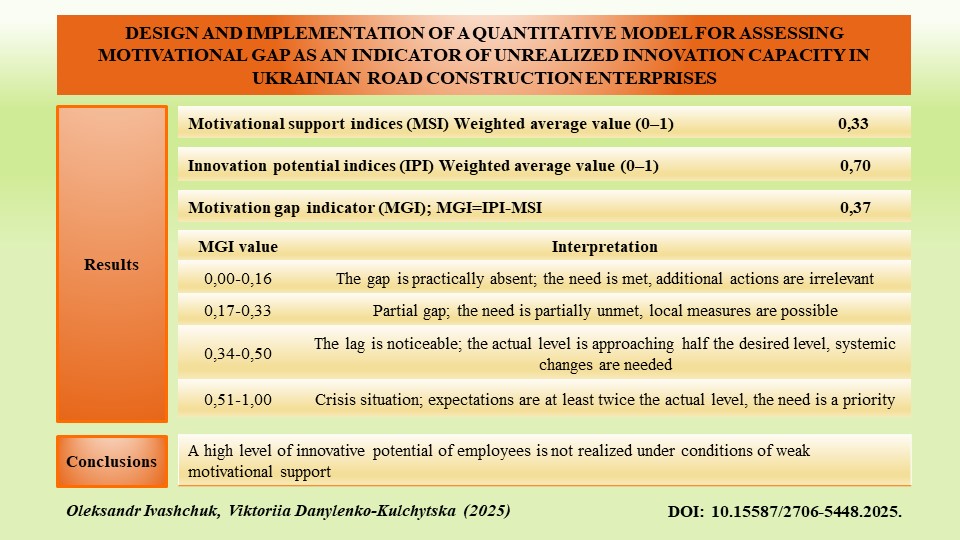
The study focuses on assessing the current state and future prospects of motivational support systems in Ukraine’s road construction sector, with particular emphasis on their role in strengthening innovation potential during wartime conditions and post-crisis recovery. The object of the research is the motivational support systems of employees in enterprises of the road construction industry of Ukraine. The aim of the study is to identify motivational gaps between the actual and target levels of motivation and to determine the directions and principles on the basis of which a framework model for increasing the motivational support index (MSI) can be developed in future research. It was established that the innovation potential index (IPI) of Ukrainian companies remains consistently high and corresponds to the findings of the Global Innovation Index, where Ukraine held leading positions in 2021–2024 in terms of the innovation efficiency ratio. However, this potential is largely underutilized due to insufficient motivational support. The calculation of the motivational gap index (MGI), defined as the normalized difference between innovation potential (≈ 0.6) and the actual level of motivation (≈ 0.4), yielded MGI ≈ 0.33, indicating a substantial human resource reserve that remains unengaged within the current HR system. The study develops an integrated motivation model aimed at enhancing the MSI, capable of functioning effectively under resource constraints while remaining consistent with contemporary global HR and ESG trends. The proposed model may serve as a roadmap for identifying and reducing motivational gaps, increasing employee engagement, and strengthening the competitiveness of Ukraine’s road construction sector. Thus, the results of the study have not only theoretical significance but also practical value for optimizing HR practices in the industry.
References
- OECD Science, Technology and Innovation Outlook. Paris: OECD Publishing. https://doi.org/10.1787/0b55736e-en
- Himmelfarb, A. (Ed.) (2025). Ukraine – Fourth Rapid Damage and Needs Assessment (RDNA4): Feb 2022–Dec 2024. World Bank Group; Government of Ukraine; European Commission; United Nations. Washington: World Bank. Available at: https://documents1.worldbank.org/curated/en/099022025114040022/pdf/P1801741ca39ec0d81b5371ff73a675a0a8.pdf Last accessed: 10.08.2025
- Global Innovation Index 2024. GII 2024 results (2024). WIPO. Available at: https://www.wipo.int/web-publications/global-innovation-index-2024/en/gii-2024-results.html Last accessed: 10.08.2025
- Laursen, K. B., Harste, G., Roth, S. (2022). Moral communication observed with social systems theory. An introduction. Kybernetes, 51 (5), 1653–1665. https://doi.org/10.1108/k-01-2022-0059
- Al-Abbadi, G. M., Agyekum-Mensah, G. (2019). The effects of motivational factors on construction professionals productivity in Jordan. International Journal of Construction Management, 22 (5), 820–831. https://doi.org/10.1080/15623599.2019.1652951
- Abdolmaleki, G., Naismith, N., Ghodrati, N., Poshdar, M., Babaeian Jelodar, M. (2024). An analysis of the literature on construction employee turnover: drivers, consequences, and future direction. Construction Management and Economics, 42 (9), 822–846. https://doi.org/10.1080/01446193.2024.2337084
- Bos‐Nehles, A., Townsend, K., Cafferkey, K., Trullen, J. (2023). Examining the Ability, Motivation and Opportunity (AMO) framework in HRM research: Conceptualization, measurement and interactions. International Journal of Management Reviews, 25 (4), 725–739. https://doi.org/10.1111/ijmr.12332
- Deci, E. L., Ryan, R. M. (2000). The “What” and “Why” of goal pursuits: Human needs and the self-determination of behavior. Psychological Inquiry, 11 (4), 227–268. https://doi.org/10.1207/S15327965PLI1104_01
- Osman, A. M., Liu, Y., Wang, Z. (2023). Influence of Organizational Culture on Construction Firms’ Performance: The Mediating Roles of Innovation and Marketing Capabilities. Buildings, 13 (2), 308. https://doi.org/10.3390/buildings13020308
- Gerhart, B., Feng, J. (2021). The Resource-Based View of the Firm, Human Resources, and Human Capital: Progress and Prospects. Journal of Management, 47 (7), 1796–1819. https://doi.org/10.1177/0149206320978799
- Handbook on Constructing Composite Indicators: Methodology and User Guide (2008). Paris: OECD Publishing. Available at: https://www.oecd.org/content/dam/oecd/en/publications/reports/2008/08/handbook-on-constructing-composite-indicators-methodology-and-user-guide_g1gh9301/9789264043466-en.pdf
- Annual and sustainability report 2023 (2023). Skanska AB. Available at: https://group.skanska.com/493370/siteassets/investors/reports-publications/annual-reports/2023/annual-and-sustainability-report-2023.pdf
- Sustainability report 2023 (2023). STRABAG SE. Available at: https://www.strabag.com/site/strabag-company-locale/get/params_E2074889770/1002420/Sustainability-Report-2023.pdf
- Forging a sustainable world (2023). VINCI. Available at: https://www.vinci.com/publi/vinci/extract/2023_workforce_related_environmental_and_social_information.pdf
- Barney, J. (1991). Firm Resources and Sustained Competitive Advantage. Journal of Management, 17 (1), 99–120. https://doi.org/10.1177/014920639101700108
- Delery, J. E., Doty, D. H. (1996). Modes of theorizing in strategic human resource management: tests of universalistic, contingency, and configurations. performance predictions. Academy of Management Journal, 39 (4), 802–835. https://doi.org/10.2307/256713; Available at: https://www.jstor.org/stable/256713 Last accessed: 22.10.2025
- Cronbach, L. J. (1951). Coefficient Alpha and the Internal Structure of Tests. Psychometrika, 16 (3), 297–334. https://doi.org/10.1007/bf02310555
- Gliem, J. A., Gliem, R. R. (2003). Calculating, interpreting, and reporting Cronbach’s alpha reliability coefficient for Likert-type scales. Midwest Research-to-Practice Conference in Adult, Continuing, and Community Education, Columbus. Available at: https://scholarworks.iupui.edu/handle/1805/344
- Tejada, J. J., Punzalan, J. R. B. (2012). On the misuse of Slovin’s formula. Philippine Statistician, 61 (1), 129–136. Available at: https://www.psai.ph/docs/publications/tps/tps_2012_61_1_9.pdf
- Research Ethics and New Forms of Data for Social and Economic Research (2016). Paris: OECD Publishing. https://doi.org/10.1787/5jln7vnpxs32-en
- Working conditions and sustainable work: An analysis using the job quality framework. Challenges and prospects in the EU (2021). Eurofound. Luxembourg: Publications Office of the European Union. Available at: https://www.eurofound.europa.eu/system/files/2021-02/ef20021en.pdf Last accessed: 10.08.2025
- European Skills Index 2024: Technical report. Cedefop (2024). Luxembourg: Publications Office of the European Union. Available at: https://www.cedefop.europa.eu/files/esi_technical_report_2024.pdf Last accessed: 10.08.2025
- Kim, T. K. (2017). Understanding one-way ANOVA using conceptual figures. Korean Journal of Anesthesiology, 70 (1), 22–26. https://doi.org/10.4097/kjae.2017.70.1.22
- Herzberg, F., Mausner, B., Snyderman, B. B. (1959). The motivation to work. New York: John Wiley & Sons.
- Bakker, A. B., Demerouti, E. (2007). The Job Demands‐Resources model: state of the art. Journal of Managerial Psychology, 22 (3), 309–328. https://doi.org/10.1108/02683940710733115
- Mehner, L., Rothenbusch, S., Kauffeld, S. (2024). How to maximize the impact of workplace training: a mixed-method analysis of social support, training transfer and knowledge sharing. European Journal of Work and Organizational Psychology, 34 (2), 201–217. https://doi.org/10.1080/1359432x.2024.2319082
- Kötting, M., Kuckertz, A. (2019). Three configurations of corporate innovation programs and their interplay. European Journal of Innovation Management, 23 (1), 90–113. https://doi.org/10.1108/ejim-07-2018-0142
- Cotton, J. L., Vollrath, D. A., Froggatt, K. L., Lengnick-Hall, M. L., Jennings, K. R. (1988). Employee Participation: Diverse Forms and Different Outcomes. The Academy of Management Review, 13 (1), 8–22. https://doi.org/10.2307/258351
- Priyashantha, K. G., De Alwis, A. C., Welmilla, I. (2022). Disruptive human resource management technologies: a systematic literature review. European Journal of Management and Business Economics, 33 (1), 116–136. https://doi.org/10.1108/ejmbe-01-2022-0018
- Roth, S., Clausen, L., Möller, S. (2020). COVID-19. Scenarios of a superfluous crisis. Kybernetes, 50 (5), 1621–1632. https://doi.org/10.1108/k-05-2020-0280
- Deiaki pytannia realizatsii polozhen Zakonu Ukrainy “Pro mobilizatsiinu pidhotovku ta mobilizatsiiu” shchodo broniuvannia viiskovozoboviazanykh na period mobilizatsii ta na voiennyi chas (2023). Postanova Kabinetu Ministriv Ukrainy No. 76. 27.01.2023. Available at: https://zakon.rada.gov.ua/laws/show/76-2023-%D0%BF
Downloads
Published
How to Cite
Issue
Section
License
Copyright (c) 2025 Oleksandr Ivashchuk, Viktoriia Danylenko-Kulchytska

This work is licensed under a Creative Commons Attribution 4.0 International License.
The consolidation and conditions for the transfer of copyright (identification of authorship) is carried out in the License Agreement. In particular, the authors reserve the right to the authorship of their manuscript and transfer the first publication of this work to the journal under the terms of the Creative Commons CC BY license. At the same time, they have the right to conclude on their own additional agreements concerning the non-exclusive distribution of the work in the form in which it was published by this journal, but provided that the link to the first publication of the article in this journal is preserved.