Ensuring the enterprise functioning under conditions of uncertainty: parametric assessment
DOI:
https://doi.org/10.15587/2706-5448.2025.344903Keywords:
information asymmetry, entropy, risk analysis, security, SPOD/U matrix, parametric uncertainty assessment, electronic communicationsAbstract
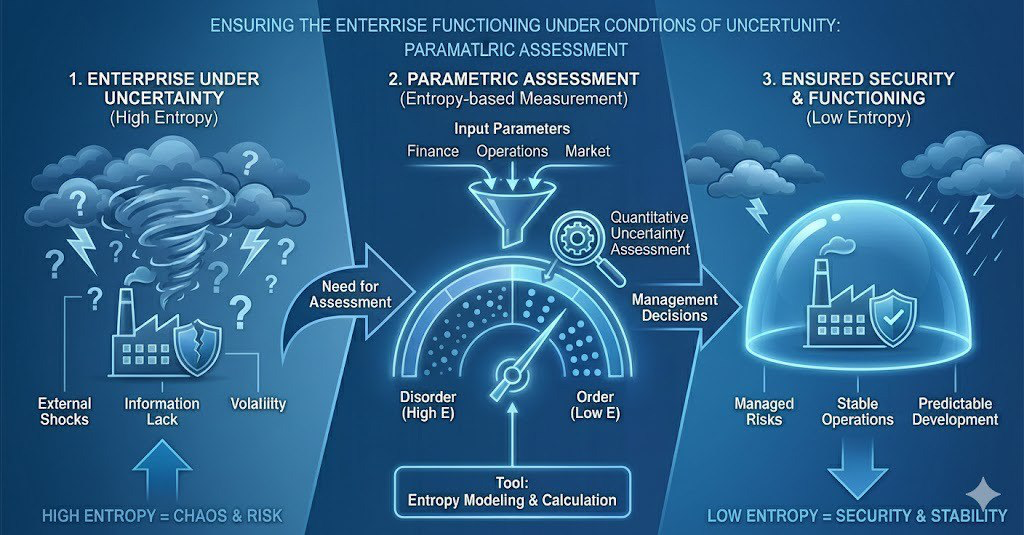
The study substantiates the importance of enterprise awareness of its environment for making managerial decisions under conditions of uncertainty. The object of the study is information and its asymmetry in the enterprise awareness of its environment when making decisions under conditions of uncertainty. Making management decisions in conditions of uncertainty requires a high-quality information base, which necessitates the need to improve approaches to assessing the impact of challenges on the enterprise functioning. The SPOD (Strengths, Problems, Opportunities, Definite) matrix is used to analyze enterprise challenges. It is emphasized that the classical SPOD matrix has a static nature and does not account for informational influences; therefore, it is proposed to extend it with a component U (Uncertainty) to reflect the dynamics of uncertainty. The entropic nature of economic processes is identified, revealing that increasing entropy reduces the resilience of economic systems and necessitates adaptive management. The proposed approach, based on the entropic measurement of uncertainty, enables a quantitative assessment of the degree of unpredictability of challenges. The variability of the enterprise environment under uncertainty imposes certain limitations on the applicability of the research results, particularly those related to the integration of non-formalized factors – socio-psychological, reputational, communicative – which are difficult to represent quantitatively. Ensuring the relevance of data is required to prevent overloading the matrix with excessive variables. The combining the SPOD/U method with an entropic assessment establishes a methodological foundation for evaluating environmental uncertainty of enterprise functioning. The research findings are particularly relevant for enterprises operating in the field of electronic communications.
References
- Shyian, A. A. (2007). Ekonomichna kibernetyka: vstup do modeliuvannia sotsialnykh i ekonomichnykh system. Mahnoliia, 264. Available at: http://inrtzp.vntu.edu.ua/pmba/stf/mater/OMBES.pdf
- Shannon, C. E. (1948). A Mathematical Theory of Communication. Bell System Technical Journal, 27 (3), 379–423. https://doi.org/10.1002/j.1538-7305.1948.tb01338.x
- Kline, R. R. (2015). The cybernetics moment: Or why we call our age the information age. Baltimore: Johns Hopkins University Press, 336. Available at: https://archive.org/details/cyberneticsmomen0000klin
- McLuhan, M., Hutchon, K., McLuhan, E. (1977). City as Classroom: Understanding Language and Media. Ontario: Irwin Publishing, 184. Available at: https://www.scribd.com/document/405514619/City-as-classroom-pdf
- Akerlof, G. A. (1970). The Market for “Lemons”: Quality Uncertainty and the Market Mechanism. The Quarterly Journal of Economics, 84 (3), 488–500. https://doi.org/10.2307/1879431
- Georgescu-Roegen, N. (1971). The Entropy Law and the Economic Process. Cambridge, London: Harvard University Press. https://doi.org/10.4159/harvard.9780674281653
- Hicks, J. R., Davis, H. T. (1942). The Theory of Econometrics. The Economic Journal, 52 (208), 350–352. https://doi.org/10.2307/2226237
- Jakimowicz, A. (2020). The Role of Entropy in the Development of Economics. Entropy, 22 (4), 452. https://doi.org/10.3390/e22040452
- Pomares, M. (2024). Entropy and Economics. arXiv:2407.00022. https://doi.org/10.48550/arXiv.2407.00022
- Sanidas, E. (2008). Entropy in economics: its measurement through primary data and its usefulness in business. Lex et scientia, 44–59. Available at: https://www.researchgate.net/publication/42437357_ENTROPY_IN_ECONOMICS_ITS_MEASUREMENT_THROUGH_PRIMARY_DATA_AND_ITS_USEFULNESS_IN_BUSINESS
- Foster, J. (2011). Energy, aesthetics and knowledge in complex economic systems. Journal of Economic Behavior & Organization, 80 (1), 88–100. https://doi.org/10.1016/j.jebo.2011.02.013
- Shevtsova, H. Z. (2016). Synerhetychnyi menedzhment pidpryiemstv. Kyiv: NAN Ukrainy, In-t ekonomiky prom-sti, 454. Available at: https://iie.org.ua/wp-content/uploads/monografiyi/2016/2016_mono_Shevtsova.pdf
- Wankhade, L., Dabade, B. (2010). Quality Uncertainty and Perception Information Asymmetry and Management of Quality Uncertainty and Quality Perception. Heidelberg, Dordrecht, London, New York: Springer. https://doi.org/10.1007/978-3-7908-2195-6
- Stiglitz, J. E. (2003). Information and the Change in the Paradigm in Economics, Part 1. The American Economist, 47 (2), 6–26. https://doi.org/10.1177/056943450304700202
- Raine, A., Foster, J., Potts, J. (2006). The new entropy law and the economic process. Ecological Complexity, 3 (4), 354–360. https://doi.org/10.1016/j.ecocom.2007.02.009
- Finansovi rezultaty. Vodafone Ukraina. Available at: https://www.vodafone.ua/company/investors/finansovi-rezultaty
- Richnyi zvit zi staloho rozvytku. Vodafone Ukraina (2024). Kyiv, 84. Available at: https://www.vodafone.ua/storage/image-storage/2025/04/25/753/source/shhoricnii-zvit-zi-stalogo-rozvitku-za-2024-rik_1745571916.pdf
- Informatsiia dlia aktsioneriv ta steikkholderiv. Kyivstar. Available at: https://kyivstar.ua/about/investors-and-shareholders/issuers
- Richni zvity za MSFZ. lifecell.ua. Available at: https://www.lifecell.ua/uk/pro_lifecell/finansovi-ta-operacijni-dani/richni-zviti/?flavour=full
- Richnyi zvit. Systemy vyiavlennia vrazlyvostei i reahuvannia na kiberintsydenty ta kiberataky. Available at: https://scpc.gov.ua/api/files/72e13298-4d02-40bf-b436-46d927c88006
- Zvity NKEK. Natsionalna komisiia, shcho zdiisniuie derzhavne rehuliuvannia u sferakh elektronnykh komunikatsii, radiochastotnoho spektra ta nadannia posluh poshtovoho zviazku. Available at: https://nkek.gov.ua/pro-nkek/zvity-nkek
- Kremen, V. H. (Ed.) (2014). Synerhetyka i osvita. Kyiv: Instytut obdarovanoi dytyny, 348. Available at: https://drive.google.com/file/d/0B6UkMWiy4uKzS2V0cUludjdjaEE/view?resourcekey=0-q4dJbH6e31HAottbt0mFhw
- Homonai, O. V.; Dziuba, I. М., Zhukovsky, A. I., Zhelezniak, M. H. et al. (Eds.) (2012). Kvantova teoriia informatsii. Encyclopedia of Modern Ukraine. Kyiv: The NASU institute of Encyclopedic Research. Available at: https://esu.com.ua/article-11530
- Smith, C. E., Smith, J. W. (1996). Economics, ecology and entropy: The second law of thermodynamics and the limits to growth. Population and Environment, 17 (4), 309–321. https://doi.org/10.1007/bf02208231
- De Castro, L., Yannelis, N. C. (2018). Uncertainty, efficiency and incentive compatibility: Ambiguity solves the conflict between efficiency and incentive compatibility. Journal of Economic Theory, 177, 678–707. https://doi.org/10.1016/j.jet.2018.02.008
- Chen, J. (2002). An Entropy Theory of Value. SSRN Electronic Journal. https://doi.org/10.2139/ssrn.307442
- Kapeliushna, T. (2024). Upravlinnia bezpekoiu pidpryiemstv: teoriia ta metodolohiia. Kyiv: DUIKT, 40. Available at: https://duikt.edu.ua/uploads/p_1537_29713705.pdf
Downloads
Published
How to Cite
Issue
Section
License
Copyright (c) 2025 Оlena Vynogradova, Svitlana Lehominova, Tetiana Kapeliushna, Alona Goloborodko

This work is licensed under a Creative Commons Attribution 4.0 International License.
The consolidation and conditions for the transfer of copyright (identification of authorship) is carried out in the License Agreement. In particular, the authors reserve the right to the authorship of their manuscript and transfer the first publication of this work to the journal under the terms of the Creative Commons CC BY license. At the same time, they have the right to conclude on their own additional agreements concerning the non-exclusive distribution of the work in the form in which it was published by this journal, but provided that the link to the first publication of the article in this journal is preserved.