Systematization of approaches to state economic security using bibliometric methods
DOI:
https://doi.org/10.15587/2706-5448.2025.347673Keywords:
economic security, state policy, economic system, economic development, crisis, sustainable developmentAbstract
The object of research is the economic security of the state as the basis for protecting the national economy from threats in conditions of crises, martial law and integration transformations. It covers historical and modern aspects of the formation of this concept, starting from the “New Deal” of 1934 in the USA to modern Ukrainian realities.
The lack of a single definition of the economic security of the state and the plurality of theoretical approaches complicate the formation of effective state policy. The problem lies in the need to systematize approaches to the concept, take into account the impact of crises, martial law and external threats, as well as identify key factors for ensuring economic security in conditions of European integration.
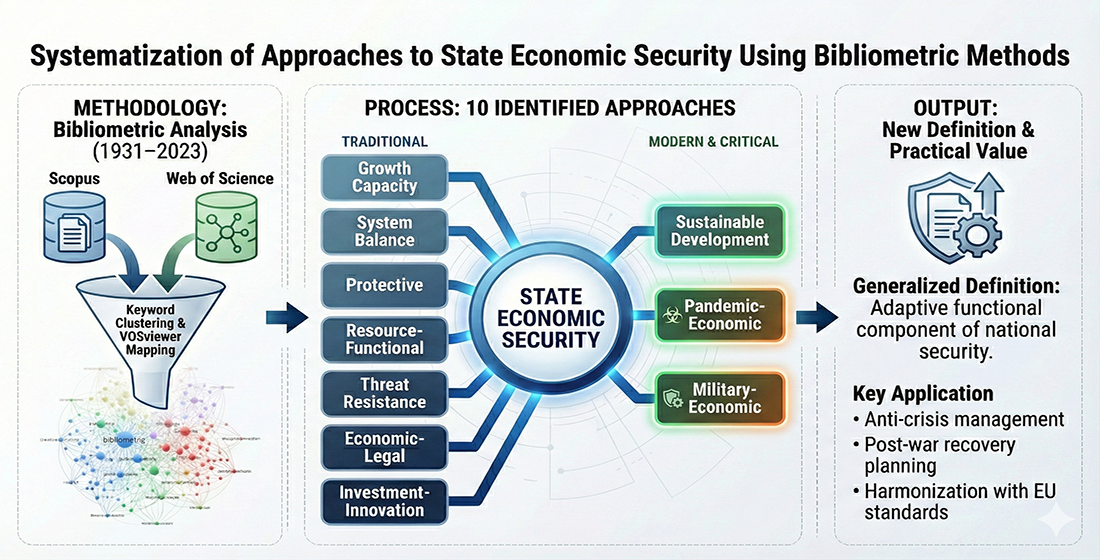
Using bibliometric analysis of Scopus and Web of Science data, a retrospective analysis of indexed sources on economic security was conducted. Based on this, 10 classification approaches were identified: growth capacity, economic system balance, threat resistance, resource-functional approach, protective approach, investment-innovation approach, economic-legal approach, sustainable development security, pandemic-economic approach and military-economic security. The author’s definition of the economic security of the state was proposed, which takes into account its interdisciplinary nature and modern challenges.
Three broad clusters of 256 keywords were formed in Scopus; five narrower clusters of 146 words (45% less) were formed in Web of Science. A wider thematic coverage was found in Scopus and a more specialized one in Web of Science, reflecting different research emphases.
The results are recommended for developing a state policy of economic security, improving anti-crisis management, planning economic development and harmonization with European standards. They can be used to forecast risks, assess the stability of the economic system and support sustainable development in conditions of martial law and post-war recovery.
References
- Roosevelt, F. D. (1934). Executive Order 6757 – Establishing the Committee on Economic Security and the Advisory Council on Economic Security. The American Presidency Project. Available at: https://www.presidency.ucsb.edu/node/208449
- Tretiak, V. V., Hordiienko, T. M. (2010). Ekonomichna bezpeka: sutnist ta umovy formuvannia. Ekonomika ta derzhava, 1, 6–8. Available at: http://www.economy.in.ua/pdf/1_2010/3.pdf
- Holikov, I. V. (2014). Essence and evolution of the economic security notion. Problemy ekonomiky, 1, 309–314. Available at: http://nbuv.gov.ua/UJRN/Pekon_2014_1_47
- Committee on economic security (1934). JAMA: The Journal of the American Medical Association, 103 (19), 1454. https://doi.org/10.1001/jama.1934.02750450038013
- Report to the President of the Committee on Economic Security (1935). Washington: Government Printing Office, 53. Available at: https://www.ssa.gov/history/reports/ces.html
- Edgerton, J. E. (1931). Principles of Economic Security. The ANNALS of the American Academy of Political and Social Science, 154 (1), 73–77. https://doi.org/10.1177/000271623115400115
- Pollard, R. A. (1985). Economic security and the origins of the Cold War, 1945–1950. New York, Chichester, West Sussex: Columbia University Press, 380. https://doi.org/10.7312/poll90954
- Sperling, J., Kirchner, E. (1998). Economic security and the problem of cooperation in post-Cold War Europe. Review of International Studies, 24 (2), 221–237. https://doi.org/10.1017/s0260210598002216
- Ronis, S. R. (Ed.) (2011). Economic security: Neglected dimension of national security? Washington: National Defense University Press, 116. Available at: https://apps.dtic.mil/sti/pdfs/ADA585192.pdf
- National Security Act (1947). Public Law No. 235. 26.07.1947. Available at: https://www.dni.gov/index.php/ic-legal-reference-book/national-security-act-of-1947
- Charter of Paris for a New Europe (1990). Paris. Available at: https://www.osce.org/files/f/documents/0/6/39516.pdf
- Dohovir pro zvychaini zbroini syly v Yevropi (1992). Dohovir ratyfikovano Postanovoiu VR No. 2526-12. 01.07.92. Available at: https://zakon.rada.gov.ua/laws/show/994_314#Text
- Charter for European Security (1999). Istanbul. Available at: https://www.osce.org/files/f/documents/4/2/17502.pdf
- Uhoda z adaptatsii Dohovoru pro zvychaini zbroini syly v Yevropi (2000). Uhodu ratyfikovano Zakonom No. 1974-14. 21.09.2000. Available at: https://zakon.rada.gov.ua/laws/show/994_063#Text
- Vienna Document 2011 On Confidence and Security-Building Measures (2011). FSC.DOC/1/11 30.11.2011. Available at: https://www.osce.org/files/f/documents/a/4/86597.pdf
- International economic security: resolution (1985). Adopted by the General Assembly during its 40th session. Available at: https://digitallibrary.un.org/record/109472?ln=en
- Inglehart, R., Abramson, P. R. (1994). Economic Security and Value Change. American Political Science Review, 88 (2), 336–354. https://doi.org/10.2307/2944708
- Yunus, M. (2009). Economic security for a world in crisis. World Policy Journal, 26 (2), 5–12. Available at: http://www.jstor.org/stable/40468628
- Mencher, S. (1968). Poor Law to Poverty Program: Economic security policy in Britain and the United States. Pittsburgh: University of Pittsburgh Press, 496. Available at: https://books.google.com.ua/books?id=JgHsTS0IxBwC&dq=history+of+the+economic+security&lr=&hl=uk&source=gbs_navlinks_s
- Yeung, B. (2008). China in the era of globalization: the emergence of the discourse on economic security. The Pacific Review, 21 (5), 635–660. https://doi.org/10.1080/09512740802493182
- Martynenko, V. (2015). Conceptual Approaches to Economic Security Strengthening in Ukraine. Economic Annals-XXI, 1-2 (2), 12–15. https://ea21journal.world/index.php/ea-v148-03/
- Martynenko, V. V. (2015). Macroeconomic analysis of socioeconomic development impact on economic security level in Ukraine. Actual Problems of Economics, 168 (6), 402–409.
- Pro Kontseptsiiu (osnovy derzhavnoi polityky) natsionalnoi bezpeky Ukrainy (1997). Postanova Verkhovnoi Rady Ukrainy No. 3/97-VR. 16.01.1997. Available at: https://zakon.rada.gov.ua/laws/show/3/97-%D0%B2%D1%80#Text
- Welcome to VOSviewer. Available at: https://www.vosviewer.com/
- Scopus Start Exploring. Available at: https://www.scopus.com/search/form.uri?display=basic#basic
- Web of Science. Search. Available at: https://www.webofscience.com/wos/woscc/basic-search
- Chorna, S. (2023). Analysis of financial security research vectors: bibliometric analysis and visualization. World of Finance, 2 (75), 125–139. https://doi.org/10.35774/sf2023.02.125
- Price, M. (1970). Government policy and economic security for artists: The case of the “droit de suite”. Leonardo, 2 (3), 221–231. https://doi.org/10.2307/1572093
- Boiko, V. V. (2015). Evolution of development and essence of economic security of the state. Visnyk Khmelnytskoho natsionalnoho universytetu. Ekonomichni nauky, 4 (1), 162–167. Available at: http://nbuv.gov.ua/UJRN/Vchnu_ekon_2015_4(1)__28
- Kryshtanovych, M., Panfilova, T., Khomenko, A., Dziubenko, O., Lukashuk, L. (2023). Optimization of state regulation in the field of safety and security of business: a local approach. Business: Theory and Practice, 24 (2), 613–621. https://doi.org/10.3846/btp.2023.19563
- Iuga, I.-C., Socol, A. (2023). Defending the nation, securing the economy. E+M Ekonomie a Management, 26 (4), 17–37. https://doi.org/10.15240/tul/001/2023-4-002
- Ma, L., Li, X., Pan, Y. (2023). Global Industrial Chain Resilience Research: Theory and Measurement. Systems, 11 (9), 466. https://doi.org/10.3390/systems11090466
- Banna, H., Alam, A., Chen, X. H., Alam, A. W. (2023). Energy security and economic stability: The role of inflation and war. Energy Economics, 126, 106949. https://doi.org/10.1016/j.eneco.2023.106949
- Manuilova, K., Motornyy, V., Koval, O., Mykytyn, O., Norchuk, Y. (2023). Economic Security Management for Sustainable Planning. International Journal of Sustainable Development and Planning, 18 (7), 2055–2060. https://doi.org/10.18280/ijsdp.180707
- Xianchun, X., Jinyu, L. (2023). Maintaining stable economic growth in China: Conditions and strategies. China Economist, 18 (4), 127–138. https://doi.org/10.19602/j.chinaeconomist.2023.07.05
- Kryvdyk, V., Rudnichenko, Y., Havlovska, N., Matiukh, S., Harbusiuk, V., Samborska, O. (2023). Implementation of Modern Management Technologies in Enterprise Economic Security. TEM Journal, 12 (4), 2137–2143. https://doi.org/10.18421/tem124-24
- Popova, T., Makarenko, P., Trusova, N., Karpenko, A., Pilyavsky, V., Svynous, I. (2023). Activation of Business Processes in Service Cooperation of Rural Territories of Ukraine. RIVAR, 10 (29), 99–120. https://doi.org/10.35588/rivar.v10i29.5726
- Biloshkurska, N. (2010). Adaptive behavior models and their role in formation of enterprise economic security. Actual Problems of Economics, 12, 101–105.
- Shchokin, R., Soloviov, O., Tantsiura, I. (2023). Strengthening Cooperation between the Civilian and Military Sectors In the Context of State Security: Benefits and Challenges. Revista de Cercetare Si Interventie Sociala, 83, 155–170. https://doi.org/10.33788/rcis.83.11
- Brazhnyk, L., Ivanyuta, V., Kravchenko, T., Kozak, O., Los, O., Pavliuk, S. (2022). Harmonization of Agricultural Policy and Economic Security of the EU States. WSEAS Transactions on Environment and Development, 19, 1–10. https://doi.org/10.37394/232015.2023.19.1
- Drobyazko, S., Bondiuk, A., Ovcharenko, I., Lebid, O., Mikish, A. (2020). Resource supporing of business economic security at the micro and macro levels. Journal of Security and Sustainability Issues, 10 (1), 307–320. https://doi.org/10.9770/jssi.2020.10.1(22)
- Danilova, E. I., Marchenko, V. M. (2020). Methodology of Structural and Functional Approach to Management of the Enterprise Economic Safety. Journal of Advanced Research in Law and Economics, 10 (2), 488–496. https://doi.org/10.14505//jarle.v10.2(40).08
- Chubaievskyi, V., Blakyta, H., Bogma, O., Shtuler, I., Batrakova, T. (2022). Protection of information resources as an integral part of economic security of the enterprise. Naukovyi Visnyk Natsionalnoho Hirnychoho Universytetu, 4, 117–122. https://doi.org/10.33271/nvngu/2022-4/117
- Davydenko, N. (2015). Modern paradigm of agrarian units’ financial security assessment. Economic Annals-XXI, 5-6, 90–93. Available at: https://ea21journal.world/index.php/ea-v151-22
- Davydenko, N., Mykhaylichenko, M., Titenko, Z., Tsiukalo, L. (2022). External Debt Management in the System of Financial Security of the State. WSEAS Transactions on Business and Economics, 20, 144–153. https://doi.org/10.37394/23207.2023.20.15
- Zhytar, M., Sosnovska, O., Shchur, R., Lisnichuk, O., Navolokina, A. (2022). Scientific and methodical approach to the assessment of diagnostics of the economic security of economic. Financial and Credit Activity Problems of Theory and Practice, 5 (46), 209–221. https://doi.org/10.55643/fcaptp.5.46.2022.3872
- Garashchuk, О., Kutsenko, V. (2021). Innovative-investment bases for sustainable socio-economic development. Herald UNU. International Economic Relations And World Economy, 36, 58–64. https://doi.org/10.32782/2413-9971/2021-36-10
- Omelyanenko, V., Martynenko, V., Slatvinskyi, M., Povorozniuk, I., Biloshkurska, N., Biloshkurskyi, M. (2019). Methodological bases of sectoral innovation priorities evaluation within security-based strategies. International Journal of Civil Engineering and Technology, 10 (2), 1217–1226. Available at: https://iaeme.com/Home/article_id/IJCIET_10_02_118
- Andrushkiv, I., Nakonechna, N. (2017). Investment-innovative safety as constituent of economic security: Its essence and value. Scientific Journal of Lviv State University of Internal Affairs. Economics, 1, 3–10. Available at: https://journals.lvduvs.lviv.ua/index.php/economy/article/view/767
- Hordei, O., Patsai, B., Hurochkina, V., Ovdiienko, O., Mishchenko, R. (2021). Optimization of the Investment Portfolio in the Environment of Table Processor MS Excel. Studies of Applied Economics, 39 (5). https://doi.org/10.25115/eea.v39i5.4983
- Omelyanenko, V., Prokopenko, O., Kudrina, O., Petrova, I., Biloshkurska, N., Biloshkurskyi, M., Omelyanenko, O. (2021). Digital Component of Innovation Landscapes: Context of Sustainable Development at the Local Level. 2021 44th International Convention on Information, Communication and Electronic Technology (MIPRO). IEEE, 1324–1328. https://doi.org/10.23919/mipro52101.2021.9597058
- Biloshkurska, N., Harnyk, O., Biloshkurskyi, M., Liannoi, M., Kudrina, O., Omelyanenko, V. (2019). Methodological bases of innovation development priorities integrated assessment. International Journal of Civil Engineering and Technology, 1 (1), 1231–1240. Available at: https://iaeme.com/Home/article_id/IJCIET_10_01_113
- Dragan, I., Nestoryshen, I., Ostapenko, L., Terletska, V., Munko, A. (2023). Improving the mechanism of administrative and legal ensuring of the financial and economic security of the state. Financial and Credit Activity Problems of Theory and Practice, 5 (52), 461–470. https://doi.org/10.55643/fcaptp.5.52.2023.4168
- Mazaraki, A., Melnyk, T., Serova, L. (2023). The Impact of Corruption on the Economic Security of the State. Theoretical and Practical Research in Economic Fields, 14 (2), 269–282. https://doi.org/10.14505/tpref.v14.2(28).07
- Ostapenko, H. (2023). Role of Legal Certainty in Providing Economic Security: Ukraine’s Experience. Theoretical and Practical Research in Economic Fields, 14 (2), 215–222. https://doi.org/10.14505/tpref.v14.2(28).02
- Khayyum, M. (2023). Benefits of environmental and economic security from a sustainable development perspective. Journal of Environmental & Analytical Toxicology, 13, 701.
- Mohy-ud-Din, K. (2023). Board diversity and corporate social responsibility versus sustainability development: Evidence from US and Australia. Journal of Cleaner Production, 417, 138030. https://doi.org/10.1016/j.jclepro.2023.138030
- Szydło, W. (2023). Sustainable development, Agenda 2030 and food security in historical perspective. Economics and Environment, 85 (2), 154–174. https://doi.org/10.34659/eis.2023.85.2.560
- Carlsen, H., Carson, M., Hallding, K., Johnson, O., Rosner, K. et al. (2015). Integrating sustainable development and security: An analytical approach with examples from the Middle East and North Africa, the Arctic and Central Asia. Stockholm: Stockholm Environment Institute, 36. Available at: http://www.jstor.org/stable/resrep02788
- Bimonte, S., D’Agostino, A. (2023). Life satisfaction in the time of COVID-19. The frog effect. Cities, 142, 104550. https://doi.org/10.1016/j.cities.2023.104550
- Kitamura, N., Abbas, K., Nathwani, D. (2022). Public health and social measures to mitigate the health and economic impact of the COVID-19 pandemic in Turkey, Egypt, Ukraine, Kazakhstan, and Poland during 2020–2021: Situational analysis. BMC Public Health, 22 (1). https://doi.org/10.1186/s12889-022-13411-6
- Hapieieva, O., Martynenko, V., Romanovska, Yu., Potapiuk, I., Chyrva, H. (2022). Theoretical and methodological aspects of strategic management of economic security of the state in the conditions of the COVID-19: Current problems and vectors of development. Financial and Credit Activity Problems of Theory and Practice, 1 (42), 529–536. https://doi.org/10.55643/fcaptp.1.42.2022.3753
- Song, M., Sui, Z., Zhao, X. (2023). A risk measurement study evaluating the impact of COVID-19 on China’s financial market using the QR-SGED-EGARCH model. Annals of Operations Research, 330 (1-2), 787–806. https://doi.org/10.1007/s10479-023-05178-9
- Kryshtanovych, S., Syniuk, O., Yadukha, S., Blyznyuk, A., Bashtannyk, O., Ravliuk, V. (2023). Determining strategic priorities for forming state policy to provide financial and economic security under martial law. Financial and Credit Activity Problems of Theory and Practice, 6 (53), 287–299. https://doi.org/10.55643/fcaptp.6.53.2023.4237
- Shevchuk, O., Martynenko, V. (2020). An integrated approach to assessing the level of fiscal policy decentralization. Investment Management and Financial Innovations, 17 (1), 49–63. https://doi.org/10.21511/imfi.17(1).2020.05
- Mulska, O., Vasyltsiv, T., Kunytska-Iliash, M., Baranyak, I. (2023). Innovative Empirics of Migration-Economic Security Causal Nexus. Science and Innovation, 19 (3), 48–64. https://doi.org/10.15407/scine19.03.048
- Verhun, A., Lozhachevska, O., Mishchenko, M., Budiakova, O., Bakalo, N., Ivanyshyn, A., Skrypnyk, V. (2023). Management of logistics design of secure development of innovative industrial, agricultural and tourist enterprises in the conditions of martial law. Journal of Hygienic Engineering and Design, 41, 260–273. Available at: https://er.knutd.edu.ua/bitstream/123456789/24926/1/JHED_Verhun_p.260-273.pdf
Downloads
Published
How to Cite
Issue
Section
License
Copyright (c) 2025 Valentyna Martynenko, Andrii Lypkan

This work is licensed under a Creative Commons Attribution 4.0 International License.
The consolidation and conditions for the transfer of copyright (identification of authorship) is carried out in the License Agreement. In particular, the authors reserve the right to the authorship of their manuscript and transfer the first publication of this work to the journal under the terms of the Creative Commons CC BY license. At the same time, they have the right to conclude on their own additional agreements concerning the non-exclusive distribution of the work in the form in which it was published by this journal, but provided that the link to the first publication of the article in this journal is preserved.