Combined optimization of counteracting enemy amphibious operations in computer modeling
DOI:
https://doi.org/10.15587/2706-5448.2026.349558Keywords:
combined optimization, counter-amphibious operation, artillery support, minefield modeling, resource minimizationAbstract
The object of research is an integrated coastal defense system using mine barriers and artillery batteries. The research was conducted for a typical landing force and uniform mining within the fairway.
Among the most challenging issues are accounting for heterogeneous weapons and uncertainties in the combat environment. Another challenge is choosing between the speed of completing the operation and the cost of resources.
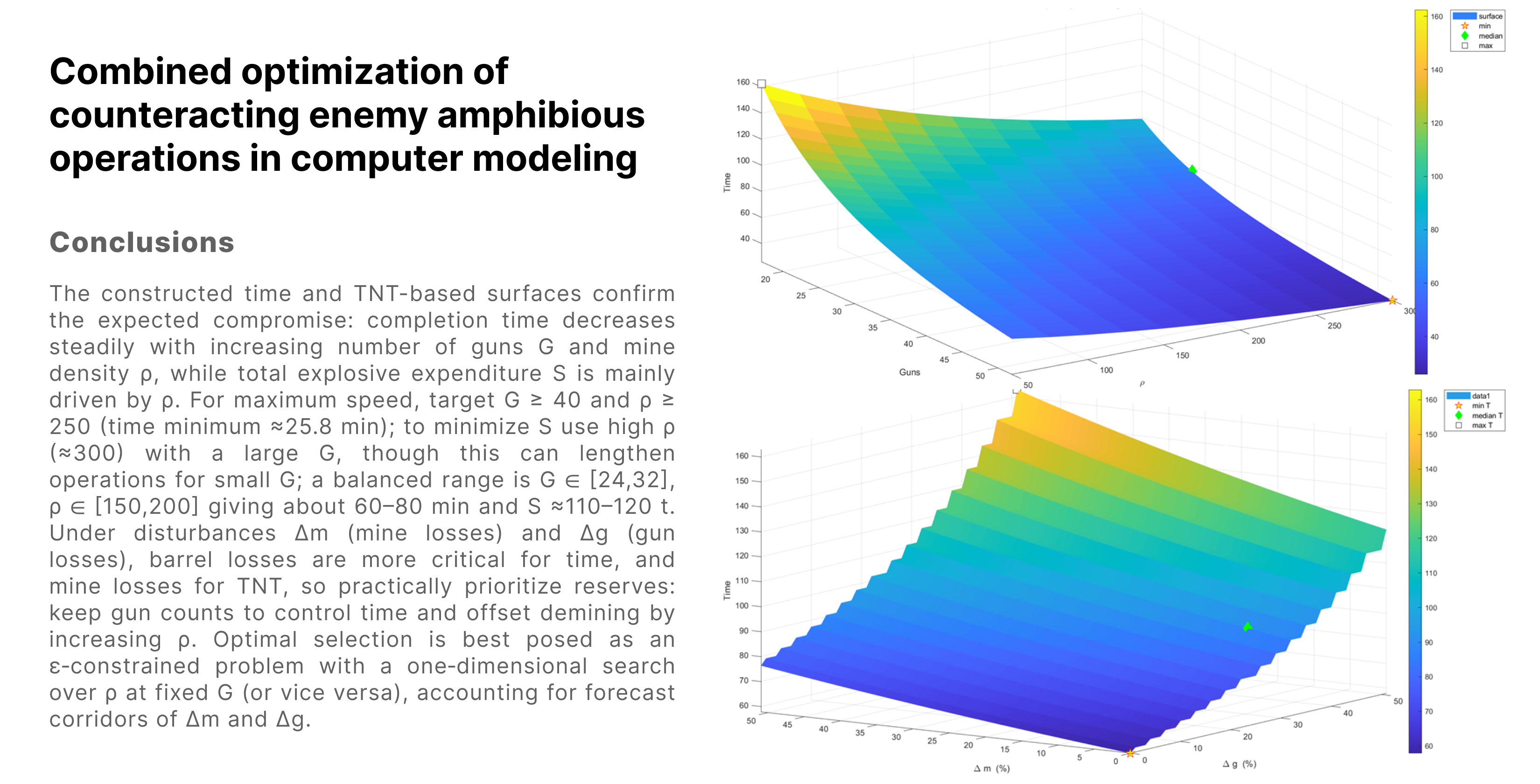
The paper presents a combined model for countering amphibious assaults, which combines the effects of sea mine barriers and artillery fire in a single scale of relative explosive effectiveness. This allows for the optimization of resource and time expenditure. Additionally, robustness to disturbances due to the loss of mines and guns (Δm, Δg) is taken into account. The research employs: standardization of ammunition nomenclature, Markov model of shelling, probabilistic model of detonation, and two-criterion optimization.
The unified model of combined optimization (ρ, G) in a common metric was developed. The operation was simulated in different modes. Robust corrections were introduced to the effective number of mines and guns in case of disturbances. For the practical selection of parameters, the ε-constraint method was applied, and tactical modes of use were outlined. The results of modelling the response time of the operation Ttot and resource costs S were obtained. Ttot depends more on G and ρ (minimum 26 minutes) than on S, which has a dominant influence to a greater extent than ρ (minimum 80 tons). This is due to the fact that as G increases, the operation time is reduced due to parallelism. Meanwhile, an increase in ρ will lead to a high probability of disruption, reducing the need for shells.
Accordingly, the proposed model enables rapid selection of parameters to meet prescribed time thresholds and risks of enemy breakthrough.
References
- Trail, C. D., Schmiedekamp, M. D., Phoha, S., Sustersic, J. P. (2013). Multiobjective planning for naval mine counter measures missions. International Journal of Operational Research, 16 (1), 113. https://doi.org/10.1504/ijor.2013.050626
- Ftemov, Yu. (2021). Recommendations for creating specialized software for calculation the engineering barrier systems. Systems of Arms and Military Equipment, 1 (65), 131–136. https://doi.org/10.30748/soivt.2021.65.19
- Neroba, V. (2019). The role of mining weapons in the modern wars and border conflicts. Collection of scientific works of the National Academy of the State Border Guard Service of Ukraine. Series: Military and Technical Sciences, 81 (3), 155–171. https://doi.org/10.32453/3.v81i3.444
- Grishyn, M., Maksymova, O., Kirkopulo, K., Klymchuk, O. (2025). Development of methods of artillery control for suppression of an enemy amphibious operation in video game simulations. Technology Audit and Production Reserves, 1 (2 (81)), 26–33. https://doi.org/10.15587/2706-5448.2025.321797
- Boltenkov, V., Brunetkin, O., Dobrynin, Y., Maksymova, O., Kuzmenko, V., Gultsov, P. et al. (2021). Devising a method for improving the efficiency of artillery shooting based on the Markov model. Eastern-European Journal of Enterprise Technologies, 6 (3 (114)), 6–17. https://doi.org/10.15587/1729-4061.2021.245854
- Dobrynin, Y. V., Boltenkov, V. O., Maksymov, M. V. (2020). Information technology for automated assessment of the artillery barrels wear based on SVM classifier. Applied Aspects of Information Technology, 3 (3), 117–132. https://doi.org/10.15276/aait.03.2020.1
- Zacks, S. (1979). Survival distributions in crossing fields containing clusters of mines with possible detection and uncertain activation or kill. Naval Research Logistics Quarterly, 26 (3), 423–435. https://doi.org/10.1002/nav.3800260306
- Mjelde, K. M. (1977). An analytical minefield evaluation model without space averages. Naval Research Logistics Quarterly, 24 (4), 639–650. https://doi.org/10.1002/nav.3800240411
- Cressie, N., Collins, L. B. (2001). Patterns in spatial point locations: Local indicators of spatial association in a minefield with clutter. Naval Research Logistics, 48 (5), 333–347. https://doi.org/10.1002/nav.1022
- Qian, L., Chen, G., Tong, M., Tang, J. (2022). General design principle of artillery for firing accuracy. Defence Technology, 18 (12), 2125–2140. https://doi.org/10.1016/j.dt.2022.09.001
- Dobrynin, Y., Volkov, V., Maksymov, M., Boltenkov, V. (2020). Development of physical models for the formation of acoustic waves at artillery shots and study of the possibility of separate registration of waves of various types. Eastern-European Journal of Enterprise Technologies, 4 (5 (106)), 6–15. https://doi.org/10.15587/1729-4061.2020.209847
- Shim, Y., Atkinson, M. P. (2018). Analysis of artillery shoot‐and‐scoot tactics. Naval Research Logistics, 65 (3), 242–274. https://doi.org/10.1002/nav.21803
- Świętochowski, N. (2019). Rules of artillery employment in combat operations. Scientific Journal of the Military University of Land Forces, 192 (2), 280–293. https://doi.org/10.5604/01.3001.0013.2599
- Krzyzanowski, S. (2018). How to assess the accuracy of artillery fire. Scientific Journal of the Military University of Land Forces, 187 (1), 25–39. https://doi.org/10.5604/01.3001.0011.7355
- Amorim, C. B., Augusto, A. da S., Gonçalves, R. F. B. (2025). A Constant Trinitrotoluene Equivalence Fit for Blast Wave Position Versus Time Data. Propellants, Explosives, Pyrotechnics, 50 (7), 44–54. https://doi.org/10.1002/prep.12071
- Hammond, T. R., Midtgaard, Ø., Connors, W. A. (2021). A Bayesian Network Approach to Evaluating the Effectiveness of Modern Mine Hunting. Remote Sensing, 13 (21), 4359. https://doi.org/10.3390/rs13214359
Downloads
Published
How to Cite
Issue
Section
License
Copyright (c) 2026 Maksym Maksymov, Maksym Grishyn, Oleksii Neizhpapa

This work is licensed under a Creative Commons Attribution 4.0 International License.
The consolidation and conditions for the transfer of copyright (identification of authorship) is carried out in the License Agreement. In particular, the authors reserve the right to the authorship of their manuscript and transfer the first publication of this work to the journal under the terms of the Creative Commons CC BY license. At the same time, they have the right to conclude on their own additional agreements concerning the non-exclusive distribution of the work in the form in which it was published by this journal, but provided that the link to the first publication of the article in this journal is preserved.