Development of methods for risk-oriented analytical assessment of financial performance of wine-producing enterprises
DOI:
https://doi.org/10.15587/2706-5448.2026.352178Keywords:
analytical assessment, management accounting, grape production, wineries, risks assessment, financial resultsAbstract
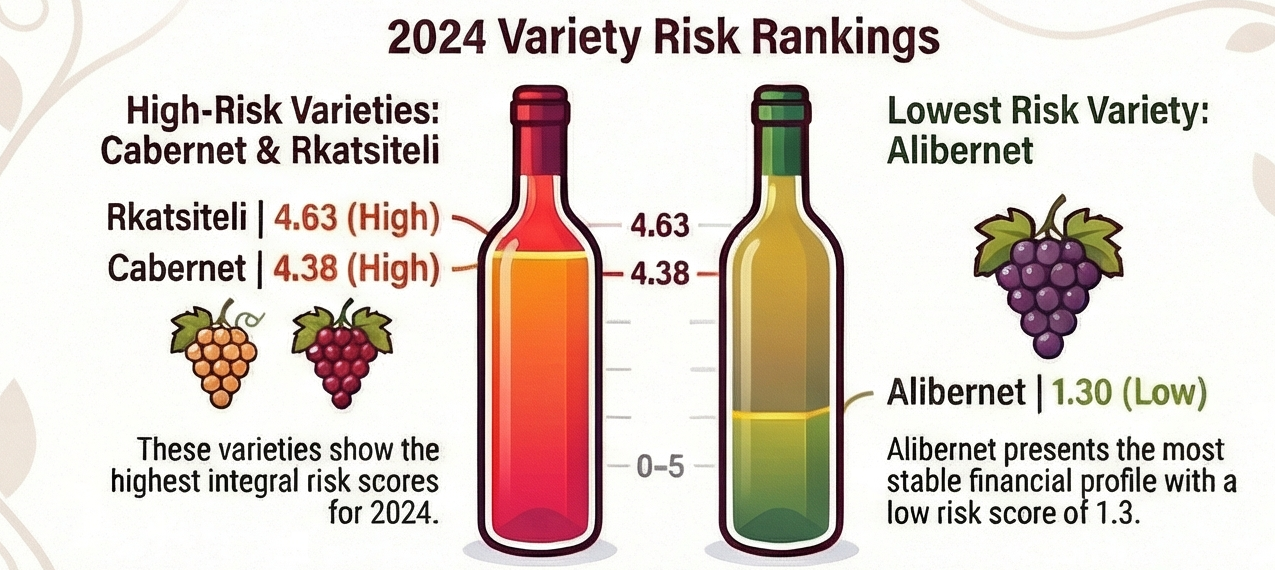
The object of research is the process of forming a comprehensive risk-oriented system for analyzing the financial performance of wine-producing enterprises. The development of this methodology will ensure systematic identification, quantitative assessment and integration of risks at all stages of the value chain. Existing approaches limit the ability to form a risk profile for operations and justify effective management decisions in conditions of instability. Traditional methods of analytical assessment do not allow for the multidimensionality of risk factors and the complex nature of their impact on changes in efficiency to be reflected. The use of an integrated risk criterion ensures more accurate forecasting of financial performance trends, increasing the effectiveness of the management control system. The developed methodology for assessing the financial performance risk of viticulture and winemaking enterprises based on normalized indicators and integral criteria made it possible to outline the risk dynamics and key parameters of uncertainty. The assessment was carried out in terms of grape varieties and enterprises on a five-level scale, with 2019 identified as the most critical year. The highest risk is in Cabernet 2024 and Rkatsiteli 2024: Alibernet 2024 has the lowest risk; Merlot 2024 has an average risk. The integrated assessment of average risk forms a unified information model that supports strategic decisions and enhances competitiveness. The applied nature of the study is determined by its focus on supporting management decisions in the financial and economic management of grape and wine-producing enterprises. The integrated risk assessment methodology ensures the identification and quantitative measurement of risks at all stages of the value chain, which allows identifying critical factors of financial performance and justifying the optimization of production and cost parameters.
References
- Sánchez-García, E., Martínez-Falcó, J., Marco-Lajara, B., Georgantzis, N. (2024). Value creation in the wine industry – a bibliometric analysis. European Food Research and Technology, 250 (4), 1135–1148. https://doi.org/10.1007/s00217-023-04451-2
- Alonso, A. D., Kok, S. K., O’Brien, S. (2019). Understanding approaches to innovation through the dynamic capabilities lens: a multi-country study of the wine industry. International Journal of Innovation Management, 23 (6), 1950054. https://doi.org/10.1142/s1363919619500543
- Forliano, C., Ferraris, A., Bivona, E., Couturier, J. (2022). Pouring new wine into old bottles: A dynamic perspective of the interplay among environmental dynamism, capabilities development, and performance. Journal of Business Research, 142, 448–463. https://doi.org/10.1016/j.jbusres.2021.12.065
- “Risk management in agriculture” – A holistic framework. Paris: OECD. Available at: https://www.oecd.org/content/dam/oecd/en/publications/reports/2009/07/agricultural-policies-in-oecd-countries-2009_g1ghacfd/agr_oecd-2009-en.pdf
- Kourtis, A., Markellos, R. N., Psychoyios, D. (2012). Wine price risk management: International diversification and derivative instruments. International Review of Financial Analysis, 22, 30–37. https://doi.org/10.1016/j.irfa.2012.02.001
- Lytovchenko, O. Yu. (2018). Approaches to identification and evaluation of financial risks of the enterprise. Ekonomika i suspilstvo, 16, 398–404. Available at: https://economyandsociety.in.ua/journals/16_ukr/61.pdf
- Vitlinskyi, V. V., Nakonechnyi, S. I., Sharapov, O. D. (2010). Ekonomichnyi ryzyk i metody yoho vymiriuvannia. Kyiv: IZMN, 358.
- Claudiu, A. (2020). Investment behavior and firms' financial performance: A comparative analysis using firm-level data from the wine industry. General Finance. https://doi.org/10.48550/arXiv.2001.10432
- Tomilin, O., Krasnikova, O., Gechbaia, B., Zorya, S., Drobotya, Y., Synytsia, Y. (2023). Risk management in the agrarian sector: financial aspect. Financial and Credit Activity Problems of Theory and Practice, 4 (51), 147–162. https://doi.org/10.55643/fcaptp.4.51.2023.4096
- Marchuk, U., Gutsalenko, L., Bondar, M., Tsaruk, N., Renkas, J. (2024). Accounting and controlling the formation of the price of wine products on the world market. Financial and Credit Activity Problems of Theory and Practice, 4 (57), 155–170. https://doi.org/10.55643/fcaptp.4.57.2024.4416
- Seccia, A., Santeramo, F. G., Nardone, G. (2016). Risk management in wine industry: A review of the literature. BIO Web of Conferences, 7, 03014. https://doi.org/10.1051/bioconf/20160703014
- Gutsalenko, L., Marchuk, U., Hutsalenko, O., Tsaruk, N. (2020). Wine industry: economic and environmental factors which influence development and accounting. Economic Annals-ХХI, 181 (1-2), 105–114. https://doi.org/10.21003/ea.v181-09
- Diakonova, I. I., Shyian, D. V. (2013). Metodyka Otsinky efektyvnosti finansovoho monitorynhu. Visnyk Ukrainskoi akademii bankivskoi spravy, 1, 10–16. Available at: https://essuir.sumdu.edu.ua/server/api/core/bitstreams/81631209-8d5a-4aa0-826f-02557b0c279f/content
- Dobryn, S. V. (2015). Financial risk management of enterprise. Efektyvna ekonomika, 5. Available at: http://www.economy.nayka.com.ua/?op=1&z=4073
- Pidlypna, R., Pidlypnyy, Y., Mostiv, D. (2025). Use of statistical methods in assessing financial risks. Economic Scope, 200, 84–89. https://doi.org/10.30838/ep.200.84-89
- Smith Maguire, J., Bridgeman, N.-M., Marco-Thyse, S., Erasmus, C. (2022). Wine farmworkers, provenance stories and ethical value claims. Journal of Wine Research, 33 (4), 214–234. https://doi.org/10.1080/09571264.2022.2143337
- Arru, B., Furesi, R., Madau, F. A., Pulina, P. (2019). Recreational Services Provision and Farm Diversification: A Technical Efficiency Analysis on Italian Agritourism. Agriculture, 9 (2), 42. https://doi.org/10.3390/agriculture9020042
- Hutsalenko L., Marchuk U. Winemaking and enotourism in Ukraine: the impact on industry accounting system. Účetnictví a auditing v procesu světové harmonizace. Slapy, 42–48. Available at: https://www.kuaa.sk/uploads/Winemaking%20and%20enotourism%20in%20Ukraine%20the%20impact%20on%20industry.pdf
- Minerbo, C., Brito, L. A. L. (2021). An integrated perspective of value creation and capture: a systematic literature review. Journal of Business & Industrial Marketing, 37 (4), 768–789. https://doi.org/10.1108/jbim-12-2020-0542
- Teoh, M. F., Ahmad, N. H., Abdul-Halim, H., Ramayah, T. (2022). Is Digital Business Model Innovation the Silver Bullet for SMEs Competitiveness in Digital Era? Evidence from a Developing Nation. Vision: The Journal of Business Perspective, 29 (4), 422–437. https://doi.org/10.1177/09722629221074771
- Broccardo, L., Zicari, A. (2020). Sustainability as a driver for value creation: A business model analysis of small and medium entreprises in the Italian wine sector. Journal of Cleaner Production, 259, 120852. https://doi.org/10.1016/j.jclepro.2020.120852
- Martínez-Falcó, J., Marco-Lajara, B., Zaragoza-Sáez, P., Sánchez-García, E. (2023). Wine tourism in Spain: The economic impact derived from visits to wineries and museums on wine routes. Investigaciones Turísticas, 25, 168–195. https://doi.org/10.14198/inturi.21219
- Nechyporenko, A. (2023). Features of financial risk management of the enterprise in the conditions of transformational changes. University Economic Bulletin, 56, 200–206. https://doi.org/10.31470/2306-546x-2023-56-200-206
- Sukach, O., Zakharchenko, O., Zadvornykh, S., Ksenofontov, D. (2025). Analytical models for financial risk assessment based on behavioral finance. Economic Herald of the Donbas, 3 (81), 54–62. https://doi.org/10.12958/1817-3772-2025-3(81)-54-62
Downloads
Published
How to Cite
Issue
Section
License
Copyright (c) 2026 Uliana Marchuk, Liubov Gutsalenko, Mykola Bondar, Mariia Gumenna-Derii, Nataliia Tsaruk

This work is licensed under a Creative Commons Attribution 4.0 International License.
The consolidation and conditions for the transfer of copyright (identification of authorship) is carried out in the License Agreement. In particular, the authors reserve the right to the authorship of their manuscript and transfer the first publication of this work to the journal under the terms of the Creative Commons CC BY license. At the same time, they have the right to conclude on their own additional agreements concerning the non-exclusive distribution of the work in the form in which it was published by this journal, but provided that the link to the first publication of the article in this journal is preserved.