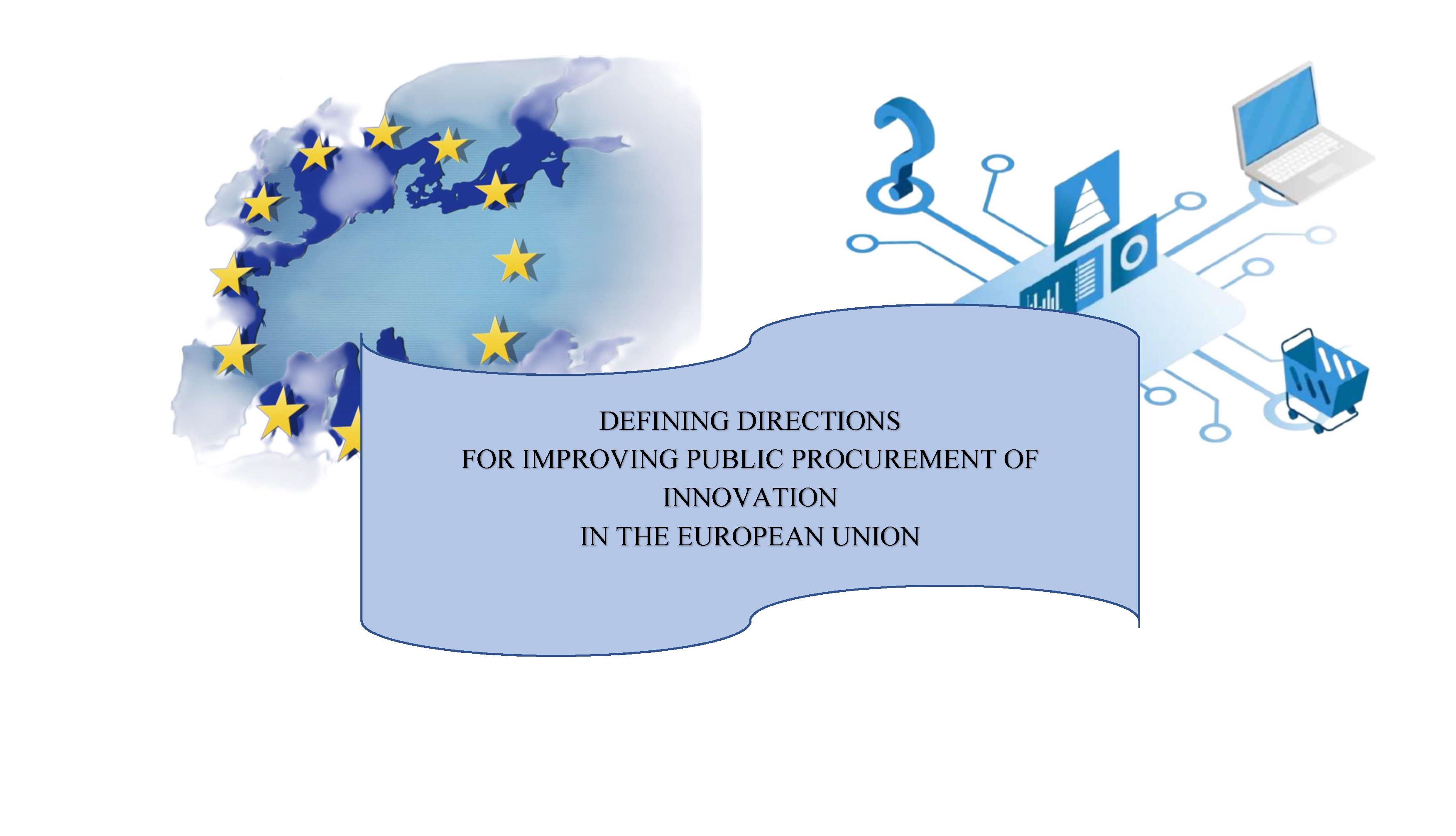
Defining directions for improving public procurement of innovation in the European Union
DOI:
https://doi.org/10.15587/2706-5448.2026.352193Keywords:
public procurement of innovations, regulation of innovations, innovative procurement, stimulation of innovationsAbstract
The object of research is the system of regulatory methods for identifying public procurement in the European Union, as one of the ways to stimulate innovation circulation. The research is aimed at solving the issue of improving the design of this support tool to the updated requirements of the European Union. The directions, methods and methods of improving the institution of public procurement are studied in order to bring it into line with real needs.
The study of the processes of regulating public procurement of innovations in the European Union has established their inconsistency with the real needs of participants in innovation circulation. It is proven that these inconsistencies negatively affect the level of support and scaling of innovation processes. The need to improve the regulatory approach to implementing public procurement of innovations in the European Union is substantiated.
The introduction of a new procedure for public procurement of innovations – public financial grant support – is proposed. The need to soften the requirements for the mandatory presence of an intellectual property right in the innovation is proven. The need to expand the circle of participants in the procedure for public procurement of innovations is substantiated. The need to amend Directive 2014/24/EU of the European Parliament and of the Council of February 26, 2014, the Horizon Europe Framework Programme; European Innovation Act is identified.
The research is aimed at developing general theoretical principles for improving the regulation of public procurement of innovations in the European Union. The results of this research can be used to improve the official rules for the dissemination and circulation of innovations, the formation of relevant decisions of government bodies, state innovation policy and the basis for further scientific research on the specified issues.
References
- Berkhout, P., Rainville, A., Janssen, M., Frenken, K. (2026). Does market engagement in public procurement foster innovation? Results from a Pan-European survey. Research Policy, 55 (1), 105372. https://doi.org/10.1016/j.respol.2025.105372
- Eklund, S. C. (2025). Intermediaries in strategic procurement: opportunities and obstacles for public organizations. Journal of Public Budgeting, Accounting & Financial Management, 37 (6), 244–262. https://doi.org/10.1108/jpbafm-02-2025-0052
- Selviaridis, K., Uyarra, E. (2025). How intermediaries manage knowledge to support public procurement of innovation: The case of UK defence. Research Policy, 54 (10), 105335. https://doi.org/10.1016/j.respol.2025.105335
- Kähkönen, A.-K., Jääskeläinen, A., Karttunen, E., Pedroso, C. B., Lintukangas, K. (2025). Promoting supply market development by the dynamic capabilities of innovative public procurement. Journal of Purchasing and Supply Management, 31 (4), 101056. https://doi.org/10.1016/j.pursup.2025.101056
- Bastianin, A., Castelnovo, P., Zirulia, L. (2025). Overcoming the innovation threshold through innovative public procurement: evidence from CERN. Industrial and Corporate Change, 34 (5), 871–900. https://doi.org/10.1093/icc/dtaf004
- Taheriruh, M., Jääskeläinen, A., Loijas, K., Harrison, D. (2025). Developing and deploying competences for innovative public procurement: a network perspective. Journal of Purchasing and Supply Management, 31 (4), 101039. https://doi.org/10.1016/j.pursup.2025.101039
- Tavana, M., Sorooshian, S., Sarvarizadehkouhpaye, M., Mina, H. (2024). A novel fuzzy general best–worst method for considering diversity and inclusion in supplier selection programs. Annals of Operations Research, 353 (1), 281–320. https://doi.org/10.1007/s10479-024-06044-y
- Birleanu, L. C., Lungu, F., Birleanu, C. (2025). Leveraging Centralized Procurement for Digital Innovation in Higher Education: Institutional Capacity and Policy Gaps in Romania. Administrative Sciences, 15 (8), 317. https://doi.org/10.3390/admsci15080317
- Ingenito, E. (2025). L’automazione dei processi nei contratti pubblici. Rivista italiana di informatica e diritto, 7 (2), 497–520. https://doi.org/10.32091/RIID0238
- Chiappinelli, O., Giuffrida, L. M., Spagnolo, G. (2025). Public procurement as an innovation policy: Where do we stand? International Journal of Industrial Organization, 100, 103157. https://doi.org/10.1016/j.ijindorg.2025.103157
- Directive 2014/24/EU of the European Parliament and of the Council of 26 February 2014 on public procurement and repealing Directive 2004/18/EC. Official Journal of the European Union, 94, 65–242. Available at: https://eur-lex.europa.eu/eli/dir/2014/24/oj/eng
- Regulation (EU) 2021/695 of the European Parliament and of the Council of 28 April 2021 establishing Horizon Europe – the Framework Programme for Research and Innovation, laying down its rules for participation and dissemination, and repealing Regulations (EU) No. 1290/2013 and (EU) No 1291/2013 (Text with EEA relevance) (2021). Official Journal of the European Union. Available at: https://eur-lex.europa.eu/eli/reg/2021/695
- Communication from the Commission to the European Parliament, the European Council, the Council, the European Economic and Social Committee and the Committee of the Regions A Competitiveness Compass for the EU. Brussels, 29.1.2025 COM (2025) 30 final. Available at: https://eur-lex.europa.eu/legal-content/EN/TXT/PDF/?uri=CELEX:52025DC0030&from=EN
- Communication from the Commission to the European Parliament, the Council, the European Economic and Social Committee and the Committee of the regions The EU Startup and Scaleup Strategy Choose Europe to start and scale. Brussels, 28.5.2025 COM(2025) 270 final. Available at: https://eur-lex.europa.eu/legal-content/EN/TXT/?uri=CELEX%3A52025DC0270
- Davydiuk, O., Shovkoplias, H., Malovatskyi, O., Ivanova, H., Tsiupak, V. (2025). Devising directions for unifying innovation flow in Ukraine in the context of its European integration, given the conditions of the ongoing armed conflict and the prospects of post-war reconstruction. Eastern-European Journal of Enterprise Technologies, 5 (13 (137)), 105–113. https://doi.org/10.15587/1729-4061.2025.341063
- European public procurement. TED. Available at: https://ted.europa.eu/en/simap/european-public-procurement
- Enterprises that received public funding for research and development (R&D) or other innovation activities, by source of funding, NACE Rev. 2 activity and size class (2020). Eurostat. https://doi.org/10.2908/inn_cis12_pub
- Enterprises by access to public funding, type of public funding and effect, NACE Rev. 2 activity and size class (CIS2022). Eurostat. https://doi.org/10.2908/inn_cis13_pub
- Davydiuk, O., Shovkoplias, G., Usatyi, V., Ivanova, H., Bytiak, O., Duiunova, T. (2025). Innovation in the Legal Regulation of Small (Medium) Enterprises in the EU Law. Science and Innovation, 21 (1), 35–49. https://doi.org/10.15407/scine21.01.035
- Brovdii, A., Bakalinska, O., Lisohorova, K., Sivash, O., Khaletska, K. (2025). Determining the regular impact on the processes of stimulating the innovation circulation within the limits of the EU sustainable development policy. Technology Audit and Production Reserves, 2 (4 (82)), 93–98. https://doi.org/10.15587/2706-5448.2025.326075
Downloads
Published
How to Cite
Issue
Section
License
Copyright (c) 2026 Oleksandr Davydiuk, Tetiana Shvydka, Iuliia Ostapenko, Oleh Tarasov, Oleksii Bytiak

This work is licensed under a Creative Commons Attribution 4.0 International License.
The consolidation and conditions for the transfer of copyright (identification of authorship) is carried out in the License Agreement. In particular, the authors reserve the right to the authorship of their manuscript and transfer the first publication of this work to the journal under the terms of the Creative Commons CC BY license. At the same time, they have the right to conclude on their own additional agreements concerning the non-exclusive distribution of the work in the form in which it was published by this journal, but provided that the link to the first publication of the article in this journal is preserved.