Substantiation of strategic management decision directions for ensuring socio-economic security in the global economy
DOI:
https://doi.org/10.15587/2706-5448.2026.352888Keywords:
socio-economic security, strategic management decisions, investment attractiveness, foreign economic activity, structural break, global economyAbstract
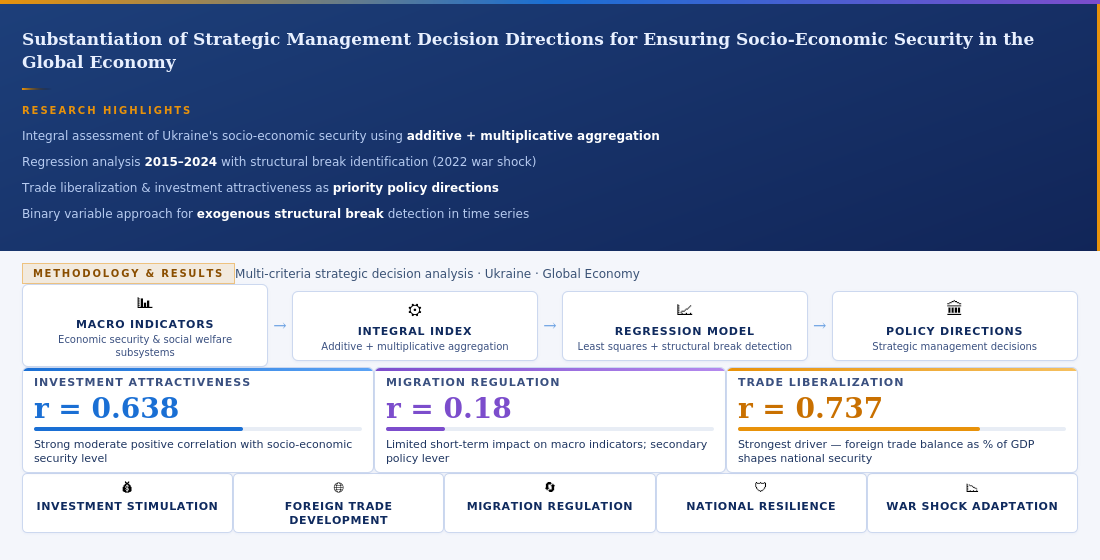
The research object is Ukraine’s socio-economic security system. The research problematic is related to the necessity of selecting effective strategic decisions under conditions of increasing risks and limited institutional resources. The research is devoted to identifying directions for strategic management decisions to strengthen the state’s socio-economic security during the period of global economic and social transformations. Specifically, institutional decisions aimed at increasing investment attractiveness, regulating migration processes, and liberalizing foreign economic activity are analyzed.
The methodological foundation of the research comprised regression analysis using an additive algorithm for aggregating indicators to assess the subsystems of economic security and social welfare, and a multiplicative aggregation algorithm for forming an integral indicator of socio-economic security. Identification of structural breaks of exogenous nature and empirical verification of the integral indicator’s sensitivity to macroeconomic factors were performed by introducing a binary variable following the analytical approach of time series analysis with a fixed break point.
Based on the results of multi-criteria analysis, a strong moderate positive relationship was established between the level of socio-economic security and strategic decisions aimed at enhancing the state’s investment attractiveness (correlation coefficient r = 0.638), and a moderate strong positive relationship with strategic decisions aimed at liberalizing foreign economic activity (r = 0.737). The obtained results are explained by the dominant influence of institutional and economic factors on the formation of national resilience in the pre-war period and the limited role of migration processes in the short-term dynamics of macroeconomic indicators. The integration of quantitative assessment of socio-economic security with analysis of strategic management decisions enabled justification of priority directions for state policy.
The theoretical significance of research is determined by the development of an approach to assessing the state’s socio-economic security that combines integral diagnostics of its condition with analysis of the impact of strategic management decisions through a system of relevant macroeconomic indicators. The practical significance is determined by the identification of strategic guidelines for state policy aimed at strengthening socio-economic security through coordinated use of instruments for investment stimulation, regulation of migration processes, and development of foreign economic cooperation.
References
- Barna, M. Yu., Klepanchuk, O. I., Pidlipna, R. P., Svidruk, I. I., Sidorchuk, O. G., Trut, O. O. (2020). Socio-economic aspects of development and security management economic system of Ukraine. Lviv: Raster-7.
- Pro rishennia Rady natsionalnoi bezpeky i oborony Ukrainy vid 14 veresnia 2020 roku «Pro Stratehiiu natsionalnoi bezpeky Ukrainy» (2020). Ukaz Prezydenta Ukrainy No. 392/2020. 14.09.2020. Available at: https://zakon.rada.gov.ua/laws/show/392/2020
- Benson, E., Mouradian, C., Palazzi, A. L. (2024). Toward a U.S. economic security strategy. Center for Strategic and International Studies. Available at: https://www.csis.org/analysis/toward-us-economic-security-strategy
- Nishimura, R. (2024). Japan would benefit from an economic security strategy. The Interpreter. Lowy Institute. Available at: https://www.lowyinstitute.org/the-interpreter/japan-would-benefit-economic-security-strategy
- Stoetman, A., Meijnders, M., Martens, M. (2019). Economic security with Chinese characteristics. Clingendael Institute. Available at: https://www.clingendael.org/pub/2019/strategic-monitor-2019-2020/economic-security-with-chinese-characteristics/
- Abubakar, A. M., Elrehail, H., Alatailat, M. A., Elçi, A. (2019). Knowledge management, decision-making style and organizational performance. Journal of Innovation & Knowledge, 4 (2), 104–114. https://doi.org/10.1016/j.jik.2017.07.003
- Svydruk, I. I. (2020). The latest management approaches to the creative motivation of employees. Scientific Bulletin of Kherson State University. Series Economic Sciences, 38, 42–45. https://doi.org/10.32999/ksu2307-8030/2020-38-7
- Shulha, O. (2022). Methodical principles of management decision making. Entrepreneurship and Innovation, 22, 54–58. https://doi.org/10.37320/2415-3583/22.9
- Mescon, M. H., Albert, M., Khedouri, F. (1988). Management. New York: Harper & Row, 777.
- Savage, L. J. (1951). The Theory of Statistical Decision. Journal of the American Statistical Association, 46 (253), 55–67. https://doi.org/10.1080/01621459.1951.10500768
- Kahneman, D., Tversky, A. (1979). Prospect Theory: An Analysis of Decision under Risk. Econometrica, 47 (2), 263–291. https://doi.org/10.2307/1914185
- Wang, L., Gu, W., Chen, P. (2023). Understanding the synergistic decision-making in Main Function Zoning constraints and regional development: Logic and mechanism. Journal of natural resources, 38 (6), 1430. https://doi.org/10.31497/zrzyxb.20230604
- Barna, M. Yu., Myronova, M. I., Bashnianyn, H. I. (2017). Intehralna efektyvnist funktsionuvannia ta rozvytku vyrobnychykh system u natsionalnii ekonomitsi: teoretyko-metodolohichni aspekty otsiniuvannia. Lviv: Liha-Pres, 166.
- Ma, H., Chu, X., Xue, D., Chen, D. (2017). A systematic decision making approach for product conceptual design based on fuzzy morphological matrix. Expert Systems with Applications, 81, 444–456. https://doi.org/10.1016/j.eswa.2017.03.074
- Roosevelt, F. D. (1934). On moving forward to greater freedom and greater security. Available at: http://docs.fdrlibrary.marist.edu/093034.html
- Shvedun, V., Hren, L. (2021). The strategic model of ensuring of the social and economic security of the state in the face of modern challenges. Investytsiyi: Praktyka ta Dosvid, 5, 52–55. https://doi.org/10.32702/2306-6814.2021.5.52
- Ahlstrom, D., Arregle, J., Hitt, M. A., Qian, G., Ma, X., Faems, D. (2020). Managing Technological, Sociopolitical, and Institutional Change in the New Normal. Journal of Management Studies, 57 (3), 411–437. https://doi.org/10.1111/joms.12569
- Gryshova, I., Kyzym, M., Hubarieva, I., Khaustova, V., Livinskyi, A., Koroshenko, M. (2020). Assessment of the EU and Ukraine Economic Security and Its Influence on Their Sustainable Economic Development. Sustainability, 12 (18), 7692. https://doi.org/10.3390/su12187692
- Sydorchuk, O., Pankova, O. (2020). Formation and Ensuring Multi-Level System of Social Security of Ukraine in the Context of State Regulation. Herald of the Economic Sciences of Ukraine, 1 (38), 138–147. https://doi.org/10.37405/1729-7206.2020.1(38).138-147
- Dobryanskyy, O. (2023). Exogenous determinants of the economic security of the country in conditions of global volatility. Scientific Notes of Ostroh Academy National University, “Economics” Series, 1 (29 (57)), 50–54. https://doi.org/10.25264/2311-5149-2023-29(57)-50-54
- Margalit, Y. (2019). Economic Insecurity and the Causes of Populism, Reconsidered. Journal of Economic Perspectives, 33 (4), 152–170. https://doi.org/10.1257/jep.33.4.152
- Vasyltsiv, T. H., Lupak, R. L., Kunytska-Iliash, M. V., Nakonechna, N. V. (2023). Ekonomichna bezpeka subiektiv hospodariuvannia ta derzhavy: aspekt harantuvannia finansovo-ekonomichnoi bezpeky priorytetnykh haluzei natsionalnoi ekonomiky Ukrainy. Scientific Notes of Lviv University of Business and Law, 37, 22–30. https://doi.org/10.5281/zenodo.7769997
- Ieleiko, V. I., Myronov, Yu. B., Demchyshyn, M. Ya., Bodnar, R. D. (2016). Ekonometrychnyi analiz innovatsiinoi diialnosti pidpryiemstv. Lviv: LTEU, 219.
- Myronova, M., Svydruk, I., Sydorchuk, O., Trut, O., Klepanchuk, O. (2022). Impact of foreign trade development on the organization of socio-economic security of Ukraine. Bulletin of Geography. Socio-Economic Series, 57, 155–168. https://doi.org/10.12775/bgss-2022-0029
- Baker, S. R., Bloom, N., Davis, S. J. (2016). Measuring Economic Policy Uncertainty*. The Quarterly Journal of Economics, 131 (4), 1593–1636. https://doi.org/10.1093/qje/qjw024
- Perron, P. (2006). Dealing with structural breaks. Palgrave Handbook of Econometrics, 1, 278–352.
- Kvietnyi, R. N., Boiko, O. R., Stepova, T. O. (2011). Multimensional polynomial approximation of interval data dependences by least squares method. Visnyk Vinnytskoho politekhnichnoho instytutu, 3, 103–106.
- Derzhavna sluzhba statystyky Ukrainy. Available at: https://www.ukrstat.gov.ua
- Indeks Ekonomichnoi Bezpeky Ukrainy. International Liberty Institute. Available at: https://www.ilibertyinstitute.org/index/ekonomichna-bezpeka
- Indeks investytsiinoi pryvablyvosti Ukrainy (2022). European Business Association. Available at: https://eba.com.ua/wp-content/uploads/2022/12/EBA-InvestIndex_2H-2022_UA.pdf
- Study on due diligence requirements through the supply chain (2020). European Commission. https://doi.org/10.2838/39830
- Hoekman, B., Nelson, D. (2020). Rethinking international subsidy rules. The World Economy, 43 (12), 3104–3132. https://doi.org/10.1111/twec.13022
- Regulation (EU) 2019/452 of the European Parliament and of the Council of 19 March 2019 establishing a framework for the screening of foreign direct investments into the Union (2019). Available at: https://eur-lex.europa.eu/eli/reg/2019/452/oj
- Ticu, I. (2023). The phenomenon of migration and the national security of the Republic of Moldova. Revista Moldovenească de Drept Internaţional Şi Relaţii Internaţionale, 18 (1), 52–59. https://doi.org/10.61753/1857-1999/2345-1963/2023.18-1.05
- Population and demographics (2024). Geostat. Available at: https://www.geostat.ge/ka/modules/categories/316/mosakhleoba-da-demografia
- Humanitarna sytuatsiia v Ukraini. Kvartalnyi ohliad No. 2 (2024). UVKB OON. Available at: https://www.unhcr.org/ua/wp-content/uploads/sites/38/2024/10/UNHCR-Ukraine-Operational-Update_11-October_UKR.pdf
- Zhang, Y., Chen, Z. J., Li, H. (2017). Toward a model of risky decisions: Synergistic effect of affect intensity and affective processing on risk-seeking as a function of decision domain. Journal of Experimental Social Psychology, 73, 235–242. https://doi.org/10.1016/j.jesp.2017.06.006
- Yazdani, M., Zarate, P., Kazimieras Zavadskas, E., Turskis, Z. (2019). A combined compromise solution (CoCoSo) method for multi-criteria decision-making problems. Management Decision, 57 (9), 2501–2519. https://doi.org/10.1108/md-05-2017-0458
- Balezhentis, A., Yatsenko, O. (2018). Asymetrii torhovelnoi intehratsii Ukrainy ta YeS. Mizhnarodna ekonomichna polityka, 1, 32–62. Available at: http://iepjournal.com/journals/28/2018_2_Basenentius_Yatsenko.pdf
- Indeksy. Ekonomika Ukrainy. Ministerstvo finansiv Ukrainy. Available at: https://index.minfin.com.ua/ua/economy
- Pro zovnishnoekonomichnu diialnist (2024). Zakon Ukrainy No. 959-XII redaktsiia vid 03.09.2024. Available at: https://zakon.rada.gov.ua/laws/show/959-12#Text
- Kuzmin, O., Yurynets, O., Yemelyanov, O. (2021). Development of investment attractiveness of enterprises in the conditions of anti-crisis management. Investytsiyi: Praktyka ta Dosvid, 10, 5–12. https://doi.org/10.32702/2306-6814.2021.10.5
- Profilul Migrațional Extins al Republicii Moldova 2017–2021: Raport analitic (2024). Ministerul Afacerilor Interne al Republicii Moldova. Available at: https://igm.gov.md/wp-content/uploads/2024/04/PME_RM_2017-2021.pdf
- Migration strategy of Georgia 2021–2030 (2020). State Commission on Migration Issues. Available at: https://migration.commission.ge/files/ms30_eng_web2.pdf
- Levytska, O. (2022). Border migration processes in Ukraine: Developing responses to emerging vulnerabilities. Migration Letters, 19 (2), 159–170.
- Bogdan, L. (2023). Navigating Migration Risks: The Role of Risk Perception and Information Engagement Among Moldovans. Journal on Migration and Human Security, 11 (4), 315–332. https://doi.org/10.1177/23315024231201622
- Walter, C. (2020). Sustainable Financial Risk Modelling Fitting the SDGs: Some Reflections. Sustainability, 12 (18), 7789. https://doi.org/10.3390/su12187789
Downloads
Published
How to Cite
Issue
Section
License
Copyright (c) 2026 Irena Svydruk, Orystlava Sydorchuk, Mariana Myronova, Olga Klepanchuk, Valeria Kozlova

This work is licensed under a Creative Commons Attribution 4.0 International License.
The consolidation and conditions for the transfer of copyright (identification of authorship) is carried out in the License Agreement. In particular, the authors reserve the right to the authorship of their manuscript and transfer the first publication of this work to the journal under the terms of the Creative Commons CC BY license. At the same time, they have the right to conclude on their own additional agreements concerning the non-exclusive distribution of the work in the form in which it was published by this journal, but provided that the link to the first publication of the article in this journal is preserved.