Development of method foundations for generating noise-like signals based on direct sequence spread spectrum of timing signal structures
DOI:
https://doi.org/10.15587/2706-5448.2026.353067Keywords:
timer constructions, noise-like signals, spectrum, stealth, interference immunity, radio electronic intelligence, correlation receptionAbstract
The object of the research is the process of forming complex noise-like signals based on timer signal constructions in secure communication systems operating under conditions of electronic warfare and counteraction to electronic intelligence systems.
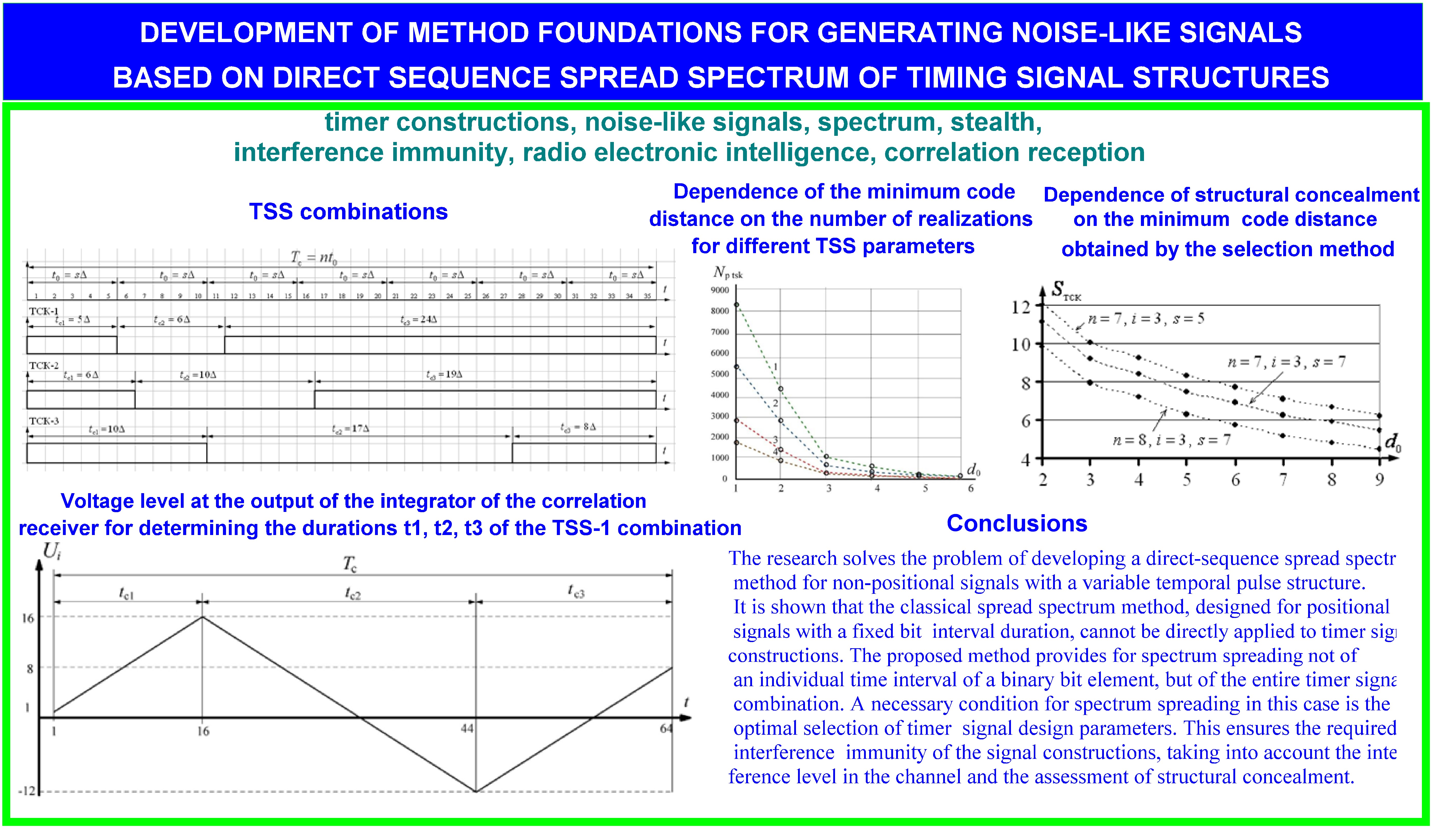
The problem addressed in the paper is the lack of a theoretical framework for spectrum spreading of non-positional signals. An example of such signals is timer signal constructions, which are characterized by a more complex and variable temporal pulse structure within a combination.
The research solves the problem of developing a direct-sequence spread spectrum method for non-positional signals with a variable temporal pulse structure. It is shown that the classical spread spectrum method, designed for positional signals with fixed bit interval duration, cannot be directly applied to timer signal constructions. The proposed method provides for spectrum spreading not of an individual time interval of a binary bit element, but of the entire timer signal combination. A necessary condition for spectrum spreading in this case is the optimal selection of timer signal design parameters. This ensures the required interference immunity of the signal constructions, taking into account the interference level in the channel and the assessment of structural concealment.
The obtained results made it possible to establish the relationship between interference immunity and the level of concealment of timer signal constructions. It is shown that varying the parameters of timer noise-like signal formation significantly complicates their detection, recognition, and analysis by electronic intelligence means. According to the results of correlation analysis, the correlation coefficient varies in the range from 0.125 to 0.516, indicating reduced predictability and an increased level of structural concealment of the generated signal constructions.
The effectiveness of the proposed solution is explained by the fact that reception of broadband constructions is possible only when the correlation receiver is configured according to the timer signal design parameters. This practically prevents the reception of broadband timer signals generated with different design parameters, as well as by means of conventional classical correlation receivers.
The practical application of the results is possible in the design of secure special-purpose communication systems operating under conditions of intensive electronic countermeasures.
References
- Zaitsev, D. V., Yafonkin, A. O., Yarema, V. V. (2021). Osnovy zviazku ta radioelektronna borotba yak vyd boiovoho zabezpechennia. Irpin: Universytet derzhavnoi fiskalnoi sluzhby Ukrainy, 279. Available at: https://ir.dpu.edu.ua/entities/publication/931c8879-4752-4096-a76d-6ab33b3b95e7/full
- Sholokhov, S. M., Samborskyi, I. I., Vakulenko, O. V., Nikolaienko, B. A. (2021). Zavadozakhyst radioelektronnykh zasobiv. Chastyna 1. Osnovy zavadozakhystu system zviazku. Kyiv: ISZZI KPI im. Ihoria Sikorskoho, 210. Available at: https://ela.kpi.ua/handle/123456789/63622
- Hurskyi, T. H., Zhuk, O. H., Klimovych, S. O. (2012). Napriamky zastosuvannia psevdovypadkovykh poslidovnostei v radiomerezhakh spetsialnoho pryznachennia. Visnyk Khmelnytskoho natsionalnoho universytetu, 6, 160–167. Available at: https://journals.khnu.km.ua/vestnik/pdf/tech/2012_6/54gur.pdf
- Zakharchenko, M. V. (2009). Systemy peredavannia danykh. Zavadostiike koduvannia. Odesa: Feniks, 448. Available at: https://duikt.edu.ua/ua/lib/1/category/2234/view/502?lang=ua&act=view&page=1&category=2234&id=502
- Korchinsky, V. V. (2012). Evaluation of structural stealth signal designs based on chaotic signals in the transmission systems of confidential information. Naukovi pratsi ONAZ im. O. S. Popova, 1, 77–81. Available at: https://ojs.suitt.edu.ua/index.php/sbornik_onat/article/view/481
- Politanskyi, R. L., Hotra, Z. Yu. (2010). Doslidzhennia psevdovypadkovykh poslidovnostei, henerovanykh kartamy khaosu. Problemy telekomunikatsii, 127–128.
- Burkinsky, B. V., Nazarenko, O., Laiko, O. I., Khadzhyradieva, S., Logvinov, V. (2024). Sustainable development and digital innovations. Odesa: DU “IREED NANU”, 543. https://doi.org/10.31520/978-617-14-0253-9
- Zakharchenko, M. V., Horokhov, Yu, S., Kril, A. S., Kovalchuk, S. V. (2015). Kodove ushchilnennia pry taimernykh syhnalakh. Suchasni informatsiini tekhnolohii u sferi bezpeky ta oborony, 3 (24), 38–42. Available at: file:///C:/Users/zimov/Downloads/61290-%D0%A2%D0%B5%D0%BA%D1%81%D1%82%20%D1%81%D1%82%D0%B0%D1%82%D1%82%D1%96-125862-1-10-20160229.pdf
- Sklar, B. (2001). Digital communications: Fundamentals and applications. Prentice Hall, 1079.
- Zakharchenko, M. V., Hadzhyev, M. M., Radzimovskyi, B. K., Horokhov, Yu. S., Shpak, D. O. (2014). Comparison of syndromic methods for correcting block positional and timing codes. Eastern-European Journal of Enterprise Technologies, 2 (9 (68)), 4–8. https://doi.org/10.15587/1729-4061.2014.23091
- Zakharchenko, M. V. (2010). Systemy peredavannya danykh. Tom 2: Poelementne ta Z–38 tsyklove fazuvannya v systemakh z blokovym koduvannyam. Odesa: 264. Available at: https://duikt.edu.ua/uploads/l_502_87152646.pdf
- Hordiichuk, V., Shyshatskyi, A., Korchinskyi, V., Kildishev, V., Pozdniakov, P. (2021). Timing pulse code modulation as a tool for quantization noise reduction in special-purpose IT systems. Journal of Physics: Conference Series, 1839 (1), 012005. https://doi.org/10.1088/1742-6596/1839/1/012005
- Hordiichuk, V., Korchynskyi, V., Kildishev, V., Molodetskyi, B., Staikutsa, S., Alfaiomi, K. (2024). Adaptive Synthesis of Wideband Timer Signals in the Conditions of Radio-Electronic Warfare. 2024 IEEE 17th International Conference on Advanced Trends in Radioelectronics, Telecommunications and Computer Engineering (TCSET). Lviv, 1–4. https://doi.org/10.1109/tcset64720.2024.10755658
- Gorokhov, S. M., Zakharchenko, N. V., Korchinsky, V. V. (2012). Criteria of efficiency of hidden communication techniques. Tsyfrovi tekhnolohii, 12, 147–150. Available at: https://ojs.suitt.edu.ua/index.php/digitech/article/view/761/759
Downloads
Published
How to Cite
Issue
Section
License
Copyright (c) 2026 Volodymyr Korchynskyi, Vitalii Kildishev, Daniyar Bektursunov, Serhii Havel, Vadym Stepanov, Vasyl Slavych, Ruslan Petrovskyi

This work is licensed under a Creative Commons Attribution 4.0 International License.
The consolidation and conditions for the transfer of copyright (identification of authorship) is carried out in the License Agreement. In particular, the authors reserve the right to the authorship of their manuscript and transfer the first publication of this work to the journal under the terms of the Creative Commons CC BY license. At the same time, they have the right to conclude on their own additional agreements concerning the non-exclusive distribution of the work in the form in which it was published by this journal, but provided that the link to the first publication of the article in this journal is preserved.