Розробка методу формування шумоподібних сигналів на основі прямого розширення спектра таймерних сигнальних конструкцій
DOI:
https://doi.org/10.15587/2706-5448.2026.353067Ключові слова:
таймерні конструкції, шумоподібні сигнали, спектр, прихованість, завадостійкість, радіоелектронна розвідка, кореляційне прийманняАнотація
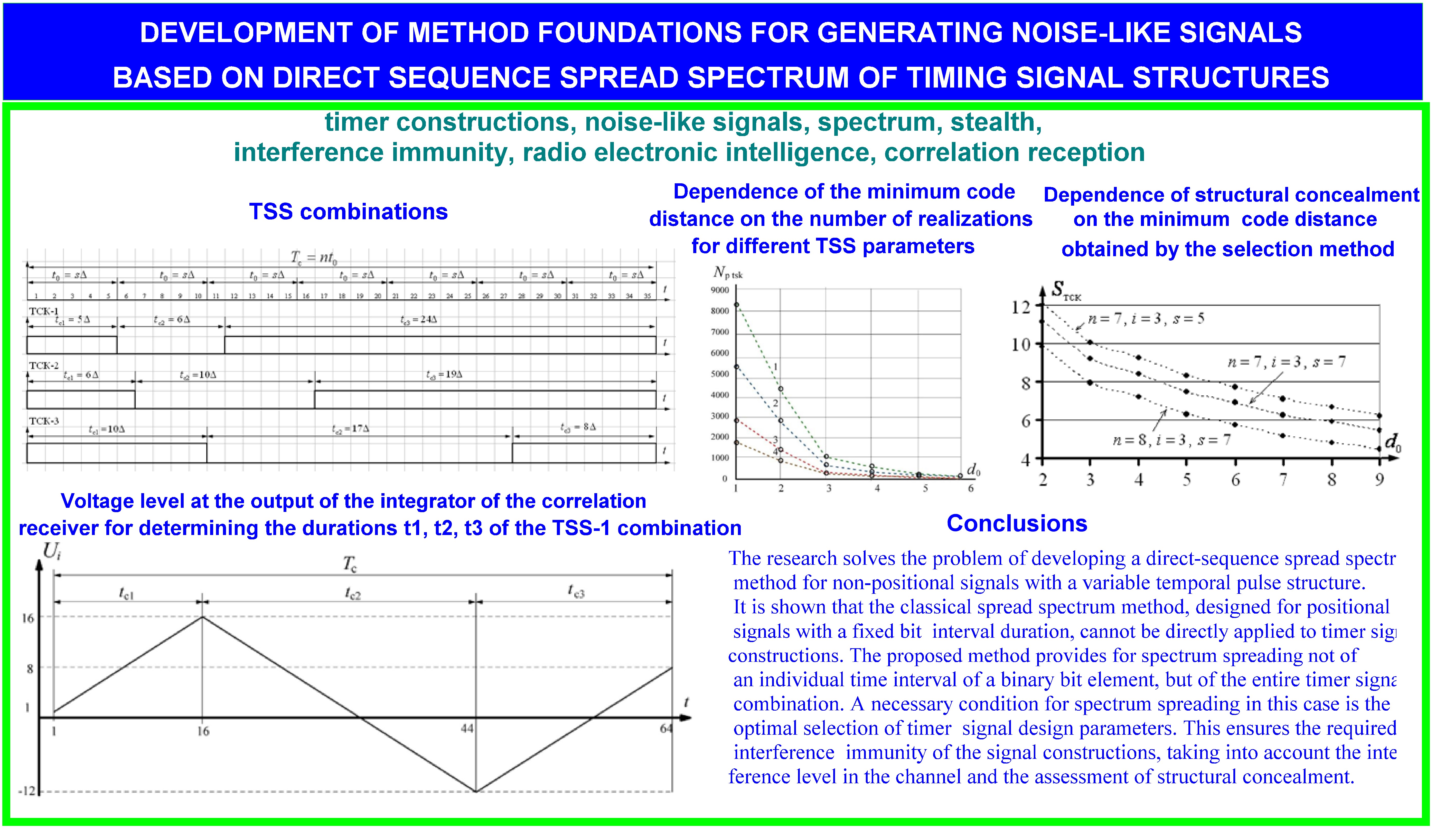
Об’єктом дослідження є процес формування складних шумоподібних сигналів на основі таймерних сигнальних конструкцій у захищених системах зв’язку, що функціонують в умовах радіоелектронної боротьби та протидії засобам радіоелектронної розвідки.
Проблема, що вирішується в роботі, полягає у відсутності теоретичної бази для розширення спектра для непозиційних сигналів. Прикладом таких сигналів є таймерні сигнальні конструкції, для яких характерним є більш складна та змінна часова структура імпульсів в межах комбінації.
У роботі запропоновано метод прямого розширення спектра для непозиційних сигналів зі змінною часовою структурою імпульсів. Показано, що класичний метод розширення спектра, орієнтований на позиційні сигнали з фіксованою тривалістю бітового інтервалу, не може бути безпосередньо застосований до таймерних сигнальних конструкцій. Запропонований метод передбачає розширення спектра не окремого часового інтервалу двійкового бітового елемента, а всієї комбінації таймерного сигналу. Необхідною умовою розширення спектра при цьому є оптимальний вибір параметрів побудови таймерних сигналів. Це потрібно для забезпечення заданої завадостійкості сигнальних конструкцій з урахуванням рівня завад у каналі та розрахунку структурної прихованості.
Отримані результати дозволили встановити взаємозв’язок між показниками завадостійкості та рівнем прихованості таймерних сигнальних конструкцій. Показано, що варіювання параметрів формування таймерних шумоподібних сигналів суттєво ускладнює їх виявлення, розпізнавання й аналіз засобами радіоелектронної розвідки. За результатами кореляційного аналізу встановлено, що коефіцієнт кореляції змінюється в межах від 0,125 до 0,516, що свідчить про зниження передбачуваності та підвищення рівня структурної прихованості сформованих сигнальних конструкцій.
Ефективність запропонованого рішення пояснюється тим, що прийом широкосмугових конструкцій можливий при налаштуванні кореляційного приймача за параметрами побудови таймерних сигналів. Це фактично унеможливлює прийом широкосмугових таймерних сигналів, які сформовані за іншими параметрами побудови, а також за допомогою відомих класичних кореляційних приймачів.
Практичне використання результатів можливе у ході проєктування захищених систем зв’язку спеціального призначення, що функціонують в умовах інтенсивного радіоелектронного протиборства.
Посилання
- Zaitsev, D. V., Yafonkin, A. O., Yarema, V. V. (2021). Osnovy zviazku ta radioelektronna borotba yak vyd boiovoho zabezpechennia. Irpin: Universytet derzhavnoi fiskalnoi sluzhby Ukrainy, 279. Available at: https://ir.dpu.edu.ua/entities/publication/931c8879-4752-4096-a76d-6ab33b3b95e7/full
- Sholokhov, S. M., Samborskyi, I. I., Vakulenko, O. V., Nikolaienko, B. A. (2021). Zavadozakhyst radioelektronnykh zasobiv. Chastyna 1. Osnovy zavadozakhystu system zviazku. Kyiv: ISZZI KPI im. Ihoria Sikorskoho, 210. Available at: https://ela.kpi.ua/handle/123456789/63622
- Hurskyi, T. H., Zhuk, O. H., Klimovych, S. O. (2012). Napriamky zastosuvannia psevdovypadkovykh poslidovnostei v radiomerezhakh spetsialnoho pryznachennia. Visnyk Khmelnytskoho natsionalnoho universytetu, 6, 160–167. Available at: https://journals.khnu.km.ua/vestnik/pdf/tech/2012_6/54gur.pdf
- Zakharchenko, M. V. (2009). Systemy peredavannia danykh. Zavadostiike koduvannia. Odesa: Feniks, 448. Available at: https://duikt.edu.ua/ua/lib/1/category/2234/view/502?lang=ua&act=view&page=1&category=2234&id=502
- Korchinsky, V. V. (2012). Evaluation of structural stealth signal designs based on chaotic signals in the transmission systems of confidential information. Naukovi pratsi ONAZ im. O. S. Popova, 1, 77–81. Available at: https://ojs.suitt.edu.ua/index.php/sbornik_onat/article/view/481
- Politanskyi, R. L., Hotra, Z. Yu. (2010). Doslidzhennia psevdovypadkovykh poslidovnostei, henerovanykh kartamy khaosu. Problemy telekomunikatsii, 127–128.
- Burkinsky, B. V., Nazarenko, O., Laiko, O. I., Khadzhyradieva, S., Logvinov, V. (2024). Sustainable development and digital innovations. Odesa: DU “IREED NANU”, 543. https://doi.org/10.31520/978-617-14-0253-9
- Zakharchenko, M. V., Horokhov, Yu, S., Kril, A. S., Kovalchuk, S. V. (2015). Kodove ushchilnennia pry taimernykh syhnalakh. Suchasni informatsiini tekhnolohii u sferi bezpeky ta oborony, 3 (24), 38–42. Available at: file:///C:/Users/zimov/Downloads/61290-%D0%A2%D0%B5%D0%BA%D1%81%D1%82%20%D1%81%D1%82%D0%B0%D1%82%D1%82%D1%96-125862-1-10-20160229.pdf
- Sklar, B. (2001). Digital communications: Fundamentals and applications. Prentice Hall, 1079.
- Zakharchenko, M. V., Hadzhyev, M. M., Radzimovskyi, B. K., Horokhov, Yu. S., Shpak, D. O. (2014). Comparison of syndromic methods for correcting block positional and timing codes. Eastern-European Journal of Enterprise Technologies, 2 (9 (68)), 4–8. https://doi.org/10.15587/1729-4061.2014.23091
- Zakharchenko, M. V. (2010). Systemy peredavannya danykh. Tom 2: Poelementne ta Z–38 tsyklove fazuvannya v systemakh z blokovym koduvannyam. Odesa: 264. Available at: https://duikt.edu.ua/uploads/l_502_87152646.pdf
- Hordiichuk, V., Shyshatskyi, A., Korchinskyi, V., Kildishev, V., Pozdniakov, P. (2021). Timing pulse code modulation as a tool for quantization noise reduction in special-purpose IT systems. Journal of Physics: Conference Series, 1839 (1), 012005. https://doi.org/10.1088/1742-6596/1839/1/012005
- Hordiichuk, V., Korchynskyi, V., Kildishev, V., Molodetskyi, B., Staikutsa, S., Alfaiomi, K. (2024). Adaptive Synthesis of Wideband Timer Signals in the Conditions of Radio-Electronic Warfare. 2024 IEEE 17th International Conference on Advanced Trends in Radioelectronics, Telecommunications and Computer Engineering (TCSET). Lviv, 1–4. https://doi.org/10.1109/tcset64720.2024.10755658
- Gorokhov, S. M., Zakharchenko, N. V., Korchinsky, V. V. (2012). Criteria of efficiency of hidden communication techniques. Tsyfrovi tekhnolohii, 12, 147–150. Available at: https://ojs.suitt.edu.ua/index.php/digitech/article/view/761/759
##submission.downloads##
Опубліковано
Як цитувати
Номер
Розділ
Ліцензія
Авторське право (c) 2026 Volodymyr Korchynskyi, Vitalii Kildishev, Daniyar Bektursunov, Serhii Havel, Vadym Stepanov, Vasyl Slavych, Ruslan Petrovskyi

Ця робота ліцензується відповідно до Creative Commons Attribution 4.0 International License.
Закріплення та умови передачі авторських прав (ідентифікація авторства) здійснюється у Ліцензійному договорі. Зокрема, автори залишають за собою право на авторство свого рукопису та передають журналу право першої публікації цієї роботи на умовах ліцензії Creative Commons CC BY. При цьому вони мають право укладати самостійно додаткові угоди, що стосуються неексклюзивного поширення роботи у тому вигляді, в якому вона була опублікована цим журналом, але за умови збереження посилання на першу публікацію статті в цьому журналі.