Development of an analytical model for predicting the trajectory and energy dissipation of bee bread granules in a rotary impact separator
DOI:
https://doi.org/10.15587/2706-5448.2026.353169Keywords:
bee bread, granule, rotor, mechanics, inertia, energy, trajectory, separation, dissipation, efficiencyAbstract
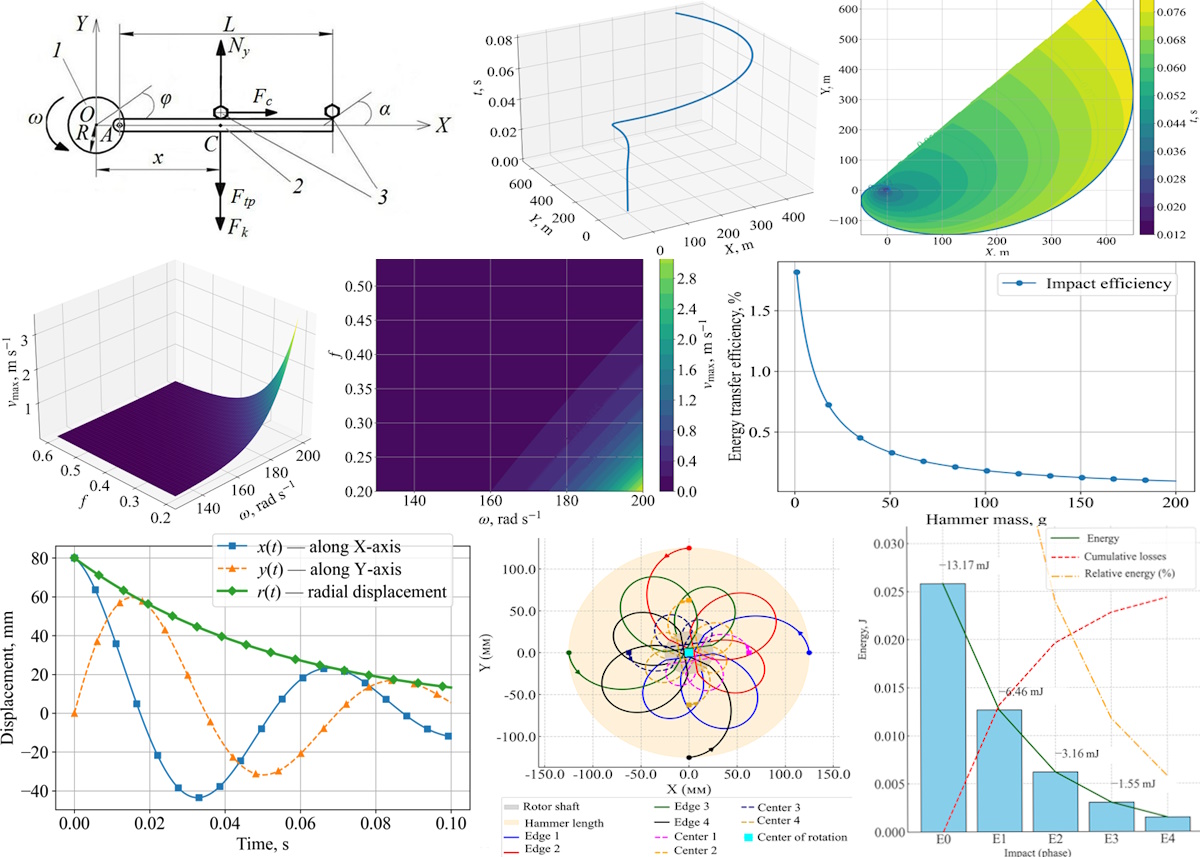
The object of this research is the impact interaction between a bee bread granule and a hammer-type working element in a rotary separator. The practical relevance of the research arises from the need to ensure reliable release of granules while preventing their mechanical damage, since even partial destruction leads to deterioration of product quality and a decrease in its commercial value. Such an approach does not allow reliable prediction of energy transfer during impact or the subsequent trajectory of the granule. As a consequence, rotor speed and hammer mass are often selected without sufficient theoretical justification, which limits the efficiency and controllability of the separation process. To overcome these limitations, an analytical model describing granule impact and its post-impact motion in a rotating reference frame was developed. The mathematical formulation accounts for the combined action of centrifugal, Coriolis, gravitational, and friction forces, which made it possible to derive parametric relationships for velocity and displacement as functions of time. It was established that the post-impact motion follows a damped pattern, with the displacement amplitude decreasing by more than 60% within the first 0.02 s and exceeding an 80% reduction after 0.05 s. It was also found that energy transfer efficiency strongly depends on hammer mass. At a mass of 5 g, the efficiency reaches approximately 0.7–0.8%, whereas at 100 g it decreases to about 0.1%, and at 200 g it falls below 0.05%. These trends are explained by increasing dissipative losses within the rotating system. The proposed model enables prediction of granule trajectory, velocity, and energy dissipation under different operating conditions. Its practical value lies in providing a scientifically grounded basis for selecting hammer mass and rotor speed to achieve efficient and gentle separation of bee bread granules.
References
- Ghazi Alshanti, W. (2019). Discrete Element Modeling of a Projectile Impacting and Penetrating into Granular Systems. Ballistics. IntechOpen. https://doi.org/10.5772/intechopen.75550
- Chou, Y. F., Keh, H. J. (2024). Axisymmetric Slow Rotation of Coaxial Soft/Porous Spheres. Molecules, 29 (15), 3573. https://doi.org/10.3390/molecules29153573
- Sanoria, M., Chelakkot, R., Nandi, A. (2021). Influence of interaction softness on phase separation of active particles. Physical Review E, 103 (5). https://doi.org/10.1103/physreve.103.052605
- Lips, D., Cereceda-López, E., Ortiz-Ambriz, A., Tierno, P., Ryabov, A., Maass, P. (2022). Hydrodynamic interactions hinder transport of flow-driven colloidal particles. Soft Matter, 18 (47), 8983–8994. https://doi.org/10.1039/d2sm01114j
- Zhou, L., Ren, L., Chen, Y., Niu, S., Han, Z., Ren, L. (2021). Bio‐Inspired Soft Grippers Based on Impactive Gripping. Advanced Science, 8 (9). https://doi.org/10.1002/advs.202002017
- Seifert, J., Koch, K., Hess, M., Schmidt, A. M. (2020). Magneto-mechanical coupling of single domain particles in soft matter systems. Physical Sciences Reviews, 7 (11), 1237–1261. https://doi.org/10.1515/psr-2019-0092
- Rosas, A., Buceta, J., Lindenberg, K. (2003). Dynamics of two granules. Physical Review E, 68 (2). https://doi.org/10.1103/physreve.68.021303
- van der Meer, D. (2017). Impact on Granular Beds. Annual Review of Fluid Mechanics, 49 (1), 463–484. https://doi.org/10.1146/annurev-fluid-010816-060213
- Sano, T. G., Kanazawa, K., Hayakawa, H. (2016). Granular rotor as a probe for a nonequilibrium bath. Physical Review E, 94 (3). https://doi.org/10.1103/physreve.94.032910
- Wang, X., Huang, Y., Zhang, F., Meng, Q. (2025). Influence of Rotor-Induced Airflow on Particle Fragmentation in an Impact Crusher: A Computational Fluid Dynamics–Discrete Element Method Study. ACS Omega, 10 (39), 46051–46064. https://doi.org/10.1021/acsomega.5c06659
- Ghodki, B. M., Chhetri, K. B., Goswami, T. K. (2020). Numerical modeling of granular flow in star valve type cryogenic precooler. Journal of Food Process Engineering, 43 (4). https://doi.org/10.1111/jfpe.13376
- Yang, J. H., Fang, H. Y., Luo, M. (2015). Load and wear experiments on the impact hammer of a vertical shaft impact crusher. IOP Conference Series: Materials Science and Engineering, 103. https://doi.org/10.1088/1757-899x/103/1/012041
- Feng, F., Shi, J., Yang, J., Ma, J. (2020). Study on Wear form of Split Cone of Vertical Shaft Impact Crusher. Journal of Scientific Research and Reports, 21 (11), 13–20. https://doi.org/10.9734/jsrr/2020/v26i1130331
- Xu, B., Cui, Q., Guo, L., Hao, L. (2024). Design and Parameter Optimization of a Combined Rotor and Lining Plate Crushing Organic Fertilizer Spreader. Agronomy, 14 (8), 1732. https://doi.org/10.3390/agronomy14081732
- Paraschiv, G., Moiceanu, G., Voicu, G., Chitoiu, M., Cardei, P., Dinca, M. N., Tudor, P. (2021). Optimization Issues of a Hammer Mill Working Process Using Statistical Modelling. Sustainability, 13 (2), 973. https://doi.org/10.3390/su13020973
- Kim, A. S., Kim, H.-J. (2017). Dissipative Dynamics of Granular Materials. Granular Materials. IntechOpen. https://doi.org/10.5772/intechopen.69196
- Kollmer, J. E., Sack, A., Heckel, M., Pöschel, T. (2013). Relaxation of a spring with an attached granular damper. New Journal of Physics, 15 (9), 093023. https://doi.org/10.1088/1367-2630/15/9/093023
- Păun, A., Stroescu, G., Milea, D., Olan, M., Epure, M. (2019). Concaves influence on the milling process of cereal seeds in hammer mills. E3S Web of Conferences, 112, 03009. https://doi.org/10.1051/e3sconf/201911203009
- Ahmadian, H., Ghadiri, M. (2021). Granule attrition by coupled particle impact and shearing. Advanced Powder Technology, 32 (1), 204–210. https://doi.org/10.1016/j.apt.2020.12.001
- Li, T., Shi, G., Zhang, Q. (2024). Research on hammering characteristics of hammer mill based on discrete element method. Engineering Research Express, 6 (3), 035540. https://doi.org/10.1088/2631-8695/ad6ca4
- Kyzas, G., Mitropoulos, A. C. (Eds.) (2018). Granularity in Materials Science. IntechOpen. https://doi.org/10.5772/intechopen.75231
- Syromyatnikov, Y. N., Orekhovskaya, A. A., Dzjasheev, A.-M. S., Tikhonov, E. A., Kalimullin, M. N., Ivanov, A. A., Sokolova, V. A. (2021). Improving stability of movement of machine section for soil preparation and seeding. Journal of Physics: Conference Series, 2094 (4), 042027. https://doi.org/10.1088/1742-6596/2094/4/042027
- Pashchenko, V. F., Syromyatnikov, Y. U. N. (2019). The transporting ability of the rotor of the soil-cultivating loosening and separating vehicle. Traktory i Sel Hozmashiny, 86 (2), 67–74. https://doi.org/10.31992/0321-4443-2019-2-67-74
- Syromyatnikov, Y. N., Orekhovskaya, A. A., Dzjasheev, A.-M. S., Kalimullin, M. N., Tikhonov, E. A., Luchinovich, A. A., Bielykh, A. V. (2021). Cultivator points of the rotary tillage loosening and separating machine of the stratifier. Journal of Physics: Conference Series, 2094 (4), 042024. https://doi.org/10.1088/1742-6596/2094/4/042024
Downloads
Published
How to Cite
Issue
Section
License
Copyright (c) 2026 Yurii Syromiatnykov, Oleksandr Bielykh, Oleksandr Kharchenko

This work is licensed under a Creative Commons Attribution 4.0 International License.
The consolidation and conditions for the transfer of copyright (identification of authorship) is carried out in the License Agreement. In particular, the authors reserve the right to the authorship of their manuscript and transfer the first publication of this work to the journal under the terms of the Creative Commons CC BY license. At the same time, they have the right to conclude on their own additional agreements concerning the non-exclusive distribution of the work in the form in which it was published by this journal, but provided that the link to the first publication of the article in this journal is preserved.