Assessment of the effectiveness of implementing AI tools in business analytics of enterprises in the conditions of digital change
DOI:
https://doi.org/10.15587/2706-5448.2026.356142Keywords:
digital transformation, business analytics, intelligent algorithms, forecasting, modelling, resilience, algorithmizingAbstract
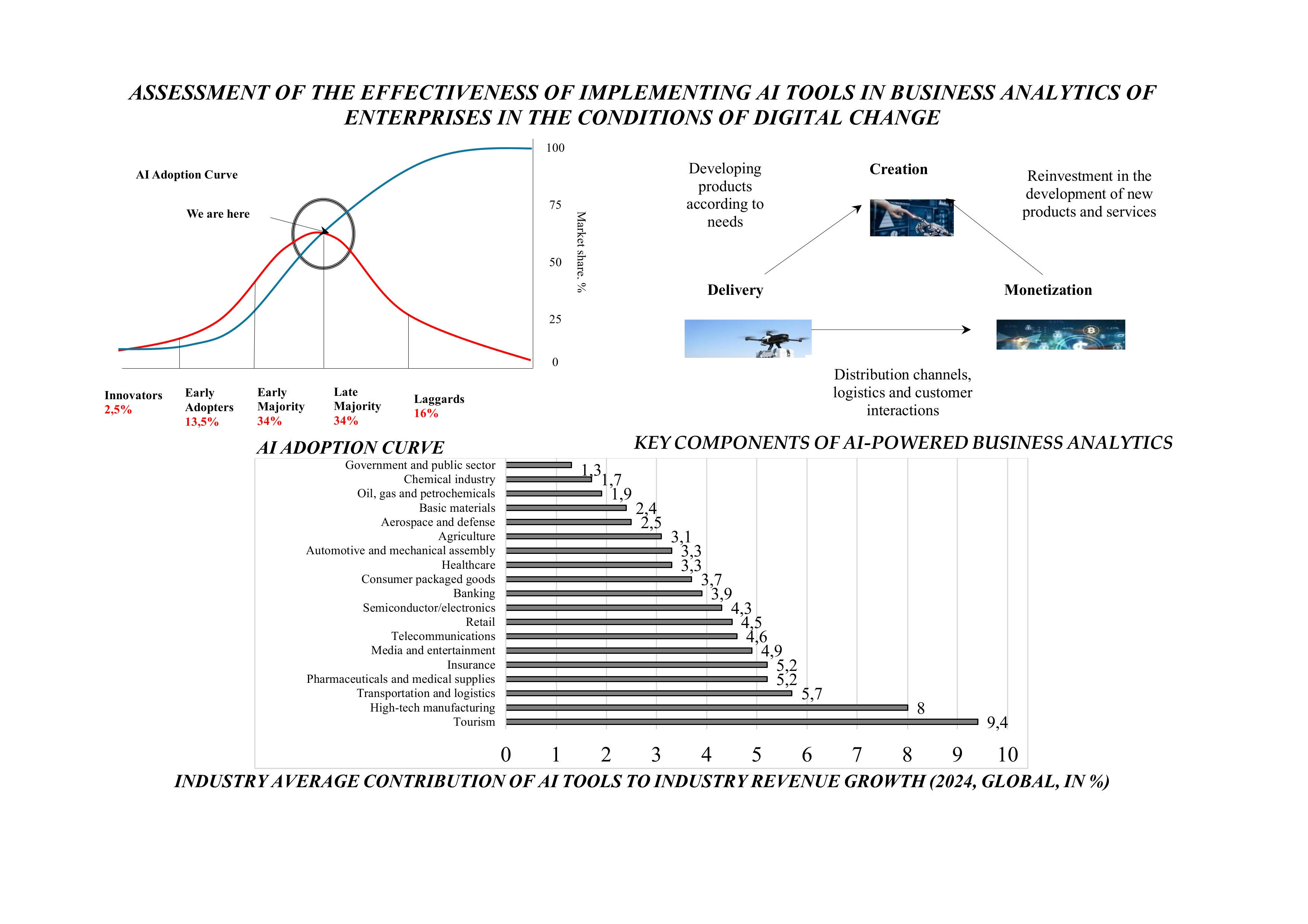
The object of research is the processes of formation, analysis, processing and analysis of information by business analysts of an enterprise in the conditions of changing digital environment. The problem being solved is the need to process a large amount of data to make high-quality management decisions and reduce economic costs. The relevance of the research is due to the trends in the development of the digital environment. The paper considers theoretical and applied aspects and stages of the development of business analytics under the influence of AI tools. The paper explores the fundamental principles of using AI tools in analytical processes of enterprises and assesses their effectiveness. The methodological apparatus is based on the use of a systems approach, methods of theoretical and economic and mathematical modulation. As a research result, it was determined that the AI implementation tools create a positive effect and reduce errors in forecasting (up to 90%) based on business analysis. Accordingly, a positive economic result was established, which proves the feasibility of improving business analytics. A significant increase in the efficiency of such business processes as logistics (by 20–30%), marketing and foreign economic activity of enterprises has been identified. Company management indicates a reduction in additional costs (up to 92%), which contributes to the choice of optimal development strategies. Key barriers to the development of AI have been identified, including the shortage of personnel and the ethics of using digital platforms. It is empirically presented that this is due to the use of only 16% of AI tools in enterprise management. For further effective implementation, a phased transformation of the management environment of enterprises is envisaged through the gradual introduction of digital tools on a permanent basis and the creation, as a result, of a common digital ecosystem of the enterprise in various areas of activity.
References
- Chui, M., Manyika, J., Miremadi, M., Henke, N., Chung, R., Nel, P., Malhotra, S. (2018). Notes from the AI frontier: applications and value of deep learning. McKinsey & Company. Available at: https://www.mckinsey.com/featured-insights/artificial-intelligence/notes-from-the-ai-frontier-applications-and-value-of-deep-learning
- Maragno, G., Tangi, L., Gastaldi, L., Benedetti, M. (2023). Exploring the factors, affordances and constraints outlining the implementation of Artificial Intelligence in public sector organizations. International Journal of Information Management, 73, 102686. https://doi.org/10.1016/j.ijinfomgt.2023.102686
- Noble, S. M., Mende, M. (2023). The future of artificial intelligence and robotics in the retail and service sector: Sketching the field of consumer-robot-experiences. Journal of the Academy of Marketing Science, 51 (4), 747–756. https://doi.org/10.1007/s11747-023-00948-0
- Zhao, X., Zhai, G., Lee, H., Apergis, N., Ma, X. (2025). Harnessing artificial intelligence for urban economic resilience. Applied Economics, 1–20. https://doi.org/10.1080/00036846.2025.2501352
- Andriushchenko, K., Buriachenko, A., Liezina, A., Lavruk, O., Korzhenivska, N., Slavina, N. (2024). The impact of labor resources on the economic security of an enterprise in the sustainable development concept. Technology Audit and Production Reserves, 6 (4 (80)), 21–31. https://doi.org/10.15587/2706-5448.2024.318702
- de Bellis, E., Venkataramani Johar, G. (2020). Autonomous Shopping Systems: Identifying and Overcoming Barriers to Consumer Adoption. Journal of Retailing, 96 (1), 74–87. https://doi.org/10.1016/j.jretai.2019.12.004
- Liezina, A., Andriushchenko, K., Domina, O., Titova, O., Petukhova, H. (2024). Regional clustering of FEC enterprises to strengthen the country’s economic security. Technology Audit and Production Reserves, 6 (4 (80)), 51–61. https://doi.org/10.15587/2706-5448.2024.320341
- Misra, K., Schwartz, E. M., Abernethy, J. (2019). Dynamic Online Pricing with Incomplete Information Using Multiarmed Bandit Experiments. Marketing Science, 38 (2), 226–252. https://doi.org/10.1287/mksc.2018.1129
- Pokataiev, P., Teteruk, K., Andriushchenko, A. (2023). A biotechnological business incubator as an instrument of innovation entrepreneurship. Recent Trends in Business and Entrepreneurial Ventures. Nova, 37–60.
- Sundaram, A., Wesselbaum, D. (2024). Economic development reloaded: the AI revolution in developing nations. New Zealand Economic Papers, 59 (1), 11–17. https://doi.org/10.1080/00779954.2024.2439955
- Andriushchenko, K., Liezina, A., Slavkova, A., Logvinov, P., Lavruk, V., Petrukha, S., Storozhenko, A. (2024). The Impact of Energy-Efficient Technologies on the Development of the Agricultural Industry. Journal of Environmental & Earth Sciences, 7 (1). https://doi.org/10.30564/jees.v7i1.7635
- A Year of Solving Together (2024). Global Annual Review. Available at: https://www.pwc.com/gx/en/global-annual-review/2024/pwc-global-annual-review-2024.pdf
- Andriushchenko, A., Liezina, A., Kolybo, D., Gurina, G., Havrysh, K., Mazur, N. et al. (2026). Determining the investment attractiveness of the biohacking and bioinnovation market based on market trends in the pharmaceutical business. Technology Audit and Production Reserves, 1 (4 (87)), 21–33. https://doi.org/10.15587/2706-5448.2026.352711
- Fotheringham, D., Wiles, M. A. (2022). The effect of implementing chatbot customer service on stock returns: an event study analysis. Journal of the Academy of Marketing Science, 51 (4), 802–822. https://doi.org/10.1007/s11747-022-00841-2
- Buriachenko, A., Zakhozhay, K., Liezina, A., Lysak, V. (2022). Sustainability and security of public budget of the Visegrad Group countries. Acta Innovations, 42, 71–88. https://doi.org/10.32933/actainnovations.42.6
- Liezina, A., Lavruk, A., Matviienko, H., Ivanets, I., Tseluiko, O., Kuchai, O. (2023). Impact of econometric modeling and perspectives of economic security of the cross-industry complex. Acta Innovations, 47, 73–83. https://doi.org/10.32933/actainnovations.47.7
- Riachy, C., He, M., Joneidy, S., Qin, S., Payne, T., Boulton, G. et al. (2025). Enhancing deep learning for demand forecasting to address large data gaps. Expert Systems with Applications, 268, 126200. https://doi.org/10.1016/j.eswa.2024.126200
- Koval, A. Iu., Riepina, I. M., Shvydanenko, H. O. (2021). Goodwill Evaluation at the Machine Building Plants. The Importance of New Technologies and Entrepreneurship in Business Development: In The Context of Economic Diversity in Developing Countries, 1393–1409. https://doi.org/10.1007/978-3-030-69221-6_104
- Zierau, N., Hildebrand, C., Bergner, A., Busquet, F., Schmitt, A., Marco Leimeister, J. (2022). Voice bots on the frontline: Voice-based interfaces enhance flow-like consumer experiences & boost service outcomes. Journal of the Academy of Marketing Science, 51 (4), 823–842. https://doi.org/10.1007/s11747-022-00868-5
- Yu, H., Hou, Y., Liu, Y., Li, Y. (2025). How generative AIs support selection and evaluation in complex decision tasks: insights from academic paper review. Journal of Management Analytics, 12 (3), 435–449. https://doi.org/10.1080/23270012.2025.2537410
- Andriushchenko, K., Kovtun, V., Cherniaieva, O., Datsii, N., Aleinikova, O., Mykolaiets, A. (2020). Transformation of the Educational Ecosystem in the Singularity Environment. International Journal of Learning, Teaching and Educational Research, 19 (9), 77–98. https://doi.org/10.26803/ijlter.19.9.5
- Aung, T. S., Fischer, T. B. (2025). Impact assessment in the age of artificial intelligence: reflections from IAIA25. Impact Assessment and Project Appraisal, 43 (3), 166–170. https://doi.org/10.1080/14615517.2025.2505265
- Bakker, A. B., Demerouti, E. (2017). Job demands-resources theory: Taking stock and looking forward. Journal of Occupational Health Psychology, 22 (3), 273–285. https://doi.org/10.1037/ocp0000056
- Tech & AI Insights. McKinsey. Available at: https://www.mckinsey.com/capabilities/mckinsey-digital/our-insights
- Shalko, M., Domina, O., Korobko, I., Melnyk, D., Andriushchenko, A. (2024). The transformative impact of large language models in healthcare. Technology Audit and Production Reserves, 6 (4 (80)), 32–42. https://doi.org/10.15587/2706-5448.2024.319006
- Bazaluk, O., Kader, S. A., Zayed, N. M., Chowdhury, R., Islam, Md. Z., Nitsenko, V. S., Bratus, H. (2024). Determinant on Economic Growth in Developing Country: A Special Case Regarding Turkey and Bangladesh. Journal of the Knowledge Economy, 16 (1), 135–159. https://doi.org/10.1007/s13132-024-01989-8
- Danyliuk, V., Riepina, I., Shafalyuk, A., Valinkevych, N., Reznik, N. (2022). Methodical approaches to measurement of the technical level of a production enterprise. International conference on sustainable innovation in mechanical engineering, 2413, 040017. https://doi.org/10.1063/5.0080013
- Ying, S., Li, Z., Yu, M. (2025). Beyond words: evaluating large language models in transportation planning. Geo-Spatial Information Science, 29 (1), 451–473. https://doi.org/10.1080/10095020.2025.2493073
- Schneier, B. (2025). AI and Trust. Communications of the ACM, 68 (8), 29–33. https://doi.org/10.1145/3737610
- Andriushchenko, K., Liezina, A., Vasylchak, S., Manylich, M., Shterma, T., Petrynyak, U. (2022). Management of the Development of the Innovative Potential of the Region. TEM Journal, 11 (1), 339–347. https://doi.org/10.18421/tem111-43
- Bughin, J. (2025). Incumbent strategic renewal drivers to AI disruption. Technology Analysis & Strategic Management, 1–12. https://doi.org/10.1080/09537325.2025.2509233
- DeMasi, O., Kording, K., Recht, B. (2017). Meaningless comparisons lead to false optimism in medical machine learning. PLOS ONE, 12 (9), e0184604. https://doi.org/10.1371/journal.pone.0184604
- Grandinetti, R. (2020). How artificial intelligence can change the core of marketing theory. Innovative Marketing, 16 (2), 91–103. https://doi.org/10.21511/im.16(2).2020.08
- Grewal, D., Noble, S. M., Roggeveen, A. L., Nordfalt, J. (2019). The future of in-store technology. Journal of the Academy of Marketing Science, 48 (1), 96–113. https://doi.org/10.1007/s11747-019-00697-z
- Holthöwer, J., van Doorn, J. (2022). Robots do not judge: service robots can alleviate embarrassment in service encounters. Journal of the Academy of Marketing Science, 51 (4), 767–784. https://doi.org/10.1007/s11747-022-00862-x
- Cooper, R. G., Brem, A. M. (2024). Insights for Managers About AI Adoption in New Product Development. Research-Technology Management, 67 (6), 39–46. https://doi.org/10.1080/08956308.2024.2418734
- Demsar, V., Ferraro, C., Sands, S., Kohn, A. (2025). Harmony or Discord? The Intersection of Generative AI and Human Creativity in Advertising. Journal of Advertising Research, 65 (2), 150–166. https://doi.org/10.1080/00218499.2025.2464305
- Stender, S., Bulkot, O., Iastremska, O., Saienko, V., Pereguda, Y. (2024). Digital transformation of the national economy of Ukraine: challenges and opportunities. Financial and Credit Activity Problems of Theory and Practice, 2 (55), 333–345. https://doi.org/10.55643/fcaptp.2.55.2024.4328
- Kmiecik, M., Skórnóg, D. (2025). Impact of generative AI on logistics companies’ business models. International Journal of Logistics Research and Applications, 1–25. https://doi.org/10.1080/13675567.2025.2497537
- Riepina, I., Ligonenko, L., Sadovnyk, O., Dzyubenko, L., Kovtun, V. (2022). Identification of factors related to transport entrepreneurship influencing the economic development of Ukraine. Transport Problems, 17 (4), 151–163. https://doi.org/10.20858/tp.2022.17.4.13
- Andriushchenko, K., Khaletska, A., Ushenko, N., Zholnerchyk, H., Ivanets, I., Petrychuk, S., Uliganets, S. (2021). Education process digitalization and its impact on human capital of an enterprise. Journal of Management Information and Decision Sciences, 24 (5).
- Bonetti, F., Montecchi, M., Plangger, K., Schau, H. J. (2022). Practice co-evolution: Collaboratively embedding artificial intelligence in retail practices. Journal of the Academy of Marketing Science, 51 (4), 867–888. https://doi.org/10.1007/s11747-022-00896-1
- Mohamed, N. (2025). Cutting-edge advances in AI and ML for cybersecurity: a comprehensive review of emerging trends and future directions. Cogent Business & Management, 12 (1). https://doi.org/10.1080/23311975.2025.2518496
- Choi, D., Cho, I. (2025). Analysis of informatization-related factors for digital transformation in manufacturing small and medium-sized enterprises using machine learning techniques. International Journal of Production Research, 63 (18), 6669–6689. https://doi.org/10.1080/00207543.2025.2481182
- Zhao, J., Gómez Fariñas, B. (2022). Artificial Intelligence and Sustainable Decisions. European Business Organization Law Review, 24 (1), 1–39. https://doi.org/10.1007/s40804-022-00262-2
- Davenport, T., Guha, A., Grewal, D., Bressgott, T. (2019). How artificial intelligence will change the future of marketing. Journal of the Academy of Marketing Science, 48 (1), 24–42. https://doi.org/10.1007/s11747-019-00696-0
- Andriushchenko, K., Liezina, A., Lavruk, V., Sliusareva, L., Rudevska, V. (2022). Intelligent enterprise capital control based on Markov chain. Acta Innovations, 45, 18–30. https://doi.org/10.32933/actainnovations.45.2
- Ligonenko, L., Riepina, I., Nykyforuk, O., Berezhnytska, U., Mysyliuk, V., Ovsienko, A. (2023). Prospects for the Development of Enterpeneurship: the Role of Universities. Science and Innovation, 19 (3), 15–37. https://doi.org/10.15407/scine19.03.015
- Kovtun, V., Andriushchenko, K., Horbova, N., Lavruk, O., Yelyzaveta Muzychka, Y. (2020). Features of the Management Process of Ambidextrous Companies. TEM Journal, 9 (1), 221–226. https://doi.org/10.18421/tem91-31
- Mende, M., Scott, M. L., Ubal, V. O., Hassler, C. M. K., Harmeling, C. M., Palmatier, R. W. (2023). Personalized Communication as a Platform for Service Inclusion? Initial Insights Into Interpersonal and AI-Based Personalization for Stigmatized Consumers. Journal of Service Research, 27 (1), 28–48. https://doi.org/10.1177/10946705231188676
- Arsawan, I. W. E., Suhartanto, D., Koval, V., Tralo, I., Demenko, V., Azizah, A. (2024). Enhancing the circular economy business model towards sustainable business performance: Moderating the role of environmental dynamism. Journal of Infrastructure Policy and Development, 8 (5), 3321. https://doi.org/10.24294/jipd.v8i5.3321
- Pokataiev, P., Liezina, A., Petukhova, H., Andriushchenko, A. (2022). The role of biotechnology in the development of the bioeconomy. Acta Innovations, 46, 19–34. https://doi.org/10.32933/actainnovations.46.2
- Ligonenko, L., Riepina, I., Shevchuk, N., Tepliuk, M., Domina, O. (2024). Innovation and infrastructure: driving forces for entrepreneurship development and economic opportunities. Naukovyi Visnyk Natsionalnoho Hirnychoho Universytetu, 5, 163–169. https://doi.org/10.33271/nvngu/2024-5/163
- Silcox, C., Zimlichmann, E., Huber, K., Rowen, N., Saunders, R., McClellan, M. et al. (2024). The potential for artificial intelligence to transform healthcare: perspectives from international health leaders. Npj Digital Medicine, 7 (1). https://doi.org/10.1038/s41746-024-01097-6
- Andriushchenko, K., Riepina, I., Buriachenko, A., Kyryliuk, O. (2025). Determining the capabilities of artificial intelligence on the development of cryptotrading and blockchain technology. Technology Audit and Production Reserves, 3 (4 (83)), 42–52. https://doi.org/10.15587/2706-5448.2025.330463
- Haleem, A., Javaid, M., Asim Qadri, M., Pratap Singh, R., Suman, R. (2022). Artificial intelligence (AI) applications for marketing: A literature-based study. International Journal of Intelligent Networks, 3, 119–132. https://doi.org/10.1016/j.ijin.2022.08.005
- Financial statements. PrivatBank. Available at: https://privatbank.ua/about/finansovaja-otchetnost
- Zvit nezalezhnoho audytora. Nova Poshta. Available at: https://static.novaposhta.ua/sitecard/misc/doc/Фінансова%20звітність%202023.pdf
- Kernel zavershyv finansovyi rik zbilshenniam valovoho y operatsiinoho prybutku na 38% i 25% vidpovidno. Kernel. Available at: https://career.kernel.ua/novyny/kernel-zavershyv-finansovyj-rik-zbilshennyam-valovogo-j-operatsijnogo-prybutku-na-38-i-25-vidpovidno/
- Finansova zvitnist za 2006 – 2025 roky. Kyivstar. Available at: https://kyivstar.ua/about/investors-and-shareholders/issuers
Downloads
Published
How to Cite
Issue
Section
License
Copyright (c) 2026 Inna Riepina, Maksym Budiaiev, Oleksandr Nychyporuk, Nataliia Yakusheva, Anhelina Andriushchenko, Andrii Blyznyuk, Yuliia Mazur

This work is licensed under a Creative Commons Attribution 4.0 International License.
The consolidation and conditions for the transfer of copyright (identification of authorship) is carried out in the License Agreement. In particular, the authors reserve the right to the authorship of their manuscript and transfer the first publication of this work to the journal under the terms of the Creative Commons CC BY license. At the same time, they have the right to conclude on their own additional agreements concerning the non-exclusive distribution of the work in the form in which it was published by this journal, but provided that the link to the first publication of the article in this journal is preserved.





