Improvement of the method for assessing load reactivity based on energy flows within a single voltage period
DOI:
https://doi.org/10.15587/2706-5448.2026.356688Keywords:
reactive power, power factor, harmonic, energy flows, electrical network, power systemAbstract
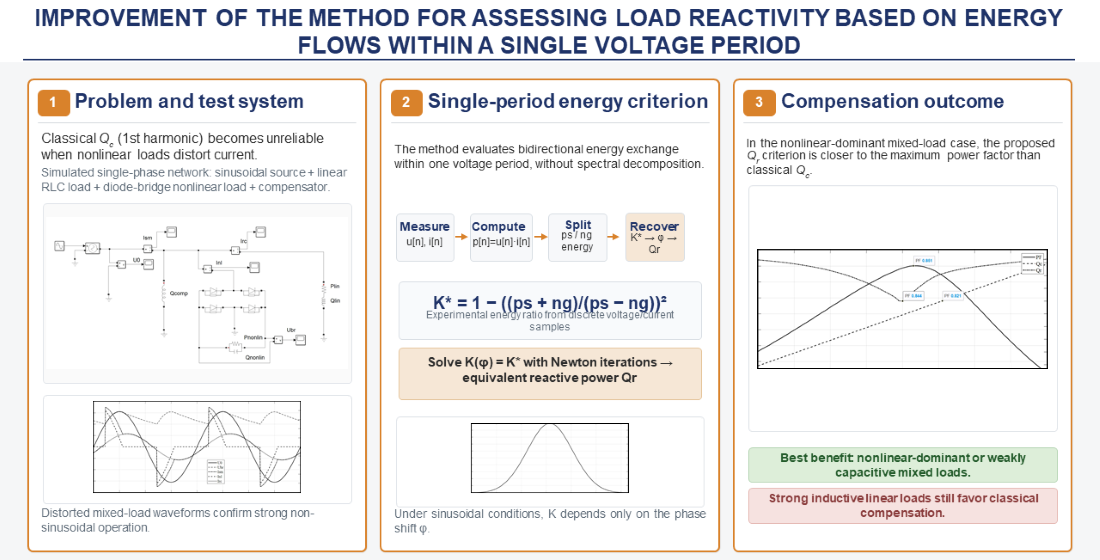
The object of this research is the process of assessing reactance and compensating for reactive power in single-phase electrical networks containing both linear and nonlinear loads.
The problem addressed is the limited applicability of classical reactive power definitions based on the fundamental harmonic when current waveforms are distorted by nonlinear loads, which complicates correct reactive power assessment and compensation control.
An energy-based approach for estimating load reactance is proposed. The method introduces a dimensionless reactance coefficient determined from the ratio between the energy value over one voltage period and the total area of instantaneous energy flow components associated with the bidirectional energy exchange between the source and the load. For sinusoidal conditions, an analytical relationship between this coefficient and the phase shift angle between voltage and current is obtained. This relationship allows reconstruction of the phase shift angle from discrete voltage and current measurements using Newton’s iterative method.
To validate the method, a simulation model of a single-phase electrical network with linear and nonlinear loads was developed in the Simulink environment. Simulations were performed for linear, nonlinear, and mixed operating modes with different ratios of active and reactive power.
The results show that when the nonlinear load dominates or when the capacitive reactive component of the linear load is small, compensation based on the proposed criterion provides higher power factor values than the classical reactive power approach. For loads with a significant inductive component the classical method remains more effective. The proposed improved method can be applied in power quality monitoring systems and adaptive reactive power compensation devices for networks with nonlinear loads.
References
- IEEE Standard Definitions for the Measurement of Electric Power Quantities Under Sinusoidal, Nonsinusoidal, Balanced, or Unbalanced Conditions (2010). IEEE. https://doi.org/10.1109/ieeestd.2010.5439063
- Emanuel, A. E. (2004). Summary of IEEE Standard 1459: Definitions for the Measurement of Electric Power Quantities Under Sinusoidal, Nonsinusoidal, Balanced, or Unbalanced Conditions. IEEE Transactions on Industry Applications, 40 (3), 869–876. https://doi.org/10.1109/tia.2004.827452
- Czarnecki, L. S. (2005). Physical Fundamentals of the Power Theory of Electrical Systems. Poznan University of Technology. Available at: https://czarnecki.study/wp-content/uploads/2019/08/J153-Physical-Fund-of-the-Power-Theory.pdf
- Montoya, F. G. (2019). Geometric Algebra in Nonsinusoidal Power Systems: A Case of Study for Passive Compensation. Symmetry, 11 (10), 1287. https://doi.org/10.3390/sym11101287
- Bucci, G., Ciancetta, F., Fiorucci, E., Ometto, A. (2017). Survey about Classical and Innovative Definitions of the Power Quantities Under Nonsinusoidal Conditions. International Journal of Emerging Electric Power Systems, 18 (3). https://doi.org/10.1515/ijeeps-2017-0002
- Czarnecki, L. S. (2005). Currents’ Physical Components (CPC) in Circuits with Nonsinusoidal Voltages and Currents. Electrical Power Quality and Utilisation Journal, 11 (2), 3–14. Available at: https://bibliotekanauki.pl/articles/262747.pdf
- Czarnecki, L. S. (2007). Physical interpretation of the reactive power in terms of the CPC power theory. Electrical Power Quality and Utilisation Journal, 13 (1), 87–93. Available at: https://czarnecki.study/wp-content/uploads/2019/08/103-Physical-Interpretation-1.pdf
- Mikulović, J. Č., Šekara, T. B. (2015). A new reactive power definition based on the minimization of the load non-reactive currents. 2015 International School on Nonsinusoidal Currents and Compensation (ISNCC). Lagow: IEEE, 1–6. https://doi.org/10.1109/isncc.2015.7174683
- Garzón, C., Blanco, A. M., Pavas, A., Meyer, J. (2024). Potential Use of Fryze’s Approach-Based Power Theories in Waveform Distortion Contribution Assessment. Revista UIS Ingenierías, 23 (1). https://doi.org/10.18273/revuin.v23n1-2024003
- Sinvula, R., Abo-Al-Ez, K. M., Kahn, M. T. (2019). Harmonic Source Detection Methods: A Systematic Literature Review. IEEE Access, 7, 74283–74299. https://doi.org/10.1109/access.2019.2921149
- Filianik, D. V., Voloshko, A. V. (2020). Analiz metodiv vyznachennia dzherel harmonichnykh spotvoren v elektrychnii merezhi. Enerhetyka: ekonomika, tekhnolohii, ekolohiia, 1, 29–38. Available at: https://energy.kpi.ua/article/download/217561/217460/492402
- Martinez, R., Castro, P., Arroyo, A., Manana, M., Galan, N., Moreno, F. S. et al. (2022). Techniques to Locate the Origin of Power Quality Disturbances in a Power System: A Review. Sustainability, 14 (12), 7428. https://doi.org/10.3390/su14127428
- Zhang, C., Li, Y., Han, W., Song, G., Zhang, H. (2024). Time‐domain harmonic source location and evaluation methods based on non‐linear and time‐varying properties of devices. IET Generation, Transmission & Distribution, 18 (16), 2604–2624. https://doi.org/10.1049/gtd2.13219
- Kirihara, K., Yamazaki, J., Chongfuangprinya, P., Konstantinopoulos, S., Lackner, C., Chow, J. H. et al. (2019). Speeding Up the Dissipating Energy Flow Based Oscillation Source Detection. 2019 International Conference on Smart Grid Synchronized Measurements and Analytics (SGSMA). College Station: IEEE, 1–8. https://doi.org/10.1109/sgsma.2019.8784528
- Liu, R., Zhang, Y., Gao, S., Li, D., Liu, C., Che, J. et al. (2025). Localization of Forced Oscillation Sources in Power Systems with Grid-Forming Wind Turbines Based on ICEEMDAN-ITEO. Energies, 18 (22), 6025. https://doi.org/10.3390/en18226025
- Reactive Power Measurement and Math Channel (2024). Pico Technology. Available at: https://www.picotech.com/library/knowledge-bases/oscilloscopes/reactive-power-measurement-and-math-channel
- Shukla, S., Mishra, S., Singh, B., Kumar, S. (2017). Implementation of Empirical Mode Decomposition Based Algorithm for Shunt Active Filter. IEEE Transactions on Industry Applications, 53 (3), 2392–2400. https://doi.org/10.1109/tia.2017.2677364
- Lu, C. L., Huang, P. H. (2013). Power System Stability Study with Empirical Mode Decomposition. Advanced Materials Research, 732–733, 905–908. https://doi.org/10.4028/www.scientific.net/amr.732-733.905
- Akagi, H., Watanabe, E. H., Aredes, M. (2017). Instantaneous Power Theory and Applications to Power Conditioning. John Wiley & Sons, 480. https://doi.org/10.1002/9781119307181
- Nikolov, Z., Hlebarov, Z., Korsemov, C., Toshev, H. (2008). Distribution of Active and Reactive Energy in a Power Line. Cybernetics and Information Technologies, 8 (2), 12–25. Available at: https://cit.iict.bas.bg/CIT_08/v8-2/12-25.pdf
- Spasojevic, B. (2007). The Time Domain Method for Power Line Reactive Energy Measurement. IEEE Transactions on Instrumentation and Measurement, 56 (5), 2033–2042. https://doi.org/10.1109/tim.2007.895622
Downloads
Published
How to Cite
Issue
Section
License
Copyright (c) 2026 Dmytro Gapon, Roman Demianenko, Andriy Solodovnyk, Oleksandr Svetelik

This work is licensed under a Creative Commons Attribution 4.0 International License.
The consolidation and conditions for the transfer of copyright (identification of authorship) is carried out in the License Agreement. In particular, the authors reserve the right to the authorship of their manuscript and transfer the first publication of this work to the journal under the terms of the Creative Commons CC BY license. At the same time, they have the right to conclude on their own additional agreements concerning the non-exclusive distribution of the work in the form in which it was published by this journal, but provided that the link to the first publication of the article in this journal is preserved.