Substitution of the method for assessing generalized dynamic instability of parameters of the gas environment of premises for early fire warning
DOI:
https://doi.org/10.15587/2706-5448.2026.357223Keywords:
generalized dynamic instability, local Kantz function, ignition of materials, gas environment, fire warningAbstract
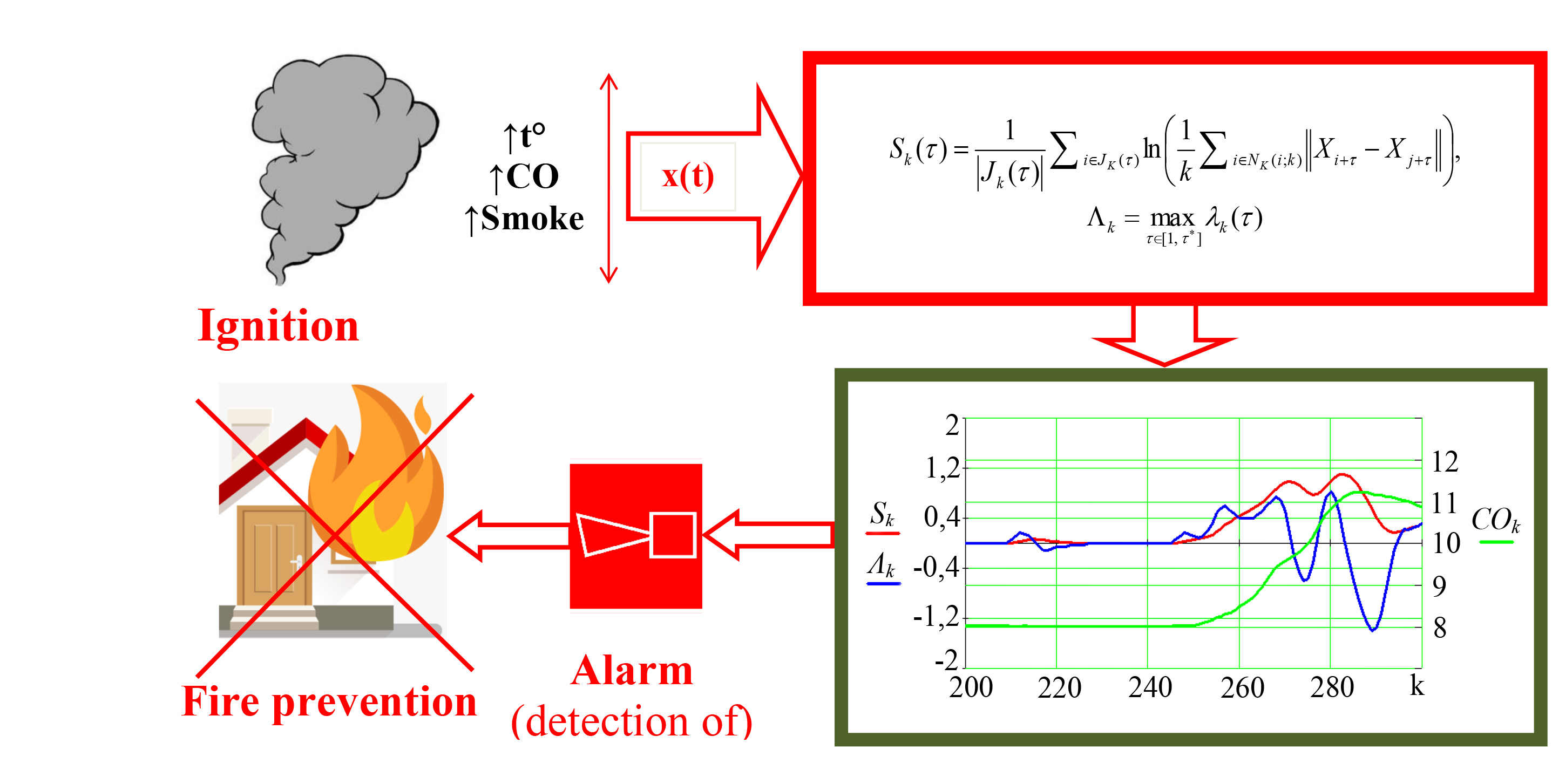
The object of research is the dynamics of the gas environment at the early stages of material combustion in premises. The problem to be solved is to develop a method of generalized dynamic instability of the gas environment, based on the local Kant function and its time derivative, to detect early unstable regimes of the gas environment preceding the development of a fire. A method for assessing the generalized dynamic instability of the gas environment of premises is proposed, focused on the parameters of early fire warning. Generalized dynamic instability is understood as a cumulative characteristic that expresses the level of local sensitivity of the dynamics of time series of gas environment parameters to excitation, as well as the rate of change of this sensitivity in time. The local in time variant of the Kantz method and its time derivative are used as the basis. The method is tested on experimental data of the current concentration of carbon monoxide, which are obtained under the conditions of modeling the ignition of materials. It is shown that the local Kantz function and its derivative demonstrate pronounced changes in the transient regimes of the gas environment in the absence of significant excesses of the permissible thresholds of the dangerous measured parameter. The results obtained allow to consider the proposed measure of generalized dynamic instability as an additional diagnostic feature in early fire warning systems. The dynamics of the proposed measure for the initial stages of ignition of alcohol, paper and textiles are studied. The relationship between the dynamic content of carbon monoxide and the change in the generalized measure is analyzed. The results obtained indicate the efficiency of the method and show that, despite the differences in the kinetics of gas release and the nature of combustion, the dynamic response of the generalized measure of dynamic instability is universal.
References
- Otrosh, Y., Rybka, Y., Danilin, O., Zhuravskyi, M. (2019). Assessment of the technical state and the possibility of its control for the further safe operation of building structures of mining facilities. E3S Web of Conferences, 123, 01012. https://doi.org/10.1051/e3sconf/201912301012
- Semko, A., Beskrovnaya, M., Vinogradov, S., Hritsina, I., Yagudina, N. (2014). The usage of high speed impulse liquid jets for putting out gas blowouts. Journal of Theoretical and Applied Mechanics, 52 (3), 655–664. Available at: http://iwww.ptmts.org.pl/jtam/index.php/jtam/article/view/v52n3p655
- Vasyukov, A., Loboichenko, V., Bushtec, S. (2016). Identification of bottled natural waters by using direct conductometry. Ecology, Environment and Conservation, 22 (3), 1171–1176. Available at: http://repositsc.nuczu.edu.ua/handle/123456789/1633
- Andronov, V., Pospelov, B., Rybka, E., Skliarov, S. (2017). Examining the learning fire detectors under real conditions of application. Eastern-European Journal of Enterprise Technologies, 3 (9 (87)), 53–59. https://doi.org/10.15587/1729-4061.2017.101985
- Quintiere, J. G. (2016). Principles of Fire Behavior. CRC Press, 437. https://doi.org/10.1201/9781315369655
- Cencini, M., Cecconi, F., Vulpiani, A. (2009). Chaos. World Scientific, 480. https://doi.org/10.1142/7351
- Dieci, L., Van Vleck, E. S. (2002). Lyapunov Spectral Intervals: Theory and Computation. SIAM Journal on Numerical Analysis, 40 (2), 516–542. https://doi.org/10.1137/s0036142901392304
- Cheng, C., Sun, F., Zhou, X. (2011). One fire detection method using neural networks. Tsinghua Science and Technology, 16 (1), 31–35. https://doi.org/10.1016/s1007-0214(11)70005-0
- Ding, Q., Peng, Z., Liu, T., Tong, Q. (2014). Multi-Sensor Building Fire Alarm System with Information Fusion Technology Based on D-S Evidence Theory. Algorithms, 7 (4), 523–537. https://doi.org/10.3390/a7040523
- Pospelov, B., Rybka, E., Samoilov, M., Morozov, I., Bezuhla, Y., Butenko, T. et al. (2022). Defining the features of amplitude and phase spectra of dangerous factors of gas medium during the ignition of materials in the premises. Eastern-European Journal of Enterprise Technologies, 2 (10 (116)), 57–65. https://doi.org/10.15587/1729-4061.2022.254500
- Jiang, Y. Z., Wang, G. Y., Lü, L. C., Yuan, S. P., Ma, L. (2004). Studies on pulp-oriented cultivation techniques of poplar wood. Scientia Silvae Sinicae, 40 (1), 123–130. Available at: https://www.cabidigitallibrary.org/doi/full/10.5555/20053037338
- Bei, P., Liwei, C., Chang, L. (2012). An Experimental Study on the Burning Behavior of Fabric used Indoor. Procedia Engineering, 43, 257–261. https://doi.org/10.1016/j.proeng.2012.08.044
- Peng, X., Liu, S., Lu, G. (2005). Experimental analysis on heat release rate of materials. Journal of Chongqing University, 28 (8), 122–125. http://dx.doi.org/10.11835/j.issn.1000-582X.2005.08.031
- Pospelov, B., Rybka, E., Savchenko, A., Dashkovska, O., Harbuz, S., Naden, E. et al. (2022). Peculiarities of amplitude spectra of the third order for the early detection of indoor fires. Eastern-European Journal of Enterprise Technologies, 5 (10 (119)), 49–56. https://doi.org/10.15587/1729-4061.2022.265781
- Pospelov, B., Andronov, V., Rybka, E., Chubko, L., Bezuhla, Y., Gordiichuk, S. et al. (2023). Revealing the peculiarities of average bicoherence of frequencies in the spectra of dangerous parameters of the gas environment during fire. Eastern-European Journal of Enterprise Technologies, 1 (10 (121)), 46–54. https://doi.org/10.15587/1729-4061.2023.272949
- Pospelov, B., Rybka, E., Polkovnychenko, D., Myskovets, I., Bezuhla, Y., Butenko, T. et al. (2023). Comparison of bicoherence on the ensemble of realizations and a selective evaluation of the bispectrum of the dynamics of dangerous parameters of the gas medium during fire. Eastern-European Journal of Enterprise Technologies, 2 (10 (122)), 14–21. https://doi.org/10.15587/1729-4061.2023.276779
- Sadkovyi, V., Pospelov, B., Rybka, E., Kreminskyi, B., Yashchenko, O., Bezuhla, Y. et al. (2022). Development of a method for assessing the reliability of fire detection in premises. Eastern-European Journal of Enterprise Technologies, 3 (10 (117)), 56–62. https://doi.org/10.15587/1729-4061.2022.259493
- Pospelov, B., Andronov, V., Rybka, E., Bezuhla, Y., Liashevska, O., Butenko, T. et al. (2022). Empirical cumulative distribution function of the characteristic sign of the gas environment during fire. Eastern-European Journal of Enterprise Technologies, 4 (10 (118)), 60–66. https://doi.org/10.15587/1729-4061.2022.263194
- Heskestad, G., Newman, J. S. (1992). Fire detection using cross-correlations of sensor signals. Fire Safety Journal, 18 (4), 355–374. https://doi.org/10.1016/0379-7112(92)90024-7
- Gottuk, D. T., Wright, M. T., Wong, J. T., Pham, H. V., Rose-Pehrson, S. L. (2002). Prototype early warning fire detection system: test series 4 results. Naval Research Laboratory. Available at: https://apps.dtic.mil/sti/pdfs/ADA399480.pdf
- Nakamura, T. (2022). Nonlinear systems and Lyapunov spectrum. Available at: https://sites.google.com/view/lyapunov-spectrum/home
- Pospelov, B., Rybka, E., Meleshchenko, R., Krainiukov, O., Biryukov, I., Butenko, T. et al. (2021). Short-term fire forecast based on air state gain recurrence and zero-order brown model. Eastern-European Journal of Enterprise Technologies, 3 (10 (111)), 27–33. https://doi.org/10.15587/1729-4061.2021.233606
- Pospelov, B., Rybka, E., Krainiukov, O., Fedyna, V., Bezuhla, Y., Melnychenko, A. et al. (2024). Method for early ignition detection based on the sampling dispersion of dangerous parameter. Eastern-European Journal of Enterprise Technologies, 1 (10 (127)), 55–63. https://doi.org/10.15587/1729-4061.2024.299001
- Prat-Guitart, N., Nugent, C., Mullen, E., Mitchell, F. J. G., Hawthorne, D., Belcher, C. M. et al. (2019). Peat Fires in Ireland. Coal and Peat Fires: A Global Perspective, 451–482. https://doi.org/10.1016/b978-0-12-849885-9.00020-2
- Fonollosa, J., Solórzano, A., Marco, S. (2018). Chemical Sensor Systems and Associated Algorithms for Fire Detection: A Review. Sensors, 18 (2), 553. https://doi.org/10.3390/s18020553
- Liu, C., Zhang, C., Mu, Y., Liu, J., Zhang, Y. (2017). Emission of volatile organic compounds from domestic coal stove with the actual alternation of flaming and smoldering combustion processes. Environmental Pollution, 221, 385–391. https://doi.org/10.1016/j.envpol.2016.11.089
- Gann, R. G., Bryner, N. P. (2008). Combustion Products and Their Effects on Life Safety. Fire protection handbook. Available at: https://tsapps.nist.gov/publication/get_pdf.cfm?pub_id=900093
- Stec, A. A. (2017). Fire toxicity – The elephant in the room? Fire Safety Journal, 91, 79–90. https://doi.org/10.1016/j.firesaf.2017.05.003
- McKenna, S. T., Birtles, R., Dickens, K., Walker, R. G., Spearpoint, M. J., Stec, A. A. et al. (2018). Flame retardants in UK furniture increase smoke toxicity more than they reduce fire growth rate. Chemosphere, 196, 429–439. https://doi.org/10.1016/j.chemosphere.2017.12.017
- Schuster, H. G., Just, W. (2005). Deterministic chaos: an introduction. John Wiley & Sons. https://doi.org/10.1002/3527604804
- Broer, H., Takens, F. (2011). Dynamical Systems and Chaos. Applied Mathematical Sciences. New York: Springer, 313. https://doi.org/10.1007/978-1-4419-6870-8
- Vogel, M. (2019). Chaos in nature. Contemporary Physics, 60 (3), 271–272. https://doi.org/10.1080/00107514.2019.1660722
- Vambol, S., Vambol, V., Kondratenko, O., Koloskov, V., Suchikova, Y. (2018). Substantiation of expedienceof application of high-temperatureutilization of used tires for liquefiedmethane production. Journal of Achievements in Materials and Manufacturing Engineering, 2 (87), 77–84. https://doi.org/10.5604/01.3001.0012.2830
- Winter, L., Taylor, P., Bellenger, C., Grimshaw, P., Crowther, R. G. (2023). The application of the Lyapunov Exponent to analyse human performance: A systematic review. Journal of Sports Sciences, 41 (22), 1994–2013. https://doi.org/10.1080/02640414.2024.2308441
- Drysdale, D. (2011). An Introduction to Fire Dynamics. John Wiley & Sons. https://doi.org/10.1002/9781119975465
- Ming Wang, Perricone, J., Chang, P. C., Quintiere, J. G. (2008). Scale Modeling of Compartment Fires for Structural Fire Testing. Journal of Fire Protection Engineering, 18 (3), 223–240. https://doi.org/10.1177/1042391508093337
- CO-B4 Carbon Monoxide Sensor. Alphasense. Available at: https://www.alphasense.com/products/view-by-target-gas/co-b4
- Hurley, M. J., Gottuk, D., Hall, J. R., Harada, K., Kuligowski, E., Puchovsky, M. et al. (Eds.) (2016). SFPE Handbook of Fire Protection Engineering. New York: Springer. https://doi.org/10.1007/978-1-4939-2565-0
- Kantz, H., Schreiber, T. (2003). Nonlinear Time Series Analysis. Cambridge University Press, 396. https://doi.org/10.1017/cbo9780511755798
- Skokos, Ch. (2009). The Lyapunov Characteristic Exponents and Their Computation. Dynamics of Small Solar System Bodies and Exoplanets, 63–135. https://doi.org/10.1007/978-3-642-04458-8_2
- Wolf, A., Swift, J. B., Swinney, H. L., Vastano, J. A. (1985). Determining Lyapunov exponents from a time series. Physica D: Nonlinear Phenomena, 16 (3), 285–317. https://doi.org/10.1016/0167-2789(85)90011-9
- Rosenstein, M. T., Collins, J. J., De Luca, C. J. (1993). A practical method for calculating largest Lyapunov exponents from small data sets. Physica D: Nonlinear Phenomena, 65 (1–2), 117–134. https://doi.org/10.1016/0167-2789(93)90009-p
- Kantz, H. (1994). A robust method to estimate the maximal Lyapunov exponent of a time series. Physics Letters A, 185 (1), 77–87. https://doi.org/10.1016/0375-9601(94)90991-1
- Heilmann, О. (2023). Multifunctional Echo State Networks: Effects of Topology and Memory on the Reconstruction of Chaotic Attractors. Available at: https://elib.dlr.de/195462/1/Heilmann_Oliver_20.03.2023_fuer_SS2023.pdf
- Busse, A. M. (2004). ClassificationofProcessesbytheLyapunovexponent. Universität Dortmund, Sonderforschungsbereich 475 – Komplexitätsreduktion in Multivariaten Datenstrukturen, 70. Available at: https://hdl.handle.net/10419/22583
- De Micco, L., Antonelli, M., Crespo, M. L., Cicuttin, A. (2017). HW/SW codesign of maximum Lyapunov exponent estimator. 2017 IEEE 8th Latin American Symposium on Circuits & Systems (LASCAS). Bariloche: IEEE, 1–4. https://doi.org/10.1109/lascas.2017.7948066
- Takens, F.; Rand, D., Young, L. S. (Eds.) (1981). Detecting strange attractors in turbulence. Dynamical Systems and Turbulence, Warwick 1980. Heidelberg: Springer, 366–381. https://doi.org/10.1007/bfb0091924
- Vannitsem, S. (2017). Predictability of large-scale atmospheric motions: Lyapunov exponents and error dynamics. Chaos: An Interdisciplinary Journal of Nonlinear Science, 27 (3). https://doi.org/10.1063/1.4979042
- Wu, H., Shi, S. (2021). Real-time anomaly detection in gas sensor streaming data. International Journal of Embedded Systems, 14 (1), 81–88. https://doi.org/10.1504/ijes.2021.111985
- Pospelov, B., Rybka, E., Otrosh, Y., Maladyka, L., Krainiukov, O., Kurtseitov, T. et al. (2025). Development of a method for rapid detection of fires based on combined current sampling and dispersions of a controlled hazardous environmental parameter. Technology Audit and Production Reserves, 2 (3 (82)), 31–35. https://doi.org/10.15587/2706-5448.2025.326336
- Tolok, I., Pospelov, B., Rybka, E., Savchenko, S., Kozar, Y., Krainiukov, O. et al. (2025). Determination of the largest Lyapunov exponent of chaos in the dynamics of hazardous parameters of a gas environment for the rapid ignition detection. Technology Audit and Production Reserves, 6 (3 (86)), 21–26. https://doi.org/10.15587/2706-5448.2025.345030
Downloads
Published
How to Cite
Issue
Section
License
Copyright (c) 2026 Boris Pospelov, Igor Tolok, Evgenіy Rybka, Ihor Morozov, Yurii Kozar, Olekcii Krainiukov, Volodymyr Volovyk, Olga Levada, Maksym Harifullin, Natalia Bed

This work is licensed under a Creative Commons Attribution 4.0 International License.
The consolidation and conditions for the transfer of copyright (identification of authorship) is carried out in the License Agreement. In particular, the authors reserve the right to the authorship of their manuscript and transfer the first publication of this work to the journal under the terms of the Creative Commons CC BY license. At the same time, they have the right to conclude on their own additional agreements concerning the non-exclusive distribution of the work in the form in which it was published by this journal, but provided that the link to the first publication of the article in this journal is preserved.