Developing a task allocation model for remote health monitoring in smart cities, considering latency, energy consumption, and privacy on fog nodes
DOI:
https://doi.org/10.15587/2706-5448.2026.358187Keywords:
smart city, fog computing, remote health monitoring, energy efficiency, confidentiality, data distributionAbstract
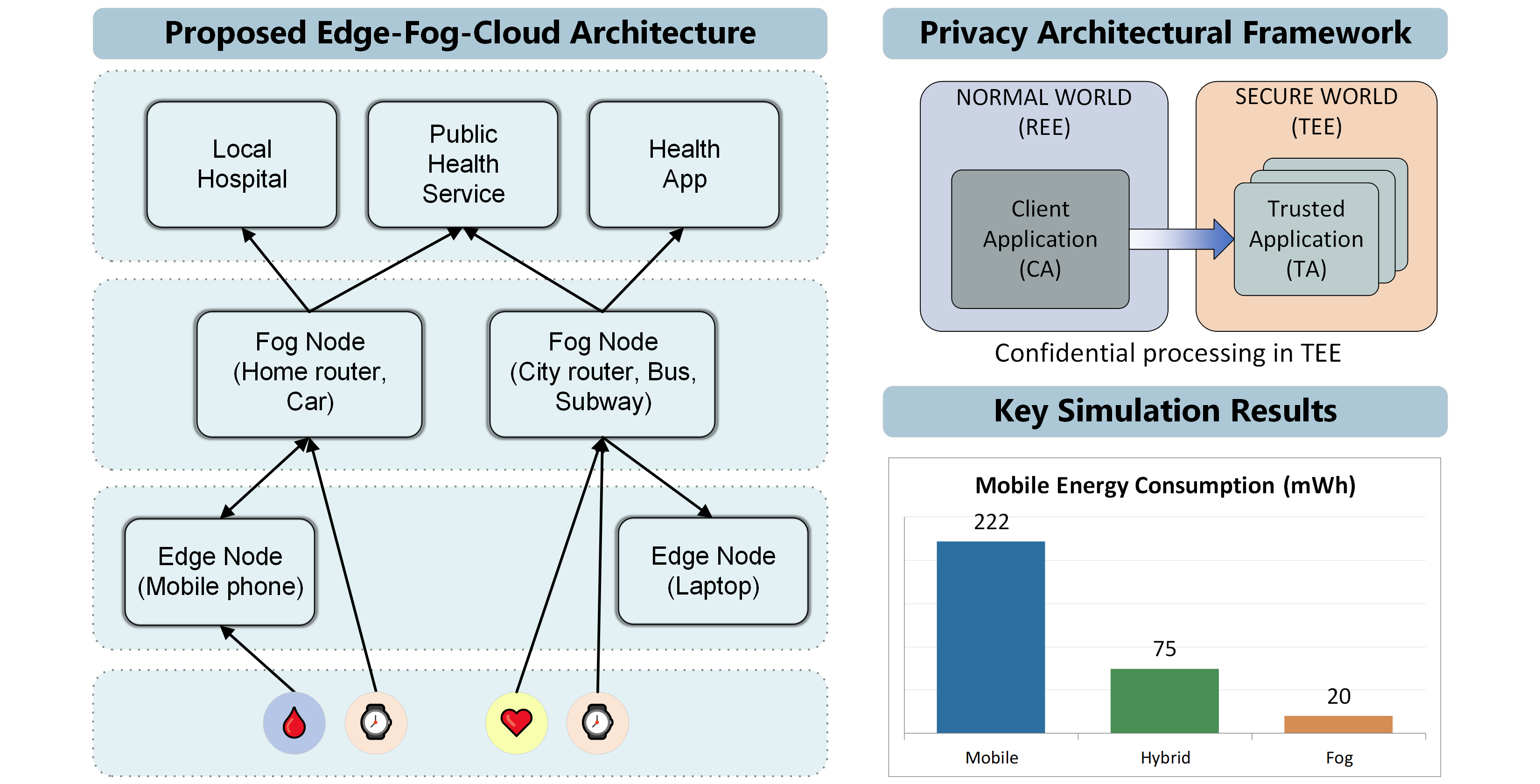
The object of the research is the processes of dynamic distribution of computing tasks in multi-level infrastructures of a smart city. The possibilities of integrating edge, fog, and cloud computing resources for the development of remote patient monitoring systems (Remote Patient Monitoring, RPM) were investigated. The study addresses the challenge of balancing the rapid processing of critical medical signals with the limited energy resources of mobile devices. In addition, the need to ensure the confidentiality of personal data when transferring tasks to third-party fog nodes was addressed through encryption, remote attestation mechanisms, and isolated execution environments.
A comprehensive system model was developed to describe the processes of performing RPM tasks (ECG classification, audio analysis). An offloading strategy was developed, based on a weighted linear to minimize energy consumption and delay. An architectural framework is proposed to ensure the confidentiality of data processing on uncontrolled fog nodes, through the use of Trusted Execution Environment (TEE) technologies and the deployment of Trusted Applications (TA). To validate the solutions, a series of simulations was conducted in the YAFS (Yet Another Fog Simulator) environment to compare Mobile, Hybrid, and Fog scenarios.
It was experimentally established that transitioning to a Fog-oriented strategy results in a radical reduction in the average system latency (from 0.57 s to 0.027–0.030 s). The load on the smartphone is reduced by more than 10 times (from 222–225 mWh to 20.3–20.4 mWh), and the autonomy of wearable sensors increases almost fivefold. It is proven that the use of fog computing provides stable Quality of Service (QoS) on equipment with lower power (500 MIPS). The integration of attestation procedures according to RATS (Remote ATtestation procedureS) standard is intended to enable verification of the integrity of the computing stack before the transfer of confidential data.
References
- Farias, F. A. C., Dagostini, C. M., Bicca, Y. A., Falavigna, V. F., Falavigna, A. (2020). Remote Patient Monitoring: A Systematic Review. Telemedicine and E-Health, 26 (5), 576–583. https://doi.org/10.1089/tmj.2019.0066
- Malasinghe, L. P., Ramzan, N., Dahal, K. (2017). Remote patient monitoring: a comprehensive study. Journal of Ambient Intelligence and Humanized Computing, 10 (1), 57–76. https://doi.org/10.1007/s12652-017-0598-x
- Dadkhah, M., Mehraeen, M., Rahimnia, F., Kimiafar, K. (2021). Use of Internet of Things for Chronic Disease Management. Journal of Medical Signals & Sensors, 11 (2), 138–157. https://doi.org/10.4103/jmss.jmss_13_20
- HealthTrack SG (2026). Health Promotion Board. Available at: https://www.hpb.gov.sg/healthy-living/healthtracksg
- Nanehkaran, Y. A., Licai, Z., Chen, J., Zhongpan, Q., Xiaofeng, Y., Navaei, Y. D. et al. (2022). Diagnosis of Chronic Diseases Based on Patients’ Health Records in IoT Healthcare Using the Recommender System. Wireless Communications and Mobile Computing, 2022 (1). https://doi.org/10.1155/2022/5663001
- Rodrigues, V. F., da Rosa Righi, R., da Costa, C. A., Zeiser, F. A., Eskofier, B., Maier, A. et al. (2023). Digital health in smart cities: Rethinking the remote health monitoring architecture on combining edge, fog, and cloud. Health and Technology, 13 (3), 449–472. https://doi.org/10.1007/s12553-023-00753-3
- Pro zatverdzhennia normatyvnykh dokumentiv shchodo zastosuvannia telemedytsyny u sferi okhorony zdorovia (2015). Nakaz MOZ Ukrainy No. 681. 19.10.2015. Available at: https://zakon.rada.gov.ua/go/z1400-15 Last accessed: 03.02.2026
- Byshenko, H., Avtomieienko, Y. (2024). Analysis of the government policy of the reform of electronic health care and medicine of Ukraine. State Formation, 1 (35), 290–304. https://doi.org/10.26565/1992-2337-2024-1-22
- OpenFog Reference Architecture for Fog Computing (2017). OpenFog Consortium, 162. Available at: https://www.iiconsortium.org/pdf/OpenFog_Reference_Architecture_2_09_17.pdf
- Muneeb, M., Ko, K.-M., Park, Y.-H. (2021). A Fog Computing Architecture with Multi-Layer for Computing-Intensive IoT Applications. Applied Sciences, 11 (24), 11585. https://doi.org/10.3390/app112411585
- Hossam, H. S., Abdel-Galil, H., Belal, M. (2024). An energy-aware module placement strategy in fog-based healthcare monitoring systems. Cluster Computing, 27 (6), 7351–7372. https://doi.org/10.1007/s10586-024-04308-7
- Mahmoud, M. M. E., Rodrigues, J. J. P. C., Saleem, K. (2019). Cloud of Things for Healthcare: A Survey from Energy Efficiency Perspective. 2019 International Conference on Computer and Information Sciences (ICCIS). Sakaka: IEEE, 1–7. https://doi.org/10.1109/iccisci.2019.8716388
- Dong, S., Tang, J., Abbas, K., Hou, R., Kamruzzaman, J., Rutkowski, L. et al. (2024). Task offloading strategies for mobile edge computing: A survey. Computer Networks, 254, 110791. https://doi.org/10.1016/j.comnet.2024.110791
- Matrouk, K., Alatoun, K. (2021). Scheduling Algorithms in Fog Computing: A Survey. International Journal of Networked and Distributed Computing, 9 (1), 59. https://doi.org/10.2991/ijndc.k.210111.001
- Adhikari, M., Gianey, H. (2019). Energy efficient offloading strategy in fog-cloud environment for IoT applications. Internet of Things, 6, 100053. https://doi.org/10.1016/j.iot.2019.100053
- Fan, J., Liu, J., Chen, J., Yang, J. (2018). LPDC: Mobility-and Deadline-Aware Task Scheduling in Tiered IoT. 2018 IEEE 4th International Conference on Computer and Communications (ICCC). Chengdu: IEEE, 857–863. https://doi.org/10.1109/compcomm.2018.8780904
- Gao, X., Huang, X., Bian, S., Shao, Z., Yang, Y. (2020). PORA: Predictive Offloading and Resource Allocation in Dynamic Fog Computing Systems. IEEE Internet of Things Journal, 7 (1), 72–87. https://doi.org/10.1109/jiot.2019.2945066
- Li, C., Tang, J., Zhang, Y., Yan, X., Luo, Y. (2019). Energy efficient computation offloading for nonorthogonal multiple access assisted mobile edge computing with energy harvesting devices. Computer Networks, 164, 106890. https://doi.org/10.1016/j.comnet.2019.106890
- Shevtsov, I. (2024). Actual problems of remote patient monitoring. Computer-Integrated Technologies: Education, Science, Production, (56), 5–11. https://doi.org/10.36910/6775-2524-0560-2024-56-01
- Shevtsov, I. (2024). The comparative analysis of the effectiveness of edge computing and fog computing in medical monitoring systems. Information Technology and Society, 3 (14), 44–53. https://doi.org/10.32689/maup.it.2024.3.6
- Shevtsov, I. O. (2024). Hybrid computing models (fog and edge) for optimizing remote monitoring of chronic diseases. Scientific Notes of Taurida National V. I. Vernadsky University. Series: Technical Sciences, 1 (5), 343–353. https://doi.org/10.32782/2663-5941/2024.5.1/48
- TEE Internal Core API Specification. GlobalPlatform. Available at: https://globalplatform.org/wp-content/uploads/2021/03/GPD_TEE_Internal_Core_API_Specification_v1.3.1_PublicRelease_CC.pdf
- RFC 9334: Remote ATtestation procedureS (RATS) Architecture. IETF Datatracker. Available at: https://datatracker.ietf.org/doc/rfc9334/
- Ménétrey, J., Göttel, C., Khurshid, A., Pasin, M., Felber, P., Schiavoni, V. et al. (2022). Attestation Mechanisms for Trusted Execution Environments Demystified. Distributed Applications and Interoperable Systems. Cham: Springer, 95–113. https://doi.org/10.1007/978-3-031-16092-9_7
- Albahri, O. S., Albahri, A. S., Mohammed, K. I., Zaidan, A. A., Zaidan, B. B., Hashim, M. et al. (2018). Systematic Review of Real-time Remote Health Monitoring System in Triage and Priority-Based Sensor Technology: Taxonomy, Open Challenges, Motivation and Recommendations. Journal of Medical Systems, 42 (5). https://doi.org/10.1007/s10916-018-0943-4
- Kraemer, F. A., Braten, A. E., Tamkittikhun, N., Palma, D. (2017). Fog Computing in Healthcare – A Review and Discussion. IEEE Access, 5, 9206–9222. https://doi.org/10.1109/access.2017.2704100
- Skorin-Kapov, L., Matijasevic, M. (2010). Analysis of QoS Requirements for e-Health Services and Mapping to Evolved Packet System QoS Classes. International Journal of Telemedicine and Applications, 2010, 1–18. https://doi.org/10.1155/2010/628086
- Gallego, J. R., Hernandez-Solana, A., Canales, M., Lafuente, J., Valdovinos, A., Fernandez-Navajas, J. (2005). Performance analysis of multiplexed medical data transmission for mobile emergency care over the UMTS channel. IEEE Transactions on Information Technology in Biomedicine, 9 (1), 13–22. https://doi.org/10.1109/titb.2004.838362
- Ding, N., Wagner, D., Chen, X., Pathak, A., Hu, Y. C., Rice, A. (2013). Characterizing and modeling the impact of wireless signal strength on smartphone battery drain. Proceedings of the ACM SIGMETRICS/International Conference on Measurement and Modeling of Computer Systems, 29–40. https://doi.org/10.1145/2465529.2466586
- Arm Firmware Framework for Arm A-profile (2025). Arm Ltd. Available at: https://developer.arm.com/-/cdn-downloads/permalink/Architectures/Armv9/DEN0077A_Firmware_Framework_Arm_A-profile_1.3_ALP1_ALP2_Diff.pdf
- Pei, M., Tschofenig, H., Thaler, D. (2023). Trusted Execution Environment Provisioning (TEEP) Architecture. Internet Engineering Task Force. Available at: https://datatracker.ietf.org/doc/html/rfc9397
- Remote Integrity Verification of Network Devices Containing Trusted Platform Modules (2024). IETF. Available at: https://datatracker.ietf.org/doc/rfc9683/ Last accessed: 27.03.2026
- Security-Enhanced Linux in Android. Available at: https://source.android.com/docs/security/features/selinux/ Last accessed: 27.03.2026
- Lera, I., Guerrero, C., Juiz, C. (2019). YAFS: A Simulator for IoT Scenarios in Fog Computing. IEEE Access, 7, 91745–91758. https://doi.org/10.1109/access.2019.2927895
- Chen, X., Ding, N., Jindal, A., Hu, Y. C., Gupta, M., Vannithamby, R. (2015). Smartphone Energy Drain in the Wild. ACM SIGMETRICS Performance Evaluation Review, 43 (1), 151–164. https://doi.org/10.1145/2796314.2745875
- Liu, X., Chen, T., Qian, F., Guo, Z., Lin, F. X., Wang, X. et al. (2017). Characterizing Smartwatch Usage in the Wild. Proceedings of the 15th Annual International Conference on Mobile Systems, Applications, and Services, 385–398. https://doi.org/10.1145/3081333.3081351
- Abdelmoneem, R. M., Benslimane, A., Shaaban, E. (2020). Mobility-aware task scheduling in cloud-Fog IoT-based healthcare architectures. Computer Networks, 179, 107348. https://doi.org/10.1016/j.comnet.2020.107348
- Dubey, H., Yang, J., Constant, N., Amiri, A. M., Yang, Q., Makodiya, K. (2015). Fog Data: Enhancing Telehealth Big Data Through Fog Computing. Proceedings of the ASE BigData & SocialInformatics 2015, 1–6. https://doi.org/10.1145/2818869.2818889
- Dubey, H., Monteiro, A., Mahler, L., Yang, Q., Mankodiya, K. (2016). FIT: A Fog Computing Device for Speech TeleTreatments. 2016 IEEE International Conference on Smart Computing (SMARTCOMP). https://doi.org/10.13140/RG.2.1.1023.8328
- Rahmani, A. M., Gia, T. N., Negash, B., Anzanpour, A., Azimi, I., Jiang, M. et al. (2018). Exploiting smart e-Health gateways at the edge of healthcare Internet-of-Things: A fog computing approach. Future Generation Computer Systems, 78, 641–658. https://doi.org/10.1016/j.future.2017.02.014
- Gia, T. N., Jiang, M., Rahmani, A.-M., Westerlund, T., Liljeberg, P., Tenhunen, H. (2015). Fog Computing in Healthcare Internet of Things: A Case Study on ECG Feature Extraction. 2015 IEEE International Conference on Computer and Information Technology; Ubiquitous Computing and Communications; Dependable, Autonomic and Secure Computing; Pervasive Intelligence and Computing. Liverpool: IEEE, 356–363. https://doi.org/10.1109/cit/iucc/dasc/picom.2015.51
- AMD Geode LX Processors Data Book (2009). AMD. Available at: https://www.amd.com/content/dam/amd/en/documents/archived-tech-docs/datasheets/33234H_LX_databook.pdf
- Gomez, K., Rasheed, T., Riggio, R., Miorandi, D., Sengul, C., Bayer, N. (2013). Achilles and the tortoise: Power consumption in IEEE 802.11n and IEEE 802.11g networks. 2013 IEEE Online Conference on Green Communications (OnlineGreenComm). Piscataway: IEEE, 20–26. https://doi.org/10.1109/onlinegreencom.2013.6731023
- Bulić, P., Kojek, G., Biasizzo, A. (2019). Data Transmission Efficiency in Bluetooth Low Energy Versions. Sensors, 19 (17), 3746. https://doi.org/10.3390/s19173746
Downloads
Published
How to Cite
Issue
Section
License
Copyright (c) 2026 Ivan Shevtsov, Tetiana Fesenko

This work is licensed under a Creative Commons Attribution 4.0 International License.
The consolidation and conditions for the transfer of copyright (identification of authorship) is carried out in the License Agreement. In particular, the authors reserve the right to the authorship of their manuscript and transfer the first publication of this work to the journal under the terms of the Creative Commons CC BY license. At the same time, they have the right to conclude on their own additional agreements concerning the non-exclusive distribution of the work in the form in which it was published by this journal, but provided that the link to the first publication of the article in this journal is preserved.