Розробка моделі розподілу задач віддаленого моніторингу здоров’я в розумному місті з урахуванням затримки, енергоспоживання та конфіденційності на fog-вузлах
DOI:
https://doi.org/10.15587/2706-5448.2026.358187Ключові слова:
розумне місто, туманні обчислення, віддалений моніторинг здоров’я, енергоефективність, конфіденційність, розподіл данихАнотація
Об’єктом дослідження є процеси динамічного розподілу обчислювальних задач у багаторівневих інфраструктурах розумного міста. Досліджено можливості інтеграції ресурсів edge, fog та хмарних обчислень для розбудови систем віддаленого моніторингу пацієнтів (Remote Patient Monitoring, RPM). Вирішувалась проблема балансу між швидкістю обробки критичних медичних сигналів та обмеженою енергоємністю мобільних гаджетів. Також враховано забезпечення конфіденційності персональних даних за передачі завдань на сторонні fog-вузлів (шифрування, механізми віддаленної атестації, використання ізольованих середовищ виконання).
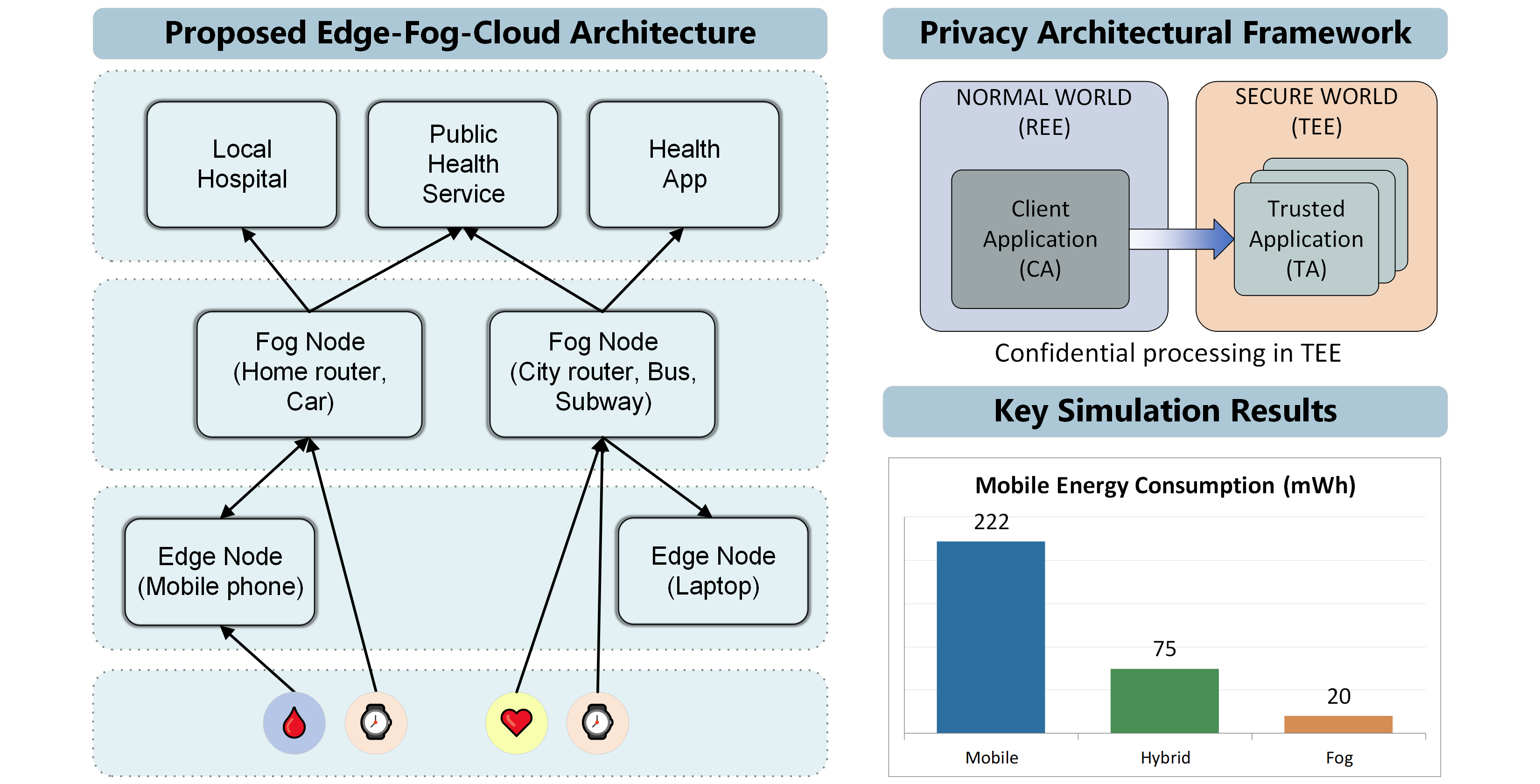
Розроблено комплексну системну модель, що описує процеси виконання RPM-задач (ECG-класифікація, аудіо-аналіз). Сформовано стратегію оффлоадингу, що базується на лінійному зваженому критерії мінімізації енерговитрат і затримки. Запропоновано архітектурний фреймворк, що забезпечує конфіденційність обробки даних на непідконтрольних fog-вузлах, за рахунок використання технологій Trusted Execution Environment (TEE) і розгортання довірених додатків (Trusted Applications). Для валідації рішень проведено серію симуляцій у середовищі YAFS (Yet Another Fog Simulator) з порівнянням сценаріїв Mobile, Hybrid та Fog.
Експериментально встановлено, що перехід до Fog-орієнтованої стратегії дозволяє радикально знизити середню латентність системи (з 0,57 с до показників рівня 0,027–0,030 с). Навантаження на смартфон зменшується більш ніж у 10 разів (з 222–225 mWh до 20,3–20,4 mWh), а автономність носимих сенсорів зростає майже вп’ятеро. Доведено, що використання туманних обчислень забезпечує стабільну якість обслуговування (Quality of Service, QoS) на обладнанні з нижчою потужністю (500 MIPS). Інтеграція процедур атестації за стандартами RATS (Remote ATtestation procedureS) дозволила верифікувати цілісність обчислювального стеку до моменту передачі конфіденційних даних.
Посилання
- Farias, F. A. C., Dagostini, C. M., Bicca, Y. A., Falavigna, V. F., Falavigna, A. (2020). Remote Patient Monitoring: A Systematic Review. Telemedicine and E-Health, 26 (5), 576–583. https://doi.org/10.1089/tmj.2019.0066
- Malasinghe, L. P., Ramzan, N., Dahal, K. (2017). Remote patient monitoring: a comprehensive study. Journal of Ambient Intelligence and Humanized Computing, 10 (1), 57–76. https://doi.org/10.1007/s12652-017-0598-x
- Dadkhah, M., Mehraeen, M., Rahimnia, F., Kimiafar, K. (2021). Use of Internet of Things for Chronic Disease Management. Journal of Medical Signals & Sensors, 11 (2), 138–157. https://doi.org/10.4103/jmss.jmss_13_20
- HealthTrack SG (2026). Health Promotion Board. Available at: https://www.hpb.gov.sg/healthy-living/healthtracksg
- Nanehkaran, Y. A., Licai, Z., Chen, J., Zhongpan, Q., Xiaofeng, Y., Navaei, Y. D. et al. (2022). Diagnosis of Chronic Diseases Based on Patients’ Health Records in IoT Healthcare Using the Recommender System. Wireless Communications and Mobile Computing, 2022 (1). https://doi.org/10.1155/2022/5663001
- Rodrigues, V. F., da Rosa Righi, R., da Costa, C. A., Zeiser, F. A., Eskofier, B., Maier, A. et al. (2023). Digital health in smart cities: Rethinking the remote health monitoring architecture on combining edge, fog, and cloud. Health and Technology, 13 (3), 449–472. https://doi.org/10.1007/s12553-023-00753-3
- Pro zatverdzhennia normatyvnykh dokumentiv shchodo zastosuvannia telemedytsyny u sferi okhorony zdorovia (2015). Nakaz MOZ Ukrainy No. 681. 19.10.2015. Available at: https://zakon.rada.gov.ua/go/z1400-15 Last accessed: 03.02.2026
- Byshenko, H., Avtomieienko, Y. (2024). Analysis of the government policy of the reform of electronic health care and medicine of Ukraine. State Formation, 1 (35), 290–304. https://doi.org/10.26565/1992-2337-2024-1-22
- OpenFog Reference Architecture for Fog Computing (2017). OpenFog Consortium, 162. Available at: https://www.iiconsortium.org/pdf/OpenFog_Reference_Architecture_2_09_17.pdf
- Muneeb, M., Ko, K.-M., Park, Y.-H. (2021). A Fog Computing Architecture with Multi-Layer for Computing-Intensive IoT Applications. Applied Sciences, 11 (24), 11585. https://doi.org/10.3390/app112411585
- Hossam, H. S., Abdel-Galil, H., Belal, M. (2024). An energy-aware module placement strategy in fog-based healthcare monitoring systems. Cluster Computing, 27 (6), 7351–7372. https://doi.org/10.1007/s10586-024-04308-7
- Mahmoud, M. M. E., Rodrigues, J. J. P. C., Saleem, K. (2019). Cloud of Things for Healthcare: A Survey from Energy Efficiency Perspective. 2019 International Conference on Computer and Information Sciences (ICCIS). Sakaka: IEEE, 1–7. https://doi.org/10.1109/iccisci.2019.8716388
- Dong, S., Tang, J., Abbas, K., Hou, R., Kamruzzaman, J., Rutkowski, L. et al. (2024). Task offloading strategies for mobile edge computing: A survey. Computer Networks, 254, 110791. https://doi.org/10.1016/j.comnet.2024.110791
- Matrouk, K., Alatoun, K. (2021). Scheduling Algorithms in Fog Computing: A Survey. International Journal of Networked and Distributed Computing, 9 (1), 59. https://doi.org/10.2991/ijndc.k.210111.001
- Adhikari, M., Gianey, H. (2019). Energy efficient offloading strategy in fog-cloud environment for IoT applications. Internet of Things, 6, 100053. https://doi.org/10.1016/j.iot.2019.100053
- Fan, J., Liu, J., Chen, J., Yang, J. (2018). LPDC: Mobility-and Deadline-Aware Task Scheduling in Tiered IoT. 2018 IEEE 4th International Conference on Computer and Communications (ICCC). Chengdu: IEEE, 857–863. https://doi.org/10.1109/compcomm.2018.8780904
- Gao, X., Huang, X., Bian, S., Shao, Z., Yang, Y. (2020). PORA: Predictive Offloading and Resource Allocation in Dynamic Fog Computing Systems. IEEE Internet of Things Journal, 7 (1), 72–87. https://doi.org/10.1109/jiot.2019.2945066
- Li, C., Tang, J., Zhang, Y., Yan, X., Luo, Y. (2019). Energy efficient computation offloading for nonorthogonal multiple access assisted mobile edge computing with energy harvesting devices. Computer Networks, 164, 106890. https://doi.org/10.1016/j.comnet.2019.106890
- Shevtsov, I. (2024). Actual problems of remote patient monitoring. Computer-Integrated Technologies: Education, Science, Production, (56), 5–11. https://doi.org/10.36910/6775-2524-0560-2024-56-01
- Shevtsov, I. (2024). The comparative analysis of the effectiveness of edge computing and fog computing in medical monitoring systems. Information Technology and Society, 3 (14), 44–53. https://doi.org/10.32689/maup.it.2024.3.6
- Shevtsov, I. O. (2024). Hybrid computing models (fog and edge) for optimizing remote monitoring of chronic diseases. Scientific Notes of Taurida National V. I. Vernadsky University. Series: Technical Sciences, 1 (5), 343–353. https://doi.org/10.32782/2663-5941/2024.5.1/48
- TEE Internal Core API Specification. GlobalPlatform. Available at: https://globalplatform.org/wp-content/uploads/2021/03/GPD_TEE_Internal_Core_API_Specification_v1.3.1_PublicRelease_CC.pdf
- RFC 9334: Remote ATtestation procedureS (RATS) Architecture. IETF Datatracker. Available at: https://datatracker.ietf.org/doc/rfc9334/
- Ménétrey, J., Göttel, C., Khurshid, A., Pasin, M., Felber, P., Schiavoni, V. et al. (2022). Attestation Mechanisms for Trusted Execution Environments Demystified. Distributed Applications and Interoperable Systems. Cham: Springer, 95–113. https://doi.org/10.1007/978-3-031-16092-9_7
- Albahri, O. S., Albahri, A. S., Mohammed, K. I., Zaidan, A. A., Zaidan, B. B., Hashim, M. et al. (2018). Systematic Review of Real-time Remote Health Monitoring System in Triage and Priority-Based Sensor Technology: Taxonomy, Open Challenges, Motivation and Recommendations. Journal of Medical Systems, 42 (5). https://doi.org/10.1007/s10916-018-0943-4
- Kraemer, F. A., Braten, A. E., Tamkittikhun, N., Palma, D. (2017). Fog Computing in Healthcare – A Review and Discussion. IEEE Access, 5, 9206–9222. https://doi.org/10.1109/access.2017.2704100
- Skorin-Kapov, L., Matijasevic, M. (2010). Analysis of QoS Requirements for e-Health Services and Mapping to Evolved Packet System QoS Classes. International Journal of Telemedicine and Applications, 2010, 1–18. https://doi.org/10.1155/2010/628086
- Gallego, J. R., Hernandez-Solana, A., Canales, M., Lafuente, J., Valdovinos, A., Fernandez-Navajas, J. (2005). Performance analysis of multiplexed medical data transmission for mobile emergency care over the UMTS channel. IEEE Transactions on Information Technology in Biomedicine, 9 (1), 13–22. https://doi.org/10.1109/titb.2004.838362
- Ding, N., Wagner, D., Chen, X., Pathak, A., Hu, Y. C., Rice, A. (2013). Characterizing and modeling the impact of wireless signal strength on smartphone battery drain. Proceedings of the ACM SIGMETRICS/International Conference on Measurement and Modeling of Computer Systems, 29–40. https://doi.org/10.1145/2465529.2466586
- Arm Firmware Framework for Arm A-profile (2025). Arm Ltd. Available at: https://developer.arm.com/-/cdn-downloads/permalink/Architectures/Armv9/DEN0077A_Firmware_Framework_Arm_A-profile_1.3_ALP1_ALP2_Diff.pdf
- Pei, M., Tschofenig, H., Thaler, D. (2023). Trusted Execution Environment Provisioning (TEEP) Architecture. Internet Engineering Task Force. Available at: https://datatracker.ietf.org/doc/html/rfc9397
- Remote Integrity Verification of Network Devices Containing Trusted Platform Modules (2024). IETF. Available at: https://datatracker.ietf.org/doc/rfc9683/ Last accessed: 27.03.2026
- Security-Enhanced Linux in Android. Available at: https://source.android.com/docs/security/features/selinux/ Last accessed: 27.03.2026
- Lera, I., Guerrero, C., Juiz, C. (2019). YAFS: A Simulator for IoT Scenarios in Fog Computing. IEEE Access, 7, 91745–91758. https://doi.org/10.1109/access.2019.2927895
- Chen, X., Ding, N., Jindal, A., Hu, Y. C., Gupta, M., Vannithamby, R. (2015). Smartphone Energy Drain in the Wild. ACM SIGMETRICS Performance Evaluation Review, 43 (1), 151–164. https://doi.org/10.1145/2796314.2745875
- Liu, X., Chen, T., Qian, F., Guo, Z., Lin, F. X., Wang, X. et al. (2017). Characterizing Smartwatch Usage in the Wild. Proceedings of the 15th Annual International Conference on Mobile Systems, Applications, and Services, 385–398. https://doi.org/10.1145/3081333.3081351
- Abdelmoneem, R. M., Benslimane, A., Shaaban, E. (2020). Mobility-aware task scheduling in cloud-Fog IoT-based healthcare architectures. Computer Networks, 179, 107348. https://doi.org/10.1016/j.comnet.2020.107348
- Dubey, H., Yang, J., Constant, N., Amiri, A. M., Yang, Q., Makodiya, K. (2015). Fog Data: Enhancing Telehealth Big Data Through Fog Computing. Proceedings of the ASE BigData & SocialInformatics 2015, 1–6. https://doi.org/10.1145/2818869.2818889
- Dubey, H., Monteiro, A., Mahler, L., Yang, Q., Mankodiya, K. (2016). FIT: A Fog Computing Device for Speech TeleTreatments. 2016 IEEE International Conference on Smart Computing (SMARTCOMP). https://doi.org/10.13140/RG.2.1.1023.8328
- Rahmani, A. M., Gia, T. N., Negash, B., Anzanpour, A., Azimi, I., Jiang, M. et al. (2018). Exploiting smart e-Health gateways at the edge of healthcare Internet-of-Things: A fog computing approach. Future Generation Computer Systems, 78, 641–658. https://doi.org/10.1016/j.future.2017.02.014
- Gia, T. N., Jiang, M., Rahmani, A.-M., Westerlund, T., Liljeberg, P., Tenhunen, H. (2015). Fog Computing in Healthcare Internet of Things: A Case Study on ECG Feature Extraction. 2015 IEEE International Conference on Computer and Information Technology; Ubiquitous Computing and Communications; Dependable, Autonomic and Secure Computing; Pervasive Intelligence and Computing. Liverpool: IEEE, 356–363. https://doi.org/10.1109/cit/iucc/dasc/picom.2015.51
- AMD Geode LX Processors Data Book (2009). AMD. Available at: https://www.amd.com/content/dam/amd/en/documents/archived-tech-docs/datasheets/33234H_LX_databook.pdf
- Gomez, K., Rasheed, T., Riggio, R., Miorandi, D., Sengul, C., Bayer, N. (2013). Achilles and the tortoise: Power consumption in IEEE 802.11n and IEEE 802.11g networks. 2013 IEEE Online Conference on Green Communications (OnlineGreenComm). Piscataway: IEEE, 20–26. https://doi.org/10.1109/onlinegreencom.2013.6731023
- Bulić, P., Kojek, G., Biasizzo, A. (2019). Data Transmission Efficiency in Bluetooth Low Energy Versions. Sensors, 19 (17), 3746. https://doi.org/10.3390/s19173746
##submission.downloads##
Опубліковано
Як цитувати
Номер
Розділ
Ліцензія
Авторське право (c) 2026 Ivan Shevtsov, Tetiana Fesenko

Ця робота ліцензується відповідно до Creative Commons Attribution 4.0 International License.
Закріплення та умови передачі авторських прав (ідентифікація авторства) здійснюється у Ліцензійному договорі. Зокрема, автори залишають за собою право на авторство свого рукопису та передають журналу право першої публікації цієї роботи на умовах ліцензії Creative Commons CC BY. При цьому вони мають право укладати самостійно додаткові угоди, що стосуються неексклюзивного поширення роботи у тому вигляді, в якому вона була опублікована цим журналом, але за умови збереження посилання на першу публікацію статті в цьому журналі.