Assessment of the resistance of concrete with recycled aggregate to freeze-thaw cycles
DOI:
https://doi.org/10.15587/2706-5448.2026.358267Keywords:
concrete, durability, recycling, aggregates, freeze-thaw, chlorides, strength, circularity, debris, PSDAbstract
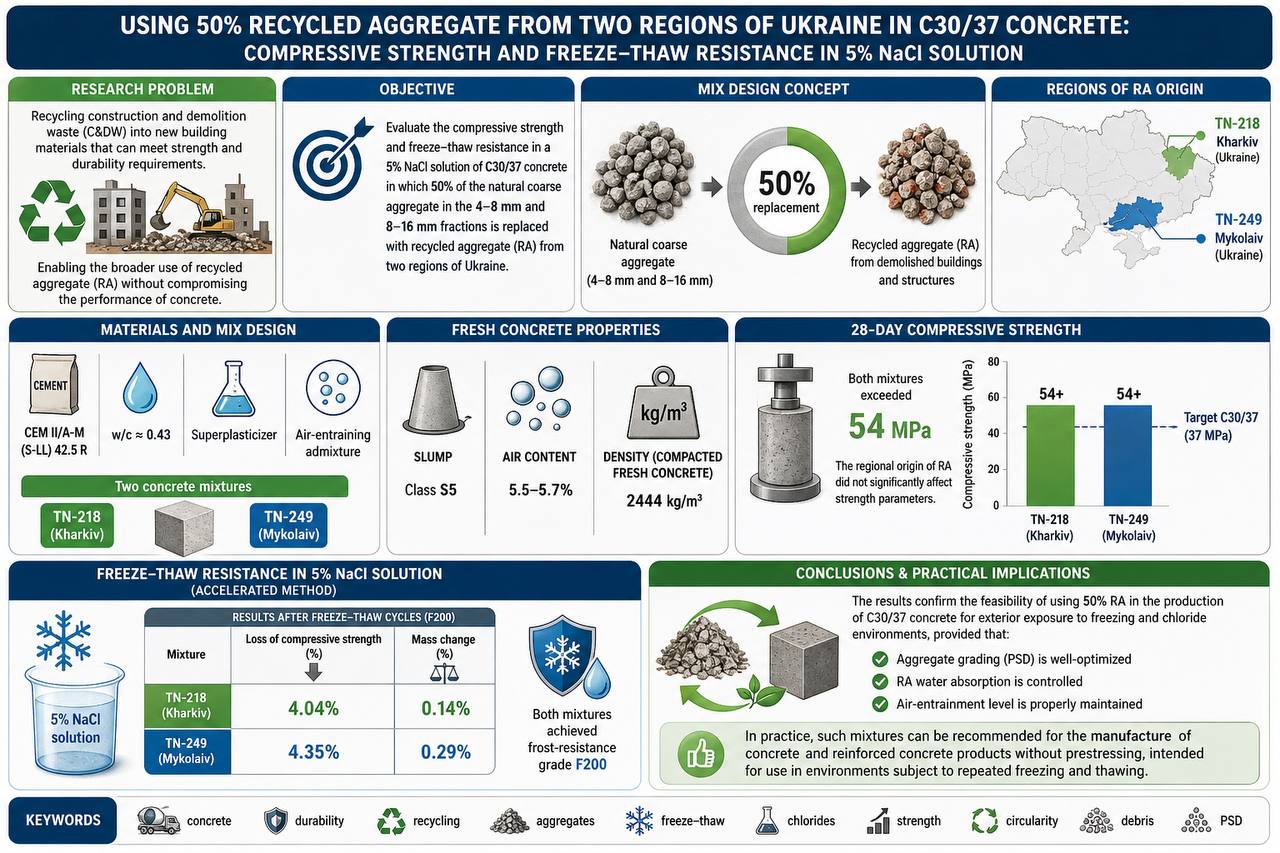
The object of research is a concrete mix in which 50% of the natural coarse aggregate is replaced with recycled aggregate (RA) obtained by crushing demolished buildings and structures. This research was aimed at assessing the compressive strength and freeze-thaw resistance in a 5% NaCl solution of C30/37 concrete in which 50% of the natural coarse aggregate in the 4–8 and 8–16 mm fractions was replaced by RA from two regions of Ukraine.
The research problem concerns the recycling of construction and demolition waste into new building materials that can meet strength and durability requirements. This approach enables the broader use of RA without compromising the performance characteristics of concrete produced with its incorporation.
Two concrete mixes were prepared using RA from different regions: TN-218 (Kharkiv, Ukraine) and TN-249 (Mykolaiv, Ukraine). Both mixtures used CEM II/A-M (S-LL) 42.5 R cement and had the same water-cement ratio (w/c ≈ 0.43). A superplasticizer and an air-entraining admixture were added to the mix.
The resulting concrete mixes demonstrated stable technological properties: the slump corresponded to class S5; the air content was 5.5–5.7%; and the density of compacted fresh concrete was 2444 kg/m³. The 28-day compressive strength of both mixes exceeded 54 MPa, confirming that the regional origin of the RA did not significantly affect strength parameters.
Freeze-thaw resistance was evaluated using an accelerated method in a 5% NaCl solution. Both mixes achieved frost-resistance grade F200: the loss of compressive strength after freeze-thaw cycles was 4.04% for TN-218 and 4.35% for TN-249, while mass change remained minimal – 0.14% and 0.29%, respectively.
The results confirm the feasibility of using 50% RA in the production of C30/37 strength-class concrete intended for exterior exposure to freezing and chloride environments, provided that the aggregate grading, RA water absorption, and air-entrainment level are properly controlled. In practice, such mixes can be recommended for the manufacture of concrete and reinforced concrete products without prestressing, intended for use in environments subject to repeated freezing and thawing.
References
- Updated Ukraine recovery and reconstruction needs assessment released (2025). World Bank Group. Available at: https://www.worldbank.org/uk/news/press-release/2025/02/25/updated-ukraine-recovery-and-reconstruction-needs-assessment-released
- UNDP launches major debris removal initiative in Ukraine to accelerate recovery (2025). United Nations Development Programme. Available at: https://www.undp.org/uk/ukraine/press-releases/proon-vprovadzhuye-masshtabnu-initsiatyvu-z-rozchyshchennya-vidkhodiv-ruynuvan-v-ukrayini
- Construction and demolition waste. European Commission. Available at: https://environment.ec.europa.eu/topics/waste-and-recycling/construction-and-demolition-waste_en
- UN warns of toxic environmental legacy for Ukraine and the region (2022). United Nations Environment Programme. Available at: https://www.unep.org/news-and-stories/press-release/un-warns-toxic-environmental-legacy-ukraine-region
- Natsionalnyi plan upravlinnia vidkhodamy do 2033 roku (2024). Kabinet Ministriv Ukrainy. Available at: https://data.rada.gov.ua/rada/file/f542151n26.pdf
- Pro zatverdzhennia Poriadku upravlinnia vidkhodamy, shcho utvorylys u zviazku z poshkodzhenniam (ruinuvanniam) budivel ta sporud vnaslidok boiovykh dii, terorystychnykh aktiv, dyversii abo provedenniam robit z likvidatsii yikh naslidkiv ta vnesennia zmin do deiakykh postanov Kabinetu Ministriv Ukrainy (2022). Postanova Kabinetu Ministriv Ukrainy No. 1073. 27.09.2022. Available at: https://zakon.rada.gov.ua/laws/show/1073-2022-%D0%BF#Text
- DSTU B EN 12620:2013. Zapovniuvachi dlia betonu (EN 12620:2002+A1:2008, IDT) (2014). Naukovo-tekhnichnyi komitet “Budstandart”. Available at: https://online.budstandart.com/ua/catalog/doc-page?id_doc=58786
- DSTU EN 206:2022. Beton. Spetsyfikatsiia, produktyvnist, vyrobnytstvo ta vidpovidnist (EN 206:2013+A2:2021, IDT) (2023). DP “UkrNDNTs”. Available at: https://online.budstandart.com/ua/catalog/doc-page.html?id_doc=106719
- Bielohrad, A., Pryymachenko, A., Tikholaz, E. (2025). Review of Ukrainian standard requirements for selecting the type of cement to ensuring the durability of reinforced concrete structures. Dorogi i Mosti, 2025 (31), 118–133. https://doi.org/10.36100/dorogimosti2025.31.118
- DSTU CEN/TS 12390-9:2019. Vyprobuvannia zatverdiloho betonu. Chastyna 9. Stiikist do tsykliv zamorozhuvannia-vidtavannia iz zastosuvanniam protyozhelednykh solei (CEN/TS 12390-9:2016, IDT) (2020). DP “UkrNDNTs”. Available at: https://online.budstandart.com/ua/catalog/doc-page.html?id_doc=87455
- Chernyak, L., Melnyk, L., Dorogan, N. (2018). The Effect of Rice Husk on the Phase Formation and Cement Clinker Properties. Chemistry Journal of Moldova, 13 (2), 24–31. https://doi.org/10.19261/cjm.2018.502
- DSTU B EN 197-1:2015. Tsement. Chastyna 1. Sklad, tekhnichni umovy ta kryterii vidpovidnosti dlia zvychainykh tsementiv (EN 197-1:2011, IDT) (2016). DP “Orhan z sertyfikatsii tsementiv “SEPROTsEM”. Available at: https://online.budstandart.com/ua/catalog/doc-page.html?id_doc=63734
- DSTU EN 196-1:2019. Metody vyprobuvannia tsementu. Chastyna 1. Vyznachennia mitsnosti (EN 196-1:2016, IDT) (2020). DP “UkrNDNTs”. Available at: https://online.budstandart.com/ua/catalog/doc-page.html?id_doc=87411
- DSTU EN 196-3:2022. Metody vyprobuvannia tsementu. Chastyna 3. Vyznachennia chasu skhopliuvannia ta mitsnosti (EN 196-3:2016, IDT) (2023). DP “UkrNDNTs”. Available at: https://online.budstandart.com/ua/catalog/doc-page.html?id_doc=110926
- DSTU EN 196-6:2019. Metody vyprobuvannia tsementu. Chastyna 6. Vyznachennia tonkosti pomelu (EN 196-6:2018, IDT) (2020). DP “UkrNDNTs”. Available at: https://online.budstandart.com/ua/catalog/doc-page?id_doc=87413
- DSTU EN 933-1:2021. Metody vyprobuvannia z vyznachennia heometrychnykh kharakterystyk zapovniuvachiv. Chastyna 1. Vyznachennia zernovoho skladu. Metod prosiiuvannia (EN 933-1:2012, IDT) (2022). DP “UkrNDNTs”. Available at: https://online.budstandart.com/ua/catalog/doc-page.html?id_doc=95570
- DSTU EN 12390-3:2024. Vyprobuvannia betonu. Chastyna 3. Mitsnist zrazkiv na stysk (EN 12390-3:2019, IDT) (2025). DP “UkrNDNTs”. Available at: https://online.budstandart.com/ua/catalog/doc-page.html?id_doc=109821
- Jagadesh, P., Karthik, K., Kalaivani, P., Karalar, M., Althaqafi, E., Madenci, E. et al. (2024). Examining the Influence of Recycled Aggregates on the Fresh and Mechanical Characteristics of High-Strength Concrete: A Comprehensive Review. Sustainability, 16 (20), 9052. https://doi.org/10.3390/su16209052
- Guo, H., Shi, C., Guan, X., Zhu, J., Ding, Y., Ling, T.-C. et al. (2018). Durability of recycled aggregate concrete – A review. Cement and Concrete Composites, 89, 251–259. https://doi.org/10.1016/j.cemconcomp.2018.03.008
- Zaharieva, R., Buyle-Bodin, F., Wirquin, E. (2004). Frost resistance of recycled aggregate concrete. Cement and Concrete Research, 34 (10), 1927–1932. https://doi.org/10.1016/j.cemconres.2004.02.025
- Setzer, M. J., Fagerlund, G., Janssen, D. J. (1996). CDF test – Test method for the freeze-thaw resistance of concrete-tests with sodium chloride solution (CDF). Materials and Structures, 29 (9), 523–528. https://doi.org/10.1007/bf02485951
- Sáez del Bosque, I. F., Van den Heede, P., De Belie, N., de Rojas, M. I. S., Medina, C. (2020). Freeze-thaw resistance of concrete containing mixed aggregate and construction and demolition waste-additioned cement in water and de-icing salts. Construction and Building Materials, 259, 119772. https://doi.org/10.1016/j.conbuildmat.2020.119772
- Bogas, J. A., de Brito, J., Ramos, D. (2016). Freeze–thaw resistance of concrete produced with fine recycled concrete aggregates. Journal of Cleaner Production, 115, 294–306. https://doi.org/10.1016/j.jclepro.2015.12.065
- Sasanipour, H., Aslani, F., Taherinezhad, J. (2022). Deicer Salt-Scaling Resistance of Concrete Using Recycled Concrete Aggregates Pretreated by Silica Fume Slurry. Materials, 15 (24), 8874. https://doi.org/10.3390/ma15248874
Downloads
Published
How to Cite
Issue
Section
License
Copyright (c) 2026 Anastasiia Bielohrad, Liubov Melnyk, Oleksandr Hizhevskyi, Denys Dudarevych

This work is licensed under a Creative Commons Attribution 4.0 International License.
The consolidation and conditions for the transfer of copyright (identification of authorship) is carried out in the License Agreement. In particular, the authors reserve the right to the authorship of their manuscript and transfer the first publication of this work to the journal under the terms of the Creative Commons CC BY license. At the same time, they have the right to conclude on their own additional agreements concerning the non-exclusive distribution of the work in the form in which it was published by this journal, but provided that the link to the first publication of the article in this journal is preserved.