Logistics risk assessment and the development of a risk-oriented controlling approach under uncertainty
DOI:
https://doi.org/10.15587/2706-5448.2026.358478Keywords:
controlling, logistics risks, supply chains, logistics risk environment, logistics system resilienceAbstract
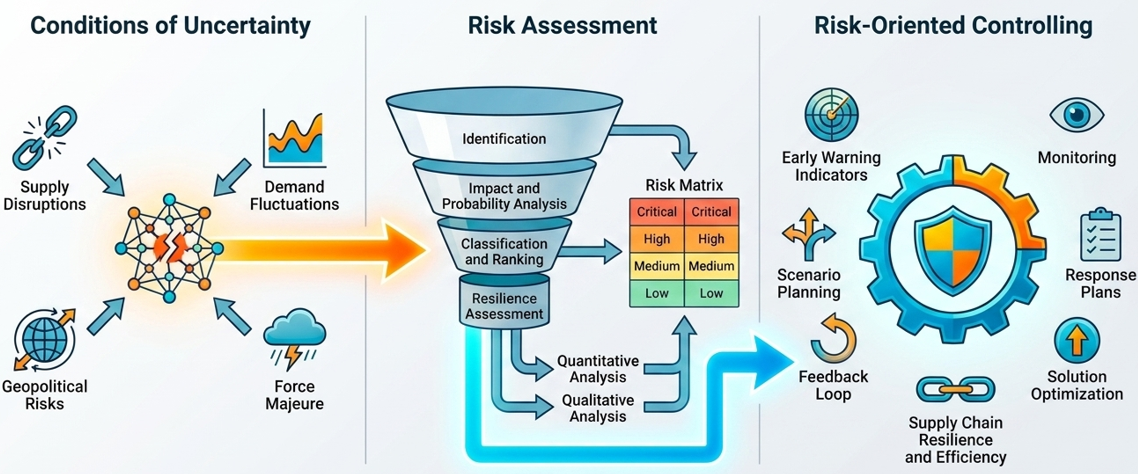
The object of research is the process of management and functioning of logistics systems of the European Union countries and Ukraine under conditions of uncertainty and crisis phenomena. The problem addressed is the lack of a methodologically formalized link between the type of logistics risk environment and the choice of a controlling model capable of ensuring efficiency and resilience of logistics processes. The results are based on internationally comparable indicators, including the logistics performance index, time to export procedures, the transport services cost index, and the political stability and absence of violence index. After data standardization, k-means cluster analysis identified three types of logistics risk environments in the European Union with different levels of risk exposure. This confirms the heterogeneity of logistics risk profiles across EU countries and limits the applicability of unified controlling models focused exclusively on efficiency. A comparative assessment of Ukraine relative to average cluster values revealed an extreme logistics risk environment. It is characterized by a 22–31% lower Logistics Performance Index, a 2.7–4.3 times longer time required for export procedures, a 24–35% higher transport services cost index, and a significant deterioration in institutional parameters compared with the average values of all EU clusters. A mechanism for selecting a risk-oriented logistics controlling model depending on the operating conditions of the system has been developed, which enhances the validity of managerial decisions and the resilience of logistics processes. A distinctive feature of the results is the proposed mechanism for selecting a risk-oriented controlling model depending on the type of logistics environment. The findings can be used by enterprises and logistics governance bodies to develop logistics risk monitoring systems, improve management accounting and logistics cost budgeting, and design anti-crisis solutions under conditions of uncertainty and crises.
References
- Jüttner, U. (2005). Supply chain risk management. The International Journal of Logistics Management, 16 (1), 120–141. https://doi.org/10.1108/09574090510617385
- Tang, C. S. (2006). Perspectives in supply chain risk management. International Journal of Production Economics, 103 (2), 451–488. https://doi.org/10.1016/j.ijpe.2005.12.006
- Ho, W., Zheng, T., Yildiz, H., Talluri, S. (2015). Supply chain risk management: a literature review. International Journal of Production Research, 53 (16), 5031–5069. https://doi.org/10.1080/00207543.2015.1030467
- Gupta, R., Rathore, B., Biswas, B. (2021). Impact of COVID-19 on supply chains: lessons learned and future research directions. International Journal of Quality & Reliability Management, 39 (10), 2400–2423. https://doi.org/10.1108/ijqrm-06-2021-0161
- Ruel, S., El Baz, J., Ivanov, D., Das, A. (2021). Supply chain viability: conceptualization, measurement, and nomological validation. Annals of Operations Research, 335 (3), 1107–1136. https://doi.org/10.1007/s10479-021-03974-9
- Wieland, A., Wallenburg, C. M. (2013). The influence of relational competencies on supply chain resilience: a relational view. International Journal of Physical Distribution & Logistics Management, 43 (4), 300–320. https://doi.org/10.1108/ijpdlm-08-2012-0243
- Lueg, R., Radlach, R. (2016). Managing sustainable development with management control systems: A literature review. European Management Journal, 34 (2), 158–171. https://doi.org/10.1016/j.emj.2015.11.005
- Beusch, P., Frisk, J. E., Rosén, M., Dilla, W. (2022). Management control for sustainability: Towards integrated systems. Management Accounting Research, 54, 100777. https://doi.org/10.1016/j.mar.2021.100777
- Pronoza, P., Kuzenko, T., Sablina, N. (2024). Implementation of financial control tools in the adaptive management of enterprise financial security. Eastern-European Journal of Enterprise Technologies, 1 (13 (127)), 33–40. https://doi.org/10.15587/1729-4061.2024.294765
- Berest, M., Sablina, N. (2023). Evaluation of the effectiveness of strategic and tactical controlling based on the analysis of the company’s financial reports. Development Management, 23 (1), 8–18. https://doi.org/10.57111/devt/1.2024.08
- Logistics Performance Index (2023). World Bank Group. Available at: https://lpi.worldbank.org
- Worldwide Governance Indicators. World Bank. Available at: https://databank.worldbank.org/source/worldwide-governance-indicators
- World Bank Open Data. World Bank Group. Available at: https://data.worldbank.org
- Eurostat. European Commission. Available at: https://ec.europa.eu/eurostat
- Vakulenko, V., Liu, Y., Liu, X. (2025). Risk management of logistics systems in the conditions of martial law in ukraine. Sustainable Development of Economy, 3 (54), 296-300. https://doi.org/10.32782/2308-1988/2025-54-45
- Kharun, O., Hrytsyna, L. (2024). Management of logistics risks at domestic enterprises in war conditions. Herald of Khmelnytskyi National University. Economic Sciences, 336 (6), 733–739. Available at: https://heraldes.khmnu.edu.ua/index.php/heraldes/article/view/1408/1437
- Samoilenko, B. V. (2025). Assessing the Impact of Crises on the Regulation of the Operation of the Logistics Services Market. The Problems of Economy, 1 (63), 90–99. https://doi.org/10.32983/2222-0712-2025-1-90-99
- Prokipchuk, L., Todoshchuk, A. (2025). Challenges and prospects for risk management in supply chains under uncertainty. Economy and Society, 71. https://doi.org/10.32782/2524-0072/2025-71-82
- Ivanov, D. (2020). Viable supply chain model: integrating agility, resilience and sustainability perspectives–lessons from and thinking beyond the COVID-19 pandemic. Annals of Operations Research, 319 (1), 1411–1431. https://doi.org/10.1007/s10479-020-03640-6
- Kolosok, V., Pedorenko, D. (2025). Methodological approach to typization of information and logistics system on the basis of omnichanality. Herald of Khmelnytskyi National University. Economic Sciences, 344 (4), 472–477. https://doi.org/10.31891/2307-5740-2025-344-4-65
- Hopkin, P. (2018). Fundamentals of Risk Management: Understanding, Evaluating and Implementing Effective Risk Management. London: Kogan Page Publishers. Available at: https://books.google.co.uk/books?hl=en&lr=&id=bzFiDwAAQBAJ&oi=fnd&pg=PP1&dq =16.%09
- Arena, M., Arnaboldi, M., Palermo, T. (2017). The dynamics of (dis)integrated risk management: A comparative field study. Accounting, Organizations and Society, 62, 65–81. https://doi.org/10.1016/j.aos.2017.08.006
- Jaeger, A., Banks, D. (2022). Cluster analysis: A modern statistical review. WIREs Computational Statistics, 15 (3). https://doi.org/10.1002/wics.1597
Downloads
Published
How to Cite
Issue
Section
License
Copyright (c) 2026 Nataliіa Sablina, Oleksandr Burtsev, Oleksandr Darushyn, Volodymyr Shalenyi, Vasyl Petrushov, Valerii Bereza, Inna Sabadash

This work is licensed under a Creative Commons Attribution 4.0 International License.
The consolidation and conditions for the transfer of copyright (identification of authorship) is carried out in the License Agreement. In particular, the authors reserve the right to the authorship of their manuscript and transfer the first publication of this work to the journal under the terms of the Creative Commons CC BY license. At the same time, they have the right to conclude on their own additional agreements concerning the non-exclusive distribution of the work in the form in which it was published by this journal, but provided that the link to the first publication of the article in this journal is preserved.