Development of a priority tool for ensuring leadership in sustainable development in tourism and hotel-restaurant enterprises
DOI:
https://doi.org/10.15587/2706-5448.2026.358682Keywords:
sustainable development, leadership, conflicts, strategic level, game theory, visionAbstract
This research explores the processes of ensuring leadership in sustainable development and the related managerial interaction of enterprise leaders in the tourism and hotel-restaurant sectors.
Within the scope of the research, the issue of establishing managerial interaction among leaders of tourism and hotel-restaurant enterprises, as well as shaping their effective influence on subordinates, was examined. In addition, the research considered conditions in which in which there is a prevailing orientation toward the extensive use of natural resources, alongside a simultaneous aspiration for integration into the European economic space, where sustainable development is a priority.
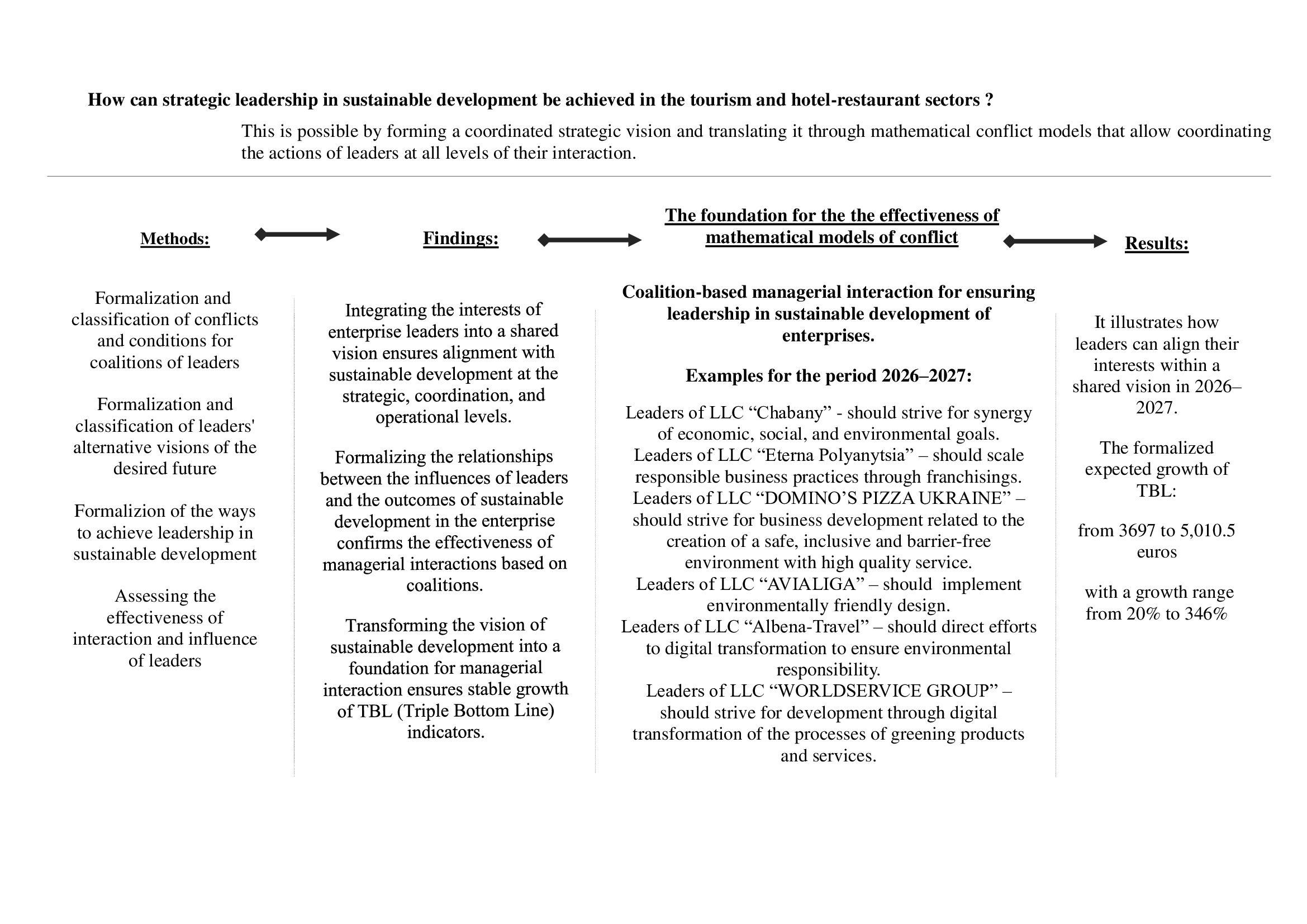
This paper intends to identify a model that can serve as a tool for ensuring leadership in sustainable development through the integration of individual leaders’ perceptions of the desired state of the enterprise into a shared vision. This implies that this vision is communicated across the strategic, coordination, and operational levels, while also balancing and enabling effective managerial interaction among its leaders.
This research defines optimal paths for achieving leadership in the field of sustainable development of tourism and hotel-restaurant enterprises. These results are explained by the following:
– integration of leaders’ interests into a shared strategic vision allows for the coordination of their actions at all levels of interaction;
– formalizing the relationship between leaders’ influences and sustainable development outcomes demonstrates the effectiveness of coalition proposals and their contribution to enhancing the significance of the Triple Bottom Line;
– translating the vision of sustainable development into specific managerial actions ensures a consistent increase in Triple Bottom Line indicators even under imperfect conditions.
The results can be implemented in organizational management, but under conditions where tourism and hotel-restaurant enterprises have formalized leader coalitions and their owners demonstrate a readiness to integrate sustainable development principles into their operations.
References
- Savruk, O. (2025). Liderstvo – tse pro maibutnie. Pro daleke maibutnie interviu. Kmbs. Available at: https://kmbs.ua/ua/article/liderstvo-pro-maibutnie-pro-dalekie-maibutnie
- Zhang, H., Zhang, R., Liu, J., Zhu, Y. (2025). Strategic manipulation behavior in graph model for conflict Resolution: The role of social trust network. Information Sciences, 686, 121313. https://doi.org/10.1016/j.ins.2024.121313
- Antipova, E., Rashkovskiy, S. (2022). Mathematical Theory of Conflicts as a Cognitive Control Theory. Information, 14 (1), 1. https://doi.org/10.3390/info14010001
- Khaletska, A. A. (2023). Responsible and globalleadership for sustainable development. Public Administration and Customs Administration, 36 (1), 89–93. https://doi.org/10.32782/2310-9653-2023-1.13
- Kulinich, T., Prosovych, O., Zhayvoronok, I., Chyzmar, I., Sternyuk, O. (2025). Concerning the issue of maximizing and balancing the components of the triple bottom line in sustainable business development. Financial and Credit Activity Problems of Theory and Practice, 4 (63), 440–454. https://doi.org/10.55643/fcaptp.4.63.2025.4779
- Lipych, L. H., Kushnir, M. A. (2024). Kontseptsiia stratehichnoho liderstva: vyklyky, evoliutsiia, pryntsypy. Dosiahnennia ekonomiky: perspektyvy ta innovatsii, 8. https://doi.org/10.5281/zenodo.13166294
- Carter, S. M., Greer, C. R. (2013). Strategic Leadership: Values, Styles, and Organizational Performance. Journal of Leadership & Organizational Studies, 20 (4), 375–393. https://doi.org/10.1177/1548051812471724
- Browning, J. W. (2013). Leading at the Strategic Level in an Uncertain World. Washington: NDU Press. Available at: https://www.academia.edu/40799981/James_W_Browning_Leading_at_the_Strategic_Level_in_an_Uncertain_World
- Rowe, G., Nejad, M. H. (2009). Strategic Leadership: Short-Term Stability and Long-Term Viability. Ivey Business Journal, 73 (5), 6–11. Available at: https://www.iveypublishing.ca/s/product/strategic-leadership-shortterm-stability-and-longterm-viability/01t5c00000CwfuiAAB
- Sivili, F. O., Boateng, P. A. (2023). Assessment of Strategic Leadership Practices in Small Business Settings. International Journal of Research and Innovation in Social Science, 7 (5), 424–433. https://doi.org/10.47772/ijriss.2023.70535
- Rusch, H. (2022). Modelling behaviour in intergroup conflicts: a review of microeconomic approaches. Philosophical Transactions of the Royal Society B, 377 (1851). https://doi.org/10.1098/rstb.2021.0135
- Simons, T. L., Peterson, R. S. (2000). Task conflict and relationship conflict in top management teams: The pivotal role of intragroup trust. Journal of Applied Psychology, 85 (1), 102–111. https://doi.org/10.1037/0021-9010.85.1.102
- Liu, J., Fu, P., Liu, S. (2009). Conflicts in top management teams and team/firm outcomes: The moderating effects of conflict-handling approaches. International Journal of Conflict Management, 20 (3), 228–250. https://doi.org/10.1108/10444060910974867
- Karyy, O., Kisiołek, A., Dzyubina, A., Kucher, A. (2022). Social Capital, Rules and Their Influence on Agreement Implementation. TEM Journal, 11 (4), 1887–1896. https://doi.org/10.18421/tem114-57
- Zayed, A., Nasr, R. (2023). Analyzing the expected role of strategic leadership and supportive culture in executing business strategies: The mediating role of employee engagement. The Academic Journal of Contemporary Commercial Research, 3 (2), 18–42. Available at: https://www.researchgate.net/publication/392080097_Analyzing_the_expected_role_of_strategic_leadership_and_supportive_culture_in_executing_business_strategies_The_mediating_role_of_employee_engagement
- Lewin, K. (1939). Field Theory and Experiment in Social Psychology: Concepts and Methods. American Journal of Sociology, 44 (6), 868–896. https://doi.org/10.1086/218177
- Lewin, K., Lippitt, R., White, R. K. (1939). Patterns of Aggressive Behavior in Experimentally Created “Social Climates”. The Journal of Social Psychology, 10 (2), 269–299. https://doi.org/10.1080/00224545.1939.9713366
- Marova, S. F. (2024). Features of using tools leadership in war and peace times. Central Ukrainian Journal of Law and Public Management, 2. https://doi.org/10.32782/cuj-2024-2-6
- Albashiti, B., Hamid, Z., Aboramadan, M. (2021). Fire in the belly: the impact of despotic leadership on employees work-related outcomes in the hospitality setting. International Journal of Contemporary Hospitality Management, 33 (10), 3564–3584. https://doi.org/10.1108/ijchm-03-2021-0394
- Zhao, H., Guo, L. (2019). Abusive supervision and hospitality employees’ helping behaviors: the joint moderating effects of proactive personality and ability to manage resources. International Journal of Contemporary Hospitality Management, 31 (4), 1977–1994. https://doi.org/10.1108/ijchm-01-2018-0100
- Ye, Y., Lyu, Y., He, Y. (2019). Servant leadership and proactive customer service performance. International Journal of Contemporary Hospitality Management, 31 (3), 1330–1347. https://doi.org/10.1108/ijchm-03-2018-0180
- Nguyen, G. N. T., Wechtler, H., Lai, P.-H. (2025). Mapping leadership studies to the achievement of sustainable development goals in tourism and hospitality: A systematic literature review and future research Agenda. Journal of Hospitality and Tourism Management, 65, 101351. https://doi.org/10.1016/j.jhtm.2025.101351
- Hoang, G., Luu, T. T., Yang, M. (2024). A Systematic Literature Review of Authentic Leadership in Tourism and Hospitality: A Call for Future Research. Cornell Hospitality Quarterly, 66 (1), 110–132. https://doi.org/10.1177/19389655241241471
- McGehee, N. G., Knollenberg, W., Komorowski, A. (2015). The central role of leadership in rural tourism development: a theoretical framework and case studies. Journal of Sustainable Tourism, 23 (8-9), 1277–1297. https://doi.org/10.1080/09669582.2015.1019514
- McCarter, M. W., Wade-Benzoni, K. A., Kamal, D. K. F., Bang, H. M., Hyde, S. J., Maredia, R. (2020). Models of intragroup conflict in management: A literature review. Journal of Economic Behavior & Organization, 178, 925–946. https://doi.org/10.1016/j.jebo.2018.04.017
- Xu, K., Zhang, J., Tian, F. (2017). Community Leadership in Rural Tourism Development: A Tale of Two Ancient Chinese Villages. Sustainability, 9 (12), 2344. https://doi.org/10.3390/su9122344
- Torkabadi, A., Mamoudan, M. M., Erdebilli, B., Aghsami, A. (2025). A multi-objective game theory model for sustainable profitability in the tourism supply chain: Integrating human resource management and artificial neural networks. Systems and Soft Computing, 7. https://doi.org/10.1016/j.sasc.2025.200217
- Yulianeu, A., Ferdinand, A. T., Purnomo, R. (2021). Transformational leadership and energizing organizational learning: empirical model for improving community-based eco-tourism performance in Indonesia. GeoJournal of Tourism and Geosites, 38 (4), 1135–1142. https://doi.org/10.30892/gtg.38419-753
Downloads
Published
How to Cite
Issue
Section
License
Copyright (c) 2026 Olena Maslihan, Olena Hurman, Nataliia Kyrnasivska, Tetiana Kulinich, Olesia Popovych

This work is licensed under a Creative Commons Attribution 4.0 International License.
The consolidation and conditions for the transfer of copyright (identification of authorship) is carried out in the License Agreement. In particular, the authors reserve the right to the authorship of their manuscript and transfer the first publication of this work to the journal under the terms of the Creative Commons CC BY license. At the same time, they have the right to conclude on their own additional agreements concerning the non-exclusive distribution of the work in the form in which it was published by this journal, but provided that the link to the first publication of the article in this journal is preserved.





