Розробка пріоритетного інструменту для забезпечення лідерства у сталому розвитку в туристичних та готельно-ресторанних підприємствах
DOI:
https://doi.org/10.15587/2706-5448.2026.358682Ключові слова:
сталий розвиток, лідерство, конфлікти, стратегічний рівен, теорія ігор, візіяАнотація
Об’єктом дослідження є процеси забезпечення лідерства у сталому розвитку та пов’язаної з цим управлінської взаємодії лідерів підприємств у сферах туризму та готельно-ресторанного бізнесу.
У межах дослідження розглядалась проблема налагодження управлінської взаємодії лідерів підприємств туризму та готельно-ресторанного бізнесу та формування їх ефективного впливу на підлеглих. Крім того враховані умови, коли домінує орієнтація на екстенсивне використання природних ресурсів за одночасного прагнення до інтеграції у європейський економічний простір, де пріоритетом виступає сталий розвиток.
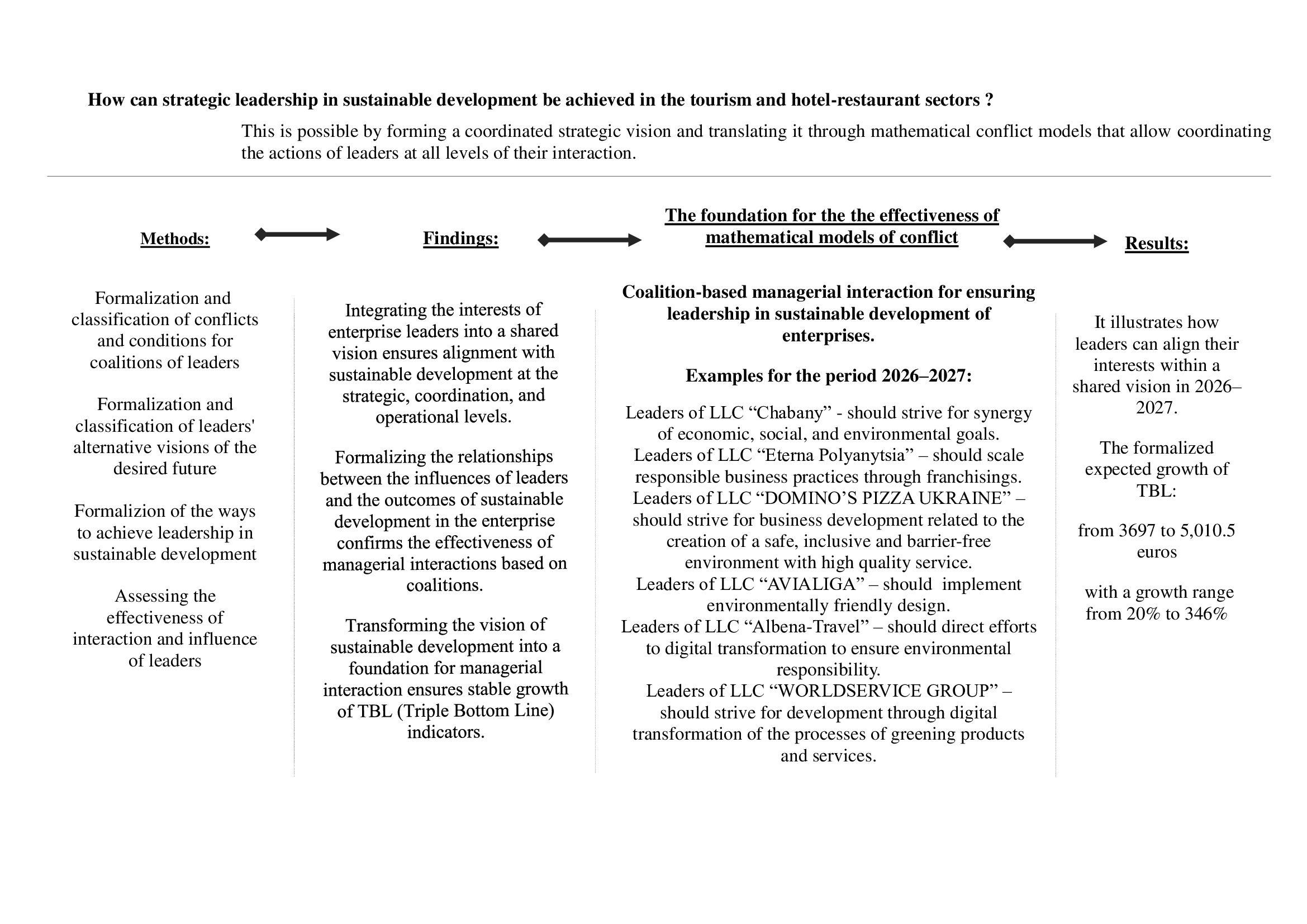
Представлене авторами дослідження спрямоване на пошук моделі, яка може розглядатися як інструмент забезпечення лідерства у сталому розвитку шляхом інтеграції індивідуальних уявлень лідерів про бажаний стан підприємства у єдине бачення. Передбачається, що це бачення має транслюється на стратегічному, координаційному та операційному рівнях, а також збалансовує та забезпечує результативну управлінську взаємодію його лідерів.
У цьому дослідженні формалізовано оптимальні шляхи досягнення лідерства у сфері сталого розвитку туристичних та готельно-ресторанних підприємств. Ці результати пояснюються тим, що:
– інтеграція інтересів лідерів у спільне стратегічне бачення дозволяє узгодити їхні дії на всіх рівнях взаємодії,
– формалізація взаємозв’язку між впливами лідерів та результатами сталого розвитку демонструє ефективність коаліційних пропозицій та їх внесок у підвищення значення Triple Bottom Line,
– трансляція бачення сталого розвитку у конкретних управлінських діях забезпечує послідовне зростання показників TBL, навіть за неідеальних умов.
Отримані результати можуть бути використані у практиці управління, але в умовах, коли підприємства туризму та готельно-ресторанного бізнесу мають формалізовані коаліції лідерів, а їх власники демонструють готовність до інтеграції принципів сталого розвитку у діяльність
Посилання
- Savruk, O. (2025). Liderstvo – tse pro maibutnie. Pro daleke maibutnie interviu. Kmbs. Available at: https://kmbs.ua/ua/article/liderstvo-pro-maibutnie-pro-dalekie-maibutnie
- Zhang, H., Zhang, R., Liu, J., Zhu, Y. (2025). Strategic manipulation behavior in graph model for conflict Resolution: The role of social trust network. Information Sciences, 686, 121313. https://doi.org/10.1016/j.ins.2024.121313
- Antipova, E., Rashkovskiy, S. (2022). Mathematical Theory of Conflicts as a Cognitive Control Theory. Information, 14 (1), 1. https://doi.org/10.3390/info14010001
- Khaletska, A. A. (2023). Responsible and globalleadership for sustainable development. Public Administration and Customs Administration, 36 (1), 89–93. https://doi.org/10.32782/2310-9653-2023-1.13
- Kulinich, T., Prosovych, O., Zhayvoronok, I., Chyzmar, I., Sternyuk, O. (2025). Concerning the issue of maximizing and balancing the components of the triple bottom line in sustainable business development. Financial and Credit Activity Problems of Theory and Practice, 4 (63), 440–454. https://doi.org/10.55643/fcaptp.4.63.2025.4779
- Lipych, L. H., Kushnir, M. A. (2024). Kontseptsiia stratehichnoho liderstva: vyklyky, evoliutsiia, pryntsypy. Dosiahnennia ekonomiky: perspektyvy ta innovatsii, 8. https://doi.org/10.5281/zenodo.13166294
- Carter, S. M., Greer, C. R. (2013). Strategic Leadership: Values, Styles, and Organizational Performance. Journal of Leadership & Organizational Studies, 20 (4), 375–393. https://doi.org/10.1177/1548051812471724
- Browning, J. W. (2013). Leading at the Strategic Level in an Uncertain World. Washington: NDU Press. Available at: https://www.academia.edu/40799981/James_W_Browning_Leading_at_the_Strategic_Level_in_an_Uncertain_World
- Rowe, G., Nejad, M. H. (2009). Strategic Leadership: Short-Term Stability and Long-Term Viability. Ivey Business Journal, 73 (5), 6–11. Available at: https://www.iveypublishing.ca/s/product/strategic-leadership-shortterm-stability-and-longterm-viability/01t5c00000CwfuiAAB
- Sivili, F. O., Boateng, P. A. (2023). Assessment of Strategic Leadership Practices in Small Business Settings. International Journal of Research and Innovation in Social Science, 7 (5), 424–433. https://doi.org/10.47772/ijriss.2023.70535
- Rusch, H. (2022). Modelling behaviour in intergroup conflicts: a review of microeconomic approaches. Philosophical Transactions of the Royal Society B, 377 (1851). https://doi.org/10.1098/rstb.2021.0135
- Simons, T. L., Peterson, R. S. (2000). Task conflict and relationship conflict in top management teams: The pivotal role of intragroup trust. Journal of Applied Psychology, 85 (1), 102–111. https://doi.org/10.1037/0021-9010.85.1.102
- Liu, J., Fu, P., Liu, S. (2009). Conflicts in top management teams and team/firm outcomes: The moderating effects of conflict-handling approaches. International Journal of Conflict Management, 20 (3), 228–250. https://doi.org/10.1108/10444060910974867
- Karyy, O., Kisiołek, A., Dzyubina, A., Kucher, A. (2022). Social Capital, Rules and Their Influence on Agreement Implementation. TEM Journal, 11 (4), 1887–1896. https://doi.org/10.18421/tem114-57
- Zayed, A., Nasr, R. (2023). Analyzing the expected role of strategic leadership and supportive culture in executing business strategies: The mediating role of employee engagement. The Academic Journal of Contemporary Commercial Research, 3 (2), 18–42. Available at: https://www.researchgate.net/publication/392080097_Analyzing_the_expected_role_of_strategic_leadership_and_supportive_culture_in_executing_business_strategies_The_mediating_role_of_employee_engagement
- Lewin, K. (1939). Field Theory and Experiment in Social Psychology: Concepts and Methods. American Journal of Sociology, 44 (6), 868–896. https://doi.org/10.1086/218177
- Lewin, K., Lippitt, R., White, R. K. (1939). Patterns of Aggressive Behavior in Experimentally Created “Social Climates”. The Journal of Social Psychology, 10 (2), 269–299. https://doi.org/10.1080/00224545.1939.9713366
- Marova, S. F. (2024). Features of using tools leadership in war and peace times. Central Ukrainian Journal of Law and Public Management, 2. https://doi.org/10.32782/cuj-2024-2-6
- Albashiti, B., Hamid, Z., Aboramadan, M. (2021). Fire in the belly: the impact of despotic leadership on employees work-related outcomes in the hospitality setting. International Journal of Contemporary Hospitality Management, 33 (10), 3564–3584. https://doi.org/10.1108/ijchm-03-2021-0394
- Zhao, H., Guo, L. (2019). Abusive supervision and hospitality employees’ helping behaviors: the joint moderating effects of proactive personality and ability to manage resources. International Journal of Contemporary Hospitality Management, 31 (4), 1977–1994. https://doi.org/10.1108/ijchm-01-2018-0100
- Ye, Y., Lyu, Y., He, Y. (2019). Servant leadership and proactive customer service performance. International Journal of Contemporary Hospitality Management, 31 (3), 1330–1347. https://doi.org/10.1108/ijchm-03-2018-0180
- Nguyen, G. N. T., Wechtler, H., Lai, P.-H. (2025). Mapping leadership studies to the achievement of sustainable development goals in tourism and hospitality: A systematic literature review and future research Agenda. Journal of Hospitality and Tourism Management, 65, 101351. https://doi.org/10.1016/j.jhtm.2025.101351
- Hoang, G., Luu, T. T., Yang, M. (2024). A Systematic Literature Review of Authentic Leadership in Tourism and Hospitality: A Call for Future Research. Cornell Hospitality Quarterly, 66 (1), 110–132. https://doi.org/10.1177/19389655241241471
- McGehee, N. G., Knollenberg, W., Komorowski, A. (2015). The central role of leadership in rural tourism development: a theoretical framework and case studies. Journal of Sustainable Tourism, 23 (8-9), 1277–1297. https://doi.org/10.1080/09669582.2015.1019514
- McCarter, M. W., Wade-Benzoni, K. A., Kamal, D. K. F., Bang, H. M., Hyde, S. J., Maredia, R. (2020). Models of intragroup conflict in management: A literature review. Journal of Economic Behavior & Organization, 178, 925–946. https://doi.org/10.1016/j.jebo.2018.04.017
- Xu, K., Zhang, J., Tian, F. (2017). Community Leadership in Rural Tourism Development: A Tale of Two Ancient Chinese Villages. Sustainability, 9 (12), 2344. https://doi.org/10.3390/su9122344
- Torkabadi, A., Mamoudan, M. M., Erdebilli, B., Aghsami, A. (2025). A multi-objective game theory model for sustainable profitability in the tourism supply chain: Integrating human resource management and artificial neural networks. Systems and Soft Computing, 7. https://doi.org/10.1016/j.sasc.2025.200217
- Yulianeu, A., Ferdinand, A. T., Purnomo, R. (2021). Transformational leadership and energizing organizational learning: empirical model for improving community-based eco-tourism performance in Indonesia. GeoJournal of Tourism and Geosites, 38 (4), 1135–1142. https://doi.org/10.30892/gtg.38419-753
##submission.downloads##
Опубліковано
Як цитувати
Номер
Розділ
Ліцензія
Авторське право (c) 2026 Olena Maslihan, Olena Hurman, Nataliia Kyrnasivska, Tetiana Kulinich, Olesia Popovych

Ця робота ліцензується відповідно до Creative Commons Attribution 4.0 International License.
Закріплення та умови передачі авторських прав (ідентифікація авторства) здійснюється у Ліцензійному договорі. Зокрема, автори залишають за собою право на авторство свого рукопису та передають журналу право першої публікації цієї роботи на умовах ліцензії Creative Commons CC BY. При цьому вони мають право укладати самостійно додаткові угоди, що стосуються неексклюзивного поширення роботи у тому вигляді, в якому вона була опублікована цим журналом, але за умови збереження посилання на першу публікацію статті в цьому журналі.