Determining the prospects of using artificial intelligence for generating energy bar recipes
DOI:
https://doi.org/10.15587/2706-5448.2026.359167Keywords:
energy bars, shelf-life, organoleptic properties, consumer properties, artificial intelligence, food qualityAbstract
The objects of research are energy bars developed using mathematical modeling and various artificial intelligence (AI) models, including ChatGPT, Gemini, and Claude. The paper analyzes the quality and shelf-life indicators of these products. The AI application in recipe addresses the challenge of overcoming the complexity of traditional mathematical modeling for the rapid optimization of multi-component recipes. This ensures the creation of energy bars with an enhanced nutritional profile without compromising their sensory and structural-mechanical properties.
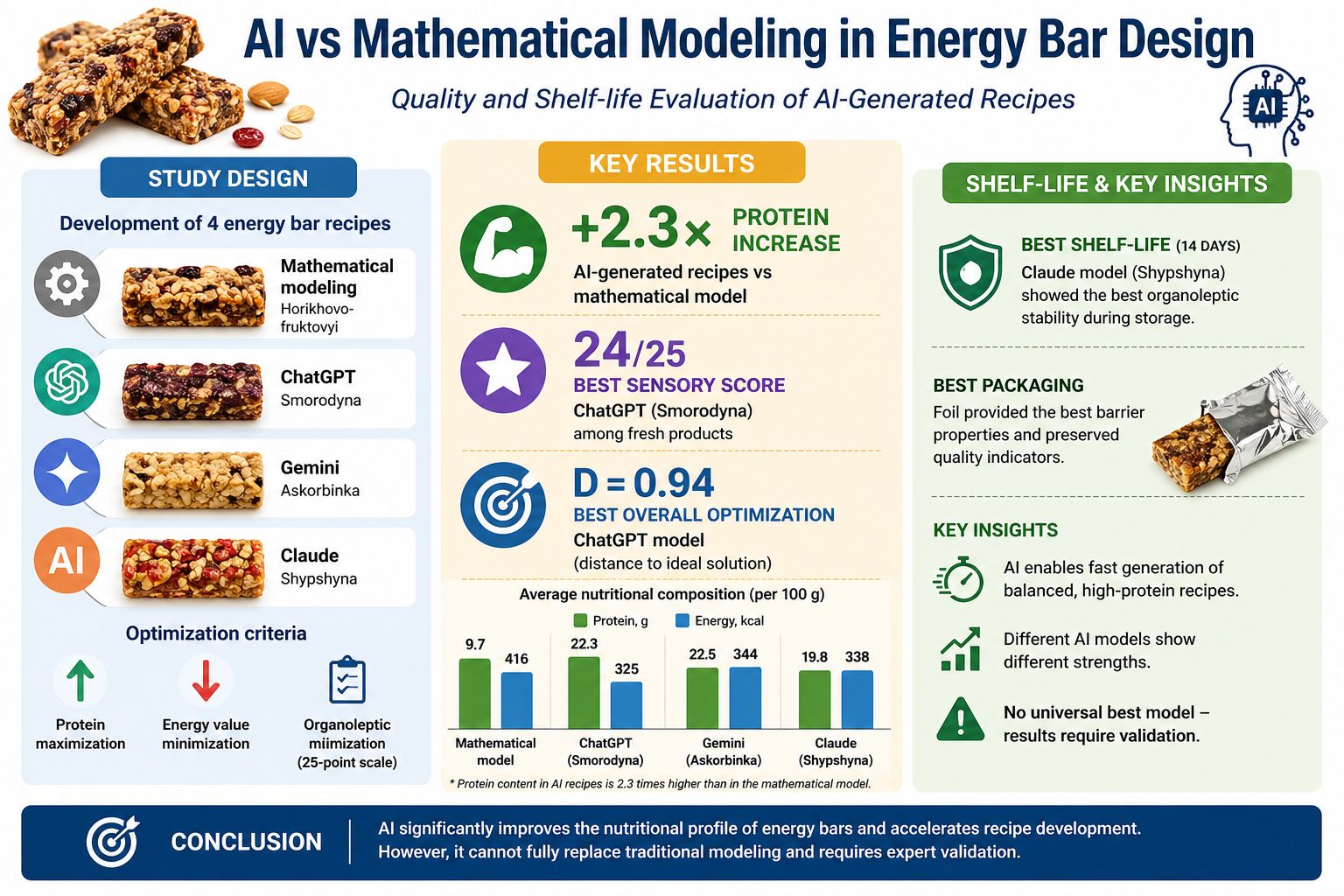
The “Horikhovo-fruktovyi” sample consisted of oat flakes, dried cranberries, and prunes with a nut mix of almonds and peanuts, and chaenomeles. The composition of the “Shypshyna” bar was generated by the Claude AI model and contained whey protein and oat flakes, as well as rosehip, honey, and nuts. The “Askorbinka” sample, generated by Gemini, contained soy components: protein isolate, milk powder, and oat flakes. The recipe for the “Smorodyna” bar, generated by the ChatGPT model, included protein isolate, oat flour, and berry powders.
The use of AI allowed for an improvement in the protein profile. The protein content in the “Askorbinka” and “Smorodyna” recipes is 2.3 times higher than the protein content in the “Horikhovo-fruktovyi” sample. These data may be explained by the fact that AI databases contain information indicating that energy bars should have high protein content.
The organoleptic evaluation of the energy bars was carried out using a 25-point scale developed by the authors. Among the fresh products, the highest score (24) was achieved by the “Smorodyna” sample, the recipe for which was generated by ChatGPT.
The samples were stored for 14 days in various packaging materials. The sample generated by Claude exhibited the best organoleptic characteristics. Regarding moisture content and acid value, the “Horikhovo-fruktovyi” sample performed best, showing moisture values from 19.9% to 25% and an acid value ranging from 1.75% to 1.83% at the end of the storage period. It was established that parchment paper and foil possess the best barrier properties for sample storage.
References
- Tarasiuk, H. M., Chahaida, A. O. (2019). Prospects of implementing the technology for energy candy bars in hotel and restaurant establishments. Economics, Management and Administration, 3 (89), 57–65. https://doi.org/10.26642/ema-2019-3(89)-57-65
- AlJaloudi, R., Al-Dabbas, M. M., Hamad, H. J., Amara, R. A., Al-Bashabsheh, Z., Abughoush, M. et al. (2024). Development and Characterization of High-Energy Protein Bars with Enhanced Antioxidant, Chemical, Nutritional, Physical, and Sensory Properties. Foods, 13 (2), 259. https://doi.org/10.3390/foods13020259
- Saravanan, G., Yusri, A. S., Sarbon, N. Mhd. (2026). Investigating the nutritional value, physicochemical properties, antioxidant activity and sensory acceptability of fiber- and protein-enriched fruit based energy bars. Food Chemistry Advances, 10, 101196. https://doi.org/10.1016/j.focha.2025.101196
- Barakat, H., Alfheeaid, H. A. (2023). Date Palm Fruit (Phoenix dactylifera) and Its Promising Potential in Developing Functional Energy Bars: Review of Chemical, Nutritional, Functional, and Sensory Attributes. Nutrients, 15 (9), 2134. https://doi.org/10.3390/nu15092134
- Tsykhanovska, I., Lazarieva, T., Stabnikova, O., Kupriyanov, O., Litvin, O., Yevlash, V. (2023). Potential benefits of functional antianemic energy bars. Ukrainian Food Journal. https://doi.org/10.24263/2304-974x-2023-12-4-7
- Elochukwu, C. U., Nwosu, J. N., Owuamanam, C. I., Osuji, C. I. (2019). Optimization and Modeling of Energy Bars Based Formulations by Simplex Lattice Mixture Design. International journal of Horticulture, Agriculture and Food science, 3 (5), 299–311.
- Bancea, B., Bolea, A., Rotaru, A., Sîngeorzan, S. M. (2025). Optimization of a High-Protein Energy Bar Formulation using Linear Programing. Journal of Agroalimentary Processes and Technologies, 31 (4), 430–433.
- Kuhl, E. (2025). AI for food: accelerating and democratizing discovery and innovation. Npj Science of Food, 9 (1). https://doi.org/10.1038/s41538-025-00441-8
- Uçuk, C., Doğdubay, M., Özdemir, S. S. (2023). The Use of Artificial Intelligence in Recipe Development: How Technology Is Changing the Way We Create and Innovate in the Kitchen. Impactful Technologies Transforming the Food Industry. IGI global, 98–115. https://doi.org/10.4018/978-1-6684-9094-5.ch007
- IM Almoselhy, R., Usmani, A. (2024). AI in Food Science: Exploring Core Elements, Challenges, and Future Directions. Open Access Journal of Microbiology & Biotechnology, 9 (4), 1–15. https://doi.org/10.23880/oajmb-16000313
- Tkachenko, A. (2025). Identification and classification examination of sugar for customs declaration using artificial intelligence tools. Herald of Khmelnytskyi National University. Economic Sciences, 340 (2), 278–285.
- Ewing-Chow, D. (2025). The Latest AI Trends Transforming The Food Industry. Forbes. Available at: https://www.forbes.com/sites/daphneewingchow/2025/03/18/these-are-the-latest-ai-trends-transforming-the-food-industry/ Last accessed: 26.03.2026
- Not Your Average Joint Venture: Kraft Heinz and TheNotCompany Create Partnership to Accelerate AI-Driven Plant-Based Innovation Globally (2022). The Kraft Heinz Company. Avaialble at: https://news.kraftheinzcompany.com/press-releases-details/2022/Not-Your-Average-Joint-Venture-Kraft-Heinz-and-TheNotCompany-Create-Partnership-to-Accelerate-AI-Driven-Plant-Based-Innovation-Globally/default.aspx Last accessed: 14.04.2026
- Kutyauripo, I., Rushambwa, M., Chiwazi, L. (2023). Artificial intelligence applications in the agrifood sectors. Journal of Agriculture and Food Research, 11, 100502. https://doi.org/10.1016/j.jafr.2023.100502
- Hassoun, A., Jagtap, S., Trollman, H., Garcia-Garcia, G., Abdullah, N. A., Goksen, G. et al. (2023). Food processing 4.0: Current and future developments spurred by the fourth industrial revolution. Food Control, 145, 109507. https://doi.org/10.1016/j.foodcont.2022.109507
- Režek Jambrak, A., Nutrizio, M., Djekić, I., Pleslić, S., Chemat, F. (2021). Internet of Nonthermal Food Processing Technologies (IoNTP): Food Industry 4.0 and Sustainability. Applied Sciences, 11 (2), 686. https://doi.org/10.3390/app11020686
- Kumar, M., Vatsa, S., Madhumita, M., Prabhakar, P. K. (2021). Mathematical Modeling of Food Processing Operations: A Basic Understanding and Overview. Turkish Journal of Agricultural Engineering Research, 2 (2), 472–492. https://doi.org/10.46592/turkager.2021.v02i02.019
- Wandhekar, S. S., Pandey, M. S., Rajput, D. B., Gehi, S. O., Prajapati, N. R. (2020). Development, organoleptic and nutritional assessment of utria energy bar. International Journal of Applied and Advanced Scientific Research, 5 (2), 22–27.
- Machackova, M., Giertlova, A., Porubska, J., Roe, M., Ramos, C., Finglas, P. (2018). EuroFIR Guideline on calculation of nutrient content of foods for food business operators. Food Chemistry, 238, 35–41. https://doi.org/10.1016/j.foodchem.2017.03.103
- DSTU 4910:2008. Vyroby kondyterski. Metody vyznachennia masovoi chastky volohy ta sukhykh rechovyn (2009). Kyiv: Derzhspozhyvstandart Ukrainy, 14. Available at: https://online.budstandart.com/ua/catalog/doc-page?id_doc=95233
- Sakaino, M., Sano, T., Kato, S., Shimizu, N., Ito, J., Rahmania, H. et al. (2022). Carboxylic acids derived from triacylglycerols that contribute to the increase in acid value during the thermal oxidation of oils. Scientific Reports, 12 (1). https://doi.org/10.1038/s41598-022-15627-3
- Khomych, G., Horobetc, A., Levchenko, Y., Boroday, A., Ishchenko, N. (2016). The study of biologically active substances of chaenomelesand the products of its processing. Eastern-European Journal of Enterprise Technologies, 4 (11 (82)), 29–35. https://doi.org/10.15587/1729-4061.2016.76111
- Dubnitskiy, V., Kobylin, A., Kobylin, O., Kushneruk, Y., Khodyrev, A. (2023). Calculation of harrington function (desirability function) values under interval determination of its arguments. Advanced Information Systems, 7 (1), 71–81. https://doi.org/10.20998/2522-9052.2023.1.12
- Tkachenko, A. (2022). Research of consumption properties of organic syrups. Herald of Khmelnytskyi National University. Economic Sciences, 308 (4), 216–222. https://doi.org/10.31891/2307-5740-2022-308-4-34
- Liu, Z., Wang, S., Zhang, Y., Feng, Y., Liu, J., Zhu, H. (2023). Artificial Intelligence in Food Safety: A Decade Review and Bibliometric Analysis. Foods, 12 (6), 1242. https://doi.org/10.3390/foods12061242
- Sahni, V., Srivastava, S., Khan, R. (2021). Modelling Techniques to Improve the Quality of Food Using Artificial Intelligence. Journal of Food Quality, 2021, 1–10. https://doi.org/10.1155/2021/2140010
- Rejeb, A., Keogh, J. G., Rejeb, K. (2022). Big data in the food supply chain: a literature review. Journal of Data, Information and Management, 4 (1), 33–47. https://doi.org/10.1007/s42488-021-00064-0
Downloads
Published
How to Cite
Issue
Section
License
Copyright (c) 2026 Alina Tkachenko, Oleksandra Horobets, Olena Goryachova, Olena Olkhovska

This work is licensed under a Creative Commons Attribution 4.0 International License.
The consolidation and conditions for the transfer of copyright (identification of authorship) is carried out in the License Agreement. In particular, the authors reserve the right to the authorship of their manuscript and transfer the first publication of this work to the journal under the terms of the Creative Commons CC BY license. At the same time, they have the right to conclude on their own additional agreements concerning the non-exclusive distribution of the work in the form in which it was published by this journal, but provided that the link to the first publication of the article in this journal is preserved.