Improving the efficiency of fault-finding work during camshaft repairs
DOI:
https://doi.org/10.15587/2706-5448.2026.359283Keywords:
distribution shaft, defect detection, wear measurement, statistical model, regression equation, quantitative correlationAbstract
The object of this research is the process of inspecting the camshafts of internal combustion engines in the context of vehicle repair production. As the inspection of a camshaft is a highly labor-intensive process due to the need to measure a large number of its components, there is a pressing need to improve the efficiency of inspection work.
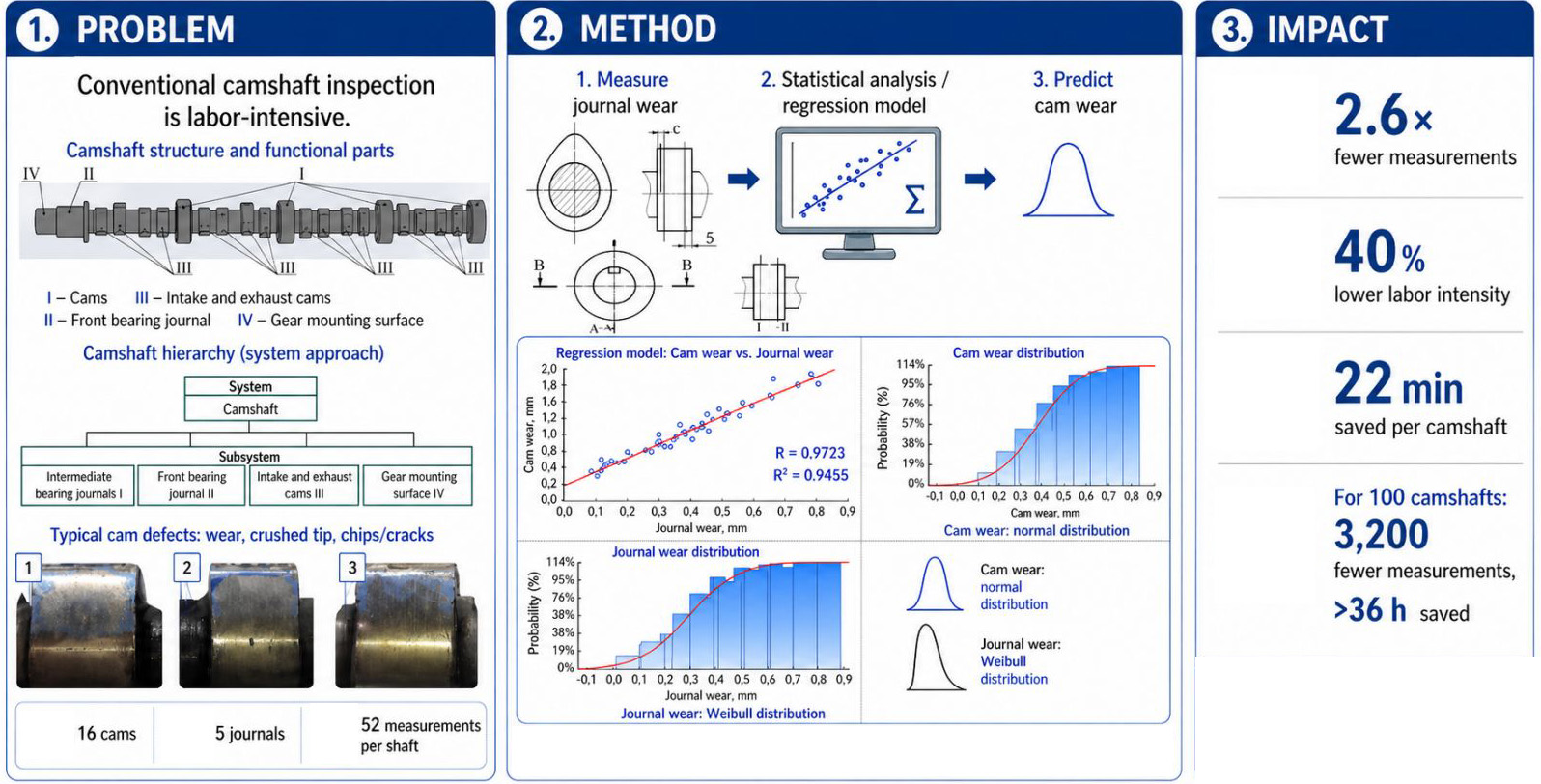
An approach is proposed for inspecting components with multiple worn surfaces, which involves determining the wear on one surface and calculating the wear on another using a regression model that establishes a quantitative relationship between the wear on the surfaces. This allows for a significant reduction in the labor intensity of defect detection work without compromising the reliability of the technical condition assessment of the component. This approach has been implemented using the example of defect detection on the camshaft of a KamAZ lorry engine.
A hierarchical diagram of the camshaft structure as a system, where its individual elements are subsystems, is examined. It is noted that, among the surfaces of the camshaft, the cams and journal necks are subject to the most intense wear. A statistical model of camshaft wear has been constructed in the form of a linear regression equation, establishing a quantitative relationship between the wear of the journal necks and the cams.
The practical significance of the proposed approach lies in improving the efficiency of defect detection work by reducing the volume of measurements by a factor of 2.6, which reduces the labor intensity of defect detection by 40%. When inspecting a batch of 100 camshafts, this results in a saving of 3,200 measurements, or over 36 hours.
The results of this research have practical significance and are important for automotive repair enterprises engaged in the repair of internal combustion engine components.
References
- Al-Samarai, R. A., Al-Douri, Y. (2024). The Wear. Friction and Wear in Metals. Singapore: Springer, 1–31. https://doi.org/10.1007/978-981-97-1168-0_1
- Fadieiev, A. (2026). Current state of restoration of machine parts and structures. Energy Saving. Power Engineering. Energy Audit., 1 (216), 64–75. https://doi.org/10.20998/2313-8890.2026.01.05
- Sukhenko, Y., Sukhenko, V., Mushtruk, M., Litvinenko, A. (2019). Mathematical Model of Corrosive-Mechanic Wear Materials in Technological Medium of Food Industry. Advances in Design, Simulation and Manufacturing. Cham: Springer, 507–514. https://doi.org/10.1007/978-3-319-93587-4_53
- Romanenko, V. A. (2013). Rozvytok mashynobuduvannia v Ukraini: systemnyi pidkhid. Ekonomika Ukrainy, 10, 56–66. Available at: http://nbuv.gov.ua/UJRN/EkUk_2013_10_6
- Permyakov, A., Nemyrovskyi, Y., Posviatenko, E., Shepelenko, I. (2023). Methodology of technological design in the restoration of parts. IOP Conference Series: Materials Science and Engineering, 1277 (1), 12013. https://doi.org/10.1088/1757-899x/1277/1/012013
- Chernovol, M., Shepelenko, I. (2023). A Systematic Approach to Forming Quality Indicators for Refurbished Parts. Central Ukrainian Scientific Bulletin. Technical Sciences, 1 (7 (38)), 30–36. https://doi.org/10.32515/2664-262x.2023.7(38).1.30-36
- Katsardis, F.; Elo, M., Katsardis, F. (Eds.) (2024). Automotive Aftermarket: Introduction to a Global Business. Automotive Aftermarket. Cham: Springer, 19–65. https://doi.org/10.1007/978-3-031-62419-3_2
- Chernovol, M. I., Kropivniy, V. M., Kuleshkov, Y. V., Shepelenko, I. V., Gutsul, V. I. (2024). Systematic approach to the study of working surfaces wear of automotive and tractor equipment parts. Problems of Tribology, 29 (1/111), 53–60. https://doi.org/10.31891/2079-1372-2024-111-1-53-60
- Acero, A., Ramírez Cajiao, M. C. (2023). Analyzing Sustainable Practices in Engineering Projects: A Systemic Approach. Sustainability, 15 (7), 6022. https://doi.org/10.3390/su15076022
- Ahieiev, M. S., Dzygar, A. K., Ustintsev, S. N. (2025). Methodology for developing a technological process for restoration of camshaft of marine engines with wear-resistant coatings. Reporter of the Priazovskyi State Technical University. Section: Technical Sciences, 51, 231–239. https://doi.org/10.31498/2225-6733.51.2025.344957
- Ravlyuk, V. G., Ravliuk, M. G., Kirichenko, I. K. (2020). Statistical processing of brake pads wear parameters of freight cars. Science and Transport Progress, 2 (86), 74–91. https://doi.org/10.15802/stp2020/203103
- Penkov, O., Khadem, M., Nieto, A., Kim, T.-H., Kim, D.-E. (2017). Design and Construction of a Micro-Tribotester for Precise In-Situ Wear Measurements. Micromachines, 8 (4), 103. https://doi.org/10.3390/mi8040103
- Fetisov, V. S. (2018). Paket statystychnoho analizu danykh STATISTICA. Nizhyn: NDU im. M. Hoholia, 114. Available at: https://files.znu.edu.ua/files/Bibliobooks/Inshi72/0053477.pdf
Downloads
Published
How to Cite
Issue
Section
License
Copyright (c) 2026 Ihor Shepelenko, Artem Krasota, Mykhailo Krasota, Ivan Vasylenko, Andrey Solovuch

This work is licensed under a Creative Commons Attribution 4.0 International License.
The consolidation and conditions for the transfer of copyright (identification of authorship) is carried out in the License Agreement. In particular, the authors reserve the right to the authorship of their manuscript and transfer the first publication of this work to the journal under the terms of the Creative Commons CC BY license. At the same time, they have the right to conclude on their own additional agreements concerning the non-exclusive distribution of the work in the form in which it was published by this journal, but provided that the link to the first publication of the article in this journal is preserved.