Composite assessment of the economic performance of circular transformation performance in industrial enterprises in the economy – environment – society dimension
DOI:
https://doi.org/10.15587/2706-5448.2026.359334Keywords:
circular transformation, economic performance, economic development, innovation potential, enterprise competitiveness, digitalizationAbstract
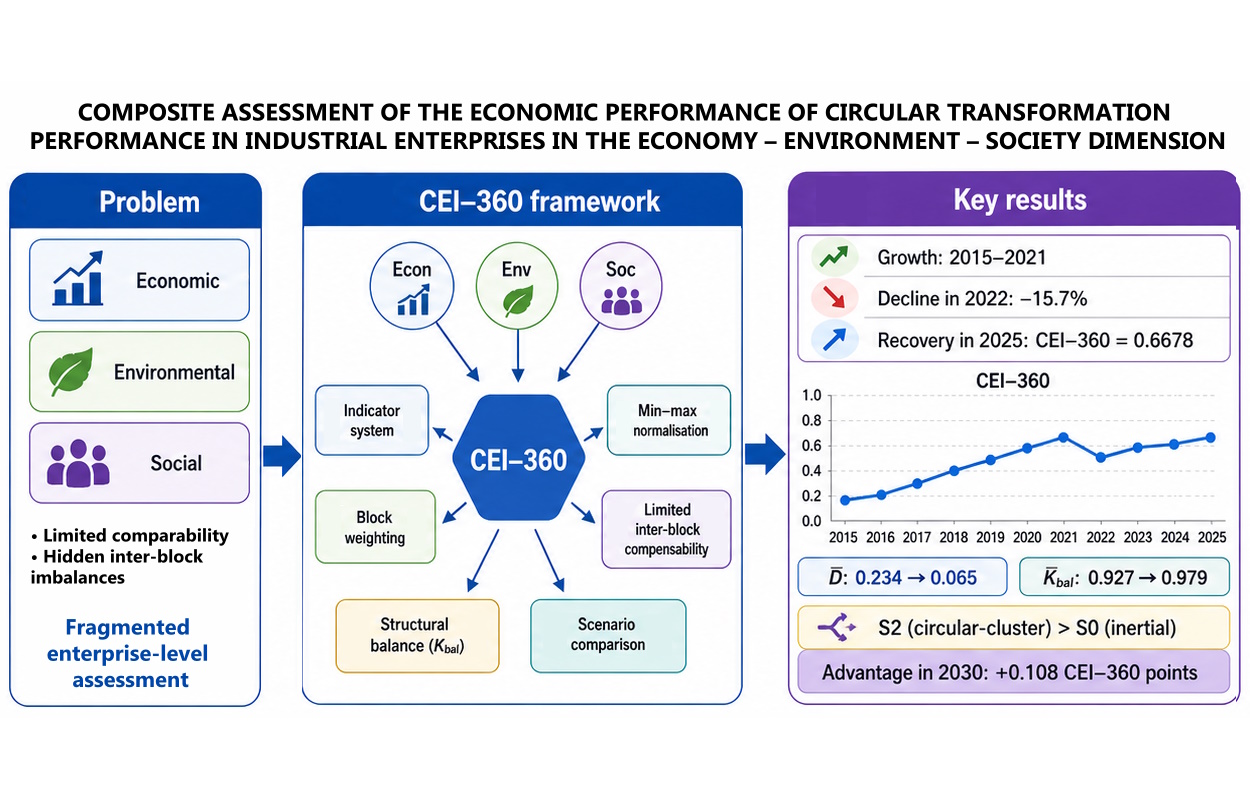
The object of research is the economic effectiveness of the processes of circular transformation of industrial enterprises. The problem lies in the absence of an integrated enterprise-level approach that would make it possible to identify of inter-block imbalances, ensure analytical consistency of indicators, and strengthen the basis for managerial decision-making.
The paper provides a comprehensive assessment of circular transformation performance in industrial enterprises in the economy – environment – society dimension.
A composite CEI-360 index is proposed, combining a harmonized system of indicators, fixed min-max normalization, block weighting, and aggregation with limited inter-block compensability. In addition, a structural-balance coefficient is introduced to distinguish the overall level of effectiveness from the consistency of change across the economic, environmental, and social dimensions.
The empirical basis is panel data for five Ukrainian industrial enterprises from different industries for 2015–2025 using scenario modeling for 2026–2030. The results showed growth in 2015–2021, a systemic decline in 2022 (–15.7%) and a further differentiated recovery in 2023–2025 exceeding the 2021 level. The scenario analysis confirmed the stable advantage of the circular-cluster development trajectory over the inertial one (up to +0.108 CEI-360 points in 2030).
The originality of the research lies in the development of an integrated tool for assessing circular transformation performance with explicit consideration of structural consistency across dimensions. The practical significance of the findings lies in using the framework for strategic diagnostics, benchmarking, monitoring of dynamics, and substantiating managerial decisions on the priorities of circular enterprise development.
References
- Geissdoerfer, M., Savaget, P., Bocken, N. M. P., Hultink, E. J. (2017). The Circular Economy – A new sustainability paradigm? Journal of Cleaner Production, 143, 757–768. https://doi.org/10.1016/j.jclepro.2016.12.048
- Kirchherr, J., Reike, D., Hekkert, M. (2017). Conceptualizing the circular economy: An analysis of 114 definitions. Resources, Conservation and Recycling, 127, 221–232. https://doi.org/10.1016/j.resconrec.2017.09.005
- Korhonen, J., Nuur, C., Feldmann, A., Birkie, S. E. (2018). Circular economy as an essentially contested concept. Journal of Cleaner Production, 175, 544–552. https://doi.org/10.1016/j.jclepro.2017.12.111
- Kirchherr, J., Yang, N.-H. N., Schulze-Spüntrup, F., Heerink, M. J., Hartley, K. (2023). Conceptualizing the Circular Economy (Revisited): An Analysis of 221 Definitions. Resources, Conservation and Recycling, 194, 107001. https://doi.org/10.1016/j.resconrec.2023.107001
- Saidani, M., Yannou, B., Leroy, Y., Cluzel, F., Kendall, A. (2019). A taxonomy of circular economy indicators. Journal of Cleaner Production, 207, 542–559. https://doi.org/10.1016/j.jclepro.2018.10.014
- Moraga, G., Huysveld, S., Mathieux, F., Blengini, G. A., Alaerts, L., Van Acker, K. et al. (2019). Circular economy indicators: What do they measure? Resources, Conservation and Recycling, 146, 452–461. https://doi.org/10.1016/j.resconrec.2019.03.045
- Kristensen, H. S., Mosgaard, M. A. (2020). A review of micro level indicators for a circular economy – moving away from the three dimensions of sustainability? Journal of Cleaner Production, 243, 118531. https://doi.org/10.1016/j.jclepro.2019.118531
- De Pascale, A., Arbolino, R., Szopik-Depczyńska, K., Limosani, M., Ioppolo, G. (2021). A systematic review for measuring circular economy: The 61 indicators. Journal of Cleaner Production, 281, 124942. https://doi.org/10.1016/j.jclepro.2020.124942
- Elia, V., Gnoni, M. G., Tornese, F. (2024). Integrating circular economy and sustainability assessment on the micro-level: An umbrella review. Sustainable Production and Consumption, 50, 405–415. https://doi.org/10.1016/j.spc.2024.08.012
- Ferrante, M., Vitti, M., Sassanelli, C. (2025). The evolution of circular economy performance assessment: A systematic literature review. Renewable and Sustainable Energy Reviews, 217, 115757. https://doi.org/10.1016/j.rser.2025.115757
- Hossain, M., Park, S., Suchek, N., Pansera, M. (2024). Circular economy: A review of review articles. Business Strategy and the Environment, 33 (7), 7077–7099. https://doi.org/10.1002/bse.3867
- Handbook on Constructing Composite Indicators: Methodology and User Guide (2008). OECD. https://doi.org/10.1787/9789264043466-en
- Schroeder, P., Anggraeni, K., Weber, U. (2019). The Relevance of Circular Economy Practices to the Sustainable Development Goals. Journal of Industrial Ecology, 23 (1), 77–95. https://doi.org/10.1111/jiec.12732
- Calisto Friant, M., Vermeulen, W. J. V., Salomone, R. (2020). A typology of circular economy discourses: Navigating the diverse visions of a contested paradigm. Resources, Conservation and Recycling, 161, 104917. https://doi.org/10.1016/j.resconrec.2020.104917
- Padilla-Rivera, A., Russo-Garrido, S., Merveille, N. (2020). Addressing the Social Aspects of a Circular Economy: A Systematic Literature Review. Sustainability, 12 (19), 7912. https://doi.org/10.3390/su12197912
- Walker, A. M., Opferkuch, K., Roos Lindgreen, E., Simboli, A., Vermeulen, W. J. V., Raggi, A. (2021). Assessing the social sustainability of circular economy practices: Industry perspectives from Italy and the Netherlands. Sustainable Production and Consumption, 27, 831–844. https://doi.org/10.1016/j.spc.2021.01.030
- Bianchini, A., Guarnieri, P., Rossi, J. (2022). A Framework to Assess Social Indicators in a Circular Economy Perspective. Sustainability, 14 (13), 7970. https://doi.org/10.3390/su14137970
- Walker, A. M., Opferkuch, K., Roos Lindgreen, E., Raggi, A., Simboli, A., Vermeulen, W. J. V. et al. (2021). What Is the Relation between Circular Economy and Sustainability? Answers from Frontrunner Companies Engaged with Circular Economy Practices. Circular Economy and Sustainability, 2 (2), 731–758. https://doi.org/10.1007/s43615-021-00064-7
- Jayakodi, S., Senaratne, S., Perera, S., Bamdad, K. (2024). Circular economy assessment using project-level and organisation-level indicators for construction organisations: A systematic review. Sustainable Production and Consumption, 48, 324–338. https://doi.org/10.1016/j.spc.2024.05.025
- Opferkuch, K., Caeiro, S., Salomone, R., Ramos, T. B. (2021). Circular economy in corporate sustainability reporting: A review of organisational approaches. Business Strategy and the Environment, 30 (8), 4015–4036. https://doi.org/10.1002/bse.2854
- Annual reports. ArcelorMittal Kryvyi Rih. Available at: https://ukraine.arcelormittal.com/en/corporate-responsibility/annual-reports
- Reports. Interpipe. Available at: https://interpipe.biz/en/reports/
- Finansova zvitnist ta zvit nezalezhnoho audytora (2021). PrAT «Sentravis Prodakshn Yukrein». Available at: https://www.centravis.com/wp-content/uploads/2023/03/2021-cpu-fs-with-audit-report-signed.pdf
- Investors. JSC “Ukrenergymachines”. Available at: https://ukrenergymachines.com/en/investors
- Financial reporting. Motor Sich. Available at: https://motorsich.com/eng/investors/othetnost/bux/
- SMIDA. Available at: https://smida.gov.ua/
- Finansova zvitnist pidpryiemstv (richna). Derzhavna sluzhba statystyky Ukrainy. Available at: https://data.gov.ua/dataset/7436ae83-dfc1-4836-9962-8af3e831c522
Downloads
Published
How to Cite
Issue
Section
License
Copyright (c) 2026 Stanislav Suslikov, Volodymyr Kuchynskyi , Maryna Gliznutsa, Iegor Vozniuk, Oleksandr Bratukh

This work is licensed under a Creative Commons Attribution 4.0 International License.
The consolidation and conditions for the transfer of copyright (identification of authorship) is carried out in the License Agreement. In particular, the authors reserve the right to the authorship of their manuscript and transfer the first publication of this work to the journal under the terms of the Creative Commons CC BY license. At the same time, they have the right to conclude on their own additional agreements concerning the non-exclusive distribution of the work in the form in which it was published by this journal, but provided that the link to the first publication of the article in this journal is preserved.