Optimization of feed procurement technology to minimize the cost of milk for farms of different production capacities
DOI:
https://doi.org/10.15587/2706-5448.2026.359366Keywords:
roughage, diet, nutrients, dairy farm, model, optimization, cost priceAbstract
The object of research is the processes of harvesting, storage and feeding of stalk fodder in the feed supply system of Ukrainian dairy farms of various sizes and their impact on the economic indicators of milk production.
The research solves the problem of choosing the optimal and economically feasible method of fodder procurement for certain production conditions. A nonlinear model has been developed for choosing the method of procurement for silage-hay feed rations of dairy farms of various production capacities (from 100 to 1200 heads) has been developed.
The relevance of research is due to the need to create a scientifically based tool for optimizing the technology of fodder procurement, aimed at increasing the efficiency of fodder production, preserving the nutritional value of products and ensuring the competitiveness of dairy cattle breeding.
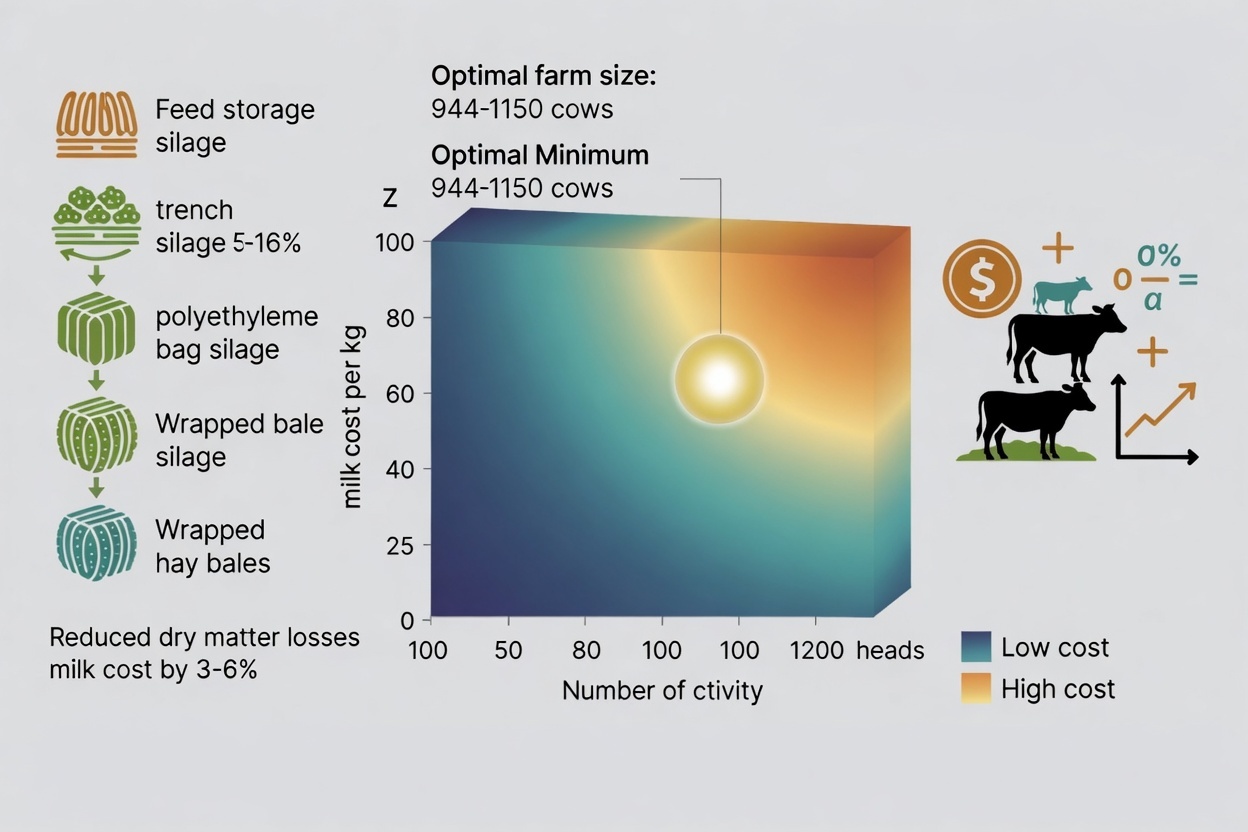
A model has been developed for optimizing production based on nonlinear programming, which takes into account technological, biochemical and economic losses of nutrients. The optimization criterion was chosen as the cost of 1 kg of milk, provided that the physiological needs of animals in dry matter, protein, and metabolizable energy are met. The theoretical model was built on the basis of nutrient balance ratios, production function of productivity, cost function and optimization of the production structure taking into account resource, technological and market constraints. The implementation was carried out using iterative methods. The results indicate an economically feasible production volume within 944–1150 cows for the productivity level, where the minimum specific costs are achieved. It is proven that a reduction in dry matter losses by 5% provides a reduction in the cost of milk by 3–6% depending on the size of the farm. Three-dimensional response surfaces were constructed, which can serve as a tool for planning dairy farms.
References
- Borreani, G., Tabacco, E., Schmidt, R. J., Holmes, B. J., Muck, R. E. (2018). Silage review: Factors affecting dry matter and quality losses in silages. Journal of Dairy Science, 101 (5), 3952–3979. https://doi.org/10.3168/jds.2017-13837
- Wróbel, B., Nowak, J., Fabiszewska, A., Paszkiewicz-Jasińska, A., Przystupa, W. (2023). Dry Matter Losses in Silages Resulting from Epiphytic Microbiota Activity – A Comprehensive Study. Agronomy, 13 (2), 450. https://doi.org/10.3390/agronomy13020450
- Luts, P. M., Troitska, O. O. (2012). Technology requirements to process of manufacture of a tinned forage from a beer pellet (the prolonged period of storage). Proceedings of Tavria State Agrotechnological University, 1 (12), 105–108. Available at: http://nbuv.gov.ua/UJRN/Ptdau_2012_12_1_15
- Koehler, B., Diepolder, M., Ostertag, J., Thurner, S., Spiekers, H. (2013). Dry matter losses of grass, lucerne and maize silages in bunker silos. Agricultural and Food Science, 22 (1), 145–150. https://doi.org/10.23986/afsci.6715
- Harrison, J. H., Blauwiekel, R., Stokes, M. R. (1994). Fermentation and Utilization of Grass Silage. Journal of Dairy Science, 77 (10), 3209–3235. https://doi.org/10.3168/jds.s0022-0302(94)77264-7
- Rotz, C. A. (1995). Loss Models for Forage Harvest. Transactions of the ASAE, 38 (6), 1621–1631. https://doi.org/10.13031/2013.27987
- Rotz, C. A., Oenema, J., van Keulen, H. (2006). Whole farm management to reduce nutrient losses from dairy farms: a simulation study. Applied Engineering in Agriculture, 22 (5), 773–784. https://doi.org/10.13031/2013.21992
- Val-Arreola, D., Kebreab, E., Mills, J. A. N., Wiggins, S. L., France, J. (2004). Forage production and nutrient availability in small-scale dairy systems in central Mexico using linear programming and partial budgeting. Nutrient Cycling in Agroecosystems, 69 (3), 191–201. https://doi.org/10.1023/b:fres.0000035173.67852.e8
- Savoie, P., Blais, Y., Desilets, D. (1986). Feasibility of direct-cut forage conservation in Quebec. Canadian Agricultural Engineering, 28 (1), 31–34. Available at: https://library.csbe-scgab.ca/docs/journal/28/28_1_31_ocr.pdf
- White, Wm. A. B., Batte, M. T., Forster, D. L. (1989). Selection of Forage Technologies for Beef Cow‐Calf Enterprises. Journal of Production Agriculture, 2 (3), 228–234. https://doi.org/10.2134/jpa1989.0228
- Nedosiekov, V. V., Petkun, H. V (2021). Animal welfare of dairy farm. Naukovi dopovidi NUBiP Ukrainy, 4 (92), 120–132. https://doi.org/10.31548/dopovidi2021.04.011
- Silage and Dry Hay Management (2019). Livestock and Poultry Environmental Learning Community Publication. Available at: https://lpelc.org/silage-and-dry-hay-management Last accessed: 09.02.2026
- Thoma, G., Popp, J., Nutter, D., Shonnard, D., Ulrich, R., Matlock, M. et al. (2013). Greenhouse gas emissions from milk production and consumption in the United States: A cradle-to-grave life cycle assessment circa 2008. International Dairy Journal, 31, S3–S14. https://doi.org/10.1016/j.idairyj.2012.08.013
- Sakhawat, I. (2011). The effect of silage quality on gross energy losses. [Master's Thesis; Swedish University of Agricultural Science]. Available at: https://stud.epsilon.slu.se/3684/1/sakhawat_i_111209.pdf
- Kondratuk, D., Luts, P., Zozulyak, I. (2025). Research into the processes of active ventilation and drying of agricultural crops for further storage. Transactions of Kremenchuk Mykhailo Ostrohradskyi National University, 4 (153), 370–377. https://doi.org/10.32782/1995-0519.2025.4.44
- Castillo, M. S. (2024). Silage and Haylage Production. NC State Extension Publication. Available at: https://content.ces.ncsu.edu/forage-conservation-techniques-silage-and-haylage-production Last accessed: 09.02.2026
- Coblentz, W. K., Akins, M. S., Jaramillo, D. M., Cavadini, J. S. (2022). Nutritive value, silage fermentation characteristics, and aerobic stability of grass-legume round-baled silages at differing moisture concentrations with and without manure fertilization and microbial inoculation. Journal of Animal Science, 100 (11). https://doi.org/10.1093/jas/skac325
- Charmley, E., Thomas, C. (1987). Wilting of herbage prior to ensiling: effects on conservation losses, silage fermentation and growth of beef cattle. Animal Science, 45 (2), 191–203. https://doi.org/10.1017/s000335610001878x
- Gunko, I., Babyn, I, Aliiev, E., Yaropud, V., Hrytsun, A. (2021). Research into operating modes of the air injector of the milking parlor flushing system. Universitatea Politehnica Bucureşti Scientific Bulletin. Series D, 83 (2), 297–310. Available at: https://dspace.dsau.dp.ua/items/819feab2-5070-4a9f-adaa-ba1c3ec4c3a1
- Atzori, A. S., Valsecchi, C., Manca, E., Masoero, F., Cannas, A., Gallo, A. (2021). Assessment of feed and economic efficiency of dairy farms based on multivariate aggregation of partial indicators measured on field. Journal of Dairy Science, 104 (12), 12679–12692. https://doi.org/10.3168/jds.2020-19764
- Gunko, I., Babyn, I., Pryshliak, V. (2020). Experimental studies of the air injector system operating modes of the milk washing system. Scientific Horizons, 88 (3), 44–53. https://doi.org/10.33249/2663-2144-2020-88-3-44-53
Downloads
Published
How to Cite
Issue
Section
License
Copyright (c) 2026 Pavlo Luts, Ihor Babyn, Serhii Burlaka, Viktor Mykytyuk, Ruslan Kisilov

This work is licensed under a Creative Commons Attribution 4.0 International License.
The consolidation and conditions for the transfer of copyright (identification of authorship) is carried out in the License Agreement. In particular, the authors reserve the right to the authorship of their manuscript and transfer the first publication of this work to the journal under the terms of the Creative Commons CC BY license. At the same time, they have the right to conclude on their own additional agreements concerning the non-exclusive distribution of the work in the form in which it was published by this journal, but provided that the link to the first publication of the article in this journal is preserved.