Development of information technology of operator-oriented digital spectral twin with two-circuit learning for selective spectral identification
DOI:
https://doi.org/10.15587/2706-5448.2026.361810Keywords:
information technology, digital twin, operator model, spectroscopy, parameter synthesis, regularization, spectral information content, multilayer structuresAbstract
The object of research is spectral processes in plasma and multilayer optical structures.
The problem solved in the work is the insufficient accuracy of identification of physical parameters and the low resistance of classical spectral models to noise disturbances, model errors and technological uncertainties, which complicates the selective isolation of informative spectral components in real spectroscopic measurements.
The peculiarity of the obtained results is the introduction of a composite operator of a digital spectral twin, which combines a physical model, a spectral filter and a neurooperator, in a single mathematical structure. A two-loop hybrid model training algorithm has been developed, which provides consistent adaptation of both physical parameters and neurooperator parameters. The effectiveness of the developed training algorithm has been assessed and the adaptive properties of the model to external conditions have been investigated. The time dynamics of the model and the dependence of the parameter identification error on the noise level have been estimated. The model was tested on two typical synthetic films, for which the Root Mean Square Error (RMSE) was reduced by almost 6–7 times compared to the purely physical model (Transfer Matrix Method, TMM), and the parametric error was reduced by almost 3 times.
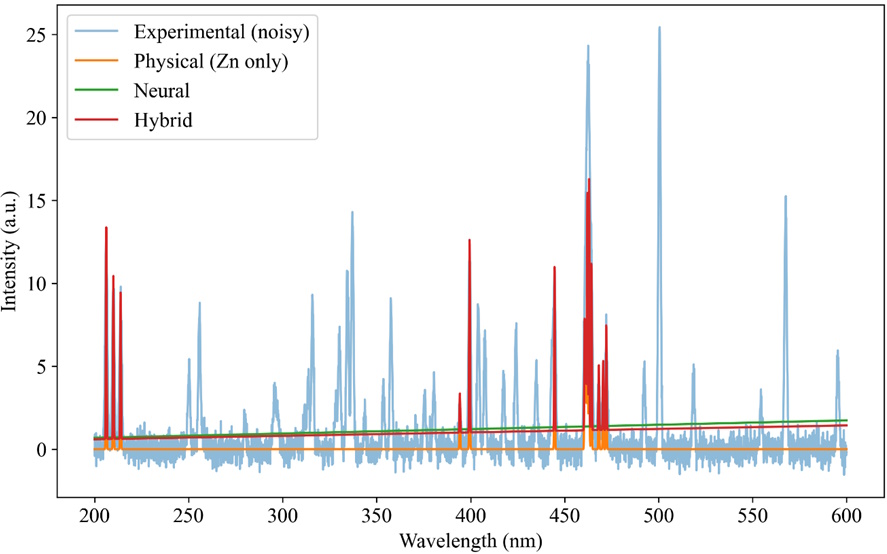
The testing of experimental data demonstrated selective identification of the dominant spectral lines of the electrode material against the background of contributions from impurity components. It was shown that the physical component of the model provides the correct localization and shape of the spectral lines of the electrodes, while the neurooperator compensates for residual spectral deviations. The practical significance of the results obtained lies in increasing the accuracy of spectral identification, automation of parametric synthesis, calibration of spectroscopic systems, and creation of adaptive digital twins in the tasks of diagnostics and design of optical and plasma systems.
References
- Azzam, R. M. A., Bashara, N. M. (1987). Ellipsometry and polarized light. North-Holland. Available at: https://archive.org/search.php?query=external-identifier%3A%22urn%3Aoclc%3Arecord%3A1330351422%22
- Born, M., Wolf, E. (1999). Principles of optics. Cambridge University Press. Available at: https://www.scribd.com/doc/23494793/Born-Wolf-1999-Principles-of-Optics-7th-Ed
- Macleod, H. A. (2010). Thin-film optical filters. CRC Press, 800. https://doi.org/10.1201/9781420073034
- Richter, M. (2020). Inverse problems: Basics, theory and applications in geophysics. Birkhäuser, 273. https://doi.org/10.1007/978-3-030-59317-9
- Kirsch, A. (2011). An introduction to the mathematical theory of inverse problems. Springer, 310. https://doi.org/10.1007/978-1-4419-8474-6
- Hansen, P. C. (2010). Discrete inverse problems: Insight and algorithms. SIAM, 206. https://doi.org/10.1137/1.9780898718836
- Isakov, V. (2017). Inverse problems. Inverse problems for partial differential equations. Springer, 1–22. https://doi.org/10.1007/978-3-319-51658-5_1
- Han, J., Jentzen, A., Weinan, E. (2018). Solving high-dimensional partial differential equations using deep learning. Proceedings of the National Academy of Sciences, 115 (34), 8505–8510. https://doi.org/10.1073/pnas.1718942115
- Karniadakis, G. E., Kevrekidis, I. G., Lu, L., Perdikaris, P., Wang, S., Yang, L. (2021). Physics-informed machine learning. Nature Reviews Physics, 3 (6), 422–440. https://doi.org/10.1038/s42254-021-00314-5
- Raissi, M., Perdikaris, P., Karniadakis, G. E. (2019). Physics-informed neural networks: A deep learning framework for solving forward and inverse problems involving nonlinear partial differential equations. Journal of Computational Physics, 378, 686–707. https://doi.org/10.1016/j.jcp.2018.10.045
- Li, Z., Kovachki, N., Azizzadenesheli, K., Liu, B., Bhattacharya, K., Stuart, A., Anandkumar, A. (2021). Fourier neural operator for parametric partial differential equations. International Conference on Learning Representations (ICLR). Available at: https://openreview.net/forum?id=c8P9NQVtmnO
- Lu, L., Jin, P., Pang, G., Zhang, Z., Karniadakis, G. E. (2021). Learning nonlinear operators via DeepONet based on the universal approximation theorem of operators. Nature Machine Intelligence, 3 (3), 218–229. https://doi.org/10.1038/s42256-021-00302-5
- Kamyab, S., Azimifar, Z., Sabzi, R., Fieguth, P. (2022). Deep learning methods for inverse problems. PeerJ Computer Science, 8, e951. https://doi.org/10.7717/peerj-cs.951
- Colson, B., Marcotte, P., Savard, G. (2007). An overview of bilevel optimization. Annals of Operations Research, 153 (1), 235–256. https://doi.org/10.1007/s10479-007-0176-2
- Franceschi, L., Frasconi, P., Salzo, S., Grazzi, R., Pontil, M. (2018). Bilevel programming for hyperparameter optimization and meta-learning. Proceedings of the 35th International Conference on Machine Learning (ICML), 1568–1577. https://doi.org/10.48550/arXiv.1806.04910
- Bilak, Yu. Yu., Saibert, F. F., Reblian, A. M. (2025). Development of a hybrid inverse analysis model for evaluating spectral characteristics of multilayered structures. Visnyk of Kherson National Technical University, 2 (1 (92)), 22–31. https://doi.org/10.35546/kntu2078-4481.2025.1.2.3
- Tao, F., Zhang, M., Nee, A. Y. C. (2019). Digital twin driven smart manufacturing. Elsevier. https://doi.org/10.1016/c2018-0-02206-9
- Yeh, P. (1988). Optical waves in layered media. John Wiley & Sons. Available at: https://www.scribd.com/document/1013619181/Optical-Waves-in-Layered-Media-2nd-Edition-Pochi-Yeh-ebook-complete-unlock-2026
- Moharam, M. G., Gaylord, T. K. (1981). Rigorous coupled-wave analysis of planar-grating diffraction. Journal of the Optical Society of America, 71 (7), 811. https://doi.org/10.1364/josa.71.000811
- Bertero, M., Boccacci, P. (1998). Introduction to inverse problems in imaging. IOP Publishing. https://doi.org/10.1887/0750304359
- Hastie, T., Tibshirani, R., Friedman, J. (2001). The elements of statistical learning. Springer, 536. https://doi.org/10.1007/978-0-387-21606-5
- Sinha, A., Malo, P., Deb, K. (2018). A Review on Bilevel Optimization: From Classical to Evolutionary Approaches and Applications. IEEE Transactions on Evolutionary Computation, 22 (2), 276–295. https://doi.org/10.1109/tevc.2017.2712906
- Kovachki, N., Li, Z., Liu, B., Azizzadenesheli, K., Bhattacharya, K., Stuart, A., Anandkumar, A. (2023). Neural operator: Learning maps between function spaces with applications to PDEs. Journal of Machine Learning Research, 24 (89), 1–97. Available at: https://www.jmlr.org/papers/volume24/21-1524/21-1524.pdf
- Kingma, D. P., Ba, J. (2015). Adam: A method for stochastic optimization. International Conference on Learning Representations (ICLR). Available at: https://arxiv.org/abs/1412.6980
- Palik, E. D. (Ed.) (1998). Handbook of optical constants of solids. Academic Press. Available at: https://www.sciencedirect.com/book/9780125444156/handbook-of-optical-constants-of-solids
- Polyanskiy, M. N. (2024). Refractiveindex.info database of optical constants. Scientific Data, 11 (1). https://doi.org/10.1038/s41597-023-02898-2
- Shuaibov, O. K., Hrytsak, R. V., Minya, O. I., Malinina, A. A., Bilak, Yu. Yu., Gomoki, Z. T. (2022). Spectroscopic diagnostics of overstressed nanosecond discharge plasma between zinc electrodes in air and nitrogen. Journal of Physical Studies, 26 (2). https://doi.org/10.30970/jps.26.2501
- Shuaibov, A. K., Minya, A. I., Malinina, A. A., Gritsak, R. V., Malinin, A. N., Bilak, Yu. Yu., Vatrala, M. I. (2022). Characteristics and Plasma Parameters of the Overstressed Nanosecond Discharge in Air between an Aluminum Electrode and a Chalcopyrite Electrode (СuInSe2). Surface Engineering and Applied Electrochemistry, 58 (4), 369–385. https://doi.org/10.3103/s1068375522040123
- Hrytsak, R., Shuaibov, O., Minya, O., Malinina, A., Shevera, I., Bilak, Y., Homoki, Z. (2024). Conditions for pulsed gas-discharge synthesis of thin tungsten oxide films from a plasma mixture of air with tungsten vapors. Physics and Chemistry of Solid State, 25 (4), 684–688. https://doi.org/10.15330/pcss.25.4.684-688
- Grippo, L., Sciandrone, M. (2000). On the convergence of the block nonlinear Gauss-Seidel method under convex constraints. Operations Research Letters, 26 (3), 127–136. https://doi.org/10.1016/s0167-6377(99)00074-7
Downloads
Published
How to Cite
Issue
Section
License
Copyright (c) 2026 Yurii Bilak, Antonina Reblian, Beata Matyashovska, Emilian Herashchenkov

This work is licensed under a Creative Commons Attribution 4.0 International License.
The consolidation and conditions for the transfer of copyright (identification of authorship) is carried out in the License Agreement. In particular, the authors reserve the right to the authorship of their manuscript and transfer the first publication of this work to the journal under the terms of the Creative Commons CC BY license. At the same time, they have the right to conclude on their own additional agreements concerning the non-exclusive distribution of the work in the form in which it was published by this journal, but provided that the link to the first publication of the article in this journal is preserved.