Integrated diagnostic assessment of light industry clusters development in the socio-economic system of Azerbaijan
DOI:
https://doi.org/10.15587/2706-5448.2026.363059Keywords:
innovation, economic potential, industrial clusters, light industry, non-oil sector, competitivenessAbstract
The object of research is the processes of formation and development of light industry clusters in the socio-economic system of Azerbaijan, as well as the mechanisms of their technological audit and assessment of production reserves in the conditions of innovative transformation of the economy. The research problematic lies in the lack of comprehensive diagnostic tools for assessing the integration potential of industrial zones and identifying hidden production reserves. Existing fragmented approaches do not allow for an accurate measurement of the impact of networking on labor productivity indicators, which complicates informed management decisions regarding the allocation of public investment in infrastructure.
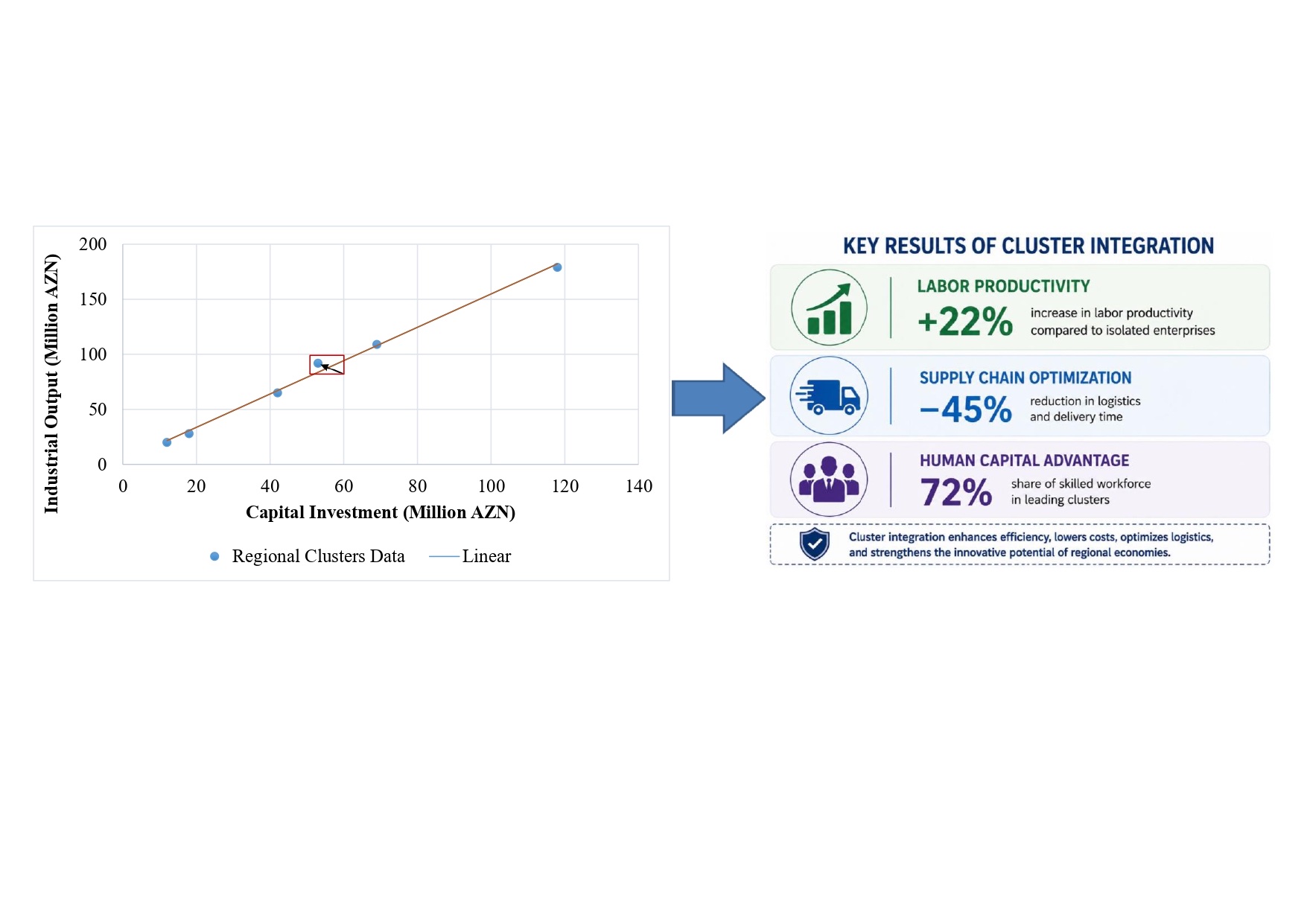
The results include a developed diagnostic model for assessing industrial cluster potential based on the Integral Diagnostic Index (IDI). Calculations revealed the highest value for the Baku-Absheron region (0.74). The Aran (0.54) and Lankaran-Astara (0.46) regions, however, have limited potential. The research quantified a stable investment multiplier – 1.61, demonstrating the effectiveness of cluster infrastructure development. It was also found that cluster integration provides a 22% increase in labor productivity compared to stand-alone enterprises.
The results are mainly explained by the synergistic effect of concentrating resources in technology parks, including the Mingachevir Technology Park, and lowering transaction costs. The Baku-Absheron region’s leadership is based on its well-developed innovation infrastructure. The higher efficiency of clusters is due to optimizing supply chains (reducing logistics time by 45%) and the dominant influence of human capital: the share of qualified personnel in leading clusters reaches 72%.
The results can be utilized in practice if they are incorporated into government monitoring programs for industrial policy until 2030. The developed IDI model is applicable to assessing the effectiveness of existing industrial districts and identifying regions requiring priority financial support for non-oil sector development.
References
- Porter, M. E. (1998). Clusters and the new economics of competition. Harvard Business Review, 76 (6), 77–90. https://hbr.org/1998/11/clusters-and-the-new-economics-of-competition
- Porter, M. E. (2000). Location, Competition, and Economic Development: Local Clusters in a Global Economy. Economic Development Quarterly, 14 (1), 15–34. https://doi.org/10.1177/089124240001400105
- Porter, M. E., Ketels, C., Delgado, M. (2011). Microeconomic foundations of competitiveness. World Economic Forum Report.
- Delgado, M., Ketels, C., Porter, M. E., Stern, S. (2019). The determinants of national competitiveness. NBER Working Paper No. 18249. https://doi.org/10.3386/w18249
- Amrahov, V. T. O., Karimova, M. H. G., Karimov, F. J. (2022). Development opportunities of material and technical resource potential in the agricultural sector. European Journal of Economics and Management Sciences, 1, 62–68. https://doi.org/10.29013/ejems-22-1-62-68
- Karimova, M. H., Babakishiyeva, S. F., Metiyeva, S. (2023). The impact of e-commerce development in Azerbaijan on consumer food market management. European Scientific Review, 5 (6), 25–28.
- Asheim, B. T., Gertler, M. S.; Fagerberg, J., Mowery, D., Nelson, R. (Eds.) (2009). The Geography of Innovation: Regional Innovation Systems. The Oxford Handbook of Innovation. Oxford University Press, 291–317. https://doi.org/10.1093/oxfordhb/9780199286805.003.0011
- Delgado, M., Porter, M. E., Stern, S. (2014). Clusters, convergence, and economic performance. Research Policy, 43 (10), 1785–1799. https://doi.org/10.1016/j.respol.2014.05.007
- Duranton, G., Puga, D. (2004). Micro-foundations of urban agglomeration economies. Handbook of Regional and Urban Economics. Elsevier, 2063–2117. https://doi.org/10.1016/s1574-0080(04)80005-1
- Gordon, I. R., McCann, P. (2000). Industrial Clusters: Complexes, Agglomeration and/or Social Networks? Urban Studies, 37 (3), 513–532. https://doi.org/10.1080/0042098002096
- Ketels, C. (2013). Recent research on competitiveness and clusters: what are the implications for regional policy? Cambridge Journal of Regions, Economy and Society, 6 (2), 269–284. https://doi.org/10.1093/cjres/rst008
- Maskell, P., Malmberg, A. (1999). Localised learning and industrial competitiveness. Cambridge Journal of Economics, 23 (2), 167–185. https://doi.org/10.1093/cje/23.2.167
- Ketels, C., Protsiv, S. (2013). Clusters and the new growth path for Europe. Europe Working Paper Series, No. 14. Available at: https://www.hbs.edu/faculty/Pages/item.aspx?num=45185
- Trillo, J. R., Mammadov, J., Huseynov, Y., Ahmadova, M., Eminova, A. (2026). Automation of the Control Process of the Research and Flexible Production Areas of the Technopark. Ai, 7 (5), 173. https://doi.org/10.3390/ai7050173
- Mammadov, J., Huseynov, E., Talibov, N., Akhmadova, T., Ganjaliyeva, G. (2018). Development of Program Tool For Expert Assessment of Innovation Projects in the Scientific Technopark. IFAC-PapersOnLine, 51 (30), 571–574. https://doi.org/10.1016/j.ifacol.2018.11.248
- Mammadov, J., Huseynov, Y., Ahmadova, M., Mammadova, G., Askerov, A. (2025). Developing a marketing strategy for efficient management of the information environment of the technology park. Eastern-European Journal of Enterprise Technologies, 3 (13 (135)), 26–34. https://doi.org/10.15587/1729-4061.2025.330483
- Audretsch, D. B., Feldman, M. P. (2004). Knowledge spillovers and the geography of innovation. Handbook of Regional and Urban Economics. Elsevier, 2713–2739. https://doi.org/10.1016/s1574-0080(04)80018-x
- Bathelt, H., Malmberg, A., Maskell, P. (2004). Clusters and knowledge: local buzz, global pipelines and the process of knowledge creation. Progress in Human Geography, 28 (1), 31–56. https://doi.org/10.1191/0309132504ph469oa
- Feldman, M. P., Audretsch, D. B. (1999). Innovation in cities: Science-based diversity, specialization and localized competition. European Economic Review, 43 (2), 409–429. https://doi.org/10.1016/s0014-2921(98)00047-6
- Krugman, P. (1991). Geography and trade. MIT Press.
- World Development Report 2020: Trading for Development in the Age of Global Value Chains (2019). Washington: World Bank. https://doi.org/10.1596/978-1-4648-1457-0
- Turok, I., McGranahan, G. (2019). Urbanisation and Economic Growth: The Arguments and Evidence for Africa and Asia. Urbanisation, 4 (2), 109–125. https://doi.org/10.1177/2455747119890450
- The future of manufacturing: Industry 4.0 and global production networks (2021). McKinsey Global Institute.
- Updating the 2020 New Industrial Strategy: Building a stronger Single Market for Europe’s recovery (2021). European Commission. Available at: https://eur-lex.europa.eu/legal-content/EN/TXT/?uri=CELEX:52021DC0350
- Centre for Entrepreneurship, SMEs, Regions and Cities. OECD. Available at: https://www.oecd.org/cfe/regionaldevelopment/oecd-reviews-of-regional-innovation.htm
- The Future of Industrialization in a Post-Pandemic World: Industrial Development Report 2022 (2022). Vienna: United Nations Industrial Development Organization. Available at: https://www.unido.org/news/future-industrialization-post-pandemic-world-industrial-development-report-2022
- Karimov, V., Karimova, S. (2018). The results of implementation of the leslie model taking into account various epidemics. Internauka, 15. https://doi.org/10.25313/2520-2057-2018-15-4115
- Gereffi, G. (2018). Global value chains and development: Redefining the contours of 21st century capitalism. Cambridge University Press. https://doi.org/10.1017/9781108559423
- Ismayilov, K. (2025). Textile Industry in Azerbaijan: Opportunities, Perspectives and Challenges. Center for Economic and Social Development (CESD). Available at: http://cesd.az/y/panel/uploads/46174627589-CESDPaperTextileindustryinAzerbaijan.pdf
- “Greening the Industry” – Azerbaijani textile manufacturers Alyans, Baku, and BETEX benefit from taking part in the EU4Environment company assessments (2023). EU4Environment. Available at: https://www.eu4environment.org/news/greening-the-industry-azerbaijani-textile-manufacturers-alyans-baku-and-betex-benefit-from-taking-part-in-the-eu4environment-company-assessments/
- Rodrik, D. (2004). Industrial policy for the twenty-first century. HKS Working Paper No. RWP04-047. Available at: https://www.hks.harvard.edu/publications/industrial-policy-twenty-first-century
- Hasanov, R. I., Mehdiyeva, G., Bahramov, A., Cavadzada, X., Kerimova, M. (2024). Examining Sectoral Contributions and Determinants of Carbon Emission Reduction in Azerbaijan: An Empirical Analysis. International Journal of Sustainable Development and Planning, 19 (8), 2873–2879. https://doi.org/10.18280/ijsdp.190806
- Orujova, G., Agayev, U., Genjeliyeva, G., Ahmadzada, A., Huseynov, Y., Ahmadova, M. (2025). Modeling of the innovation construction mobile industrial robot applied in technology park. 2025 International Conference Automatics and Informatics (ICAI). Varna 75–79. https://doi.org/10.1109/icai67591.2025.11324555
Downloads
Published
How to Cite
Issue
Section
License
Copyright (c) 2026 Metanet Ahmadova, Minura Karimova, Fazil Karimov, Rizvan Majidov, Gulgun Abdiyeva, Lamiye Bayramova, Samira Nuriyeva

This work is licensed under a Creative Commons Attribution 4.0 International License.
The consolidation and conditions for the transfer of copyright (identification of authorship) is carried out in the License Agreement. In particular, the authors reserve the right to the authorship of their manuscript and transfer the first publication of this work to the journal under the terms of the Creative Commons CC BY license. At the same time, they have the right to conclude on their own additional agreements concerning the non-exclusive distribution of the work in the form in which it was published by this journal, but provided that the link to the first publication of the article in this journal is preserved.