Комплексна діагностична оцінка розвитку кластерів легкої промисловості в соціально-економічній системі Азербайджану
DOI:
https://doi.org/10.15587/2706-5448.2026.363059Ключові слова:
інновації, економічний потенціал, промислові кластери, легка промисловість, ненафтовий сектор, конкурентоспроможністьАнотація
Об'єктом дослідження є процеси формування та розвитку кластерів легкої промисловості в соціально-економічній системі Азербайджану, а також механізми їх технологічного аудиту та оцінки резервів виробництва в умовах інноваційної трансформації економіки. Проблематика дослідження полягає у відсутності комплексних діагностичних інструментів для оцінки інтеграційного потенціалу промислових зон та виявлення прихованих резервів виробництва. Існуючі фрагментарні підходи не дозволяють точно виміряти вплив мережевої взаємодії на показники продуктивності праці, що ускладнює прийняття обґрунтованих управлінських рішень щодо розподілу державних інвестицій в інфраструктуру.
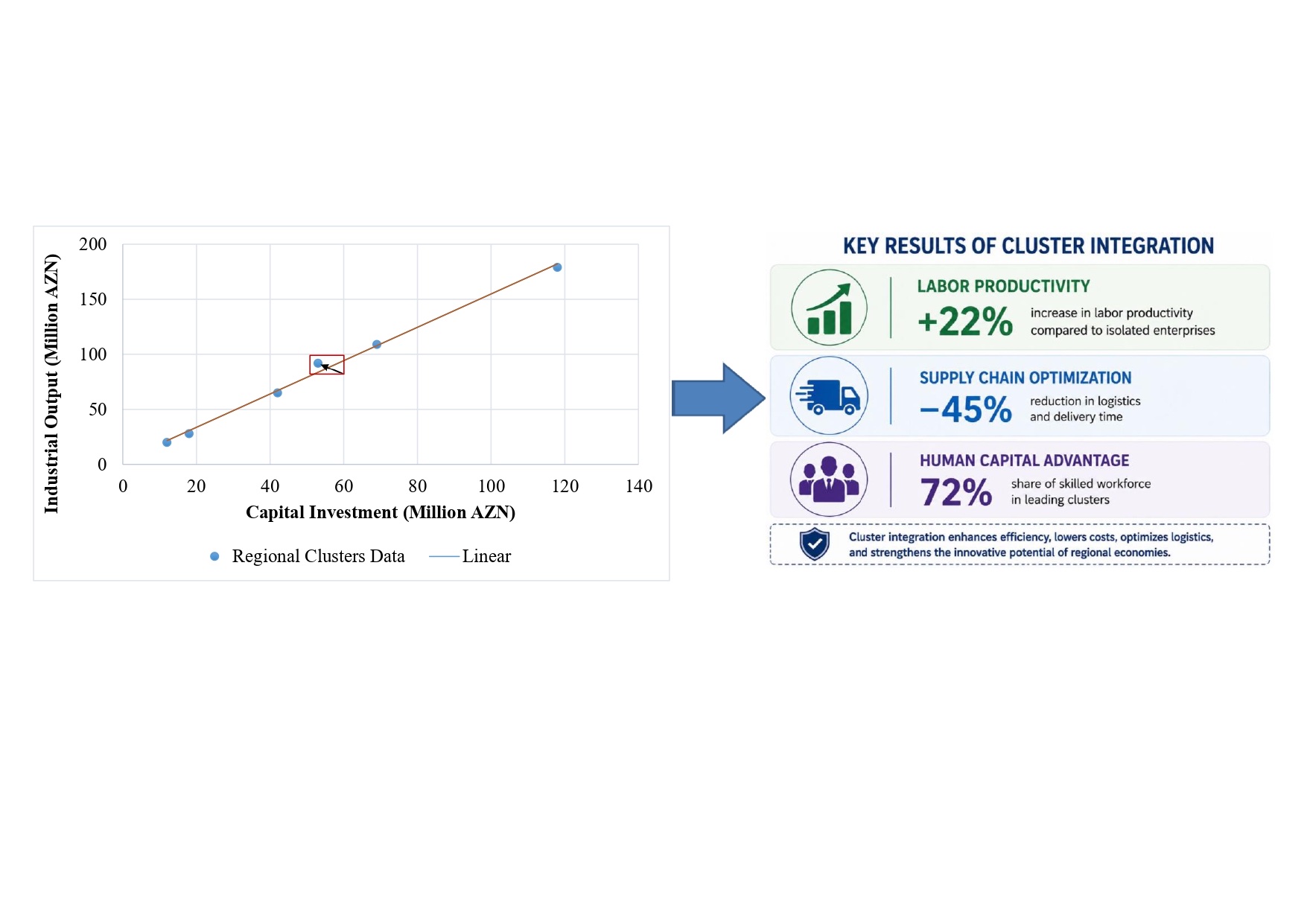
Результати включають розроблену діагностичну модель оцінки потенціалу промислового кластера на основі Інтегрального діагностичного індексу (ІДІ). Розрахунки виявили найвище значення для Бакусько-Апшеронського регіону (0,74). Проте Аранський (0,54) та Ленкорансько-Астарський (0,46) регіони мають обмежений потенціал. Дослідження кількісно визначило стабільний інвестиційний мультиплікатор – 1,61, що демонструє ефективність розвитку кластерної інфраструктури. Також було виявлено, що кластерна інтеграція забезпечує 22% зростання продуктивності праці порівняно з окремими підприємствами.
Результати пояснюються переважно синергетичним ефектом концентрації ресурсів у технопарках, зокрема в Мінгачевірському технопарку, та зниженням транзакційних витрат. Лідерство Бакусько-Апшеронського регіону базується на його добре розвиненій інноваційній інфраструктурі. Вища ефективність кластерів зумовлена оптимізацією ланцюгів поставок (скорочення часу логістики на 45%) та домінуючим впливом людського капіталу: частка кваліфікованого персоналу у провідних кластерах сягає 72%.
Результати можуть бути використані на практиці, якщо їх врахувати в державних програмах моніторингу промислової політики до 2030 року. Розроблена модель ІДІ застосовна для оцінки ефективності існуючих промислових районів та визначення регіонів, які потребують пріоритетної фінансової підтримки розвитку ненафтового сектору.
Посилання
- Porter, M. E. (1998). Clusters and the new economics of competition. Harvard Business Review, 76 (6), 77–90. https://hbr.org/1998/11/clusters-and-the-new-economics-of-competition
- Porter, M. E. (2000). Location, Competition, and Economic Development: Local Clusters in a Global Economy. Economic Development Quarterly, 14 (1), 15–34. https://doi.org/10.1177/089124240001400105
- Porter, M. E., Ketels, C., Delgado, M. (2011). Microeconomic foundations of competitiveness. World Economic Forum Report.
- Delgado, M., Ketels, C., Porter, M. E., Stern, S. (2019). The determinants of national competitiveness. NBER Working Paper No. 18249. https://doi.org/10.3386/w18249
- Amrahov, V. T. O., Karimova, M. H. G., Karimov, F. J. (2022). Development opportunities of material and technical resource potential in the agricultural sector. European Journal of Economics and Management Sciences, 1, 62–68. https://doi.org/10.29013/ejems-22-1-62-68
- Karimova, M. H., Babakishiyeva, S. F., Metiyeva, S. (2023). The impact of e-commerce development in Azerbaijan on consumer food market management. European Scientific Review, 5 (6), 25–28.
- Asheim, B. T., Gertler, M. S.; Fagerberg, J., Mowery, D., Nelson, R. (Eds.) (2009). The Geography of Innovation: Regional Innovation Systems. The Oxford Handbook of Innovation. Oxford University Press, 291–317. https://doi.org/10.1093/oxfordhb/9780199286805.003.0011
- Delgado, M., Porter, M. E., Stern, S. (2014). Clusters, convergence, and economic performance. Research Policy, 43 (10), 1785–1799. https://doi.org/10.1016/j.respol.2014.05.007
- Duranton, G., Puga, D. (2004). Micro-foundations of urban agglomeration economies. Handbook of Regional and Urban Economics. Elsevier, 2063–2117. https://doi.org/10.1016/s1574-0080(04)80005-1
- Gordon, I. R., McCann, P. (2000). Industrial Clusters: Complexes, Agglomeration and/or Social Networks? Urban Studies, 37 (3), 513–532. https://doi.org/10.1080/0042098002096
- Ketels, C. (2013). Recent research on competitiveness and clusters: what are the implications for regional policy? Cambridge Journal of Regions, Economy and Society, 6 (2), 269–284. https://doi.org/10.1093/cjres/rst008
- Maskell, P., Malmberg, A. (1999). Localised learning and industrial competitiveness. Cambridge Journal of Economics, 23 (2), 167–185. https://doi.org/10.1093/cje/23.2.167
- Ketels, C., Protsiv, S. (2013). Clusters and the new growth path for Europe. Europe Working Paper Series, No. 14. Available at: https://www.hbs.edu/faculty/Pages/item.aspx?num=45185
- Trillo, J. R., Mammadov, J., Huseynov, Y., Ahmadova, M., Eminova, A. (2026). Automation of the Control Process of the Research and Flexible Production Areas of the Technopark. Ai, 7 (5), 173. https://doi.org/10.3390/ai7050173
- Mammadov, J., Huseynov, E., Talibov, N., Akhmadova, T., Ganjaliyeva, G. (2018). Development of Program Tool For Expert Assessment of Innovation Projects in the Scientific Technopark. IFAC-PapersOnLine, 51 (30), 571–574. https://doi.org/10.1016/j.ifacol.2018.11.248
- Mammadov, J., Huseynov, Y., Ahmadova, M., Mammadova, G., Askerov, A. (2025). Developing a marketing strategy for efficient management of the information environment of the technology park. Eastern-European Journal of Enterprise Technologies, 3 (13 (135)), 26–34. https://doi.org/10.15587/1729-4061.2025.330483
- Audretsch, D. B., Feldman, M. P. (2004). Knowledge spillovers and the geography of innovation. Handbook of Regional and Urban Economics. Elsevier, 2713–2739. https://doi.org/10.1016/s1574-0080(04)80018-x
- Bathelt, H., Malmberg, A., Maskell, P. (2004). Clusters and knowledge: local buzz, global pipelines and the process of knowledge creation. Progress in Human Geography, 28 (1), 31–56. https://doi.org/10.1191/0309132504ph469oa
- Feldman, M. P., Audretsch, D. B. (1999). Innovation in cities: Science-based diversity, specialization and localized competition. European Economic Review, 43 (2), 409–429. https://doi.org/10.1016/s0014-2921(98)00047-6
- Krugman, P. (1991). Geography and trade. MIT Press.
- World Development Report 2020: Trading for Development in the Age of Global Value Chains (2019). Washington: World Bank. https://doi.org/10.1596/978-1-4648-1457-0
- Turok, I., McGranahan, G. (2019). Urbanisation and Economic Growth: The Arguments and Evidence for Africa and Asia. Urbanisation, 4 (2), 109–125. https://doi.org/10.1177/2455747119890450
- The future of manufacturing: Industry 4.0 and global production networks (2021). McKinsey Global Institute.
- Updating the 2020 New Industrial Strategy: Building a stronger Single Market for Europe’s recovery (2021). European Commission. Available at: https://eur-lex.europa.eu/legal-content/EN/TXT/?uri=CELEX:52021DC0350
- Centre for Entrepreneurship, SMEs, Regions and Cities. OECD. Available at: https://www.oecd.org/cfe/regionaldevelopment/oecd-reviews-of-regional-innovation.htm
- The Future of Industrialization in a Post-Pandemic World: Industrial Development Report 2022 (2022). Vienna: United Nations Industrial Development Organization. Available at: https://www.unido.org/news/future-industrialization-post-pandemic-world-industrial-development-report-2022
- Karimov, V., Karimova, S. (2018). The results of implementation of the leslie model taking into account various epidemics. Internauka, 15. https://doi.org/10.25313/2520-2057-2018-15-4115
- Gereffi, G. (2018). Global value chains and development: Redefining the contours of 21st century capitalism. Cambridge University Press. https://doi.org/10.1017/9781108559423
- Ismayilov, K. (2025). Textile Industry in Azerbaijan: Opportunities, Perspectives and Challenges. Center for Economic and Social Development (CESD). Available at: http://cesd.az/y/panel/uploads/46174627589-CESDPaperTextileindustryinAzerbaijan.pdf
- “Greening the Industry” – Azerbaijani textile manufacturers Alyans, Baku, and BETEX benefit from taking part in the EU4Environment company assessments (2023). EU4Environment. Available at: https://www.eu4environment.org/news/greening-the-industry-azerbaijani-textile-manufacturers-alyans-baku-and-betex-benefit-from-taking-part-in-the-eu4environment-company-assessments/
- Rodrik, D. (2004). Industrial policy for the twenty-first century. HKS Working Paper No. RWP04-047. Available at: https://www.hks.harvard.edu/publications/industrial-policy-twenty-first-century
- Hasanov, R. I., Mehdiyeva, G., Bahramov, A., Cavadzada, X., Kerimova, M. (2024). Examining Sectoral Contributions and Determinants of Carbon Emission Reduction in Azerbaijan: An Empirical Analysis. International Journal of Sustainable Development and Planning, 19 (8), 2873–2879. https://doi.org/10.18280/ijsdp.190806
- Orujova, G., Agayev, U., Genjeliyeva, G., Ahmadzada, A., Huseynov, Y., Ahmadova, M. (2025). Modeling of the innovation construction mobile industrial robot applied in technology park. 2025 International Conference Automatics and Informatics (ICAI). Varna 75–79. https://doi.org/10.1109/icai67591.2025.11324555
##submission.downloads##
Опубліковано
Як цитувати
Номер
Розділ
Ліцензія
Авторське право (c) 2026 Metanet Ahmadova, Minura Karimova, Fazil Karimov, Rizvan Majidov, Gulgun Abdiyeva, Lamiye Bayramova, Samira Nuriyeva

Ця робота ліцензується відповідно до Creative Commons Attribution 4.0 International License.
Закріплення та умови передачі авторських прав (ідентифікація авторства) здійснюється у Ліцензійному договорі. Зокрема, автори залишають за собою право на авторство свого рукопису та передають журналу право першої публікації цієї роботи на умовах ліцензії Creative Commons CC BY. При цьому вони мають право укладати самостійно додаткові угоди, що стосуються неексклюзивного поширення роботи у тому вигляді, в якому вона була опублікована цим журналом, але за умови збереження посилання на першу публікацію статті в цьому журналі.