Methodological support for assessment of the company’s personnel potential quality based on the quality function deployment method
DOI:
https://doi.org/10.15587/2706-5448.2026.363464Keywords:
company’s personnel potential, quality function deployment method, house of quality, company’s key success factors, consumer’s needsAbstract
The object of research is the company's success key factors implementation by improving the quality of its personnel potential. The research is directed at studying the issue of assessing the quality of a company's personnel potential.
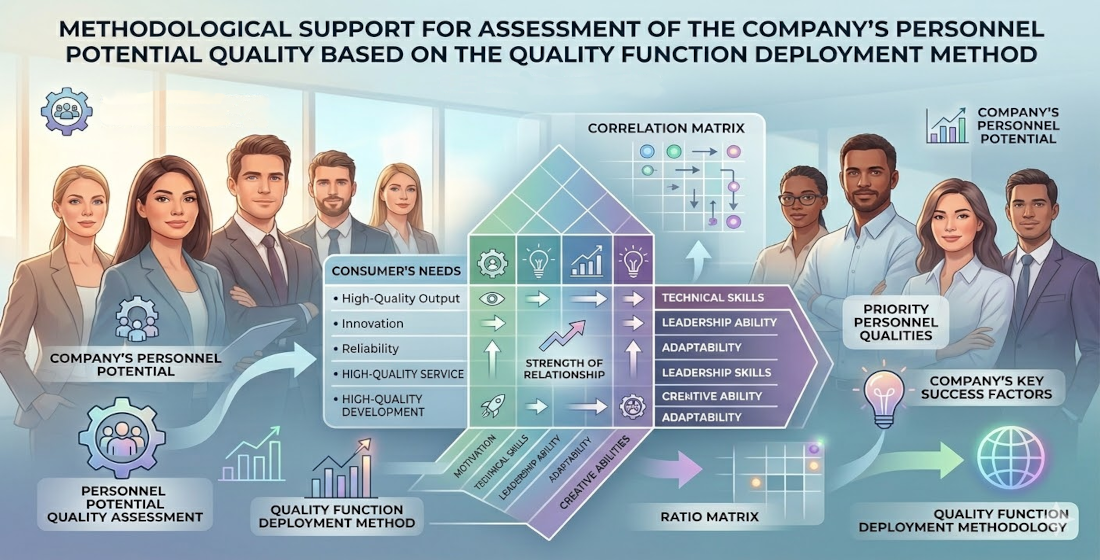
The paper is devoted to substantiating methodological recommendations for assessing the quality of the company's personnel potential based on the method of deploying the quality function. It takes into account the cause-and-effect relationships between the company's target requirements, the components of its personnel potential, and the processes that ensure the level of its implementation.
The quality function deployment analysis uses permits to reveal relationships among the personnel potential components. This method helps to set factors influencing their implementation level. Results will permit the company’s management to develop a clear measures plan for personnel work. It will be focused on the company’s key success factors achievement. Emphasis on the key areas will make it possible to minimize the costs spent on maintaining and realizing the company's employees’ potential.
To obtain an objective evaluation valid for decision-making, it is suggested to determine the company's personnel potential quality through success key factors. Such an approach makes it possible to form the objective criteria to compare personnel potential of different companies.
The results are presented with using the ratio matrix. It shows correlation of the company’s personnel potential components implementation level and influencing on them factors. The results suggest that company’s management must pay attention to the team socio-psychological climate, organizational management structure and material and non-material stimulation system.
The quality function deployment method can be used for constant improvement and quality increasing the personnel management system functioning at the enterprise in general: social and labor relations, HR policy, personnel planning, personnel selection and adaptation, personnel stimulation, personnel development, corporate culture forming, personnel assessment and control.
References
- Bilorus, T. V. (2007). Stratehichne upravlinnia kadrovym potentsialom pidpryiemstva. Irpin: Natsionalna akademiia DPS Ukrainy, 174. Available at: http://www.irbis-nbuv.gov.ua/publ/REF-0000103247
- Svetlichnaiy, V. L. (2014). Methods of assessing potential of the company in the context of knowledge economy. Ekonomichni innovatsii, 57, 361–367. Available at: http://nbuv.gov.ua/UJRN/ecinn_2014_57_38
- Akao, Y. (2004). Quality Function Deployment (QFD). Integrating customer requirements into product design. Productivity Press, 392. https://doi.org/10.4324/9781003578833
- Akao, Y., Mizuno, S. (Eds.) (1994). QFD, the customer-driven approach to quality planning and deployment. Asian Productivity Organization.
- Shigeru, M., Yoji, A. et al. (1978). Quality Function Deployment: Approach to Company-Wide Quality Management. Tokyo: Japan Union of Scientists and Engineers.
- Wolniak, R. (2017). The history of the QFD method. Scientific Papers of Silesian University of Technology. Organization and Management Series, 2017 (100), 553–564. https://doi.org/10.29119/1641-3466.2017.100.42
- Wolniak, R. (2018). The use of QFD method advantages and limitation. Production Engineering Archives, 18 (18), 14–17. https://doi.org/10.30657/pea.2018.18.02
- Abu-Assab, S. (2012). Quality Function Deployment in New Product Development. Integration of Preference Analysis Methods into Quality Function Deployment. Gabler Verlag. 47–68. https://doi.org/10.1007/978-3-8349-7075-6_4
- Chan, L.-K., Wu, M.-L. (2002). Quality function deployment: A literature review. European Journal of Operational Research, 143 (3), 463–497. https://doi.org/10.1016/s0377-2217(02)00178-9
- Holovko, M. P., Miachykov, O. V., Kolesnyk, T. L. (2012). Vykorystannia rozghortannia funktsii yakosti pid chas pidhotovky spetsialistiv u sferi sudovo-tovaroznavchoi ekspertyzy. Prohresyvni tekhnika ta tekhnolohii kharchovykh vyrobnytstv restorannoho hospodarstva i torhivli, 1, 591–598. Available at: http://nbuv.gov.ua/UJRN/Pt_2012_1_93
- Jandaghi, G., Amiri, A. N., Mollaee, A. (2020). A quality function deployment approach to HR strategy formation and prioritization: Meeting client satisfaction in service organizations. International Journal of Banking, Economics and Finance, 4 (3), 001–009. Available at: https://www.internationalscholarsjournals.com/articles/a-quality-function-deployment-approach-to-hr-strategy-formation-and-prioritization-meeting-client-satisfaction-in-servic.pdf
- Nykonenko, A. V. (2020) Diagnosis of staff competitiveness based on the concept of “Quality house”. Internauka, 3, 62–73. Available at: http://dspace.nuft.edu.ua/jspui/handle/123456789/31655
- Lami, I. M., Vitti, E. L. (2011). A combination of Quality Function Deployment and Analytic Network Process to evaluate urban redevelopment projects: An application to the Belle de Mai – La Friche of Marseille, France. Journal of Applied Operational Research, 3 (1), 2–12. Available at: https://www.researchgate.net/publication/268202735
- Dudko, P. M. (2017). The benefits and risks of QFD (quality function deployment) method implementation at enterprise. Formuvannia rynkovykh vidnosyn v Ukraini, 12, 110–114. Available at: http://nbuv.gov.ua/UJRN/frvu_2017_12_22
- Lehan, I. M. (2019). Personnels competitiveness of the enterprise: theoretical-methodological aspect. Vcheni zapysky Tavriiskoho natsionalnoho universytetu imeni V. I. Vernadskoho. Seriia: Ekonomika i upravlinnia, 30 (2 (69)), 127–132. Available at: http://nbuv.gov.ua/UJRN/UZTNU_econ_2019_30(69)_2_26
Downloads
Published
How to Cite
Issue
Section
License
Copyright (c) 2026 Tetiana Bilorus, Lesia Olikh

This work is licensed under a Creative Commons Attribution 4.0 International License.
The consolidation and conditions for the transfer of copyright (identification of authorship) is carried out in the License Agreement. In particular, the authors reserve the right to the authorship of their manuscript and transfer the first publication of this work to the journal under the terms of the Creative Commons CC BY license. At the same time, they have the right to conclude on their own additional agreements concerning the non-exclusive distribution of the work in the form in which it was published by this journal, but provided that the link to the first publication of the article in this journal is preserved.