Economic and legal support for the strategic sustainability of higher education institutions in the context of entropic development
DOI:
https://doi.org/10.15587/2706-5448.2026.363475Keywords:
strategic resilience, higher education institutions, economic and legal support, conditions of entropic developmentAbstract
It is currently important to develop a methodology for assessing the comprehensive index of strategic sustainability of higher education institutions in Ukraine for the economic and legal support of universities in the context of entropic development.
The object of research is the process of evaluating the effectiveness of economic and legal support for the strategic sustainability of higher education institutions in the context of entropic development.
The problem addressed lies in the formation of a comprehensive approach that takes into account economic and legal factors for assessing the effectiveness of economic and legal support for the strategic sustainability of universities under conditions of entropy.
The research aimed to assess the level of economic and legal support for the strategic sustainability of state higher education institutions in Ukraine under conditions of entropic development.
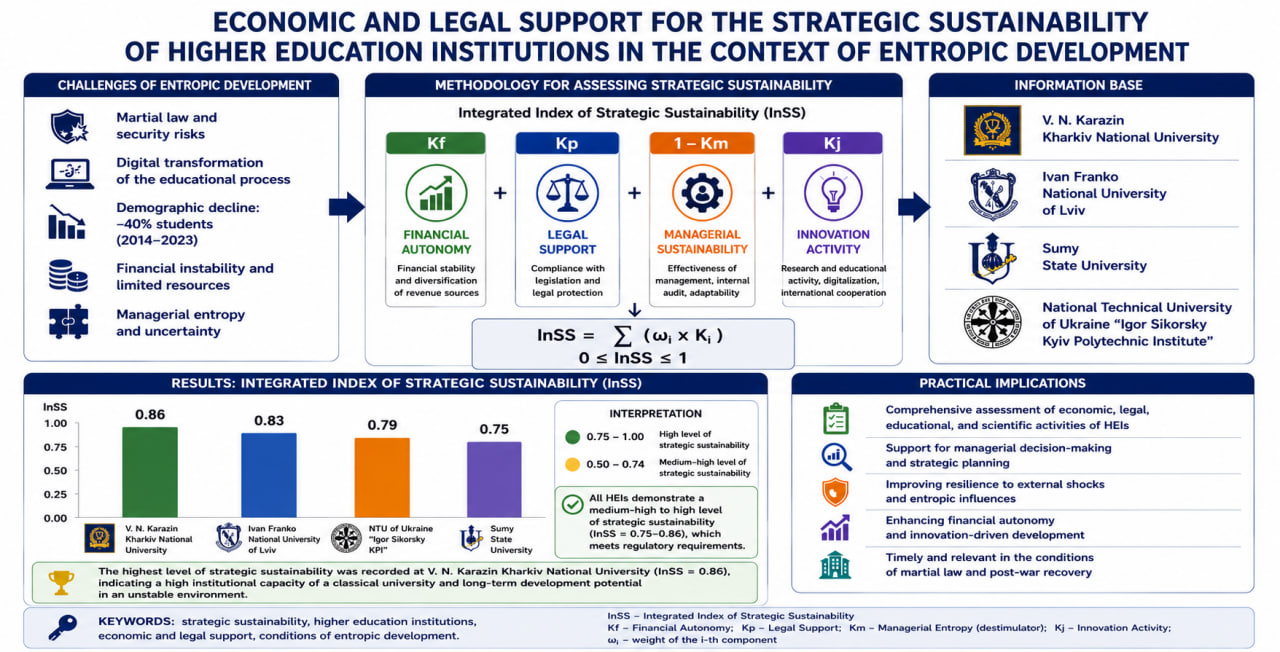
The information base of V. N. Karazin Kharkiv National University; Ivan Franko National University of Lviv; Sumy State University; and the National Technical University of Ukraine “Igor Sikorsky Kyiv Polytechnic Institute” was analyzed.
The proposed comprehensive methodology for assessing the strategic resilience of higher education institutions in Ukraine under conditions of entropic development showed that all the universities studied are characterized by different internal configurations of strong and vulnerable elements.
The practical implementation of the methodology for assessing the integral index of HEI strategic sustainability was carried out, which showed that the index is within the regulatory requirements. This indicates a medium-high and high level of HEI strategic sustainability of Ukraine in the conditions of entropic development.
The highest level of strategic sustainability was recorded at Kharkiv National University (InSS = 0.86), indicating a sufficiently high level of institutional capacity of a classical university and long-term development in an unstable external environment.
The practical application of the research results allows for a comprehensive assessment of the economic, legal, educational, and scientific activities of universities under martial law.
References
- Svyrydenko, D., Radko, V., Mordous, I., Zadorozhna, O., Apelt, H., Lisun, Y. (2022). Sustainable development of universities in the context of the Covid-19 pandemic. Financial and Credit Activity Problems of Theory and Practice, 3 (44), 338–346. https://doi.org/10.55643/fcaptp.3.44.2022.3769
- Nikoliuk, O., Kovalenko, O. (2025). Strategic management of the efficiency of higher education institutions in the conditions of transformation of the educational environment. Economy and Society, 74. https://doi.org/10.32782/2524-0072/2025-74-2
- Gryshyna, Y., Pyzhova, M. (2022). Management of higher education institution: search for an effective model. Economics and Region, 2 (85), 6–14. https://doi.org/10.26906/EiR.2022.2(85).2623
- Tarasenko, O. (2024). Tools for assessing the effectiveness of the call in the strategic management system. Economy and Society, 64. https://doi.org/10.32782/2524-0072/2024-64-86
- Skydan, M., Lopushniak, H., Kravchuk, O., Ilchenko-Syuyva, L. (2025). Strategic Analysis of Higher Education Institutions Development in Ukraine Under Current Challenges: An Integrated Approach. Transylvanian Review of Administrative Sciences, 76 E, 146–175. https://doi.org/10.24193/tras.76e.9
- Abad-Segura, E., González-Zamar, M.-D. (2021). Sustainable economic development in higher education institutions: A global analysis within the SDGs framework. Journal of Cleaner Production, 294, 126133. https://doi.org/10.1016/j.jclepro.2021.126133
- Ji, M., Jiao, Y., Cheng, N. (2023). An Innovative decision-making scheme for the high-quality economy development driven by higher education. Journal of Innovation & Knowledge, 8 (2), 100345. https://doi.org/10.1016/j.jik.2023.100345
- Sun, X. (2021). Green city and regional environmental economic evaluation based on entropy method and GIS. Environmental Technology & Innovation, 23, 101667. https://doi.org/10.1016/j.eti.2021.101667
- Dai, J., Zhou, B., Meng, W. (2025). The impact of digitization on environmental sustainability: New insights from G20 nations. Journal of Environmental Management, 394, 127225. https://doi.org/10.1016/j.jenvman.2025.127225
- Štrukelj, T., Dankova, P., Hrast, N. (2023). Strategic Transition to Sustainability: A Cybernetic Model. Sustainability, 15 (22), 15948. https://doi.org/10.3390/su152215948
- Krstić, M., Filipe, J. A., Chavaglia, J. (2020). Higher Education as a Determinant of the Competitiveness and Sustainable Development of an Economy. Sustainability, 12 (16), 6607. https://doi.org/10.3390/su12166607
- Gatto, A. (2022). Polycentric and resilient perspectives for governing the commons: Strategic and law and economics insights for sustainable development. Ambio, 51 (9), 1921–1932. https://doi.org/10.1007/s13280-022-01719-x
- Salas, D. A., Criollo, P., Ramirez, A. D. (2021). The Role of Higher Education Institutions in the Implementation of Circular Economy in Latin America. Sustainability, 13 (17), 9805. https://doi.org/10.3390/su13179805
- Gkrimpizi, T., Peristeras, V., Magnisalis, I. (2023). Classification of Barriers to Digital Transformation in Higher Education Institutions: Systematic Literature Review. Education Sciences, 13 (7), 746. https://doi.org/10.3390/educsci13070746
- Aras, G., Kutlu Furtuna, O., Hacioglu Kazak, E. (2021). The nexus between stakeholders’ materiality and sustainable development goals: evidence from higher education institutions. International Journal of Sustainability in Higher Education, 23 (1), 114–134. https://doi.org/10.1108/ijshe-11-2020-0439
- Prokhorova, V., Mushnykova, S., Abernikhina, I., Babichev, A., Slastianykova, K. (2025). The impact of geopolitical trends on the technological renewal of industrial enterprises as a basis for the convergence of investment processes in the Ukrainian economy. Economics of Development, 24 (2), 8–25. https://doi.org/10.63341/econ/2.2025.08
- Prokhorova, V., Kravchenko, O., Shkurenko, O., Babichev, A., Polivantsev, A. (2025). Study of priority directions of economic recovery of Ukraine based on scenario modelling. Economics of Development, 24 (1), 26–34. https://doi.org/10.63341/econ/1.2025.26
- Leal Filho, W., Salvia, A. L., Eustachio, J. H. P. P. (2023). An overview of the engagement of higher education institutions in the implementation of the UN Sustainable Development Goals. Journal of Cleaner Production, 386, 135694. https://doi.org/10.1016/j.jclepro.2022.135694
- Ramísio, P. J., Pinto, L. M. C., Gouveia, N., Costa, H., Arezes, D. (2019). Sustainability Strategy in Higher Education Institutions: Lessons learned from a nine-year case study. Journal of Cleaner Production, 222, 300–309. https://doi.org/10.1016/j.jclepro.2019.02.257
- Burdonos, L., Vynogradnya, V. (2020). Methodology of assessing the effectiveness of scientific, scientific and technical works in an institution of higher education. University Economic Bulletin, 46, 65–75. https://doi.org/10.31470/2306-546x-2020-46-65-75
- Borovyk, M. V. (2019). Methods of evaluation of the results of activity of ukrainian higher education institutions at the state level. Naukovyi visnyk Uzhhorodskoho natsionalnoho universytetu, 24 (1). Available at: http://visnyk-econom.uzhnu.uz.ua/archive/24_1_2019ua/11.pdf
- Prokhorova, V., Mushnykova, S., Kovalenko, D., Koleshchuk, O., Babichev, A. (2023). Convergence of educational technologies as an imperative for the development of innovation cooperation in the context of circular transformation. Eastern-European Journal of Enterprise Technologies, 4 (13 (124)), 26–35. https://doi.org/10.15587/1729-4061.2023.286183
- Prokhorova, V., Kovalenko, O., Bozhanova, O., Zakharchyn, H. (2023). The paradigm of emergent qualities of education management as a scientific and technological platform for sustainable development. IOP Conference Series: Earth and Environmental Science, 1150 (1), 12014. https://doi.org/10.1088/1755-1315/1150/1/012014
Downloads
Published
How to Cite
Issue
Section
License
Copyright (c) 2026 Tetiana Kaganovska

This work is licensed under a Creative Commons Attribution 4.0 International License.
The consolidation and conditions for the transfer of copyright (identification of authorship) is carried out in the License Agreement. In particular, the authors reserve the right to the authorship of their manuscript and transfer the first publication of this work to the journal under the terms of the Creative Commons CC BY license. At the same time, they have the right to conclude on their own additional agreements concerning the non-exclusive distribution of the work in the form in which it was published by this journal, but provided that the link to the first publication of the article in this journal is preserved.