Developing a composite economic efficiency index for Ukraine’s agricultural post-war transformation: recycling, bioenergy, and export-import regulatory mechanisms
DOI:
https://doi.org/10.15587/2706-5448.2026.364355Keywords:
agricultural sector transformation, bioenergy, circular economy, recycling, export-import regulation, sustainable development, biomethaneAbstract
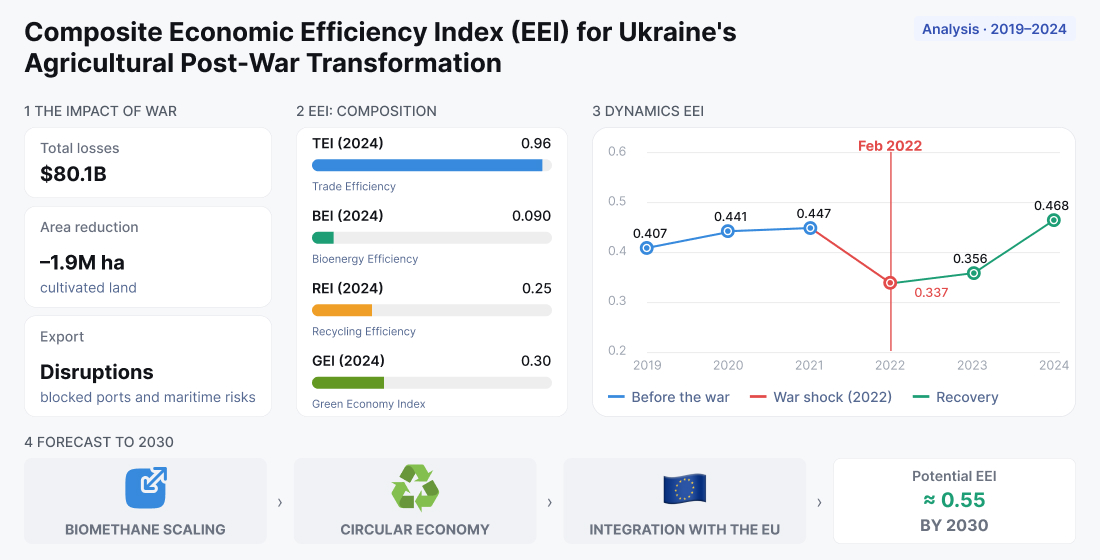
The object of this research is Ukraine’s agricultural sector undergoing structural transformation towards sustainable development. The analysis focuses on three interconnected dimensions of this transformation: agricultural recycling, bioenergy development, and regulatory mechanisms supporting sustainable change, including export-import governance. The research addresses the lack of integrated quantitative tools capable of assessing the effectiveness of agricultural transformation across these dimensions under wartime conditions and within the context of Ukraine’s European integration agenda. Since February 2022, the Ukrainian agricultural sector has faced unprecedented challenges resulting from military aggression. Total losses have been estimated at 80.1 billion USD, the area of cultivated land has decreased by approximately 1.9 million hectares, and traditional maritime export routes have become vulnerable to external disruptions. Drawing on verified data from the World Bank, the United States Department of Agriculture (USDA), the Food and Agriculture Organization (FAO), and the European Parliamentary Research Service, a Composite Economic Efficiency Index (EEI) was developed to evaluate the sector’s transformation. The index combines four dimensions: the Trade Efficiency Index (TEI, w = 0.30), the Bioenergy Efficiency Index (BEI, w = 0.25), the Recycling Efficiency Index (REI, w = 0.25), and the Green Economy Index (GEI, w = 0.20).The EEI declined from 0.447 in 2021 to its lowest value of 0.337 in 2022, reflecting the immediate impact of the war. Subsequently, the indicator recovered and reached 0.468 in 2024. However, this recovery has been uneven across the analyzed dimensions. While the TEI increased to 0.96, the BEI (0.090) and REI (0.250) remained substantially below their projected 2030 benchmark levels. These findings suggest that the restoration of export volumes through the Grain Corridor should not be interpreted as evidence of deep structural transformation. Without targeted investments in biomethane production, recycling infrastructure, and circular economy initiatives, the sector largely continues to follow its pre-war commodity-export model. Under conditions of a legally secured multilateral framework for the Grain Corridor and consistent government support for scaling bioenergy production, the EEI could increase to approximately 0.55 by 2030.The proposed approach and obtained results may support strategic planning for the post-war recovery of Ukraine’s agricultural sector and provide analytical input for negotiations related to the agricultural chapter of the country’s accession process to the European Union.
References
- Ukrainian agriculture: From Russian invasion to EU integration (PE 760.432) (2024). European Parliamentary Research Service. Available at: https://www.europarl.europa.eu/RegData/etudes/BRIE/2024/760432/EPRS_BRI(2024)760432_EN.pdf
- Husby, M., Swearingen, B., Miller, M., Hansen, J. (2024). Ukraine's rise in grain and sunflower seed market share limited by ongoing war. Amber Waves. U.S. Department of Agriculture, Economic Research Service. Available at: https://www.ers.usda.gov/amber-waves/2024/may/ukraine-s-rise-in-grain-and-sunflower-seed-market-share-limited-by-ongoing-war
- Zorya, S., Muliar, O., Nivievskyi, O. (2024). Priorities for agricultural support in Ukraine. World Bank. Available at: https://documents1.worldbank.org/curated/en/099062524074615884/pdf/P1801981319afe091b8b71b33b7a901d4e.pdf
- Pavelko, O., Lazaryshyna, I., Los, Z., Vasylieva, V., Kvasnii, L. (2024). The activities and development prospects analysis of the agricultural sector of Ukraine. BIO Web of Conferences, 114, 1031. https://doi.org/10.1051/bioconf/202411401031
- Pimenow, S., Pimenowa, O., Moldavan, L., Udova, L., Wasilewski, M., Wasilewska, N. (2025). Transforming Agriculture into Energy: Unlocking Ukraine’s Bioenergy Potential for Sustainable Post-Conflict Recovery. Energies, 18 (5), 1212. https://doi.org/10.3390/en18051212
- Shvedun, V., Bulba, V., Bozhko, L., Kucher, L., Kholodok, V., Ihnatiev, O. (2023). Circular Economy in Ukraine on the Way to European Integration: Directions for Sustainable Management during the War and Post-War Recovery. Journal of Environmental Management and Tourism, 14 (1), 194. https://doi.org/10.14505/jemt.v14.1(65).19
- Shebanin, V., Shebanina, O., Kormyshkin, I., Drobitko, A., Potryvaieva, N. (2024). Circular economy of the agricultural sector: Strategies and challenges in the context of globalisation. Scientific Horizons, 27 (9), 148–161. https://doi.org/10.48077/scihor9.2024.148
- The importance of Ukraine and the Russian Federation for global agricultural markets and the risks associated with the war in Ukraine (2023). Food and Agriculture Organization of the United Nations. Available at: https://openknowledge.fao.org/server/api/core/bitstreams/4fce6098-a3ba-4742-b8f4-685454a5d409/content
- Grain and feed quarterly (GAIN Report No. UP2024-0022) (2024). U.S. Department of Agriculture, Foreign Agricultural Service. Available at: https://apps.fas.usda.gov/newgainapi/api/Report/DownloadReportByFileName?fileName=Grain+and+Feed+Quarterly_Kyiv_Ukraine_UP2024-0022
- Ekleme, G., Yercan, F. (2025). Assessment of the Black Sea Grain Initiative: Crisis Management via Maritime Transportation. Transport Policy, 163, 199–218. https://doi.org/10.1016/j.tranpol.2024.12.011
- Kormych, B., Averochkina, T., Kormych, L. (2024). Black Sea, grain, and two humanitarian corridors: unblocking Ukrainian shipping amid the Russian invasion. Small Wars & Insurgencies, 35 (8), 1360–1396. https://doi.org/10.1080/09592318.2024.2384679
- Nivievskyi, O. (2024). EU integration of Ukraine – Assessing the challenges for agri-food public authorities. SSRN Electronic Journal. https://doi.org/10.2139/ssrn.4957056
- Halytsia, O., Vrachioli, M., Nivievskyi, O., Sauer, J. (2024). Assessing the Environmental Performance of Agricultural Production Using a Parametric Approach: An Application for Crop Producers in Ukraine. Eastern European Economics, 63 (4), 684–706. https://doi.org/10.1080/00128775.2024.2368042
- Broyaka, A., Dankevych, V., Dodd, E., Welsh, C. (2025). Blueprint for an agricultural recovery plan for Ukraine. Center for Strategic and International Studies. Available at: https://csis-website-prod.s3.amazonaws.com/s3fs-public/2025-06/250604_Broyaka_Blueprint_Recovery.pdf
- Zavadskykh, H., Safonik, N., Moroz, E., Alekseieva, K., Honcharenko, I. (2025). Exploring the Potential of Circular Economy in Ukrainian Enterprises. Grassroots Journal of Natural Resources, 8 (1), 318–336. https://doi.org/10.33002/nr2581.6853.080112
- Agricultural policy monitoring and evaluation 2022: Reforming agricultural policies for climate change mitigation (2022). OECD Publishing. https://doi.org/10.1787/7f4542bf-en
Downloads
Published
How to Cite
Issue
Section
License
Copyright (c) 2026 Yehor Zhuk, Roman Rymar, Rostyslav Melnychuk

This work is licensed under a Creative Commons Attribution 4.0 International License.
The consolidation and conditions for the transfer of copyright (identification of authorship) is carried out in the License Agreement. In particular, the authors reserve the right to the authorship of their manuscript and transfer the first publication of this work to the journal under the terms of the Creative Commons CC BY license. At the same time, they have the right to conclude on their own additional agreements concerning the non-exclusive distribution of the work in the form in which it was published by this journal, but provided that the link to the first publication of the article in this journal is preserved.