Розробка моделі зменшення заторів у місті Константайн для покращення міської мобільності: випадок перехрестя Зуагі Сліман (Алжир)
DOI:
https://doi.org/10.15587/2706-5448.2024.319674Ключові слова:
транспортна дорога, моделювання транспортних заторів, критичні потоки, управління динамікою руху, регулювання руху в містіАнотація
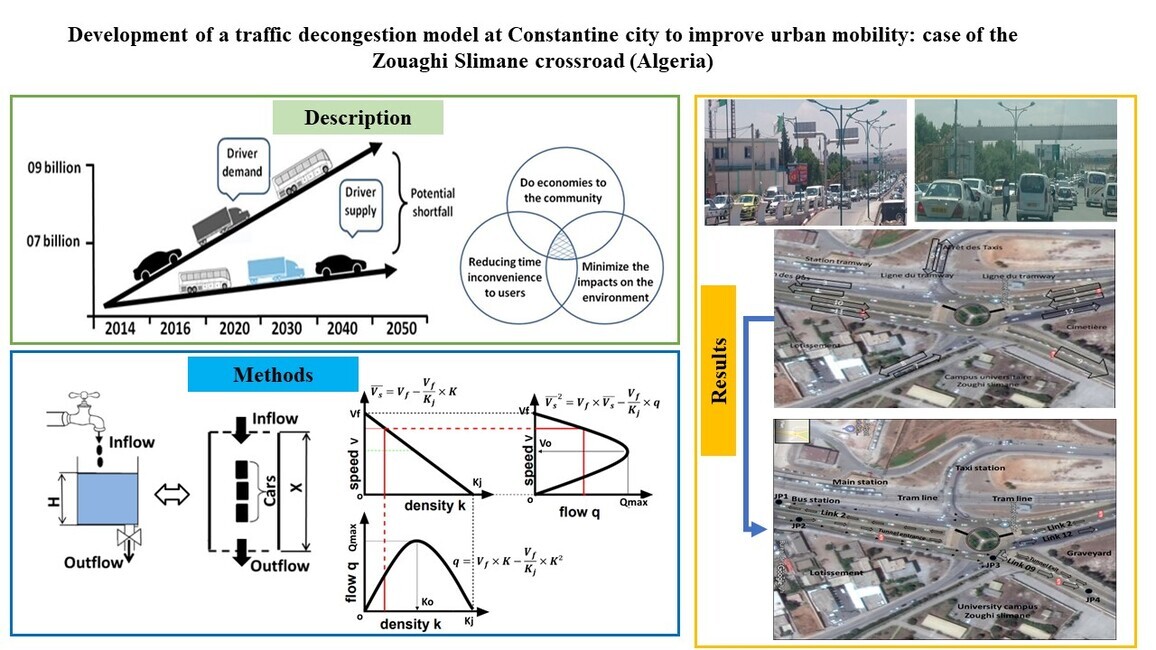
Об’єктом дослідження є моделювання заторів. Для моделювання заторів з метою кращої плавності дорожнього руху переважно в міських районах потрібно використовувати потужні комп’ютери, що випереджає складність завдання. Оскільки дорожній рух є складним явищем, особливо на перехрестях, по-перше, через велику кількість користувачів, які ним користуються, а по-друге, через характер перехресть, які мають складну сітчасту мережу. У цій роботі розроблено математичний підхід на основі моделі Гріншилда, який направлений на вивчення ефективності руху на перехрестях. Ця модель дозволяє контролювати та регулювати дорожній рух у місті, що має відповідати різним цілям, таким як: мінімізація часу очікування транспортних засобів на перехрестях, оптимізація транспортних потоків у мережі доріг. Приклад, розглянутий в цій роботі, – це перехрестя Зуагі Сліман у місті Константайн (Алжир). Згідно з отриманими результатами, час перебування на перехресті Зуагі Сліман може досягати понад 45 хвилин і більше за добу. Ця ситуація спонукає нас поставити наступне питання: як скоротити час у дорозі, втрачений на цьому перехресті? Щоб дати відповідь на останнє запитання, першим кроком є розгляд різних змінних, які характеризують поступовий рух транспортних засобів на дорозі. Завдання полягає в тому, щоб дати математичне формулювання, яке пов’язує кількість транспортних засобів, присутніх у момент часу t на довжині L дороги. Швидкість є одним із основних параметрів транспортного потоку. Співвідношення між основними параметрами руху враховує різні змінні, що характеризують поступовий рух транспортних засобів на дорозі, що дозволяє дати математичне формулювання, яке пов’язує кількість транспортних засобів, присутніх у момент часу «t» на відрізку «L» дороги. Основне завдання полягає в тому, щоб виявити такі показники, як швидкість, щільність і критичні потоки, що дозволяє налаштувати динамічне управління дорожнім рухом для розвантаження перехрестя Зуагі Сліман.
Посилання
- Forstall, R. L., Greene, R. P., Pick, J. B. (2009). Which are the largest? Why lists of major urban areas vary so greatly. Tijdschrift Voor Economische En Sociale Geografie, 100 (3), 277–297. https://doi.org/10.1111/j.1467-9663.2009.00537.x
- Greene, R. P., Pick, J. B. (2012). Exploring the Urban Community: A GIS Approach. Pearson Prentice Hall, 432.
- Abdo, J. (2011). Construire de nouvelles infrastructures routières. La solution to la congestion du trafic ? Centre d’inforamtion sur le ciment et ses application. Available at: https://www.infociments.fr/route/t32-construire-de-nouvelles-infrastructures-routieres
- Ujjwal, J., Bandyopadhyaya, V., Bandyopadhyaya, R. (2021). Identifying key determinants for parking management to reduce road traffic congestion for congested cities-A Structural Equation Modelling approach. Advances in Transportation Studies, 54, 143–158.
- Pick, J. B., Azari, R. (2008). Global digital divide: Influence of socioeconomic, governmental, and accessibility factors on information technology. Information Technology for Development, 14 (2), 91–115. https://doi.org/10.1002/itdj.20095
- Weisbrod, G., Vary, D., Treyz, G. (2003). Measuring Economic Costs of Urban Traffic Congestion to Business. Transportation Research Record: Journal of the Transportation Research Board, 1839 (1), 98–106. https://doi.org/10.3141/1839-10
- Apte, J. S., Bombrun, E., Marshall, J. D., Nazaroff, W. W. (2012). Global Intraurban Intake Fractions for Primary Air Pollutants from Vehicles and Other Distributed Sources. Environmental Science & Technology, 46 (6), 3415–3423. https://doi.org/10.1021/es204021h
- Lighthill, M. J., Whitham, G. B. (1955). On kinematic waves I. Flood movement in long rivers. Proceedings of the Royal Society of London. Series A. Mathematical and Physical Sciences, 229 (1178), 281–316. https://doi.org/10.1098/rspa.1955.0088
- Richards, P. I. (1956). Shock Waves on the Highway. Operations Research, 4 (1), 42–51. https://doi.org/10.1287/opre.4.1.42
- Greenshields, B. D., Bibbins, J. R., Channing, W. S., Miller, H. H. (1935). A study of traffic capacity. Highway Research Board proceedings. Available at: https://www.safetylit.org/citations/index.php?fuseaction=citations.viewdetails&citationIds[]=citjournalarticle_248667_38
- Payne, H. J. (1971). Model of Freeway Traffic and Control. Mathematical Model of Public System, 1 (1), 51–61.
- Fares, B., Kechida, S., Bencheriet, C. ennehar. (2013). Modélisation d’un Reseau du Trafic Urbain par Automate Hybride. Proceedings of Conference International Conference on Systems and Information Processing. Guelma. https://doi.org/10.13140/RG.2.2.31132.90241
- Geroliminis, N., Sun, J. (2011). Properties of a well-defined macroscopic fundamental diagram for urban traffic. Transportation Research Part B: Methodological, 45 (3), 605–617. https://doi.org/10.1016/j.trb.2010.11.004
- Treiber, M., Kesting, A., Helbing, D. (2010). Three-phase traffic theory and two-phase models with a fundamental diagram in the light of empirical stylized facts. Transportation Research Part B: Methodological, 44 (8-9), 983–1000. https://doi.org/10.1016/j.trb.2010.03.004
- Khelf, M., Boukebbab, S., Boulahlib, M. S.; Zamojski, W., Mazurkiewicz, J., Sugier, J., Walkowiak, T., Kacprzyk, J. (Eds.) (2016). A Mathematical Model to Regulate Roads Traffic in Order to Decongest the Urban Areas of Constantine City. Dependability Engineering and Complex Systems. Cham: Springer International Publishing, 279–289. https://doi.org/10.1007/978-3-319-39639-2_24
- Guo, Y. R., Wang, X. M., Wang, M., Zhang, H. (2020). Research on prediction of urban congestion based on radial basis function network. Advances in Transportation Studies, Special Issue 1, 145–156.
- Wang, H. X., Zheng, H. J. (2021). Prediction method of traffic congestion volume in traffic jam road section based on genetic algorithm. Advances in Transportation Studies, Special Issue 2, 79–90.
- Lidbe, A., Tedla, E., Hainen, A., Sullivan, A., Jones Jr, S. (2017). Comparative assessment of arterial operations under conventional time-of-day and adaptive traffic signal control. Advances in Transportation Studies, 42, 5–22.
- Mathew, T. V. (2017). Fundamental Relations of Traffic Flow. Lecture Notes in Transportation Systems Engineering. IIT Bombay.
- Mathew, T. V., Krishna Rao, K. V. (2007). Introduction to Transportation Engineering. Lecture Notes in Transportation Systems Engineering.
- Greenshields, B. D., Shapiro, D., Erickson, E. L. (1947). Traffic performance at urban street intersections. Tech. Rep. No. 1, Yale Bureau of Highway Traffic. New Haven: Yale University.
##submission.downloads##
Опубліковано
Як цитувати
Номер
Розділ
Ліцензія
Авторське право (c) 2024 Salim Boukebbab, Billal Soulmana, Mounira Kelilba

Ця робота ліцензується відповідно до Creative Commons Attribution 4.0 International License.
Закріплення та умови передачі авторських прав (ідентифікація авторства) здійснюється у Ліцензійному договорі. Зокрема, автори залишають за собою право на авторство свого рукопису та передають журналу право першої публікації цієї роботи на умовах ліцензії Creative Commons CC BY. При цьому вони мають право укладати самостійно додаткові угоди, що стосуються неексклюзивного поширення роботи у тому вигляді, в якому вона була опублікована цим журналом, але за умови збереження посилання на першу публікацію статті в цьому журналі.