Development of a hardware-software solution for detection of complex-shaped objects in video stream
DOI:
https://doi.org/10.15587/2706-5448.2024.319799Keywords:
computer vision, single-board computer, initialization system, double-check, video processing algorithmsAbstract
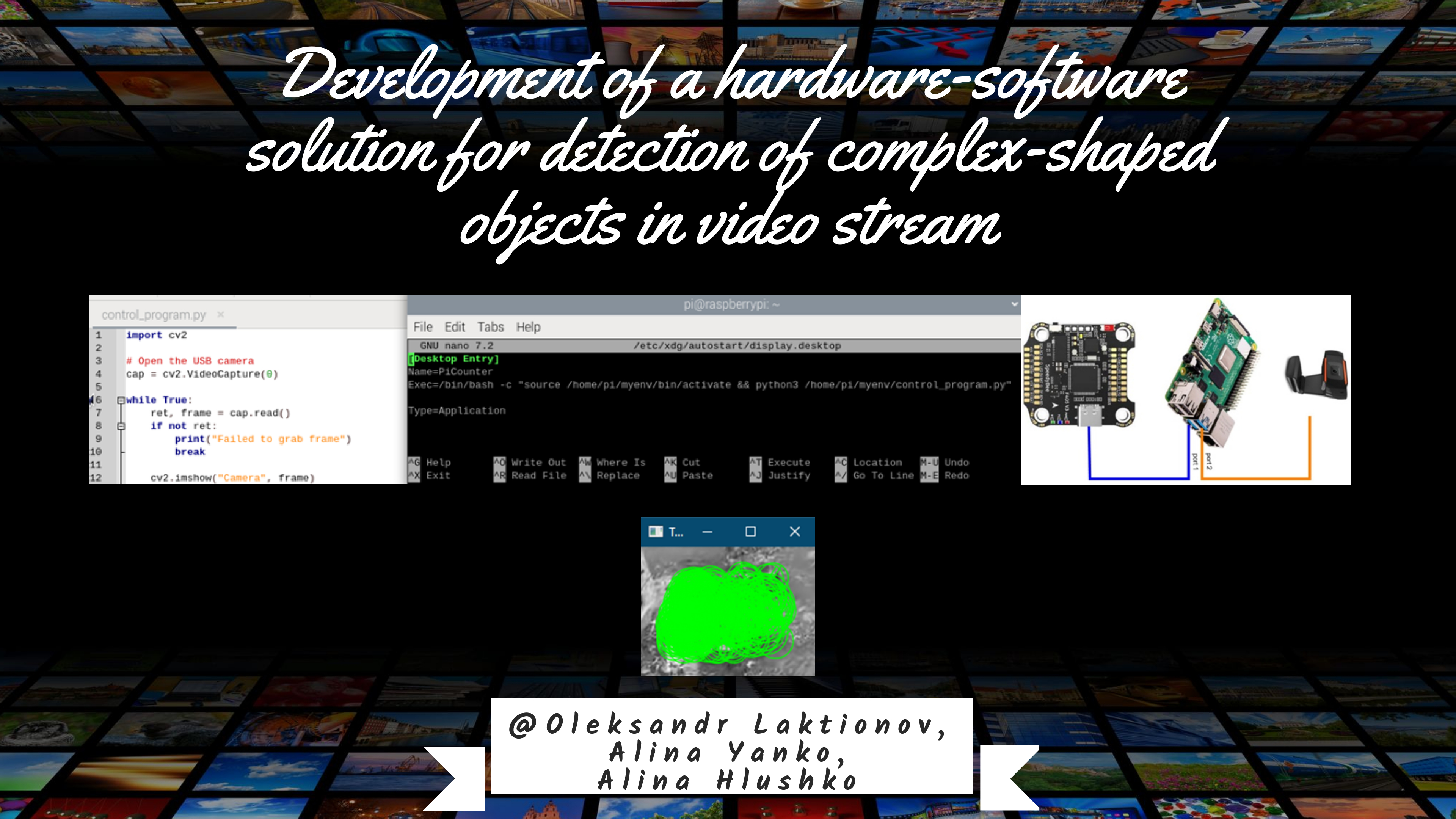
The object of the study is the process of diagnosing complex-shaped objects in a video stream. The paper investigates the applied problem of creating a hardware-software solution for detecting complex-shaped objects in a video stream. Single-board computers Raspberry Pi models 4 and 5 with additional UPS HAT (D) modules and 21700 batteries were used as hardware, ensuring operation in the absence of power supply. Serial Camera Interface cameras and Full HD 1080p webcams were connected to the single-board computers to study effective methods of video processing using several studied video processing architectures. Eight video processing architectures based on the Oriented Features from Accelerated Segment Test and Rotated Binary Robust Independent Elementary Features and Scale-Invariant Feature Transform methods were considered. Each video processing architecture was tested using a one-minute video, where its average performance was determined. The limitations of video processing were a region of interest of 400x300 pixels and the presence of a limited number of reference images. To automate the launch of programs on single-board computers, the systemd initialization system was used.
Known video processing algorithms were considered and a modification of the algorithm was proposed by using a double check for the presence of an object in the video stream. A hardware-software solution was implemented, consisting of a single-board computer with external cameras connected to it, and software for detecting complex-shaped objects in the video stream was created. The solution is useful as an auxiliary tool for detecting complex-shaped objects in the video stream on robotic platforms, in industry, everyday life, the educational process, and when repairing electronic modules. The practical significance of the study lies in the fact that the architecture for processing complex-shaped objects has been further developed. They provide for a double check for the presence of an object in the video stream, which increases the processing time of one frame, and on the other hand, increases the efficiency of object detection based on only one reference photo.
References
- Guo, J., Shao, M., Chen, X., Yang, Y., Sun, E. (2024). Research on night-time vehicle target detection based on improved KSC-YOLO V5. Signal, Image and Video Processing, 19 (1). https://doi.org/10.1007/s11760-024-03576-5
- Krasnobayev, V., Yanko, A., Fil, I. (2024). Fault-Tolerant Operation of an Integer Data Processing System. Mathematical Modeling and Simulation of Systems. Springer, 172–185. https://doi.org/10.1007/978-3-031-67348-1_13
- Krasnobayev, V., Yanko, A., Kovalchuk, D., Fil, I. (2024). Synthesis of a Mathematical Model of a Fault-Tolerant Real-Time Computer System Operating in Non-positional Arithmetic in Residual Classes. Mathematical Modeling and Simulation of Systems. Springer, 186–199. https://doi.org/10.1007/978-3-031-67348-1_14
- Krasnobayev, V., Yanko, A., Hlushko, A., Kruk, O., Kruk, O., Gakh, V. (2023). Cyberspace protection system based on the data comparison method. Economic and cyber security. Kharkiv: PC TECHNOLOGY CENTER, 3–29. https://doi.org/10.15587/978-617-7319-98-5.ch1
- Pushkarenko, Y., Zaslavskyi, V. (2024). Research on the state of areas in Ukraine affected by military actions based on remote sensing data and deep learning architectures. Radioelectronic and Computer Systems, 2024 (2), 5–18. https://doi.org/10.32620/reks.2024.2.01
- Ultralytics YOLO Docs. Available at: https://docs.ultralytics.com
- Liu, W., Anguelov, D., Erhan, D., Szegedy, C., Reed, S., Fu, C.-Y., Berg, A.; C. Leibe, B., Matas, J., Sebe, N., Welling, M. (Eds.) (2016). SSD: Single Shot MultiBox Detector. Computer Vision – ECCV 2016. Cham: Springer, 21–37. https://doi.org/10.1007/978-3-319-46448-0_2
- Svistun, L., Glushko, А., Shtepenko, K. (2018). Organizational Aspects of Development Projects Implementation at the Real Estate Market in Ukraine. International Journal of Engineering & Technology, 7 (3.2), 447. https://doi.org/10.14419/ijet.v7i3.2.14569
- Ran, Y., Xu, X. (2020). Point cloud registration method based on SIFT and geometry feature. Optik, 203, 163902. https://doi.org/10.1016/j.ijleo.2019.163902
- Singh, P. K., Jana, B., Datta, K. (2022). Robust data hiding scheme through distinct keypoint selection exploiting modified Bilateral-Laplacian SIFT with encoding pipeline. Displays, 74, 102268. https://doi.org/10.1016/j.displa.2022.102268
- Sun, Y. (2024). Exploration on Data Collection and Analysis System Based on Integrated SIFT Algorithm. Procedia Computer Science, 243, 388–395. https://doi.org/10.1016/j.procs.2024.09.048
- Yu, Q., Ni, D., Jiang, Y., Yan, Y., An, J., Sun, T. (2021). Universal SAR and optical image registration via a novel SIFT framework based on nonlinear diffusion and a polar spatial-frequency descriptor. ISPRS Journal of Photogrammetry and Remote Sensing, 171, 1–17. https://doi.org/10.1016/j.isprsjprs.2020.10.019
- Li, Y., Li, Q., Liu, Y., Xie, W. (2019). A spatial-spectral SIFT for hyperspectral image matching and classification. Pattern Recognition Letters, 127, 18–26. https://doi.org/10.1016/j.patrec.2018.08.032
- Pavithra, S., Shreyashwini, N. K., Bhavana, H. S., Nikhitha, G., Kavitha, T. (2023). Hand-Drawn Electronic Component Recognition Using ORB. Procedia Computer Science, 218, 504–513. https://doi.org/10.1016/j.procs.2023.01.032
- Belmessaoud, N. M., Bentoutou, Y., Chikr El-Mezouar, M. (2022). FPGA implementation of feature detection and matching using ORB. Microprocessors and Microsystems, 94, 104666. https://doi.org/10.1016/j.micpro.2022.104666
- Sharif, H., Hölzel, M. (2017). A comparison of prefilters in ORB-based object detection. Pattern Recognition Letters, 93, 154–161. https://doi.org/10.1016/j.patrec.2016.11.007
- A, V., Cholin, A. S., Bhat, A. D., Murthy, K. N. B., Natarajan, S. (2018). An Efficient ORB based Face Recognition framework for Human-Robot Interaction. Procedia Computer Science, 133, 913–923. https://doi.org/10.1016/j.procs.2018.07.095
- Taranco, R., Arnau, J.-M., González, A. (2023). LOCATOR: Low-power ORB accelerator for autonomous cars. Journal of Parallel and Distributed Computing, 174, 32–45. https://doi.org/10.1016/j.jpdc.2022.12.005
- Wu, T., Hung, I.-K., Xu, H., Yang, L., Wang, Y., Fang, L., Lou, X. (2022). An Optimized SIFT-OCT Algorithm for Stitching Aerial Images of a Loblolly Pine Plantation. Forests, 13 (9), 1475. https://doi.org/10.3390/f13091475
- Khudov, H., Hridasov, I., Khizhnyak, I., Yuzova, I., Solomonenko, Y. (2024). Segmentation of image from a first-person-view unmanned aerial vehicle based on a simple ant algorithm. Information and Controlling System, 4 (9 (130)), 44–55. https://doi.org/10.15587/1729-4061.2024.310372
- Rebrov, V., Lukin, V. (2023). Post-processing of compressed noisy images by BM3D filter. Radioelectronic and Computer Systems, 4, 100–111. https://doi.org/10.32620/reks.2023.4.09
- Bilozerskyi, V., Dergachov, K., Krasnov, L., Zymovin, A., Popov, A. (2023). New method for video stream brightness stabilization: algorithms and performance evaluation. Radioelectronic and Computer Systems, 3, 125–135. https://doi.org/10.32620/reks.2023.3.10
- Shefer, O., Laktionov, O., Pents, V., Hlushko, A., Kuchuk, N. (2024). Practical principles of integrating artificial intelligence into the technology of regional security predicting. Advanced Information Systems, 8 (1), 86–93. https://doi.org/10.20998/2522-9052.2024.1.11
- Polshchykov, K., Zdorenko, Y., Masesov, M. (2015). Neuro-fuzzy system for prediction of telecommunication channel load. 2015 Second International Scientific-Practical Conference Problems of Infocommunications Science and Technology (PIC S&T). Kharkiv, 33–34. https://doi.org/10.1109/infocommst.2015.7357261
- Onyshchenko, S., Haitan, O., Yanko, A., Zdorenko, Yu., Rudenko, O. (2024). Method for detection of the modified DDoS cyber attacks on a web resource of an Information and Telecommunication Network based on the use of intelligent systems. Proceedings of the Modern Data Science Technologies Workshop (MoDaST 2024). Lviv, 219–235. Available at: https://ceur-ws.org/Vol-3723/paper12.pdf
- Rublee, E., Rabaud, V., Konolige, K., Bradski, G. (2011). ORB: An efficient alternative to SIFT or SURF. 2011 International Conference on Computer Vision, 2564–2571. https://doi.org/10.1109/iccv.2011.6126544
- Lowe, D. G. (1999). Object recognition from local scale-invariant features. Proceedings of the Seventh IEEE International Conference on Computer Vision, 1150–1157. https://doi.org/10.1109/iccv.1999.790410
- Muja, M., Lowe, D. G. (2009). Fast approximate nearest neighbors with automatic algorithm configuration. International Conference on Computer Vision Theory and Application (VISSAPP), 331–340. https://doi.org/10.5220/0001787803310340
- Lowe, D. G. (2004). Distinctive Image Features from Scale-Invariant Keypoints. International Journal of Computer Vision, 60 (2), 91–110. https://doi.org/10.1023/b:visi.0000029664.99615.94
- Visual Studio Code. Available at: https://code.visualstudio.com/
- Männel, W. (2023). The ultimate guide on using systemd to autostart scripts on the Raspberry Pi. TheDigitalPictureFrame.com. Available at: https://www.thedigitalpictureframe.com/ultimate-guide-systemd-autostart-scripts-raspberry-pi/
- Laktionov, O., Yanko, A., Pedchenko, N. (2024). Identification of air targets using a hybrid clustering algorithm. Eastern-European Journal of Enterprise Technologies, 5 (4 (131)), 89–95. https://doi.org/10.15587/1729-4061.2024.314289
- Fedorenko, G., Fesenko, H., Kharchenko, V. (2022). Analysis of methods and development of the concept of guaranteed detection and recognition of explosive objects. Innovative Technologies and Scientific Solutions for Industries, 4 (22), 20–31. https://doi.org/10.30837/itssi.2022.22.020
- Sun, Y., Fesenko, H., Kharchenko, V., Zhong, L., Kliushnikov, I., Illiashenko, O., Morozova, O., Sachenko, A. (2022). UAV and IoT-Based Systems for the Monitoring of Industrial Facilities Using Digital Twins: Methodology, Reliability Models, and Application. Sensors, 22 (17), 6444. https://doi.org/10.3390/s22176444
- MultiWii. MultiWii flight controller source code and documentation. Available at: https://github.com/multiwii
Downloads
Published
How to Cite
Issue
Section
License
Copyright (c) 2024 Oleksandr Laktionov, Alina Yanko, Alina Hlushko

This work is licensed under a Creative Commons Attribution 4.0 International License.
The consolidation and conditions for the transfer of copyright (identification of authorship) is carried out in the License Agreement. In particular, the authors reserve the right to the authorship of their manuscript and transfer the first publication of this work to the journal under the terms of the Creative Commons CC BY license. At the same time, they have the right to conclude on their own additional agreements concerning the non-exclusive distribution of the work in the form in which it was published by this journal, but provided that the link to the first publication of the article in this journal is preserved.