Аналіз розподілу режимів роботи газотурбінних установок як інструмент підвищення стабільності енергосистеми
DOI:
https://doi.org/10.15587/2706-5448.2024.320229Ключові слова:
енергосистема, газотурбінна установка, кутова швидкість, інтегральний показник, регулювання частоти електроенергіїАнотація
Об’єктом дослідження є оптимальний розподіл режимів роботи газотурбінних установок (ГТУ) як інструменту підвищення стабільності енергосистеми України в умовах кризових ситуацій. З огляду на виклики, спричинені руйнуванням енергетичної інфраструктури через масовані обстріли, забезпечення стабільності постачання електроенергії вимагає розробки нових підходів до регулювання частоти. Частота електроенергії є критичним параметром, який визначає баланс між генерацією та споживанням. Її порушення може спричинити серйозні наслідки, такі як відключення обладнання та дестабілізація роботи енергосистеми.
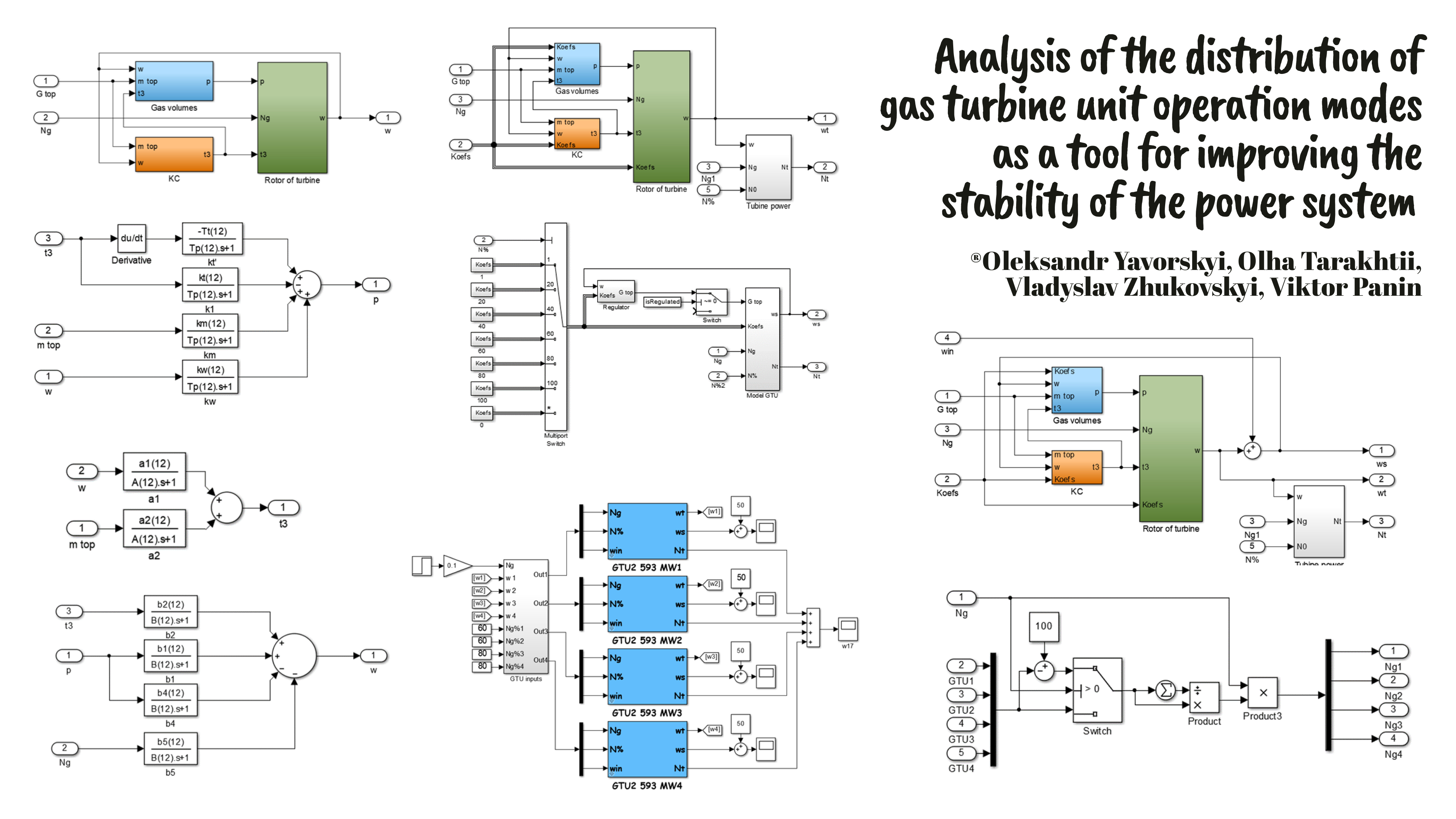
Робота була направлена на створення математичних моделей ГТУ та енергосистеми, що дозволяють аналізувати зміну частоти та потужності залежно від режимів роботи. А також на розробку методики оптимального розподілу навантажень між установками за умов змінних зовнішніх впливів. У роботі детально описано структуру моделі ГТУ в середовищі Simulink, яка враховує динамічні процеси в газових об’ємах, камері згорання та роторі установки. Запропонована методика базується на дослідженні двох підходів до розподілу потужності: рівномірного та пропорційного до діапазону регулювання кожної ГТУ. Чисельний експеримент показав, що рівномірний розподіл краще підходить для позитивних збурень, зменшуючи інтегральний показник (integtal square error ISE) на 15 % порівняно з традиційними методами, тоді як для негативних збурень пропорційний розподіл демонструє зменшення ISE на 20 %. У випадку позитивних збурень рівномірний розподіл при різних комбінаціях потужностей в середньому показує на 0,6 % кращу якість регулювання, ніж пропорційний підхід, а для негативних збурень пропорційний розподіл в середньому показує на 0,25 % кращу якість регулювання, порівняно рівномірним.
Результати дослідження мають значний практичний потенціал і можуть бути використані для вдосконалення систем управління енергосистемами України в умовах дефіциту генеруючих потужностей та кризових ситуацій.
Посилання
- Basok, B., Bazeev, E. (2023). Energy, science and engineering today: the state and challenges of development. Thermophysics and Thermal Power Engineering, 45 (1), 35–45. Available at: https://ihe.nas.gov.ua/index.php/journal/article/view/522
- Goldrin, V., Chervonenko, I., Zbinskiy, V., Brodich, R., Slonevskiy, O. (2020). Participation of Ukrainian NPPs in Regulating Frequency and Power in the United Energy System: Problem Analysis and Solutions. Nuclear and Radiation Safety, 1 (85), 50–56. https://doi.org/10.32918/nrs.2020.1(85).05
- Bardyk, Y., Bondarenko, O., Bolotnyi, M. (2024). Operational reliability analysis for sustainable energy system planning development. Vidnovluvana Energetika, 4 (79), 46–58. https://doi.org/10.36296/1819-8058.2024.4(79).46-58
- Sahu, R., Panigrahi, P. K., Lal, D. K., Dey, B. (2024). Hybrid Intelligent Algorithm Applied to Economic Dispatch of Grid-Connected Microgrid System Considering Static and Dynamic Load Demand. Control Applications in Modern Power Systems, 109–119. https://doi.org/10.1007/978-981-99-9054-2_7
- Patra, N., Chatterjee, A., Sahoo, R. K. (2024). Design of Hybrid Energy Storage System Model with Multi-input Converter. Control Applications in Modern Power Systems, 121–131. https://doi.org/10.1007/978-981-99-9054-2_8
- Deng, Y., Fang, X., Gao, N., Tan, J. (2024). Multi-Timescale Modeling Framework of Hybrid Power Plants Providing Secondary Frequency Regulation. IEEE Open Access Journal of Power and Energy, 11, 595–609. https://doi.org/10.1109/oajpe.2024.3504835
- Zhang, Y., Shotorbani, A. M., Wang, L., Mohammadi-Ivatloo, B. (2021). Distributed Secondary Control of a Microgrid with A Generalized PI Finite-Time Controller. IEEE Open Access Journal of Power and Energy, 8, 57–67. https://doi.org/10.1109/oajpe.2021.3056507
- Nagendra, M., Kalyan, Ch. N. S., Rao, R. S. (2024). Comparison of SMES and RFB Performance in Combined Voltage and Frequency Regulation of Multi Source Power System. Control Applications in Modern Power Systems, 91–107. https://doi.org/10.1007/978-981-99-9054-2_6
- Yavorskyi, O., Tarakhtii, O., Maksymov, M., Kryvda, V. (2023). Model of Gas Turbine Plant with Concentrated Parameters for Analysis of Dynamic Properties Patterns. Energy Engineering and Control Systems, 9 (2), 105–118. https://doi.org/10.23939/jeecs2023.02.105
- Bundiuk, A. M., Tarakhtii, O. S. (2015). O povyshenii kachestva upravleniya moshchnostyu GTU kogeneratsionnoy energeticheskoy ustanovki. Avtomatyzatsiya, kontrol ta upravlinnya: poshuk idey ta rishen. Zbirnyk naukovykh prats I Vseukrayinskoyi naukovo-tekhnichnoyi konferentsiyi v m. Krasnoarmiysku 25–29 travnya 2015 r. Krasnoarmiisk: DVNZ “DonNTU”, 444–447.
- GOST 13109-97. Elektricheskaya energiya. Sovmestimost tekhnicheskikh sredstv. Normy kachestva elektricheskoy energii v sistemakh obshchego naznacheniya. (1998). Vved. 1999-01-01. Izdatelstvo standartov, 17.
##submission.downloads##
Опубліковано
Як цитувати
Номер
Розділ
Ліцензія
Авторське право (c) 2024 Oleksandr Yavorskyi, Olha Tarakhtii, Vladyslav Zhukovskyi, Viktor Panin

Ця робота ліцензується відповідно до Creative Commons Attribution 4.0 International License.
Закріплення та умови передачі авторських прав (ідентифікація авторства) здійснюється у Ліцензійному договорі. Зокрема, автори залишають за собою право на авторство свого рукопису та передають журналу право першої публікації цієї роботи на умовах ліцензії Creative Commons CC BY. При цьому вони мають право укладати самостійно додаткові угоди, що стосуються неексклюзивного поширення роботи у тому вигляді, в якому вона була опублікована цим журналом, але за умови збереження посилання на першу публікацію статті в цьому журналі.