Регіональна кластеризація підприємств ПЕК для зміцнення економічної безпеки країни
DOI:
https://doi.org/10.15587/2706-5448.2024.320341Ключові слова:
енергетичні підприємства, енергетичний кластер, регіональний розвиток, економічна безпека, енергетичні системи, регіональне управлінняАнотація
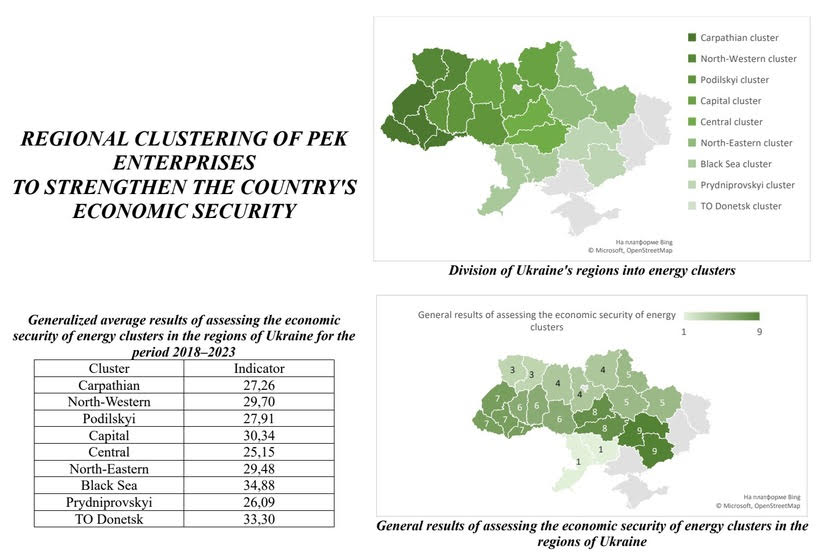
Об'єктом дослідження є процес зміцнення економічної безпеки підприємств паливно-енергетичного комплексу України. У роботі розглянуто питання поділу суб'єктів господарювання різних форм власності на кластери відповідно до їх територіальної приналежності та особливостей функціонування. Характерною особливістю територіальної організації енергетичного комплексу України є не ізольоване розміщення його виробничих об'єктів, а функціонування більшості з них в енергетичних системах і тісний взаємозв'язок. В результаті застосування запропонованих методів кластерного аналізу, подібності, кореляції та евклідової відстані було здійснено поділ на територіальні кластери відповідно до досліджуваної галузі. Отримані результати представлено у матричному вигляді, що дозволило скоригувати можливу схожість кластерів та визначити їх за територіальною близькістю та результатами фінансової діяльності. Подальші дослідження присвячено визначенню змін показників за останні п'ять років за такими характеристиками, як: економічне зростання кластера, взаємозв'язок з іншими кластерами, фінансова стійкість кластера та соціально-економічний розвиток. Це дозволило узагальнити проаналізовані дані та виявити слабкі та сильні сторони енергетичних підприємств. Визначено, що лідерами серед позитивних узагальнених результатів є Причорноморський кластер (34,88/1) та Столичний (30,34/2) кластер та Подільський (27,91/3). А негативні мають – Центральний (25,15/9), Придніпровський (26,09/8) та ТО Донецький (27,26/7). Отримані результати пояснюються різноманітністю фінансових результатів компаній за п'ятирічний період, а також постійною зміною факторів зовнішнього впливу на об'єкти критичної інфраструктури. Запропоновані заходи щодо об'єднання підприємств у кластери спрямовані на подальше підтримання існуючого рівня економічної безпеки. А також на захист усіх джерел генерації енергії підприємствами та подальші перспективи оновлення та/або реконструкції в ланцюгу надання енергетичних послуг від виробництва до кінцевого споживача, що має стати пріоритетним напрямом розвитку для країни.
Посилання
- Pro natsionalnu bezpeku Ukrainy (2022). Zakon Ukrainy No. 2469-VIII. 22.06.2022. Available at: https://zakon.rada.gov.ua/laws/show/2469-19#Text Last accessed: 10.07.2024
- Yarmol, L., Tsebenko, S., Andrusіak, I., Kovalchuk, O., Markovskyi, V. (2021). International and national guarantees of economic security. Financial and Credit Activity Problems of Theory and Practice, 3 (38), 358–367. https://doi.org/10.18371/fcaptp.v3i38.237468
- Kuhareva, O., Lysa, O., Shapoval, V. (2021). Problems of management of economic security in Ukraine. Financial and Credit Activity Problems of Theory and Practice, 4 (35), 312–319. https://doi.org/10.18371/fcaptp.v4i35.222144
- Stiglitz, J. E. (2018). Industrial Policies and Development Cooperation for a Learning Society. Asia-Pacific Review, 25 (2), 4–15. https://doi.org/10.1080/13439006.2018.1548816
- Liezina, A., Lavruk, A., Matviienko, H., Ivanets, I., Tseluiko, O., Kuchai, O. (2023). Impact of econometric modeling and perspectives of economic security of the cross-industry complex. Acta Innovations, 47, 73–83. https://doi.org/10.32933/actainnovations.47.7
- Giessmann, H. J. (2007). Regionalism and Crisis Prevention in (Western) Europe and (Eastern) Asia: A Systematic Comparison. Asia-Pacific Review, 14 (2), 62–81. https://doi.org/10.1080/13439000701736963
- Taro, A. (2022). NPI Special Seminar “Economic Security and Japan-US Relations.” Asia-Pacific Review, 29 (3), 1–9. https://doi.org/10.1080/13439006.2022.2174318
- Perkins, D. H. (2007). East Asian Economic Growth and its Implications for Regional Security. Asia-Pacific Review, 14 (1), 44–53. https://doi.org/10.1080/13439000701330601
- Yamashita, K. (2006). Food and agriculture problems for Japan and the World in the twenty-first century. Asia-Pacific Review, 13 (1), 1–15. https://doi.org/10.1080/13439000600697050
- Mowlds, S. (2020). The EU’s farm to fork strategy: missing links for transformation. Acta Innovations, 36, 17–30. https://doi.org/10.32933/actainnovations.36.2
- Martin, W. (2020). US-Japan Energy Relations: Past, Present, and the Future. Asia-Pacific Review, 27 (2), 80–93. https://doi.org/10.1080/13439006.2020.1826683
- Salimi, M., Amidpour, M. (2022). The Impact of Energy Transition on the Geopolitical Importance of Oil-Exporting Countries. World, 3 (3), 607–618. https://doi.org/10.3390/world3030033
- Hai, N. T., Duong, N. T. (2024). An improved environmental management model for assuring energy and economic prosperity. Acta Innovations, 52, 9–18. https://doi.org/10.62441/actainnovations.52.2
- Nobukatsu, K. (2023). Reading Japan’s National Security Strategy. Asia-Pacific Review, 30 (1), 7–25. https://doi.org/10.1080/13439006.2023.2198854
- Kitaoka, S. (2016). Sustainable Development Goals and Japan’s Official Development Assistance Policy: Human Security, National Interest, and a More Proactive Contribution to Peace. Asia-Pacific Review, 23 (1), 32–41. https://doi.org/10.1080/13439006.2016.1195951
- Stackpole, H. C. (2002). A US Security Approach in the Asia-Pacific Region in the Age of Globalization. Asia-Pacific Review, 9 (1), 77–87. https://doi.org/10.1080/13439000220141604
- Le Pere, G., Ikome, F. (2009). Challenges and Prospects for Economic Development in Africa. Asia-Pacific Review, 16 (2), 89–114. https://doi.org/10.1080/13439000903371650
- Khanova, O., Matyushenko, I., Kochańska, E., Tretyak, V., Tofaniuk, O. (2021). Calculation of sustainable development index in the EU and Ukraine. Acta Innovations, 40, 79–97. https://doi.org/10.32933/actainnovations.40.6
- Oba, M. (2016). TPP, RCEP, and FTAAP: Mulitlayered Regional Economic Integration and International Relations. Asia-Pacific Review, 23 (1), 100–114. https://doi.org/10.1080/13439006.2016.1195957
- Andriushchenko, K., Liezina, A., Lavruk, V., Sliusareva, L., Rudevska, V. (2022). Intelligent enterprise capital control based on Markov chain. Acta Innovations, 45, 18–30. https://doi.org/10.32933/actainnovations.45.2
- Grosse, T. G. (2006). Euro-Commentary: An Evaluation of the Regional Policy System in Poland. European Urban and Regional Studies, 13 (2), 151–165. https://doi.org/10.1177/0969776406058965
- Kochanska, E., Kyzym, M., Khaustova, V., Klimek, A., R., Adamkiewicz, I. (2016). Determinants for development of cluster initiatives in Poland and Ukraine. Acta innovations, 21, 26–50. Available at: https://www.actainnovations.com/index.php/pub/article/view/21_3
- Isbasoiu, G.-M. (2006). Industrial Clusters and Regional Development: The Case of Timisoara and Montebelluna. SSRN Electronic Journal. https://doi.org/10.2139/ssrn.1022310
- Ketels, С. (2009). Clusters, cluster policy and Swedish competitiveness in the global economy. Harvard Business School. Available at: https://citeseerx.ist.psu.edu/document?repid=rep1&type=pdf&doi=92b3b9f8699c99541505ac140615eb813fc50fdd
- Arimoto, Y., Nakajima, K., Okazaki, T. (2014). Sources of productivity improvement in industrial clusters: The case of the prewar Japanese silk-reeling industry. Regional Science and Urban Economics, 46, 27–41. https://doi.org/10.1016/j.regsciurbeco.2014.02.004
- Gochua, A., Zedelashvili, T. (2020). Cyber Threats and Asymmetric Military challenges In the Context of Nuclear Security: Ukrainian and International Cases Analysis. Ukrainian Policymaker, 7, 20–27. https://doi.org/10.29202/up/7/3
- Mori, S. (2019). US Technological Competition with China: The Military, Industrial and Digital Network Dimensions. Asia-Pacific Review, 26 (1), 77–120. https://doi.org/10.1080/13439006.2019.1622871
- Ito, A. (2019). Digital China: A Fourth Industrial Revolution with Chinese Characteristics? Asia-Pacific Review, 26 (2), 50–75. https://doi.org/10.1080/13439006.2019.1691836
- Nobuhiro, A. (2023). Bringing the Young and the Tech into Indonesia’s Digital Education Politics and the Geopolitical Impact. Asia-Pacific Review, 30 (2), 66–91. https://doi.org/10.1080/13439006.2023.2254634
- Omran, M. G. H., Engelbrecht, A. P., Salman, A. (2007). An overview of clustering methods. Intelligent Data Analysis, 11 (6), 583–605. https://doi.org/10.3233/ida-2007-11602
- Rokach, L., Maimon, O. (2005) Clustering methods. The data mining and knowledge discovery handbook, 321–352. https://doi.org/10.1007/0-387-25465-x_15
- Ştefan, R.-M. (2014). Cluster Type Methodologies for Grouping Data. Procedia Economics and Finance, 15, 357–362. https://doi.org/10.1016/s2212-5671(14)00438-9
- On the Strategy of Economic Security of Ukraine for the period until 2025 of August 11, 2021. Decision of the Verkhovna Rada of Ukraine. Available at: https://zakon.rada.gov.ua/laws/show/n0048525-21#Text Last accessed: 01.09.2024
- Maione, C., Luíza da Costa, N., Barbosa, F., Barbosa, R. M. (2021). A Cluster Analysis Methodology for the Categorization of Soil Samples for Forensic Sciences Based on Elemental Fingerprint. Applied Artificial Intelligence, 36 (1). https://doi.org/10.1080/08839514.2021.2010941
- State Statistics Service of Ukraine. Available at: https://www.ukrstat.gov.ua Last accessed: 01.09.2024
- Omerbegovic Arapovic, A., Kurtovic, A. (2024). Impact of recurrent and non-recurrent government expenditure on Bosnia and Herzegovina’s economic growth: an empirical analysis (1996–2022). Public and Municipal Finance, 13 (1), 124–136. https://doi.org/10.21511/pmf.13(1).2024.10
- Guliyev, E., Atashov, B., Guliyeva, A. (2024). Role of government policy in food security: Economic and demographic challenges. Problems and Perspectives in Management, 22 (2), 488–501. https://doi.org/10.21511/ppm.22(2).2024.38
- Pokataiev, P., Teteruk, K., Andriushchenko, A. (2023). A biotechnological business incubator as an instrument of innovation entrepreneurship. Recent Trends in Business and Entrepreneurial Ventures, 37–60.
- Hartono, S., Sobari, A. (2016). The role of cluster cycle and pattern of interaction to competition strategy. Problems and Perspectives in Management, 14 (2), 74–83. https://doi.org/10.21511/ppm.14(2).2016.08
- Andriushchenko, K., Datsii, O., Lavruk, O., Dmytrenko, R., Kutashev, I., Vіnіchenko, I. et al. (2021). Development of а matrix of food industry capacity for making management decisions in the formation of sustainable development of agroecosystems. Eastern-European Journal of Enterprise Technologies, 2 (13 (110)), 16–27. https://doi.org/10.15587/1729-4061.2021.227805
- Adamkiewicz, I., Dudojć, M. (2013). Open innovation state of the art in Lodz region (Poland). Acta Innovation, 6, 5–21.
##submission.downloads##
Опубліковано
Як цитувати
Номер
Розділ
Ліцензія
Авторське право (c) 2024 Anastasiia Liezina, Kateryna Andriushchenko, Oksana Domina, Тітова Titova, Helena Petukhova

Ця робота ліцензується відповідно до Creative Commons Attribution 4.0 International License.
Закріплення та умови передачі авторських прав (ідентифікація авторства) здійснюється у Ліцензійному договорі. Зокрема, автори залишають за собою право на авторство свого рукопису та передають журналу право першої публікації цієї роботи на умовах ліцензії Creative Commons CC BY. При цьому вони мають право укладати самостійно додаткові угоди, що стосуються неексклюзивного поширення роботи у тому вигляді, в якому вона була опублікована цим журналом, але за умови збереження посилання на першу публікацію статті в цьому журналі.