Вдосконалення прототипу мікрофільтра та його реалізація: хімічне застосування
DOI:
https://doi.org/10.15587/2706-5448.2025.322592Ключові слова:
МЕМС, НЕМС, МЕТ, 3D-принтер, мікрофільтр, мікровиробництво, хімічний мікрореактор, мікросепаратор, фільтрація повітря та рідини, здоров'я людиниАнотація
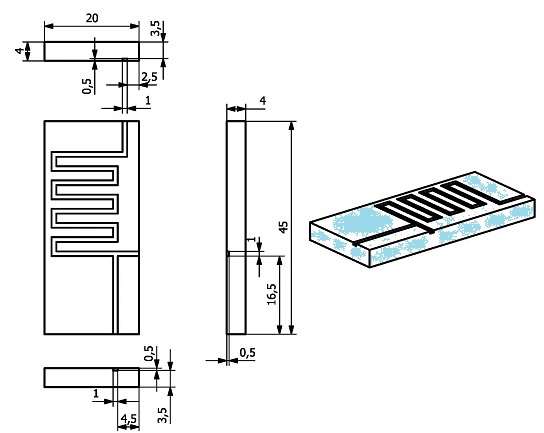
Об'єктом дослідження є мікрофільтри. Це дослідження направлено на розробку мікрофільтра, який може бути використаний, наприклад, для фільтрації повітря або води в традиційних сферах застосування. Закриті приміщення вимагають контролю якості повітря для здоров'я людей, які там працюють. Проаналізовано застосування різних технологій, таких як мікроелектромеханічні системи (MEMS), наноелектромеханічні системи (NEMS) та технологія мікрообладнання (MET) для виробництва мікрокомпонентів. Описано переваги та недоліки цих технологій. У цій роботі використано МЕТ для виготовлення та розробки структури мікрофільтра.
Представлено структуру та модель мікрофільтра. Проблема, яку необхідно вирішити, пов'язана зі спрощенням конструкції мікрофільтрів та підготовкою її до використання нових технологій їх виробництва. Для її реалізації використано 3D-принтер. 3D-принтери – це обладнання, що реалізує адитивну технологію, яка активно розвивається в останні роки. З комп'ютерної 3D-моделі можна побудувати 3D-прототип. Суть результатів полягає в можливості масового виробництва мікрофільтрів. Описано різні можливі застосування, не тільки фільтрація повітря та рідини, але й застосування в хімії для модулів мікрореакцій та мікророзділення.
Проведено порівняння нового дизайну мікрофільтра з нашим попереднім прототипом мікрофільтра, розробленим і виготовленим з використанням МЕТ. Перевага МЕТ полягає в тому, що він працює з різними матеріалами, а не лише з тими, що використовуються в мікроелектроніці. Випробування та дослідження показали, що мікрофільтри можуть бути використані на практиці. Новий прототип був виготовлений на 3D-принтері. Порівняльна оцінка першого прототипу мікрофільтра та нового прототипу показує, що новий прототип має спрощену структуру та є простішим у виготовленні. Однією з найцікавіших сфер їх застосування є хімічні мікрореактори. Це одна з нових, цікавих і перспективних сфер застосування.
Спонсор дослідження
- This research was partly supported by the project UNAM-DGAPA-PAPIIT IT 102320.
Посилання
- Trimmer, W. S. (1997). Micromechanics and MEMS. Classical and Seminal Papers to 1990. New York: IEEE Press.
- Arab, A., Feng, Q. (2014). Reliability research on micro- and nano-electromechanical systems: a review. The International Journal of Advanced Manufacturing Technology, 74 (9-12), 1679–1690. https://doi.org/10.1007/s00170-014-6095-x
- Guo, H., Lou, L., Chen, X., Lee, C. (2012). PDMS-Coated Piezoresistive NEMS Diaphragm for Chloroform Vapor Detection. IEEE Electron Device Letters, 33 (7), 1078–1080. https://doi.org/10.1109/led.2012.2195152
- Fan, X., Forsberg, F., Smith, A. D., Schröder, S., Wagner, S., Rödjegård, H. et al. (2019). Graphene ribbons with suspended masses as transducers in ultra-small nanoelectromechanical accelerometers. Nature Electronics, 2 (9), 394–404. https://doi.org/10.1038/s41928-019-0287-1
- Kussul, E. M., Rachkovskij, D. A., Baidyk, T. N., Talayev, S. A. (1996). Micromechanical engineering: a basis for the low-cost manufacturing of mechanical microdevices using microequipment. Journal of Micromechanics and Microengineering, 6 (4), 410–425. https://doi.org/10.1088/0960-1317/6/4/008
- Kussul, E., Baidyk, T., Ruiz-Huerta, L., Caballero-Ruiz, A., Velasco, G., Kasatkina, L. (2002). Development of micromachine tool prototypes for microfactories. Journal of Micromechanics and Microengineering, 12 (6), 795–812. https://doi.org/10.1088/0960-1317/12/6/311
- Kussul, E., Baidyk, T., Wunsch, D. C. (2010). Neural Networks and Micromechanics. Berlin, Heidelberg: Springer, 210. https://doi.org/10.1007/978-3-642-02535-8
- Ko, D.-H., Gyak, K.-W., Kim, D.-P. (2017). Emerging Microreaction Systems Based on 3D Printing Techniques and Separation Technologies. Journal of Flow Chemistry, 7 (3-4), 72–81. https://doi.org/10.1556/1846.2017.00013
- Romão Bineli, A., Gimenez Peres, A., Luiz Jardini, A., Maciel Filho, R. (2011). Direct metal laser sintering (DMLS): technology for design and construction of microreactors. 6th Brazilian conference on manufacturing engineering. Brazil.
- Scotti, G., Nilsson, S. M. E., Haapala, M., Pöhö, P., Boije af Gennäs, G. et al. (2017). A miniaturised 3D printed polypropylene reactor for online reaction analysis by mass spectrometry. Reaction Chemistry & Engineering, 2 (3), 299–303. https://doi.org/10.1039/c7re00015d
- Dragone, V., Sans, V., Rosnes, M. H., Kitson, P. J., Cronin, L. (2013). 3D-printed devices for continuous-flow organic chemistry. Beilstein Journal of Organic Chemistry, 9, 951–959. https://doi.org/10.3762/bjoc.9.109
- Riche, C. T., Roberts, E. J., Gupta, M., Brutchey, R. L., Malmstadt, N. (2016). Flow invariant droplet formation for stable parallel microreactors. Nature Communications, 7 (1). https://doi.org/10.1038/ncomms10780
- Jönsson, A., Svejdal, R. R., Bøgelund, N., Nguyen, T. T. T. N., Flindt, H., Kutter, J. P. et al. (2017). Thiol-ene Monolithic Pepsin Microreactor with a 3D-Printed Interface for Efficient UPLC-MS Peptide Mapping Analyses. Analytical Chemistry, 89 (8), 4573–4580. https://doi.org/10.1021/acs.analchem.6b05103
- Yang, Y., Li, X., Zheng, X., Chen, Z., Zhou, Q., Chen, Y. (2017). 3D‐Printed Biomimetic Super‐Hydrophobic Structure for Microdroplet Manipulation and Oil/Water Separation. Advanced Materials, 30 (9). https://doi.org/10.1002/adma.201704912
- Tabassum, T., Iloska, M., Scuereb, D., Taira, N., Jin, C., Zaitsev, V. et al. (2018). Development and Application of 3D Printed Mesoreactors in Chemical Engineering Education. Journal of Chemical Education, 95 (5), 783–790. https://doi.org/10.1021/acs.jchemed.7b00663
- Zhang, L., Zhu, Z., Liu, B., Li, C., Yu, Y., Tao, S., Li, T. (2019). Fluorescent Fluid in 3D‐Printed Microreactors for the Acceleration of Photocatalytic Reactions. Advanced Science, 6 (13). https://doi.org/10.1002/advs.201900583
- Neumaier, J. M., Madani, A., Klein, T., Ziegler, T. (2019). Low-budget 3D-printed equipment for continuous flow reactions. Beilstein Journal of Organic Chemistry, 15, 558–566. https://doi.org/10.3762/bjoc.15.50
- Sundarrajan, S., Tan, K. L., Lim, S. H., Ramakrishna, S. (2014). Electrospun Nanofibers for Air Filtration Applications. Procedia Engineering, 75, 159–163. https://doi.org/10.1016/j.proeng.2013.11.034
- Wlodarczyk, K., Carter, R., Jahanbakhsh, A., Lopes, A., Mackenzie, M., Maier, R. et al. (2018). Rapid Laser Manufacturing of Microfluidic Devices from Glass Substrates. Micromachines, 9 (8), 409. https://doi.org/10.3390/mi9080409
- Rodríguez Andrade, J. (2018). Diseño de microcentro de maquinado para fabricación de microfiltros de aire. [Tesis de Maestría en Ingeniería Eléctrica].
- Rodriguez Andrade, J., Kussul, E., Baydyk, T. (2020). Microchannel filter for air purification. Open Physics, 18 (1), 241–254. https://doi.org/10.1515/phys-2020-0153
- Ley de Poiseuille. HyperPhysics. Available at: http://hyperphysics.phy-astr.gsu.edu/hbasees/ppois.html Last accessed: 09.02.2025
- Curso Hidraulica (2012). Propiedades geométricas de los canales. Available at: http://hidraulicaucentral.blogspot.com/2012/05/variables-y-fenomenos-hidraulicos.html Last accessed: 09.02.2025
- An open-source 3d print software. Robots in the sun. Available at: http://robotsinthesun.org/monkeyprint-an-open-source-3d-print-software/
- FDM vs. SLA vs. SLS: 3D Printing Technology Comparison. Available at: https://formlabs.com/blog/fdm-vs-sla-vs-sls-how-to-choose-the-right-3d-printing-technology/?srsltid=AfmBOorzPrAsINci6DjihgPM5pvvxROR-7MWEdoaZzON_3PTJxvO5EQA Last accessed: 02.05.2025
##submission.downloads##
Опубліковано
Як цитувати
Номер
Розділ
Ліцензія
Авторське право (c) 2025 Tetyana Baydyk, Masuma Mammadova, Graciela Velasco Herrera, Ernst Kussul

Ця робота ліцензується відповідно до Creative Commons Attribution 4.0 International License.
Закріплення та умови передачі авторських прав (ідентифікація авторства) здійснюється у Ліцензійному договорі. Зокрема, автори залишають за собою право на авторство свого рукопису та передають журналу право першої публікації цієї роботи на умовах ліцензії Creative Commons CC BY. При цьому вони мають право укладати самостійно додаткові угоди, що стосуються неексклюзивного поширення роботи у тому вигляді, в якому вона була опублікована цим журналом, але за умови збереження посилання на першу публікацію статті в цьому журналі.