Розроблення моделі нафарблення растрових елементів поліномінального перетворення цифрових зображень
DOI:
https://doi.org/10.15587/2706-5448.2025.323533Ключові слова:
поліномінальне перетворення, нафарблення растрових елементів, симулятор, градаційні характеристики, характеристики нафарблення, оптична густинаАнотація
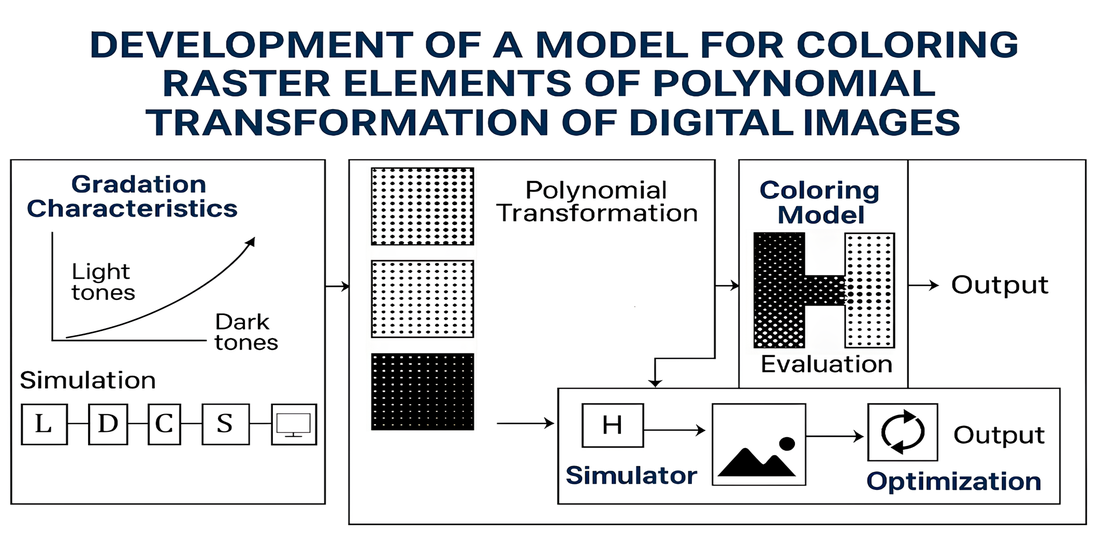
Об’єктом дослідження є процес додрукарської підготовки зображень, зокрема кінцева стадія приготування зображення до друкування – растрування із застосуванням поліномінального перетворення.
Однією з проблем в процесі приготування зображення до друку – це відсутність у програмах комп’ютерної графіки та растровому процесорі програми для побудови градаційних характеристик та характеристик растрування.
В даній роботі було використано методи наукового дослідження, зокрема метод математичного моделювання, об’єктно-орієнтоване програмування та пакет програмного забезпечення MATLAB:Simulink. В процесі дослідження було побудовано моделі растрування поліномінального перетворення цифрових зображень та розроблено симулятори для імітаційного моделювання.
Отримано градаційні характеристики, характеристики растрування та оптичну густину нафарблення растрових елементів, що кількісно та якісно описує растрове тоновідтворення друкованих зображень. Розроблена модель нафарблення для визначення кількості фарби на поверхні растрових елементів поліномінального перетворення зображень світлих тонів дозволяє коригувати зображення на основі аналізу властивостей градаційних характеристик, характеристик растрування та оптичної густин в широкому діапазоні тоновідтворення.
Завдяки запропонованій моделі значно розширяється інформативність аналізу тоновідтворення. Це суттєва перевага щодо моделі на основі степеневого перетворення, яка має обмеження щодо відтворення темних тонів і викликає явище постеризації.
На основі отриманих результатів нафарблення растрових елементів типових варіантів поліномінального перетворення для поліномінального значення товщини H=1 мкм встановлено, що збільшення товщини шару фарби на 20 % від номінальної зміщує початкові значення нафарблення. Зокрема: за V=1,2 характеристики зміщуються у сторону темних тонів – зображення притемнюється, а при V=0,8 характеристики нафарблення зміщуються у сторону середніх тонів – зображення стає світлішим.
Результати проведених досліджень растрових тонів можна застосовувати на стадії приготування цифрових зображень до растрування у комп’ютерних видавничих системах.
Посилання
- Verkhola, M., Durniak, B., Huk, I., Panovyk, U. (2014). Informatsiina tekhnolohiia vyznachennia tochnosti vidtvorennia zobrazhennia na vidbytkakh farbodrukarskoiu systemoiu poslidovno paralelnoi struktury. Kompiuterni tekhnolohii drukarstva, 31, 3–17.
- Lukiv, M. M. (2012). Tsyfrovi tekhnolohii drukarstva. Lviv: UAD, 488.
- Durnyak, B., Lutskiv, M., Shepita, P., Hunko, D., Savina, N. (2021). Formation of linear characteristics of normalized raster transformation for rhombic elements. Intelligent Information Technologies & System of Information Security, CEUR Workshop Proceedings, 2853, 127–133.
- Serdiuk, Yu. O. (2023). Vyznachennia kontrastnoi chutlyvosti hama peretvorennia zobrazhen temnykh toniv. Polihrafiia i vydavnycha sprava, 1 (85), 22–31.
- Kovalskyi, B. M., Semeniv, M. V., Shovheniuk, M. V. (2016). Kompiuterna prohrama syntezu zobrazhennia na vidbytku dlia novoi informatsiinoi ta tradytsiinykh tekhnolohii kolorovoho druku. Science and Education a New Dimention: Natural and Technical Science, IV (10 (91)), 72–78.
- Pashulia, P. L. (2011). Standartyzatsiia, metrolohiia, vidpovidnist, yakist u polihraf. Lviv: UAD, 408.
- Scott, E. (2023). Umbaugh Computer Vision and Image Analysis Digital Image Processing and Analysis. CRC Press, 441.
- Scott, E. (2023). Umbaugh Digital Image Enhancement, Restoration and Compression Digital Image Processing and Analysis. CRC Press, 489.
- Distante, A., Distante, C. (2020). Handbook of Image Processing and Computer Vision. Vol. 2: From Image to Pattern. Cham: Springer Nature, 448. https://doi.org/10.1007/978-3-030-42374-2
- Gonzales, R. C., Woods, R. E. (2008). Digital image processing: international Version. lnc publishind as Prentice Hall. Copyright, 1104.
- Buczynski, L. (2005). Skanery i skanowanie. Warszawa: Wydawnictwo MIKOMA, 88.
- Kaminski, B. (2001). Nowoczesny prepres. Warszawa: Wydawca: Translator, 352.
- Lukiv, M. M., Muzyka, O. O. (2022). Modeliuvannia rastrovoho peretvorennia tsyfrovykh zobrazhen elementiv kvadratnoi formy. Kompiuterni tekhnolohii drukarstva, 2 (48), 257–267.
- Bredies, K., Lorenz, D. (2018). Mathematical Image Processing. Birkhäuser. Cham: Springer Nature, 481.
- Lutskiv, M. M., Nakonechnyi, M. D. (2022). Modeliuvannia i analiz nafarblennia tsyfrovykh zobrazhen. Kompiuterni tekhnolohii drukarstva, 2 (48), 245–256.
- Durniak, B. V., Senkivskyi, V. M., Lutskiv, M. M., Musiiovska, M. M. (2021). Informatsiina tekhnolohiia tonovidtvorennia v korotkykh farbodrukarskykh systemakh poslidovnoi struktury. Lviv: UAD, 176.
##submission.downloads##
Опубліковано
Як цитувати
Номер
Розділ
Ліцензія
Авторське право (c) 2025 Богдан Ярославович Кавин

Ця робота ліцензується відповідно до Creative Commons Attribution 4.0 International License.
Закріплення та умови передачі авторських прав (ідентифікація авторства) здійснюється у Ліцензійному договорі. Зокрема, автори залишають за собою право на авторство свого рукопису та передають журналу право першої публікації цієї роботи на умовах ліцензії Creative Commons CC BY. При цьому вони мають право укладати самостійно додаткові угоди, що стосуються неексклюзивного поширення роботи у тому вигляді, в якому вона була опублікована цим журналом, але за умови збереження посилання на першу публікацію статті в цьому журналі.