Strategic directions for energy efficiency based on intellectual decarbonization: a cluster analysis
DOI:
https://doi.org/10.15587/2706-5448.2025.325743Keywords:
energy efficiency strategy, energy efficiency policy, economic decarbonization, intelligent decarbonization, artificial intelligence, energy policyAbstract
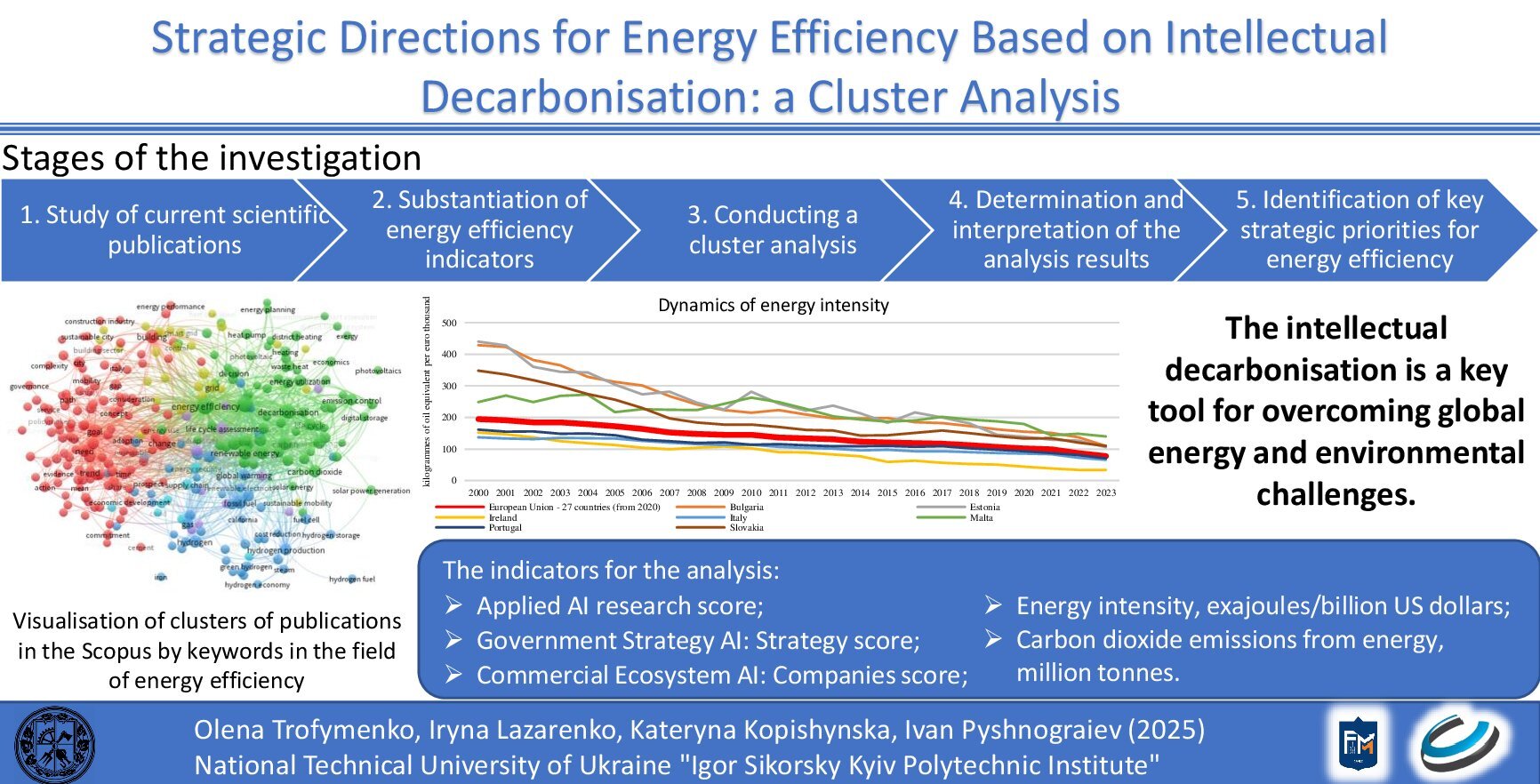
The object of research is the processes of substantiating strategic directions for energy efficiency on the basis of intelligent decarbonization and sustainable development based on cluster analysis, taking into account international experience and challenges of the global environment. The problem that has been addressed is the lack of a systematic approach to clustering countries by energy efficiency, which also takes into account indicators of intelligent decarbonization. This makes it difficult to develop targeted strategies to improve energy efficiency and decarbonization, especially given the specifics of AI and innovative technologies in different countries.
The essence of the study results is to identify five clusters of the selected countries such as USA, India, Japan, China, Ukraine, Romania, Hungary, Poland, Czech Republic, Turkey, Portugal, Belgium, Greece, Sweden, Spain, Norway, Austria, Finland, Italy, France, The Netherlands, Germany, Switzerland, United Kingdom using cluster analysis based on the following indicators:
- Applied AI research score.
- Government Strategy AI: Strategy score.
- Commercial Ecosystem AI: Companies score.
- Energy intensity.
- Carbon dioxide emissions from energy.
Cluster 1 includes India and Ukraine, countries with high energy intensity and significant CO₂ emissions, but with the potential to develop intelligent decarbonization. Cluster 2 is represented by the United States, a leader in AI and innovation, with low energy intensity but high CO₂ emissions due to its advanced industry. Cluster 3 covers countries with low energy intensity and low CO₂ emissions but weak AI development. Cluster 4 includes China, a country with a high level of AI research and commercial ecosystem, but high energy intensity and CO₂ emissions due to intensive industry. Cluster 5 covers countries with medium to high AI development, low to medium energy intensity, and varying levels of CO₂ emissions. The key principles of energy efficiency in these clusters are identified and strategic priorities for the development of energy efficiency in modern countries are defined.
The results obtained can be used in practice to develop energy efficiency and decarbonization strategies at the national and international levels.
Supporting Agency
- Olena Trofymenko has received funding from the scholarship programme of the Verkhovna Rada of Ukraine, Kateryna Kopishynska and Ivan Pyshnograiev have received funding from the Ministry of Education and Science of Ukraine (project No. 0124U000866).
References
- Damayanti, S., Sudarmaji, E., Masrio, H. (2024). The Critical Role of Energy Intensity in Decarbonizing ASEAN: Integrating Growth and Emissions Reductions. International Journal of Energy Economics and Policy, 14 (3), 247–259. https://doi.org/10.32479/ijeep.15059
- Kozlowska, A., Guarino, F., Volpe, R., Bisello, A., Gabaldòn, A., Rezaei, A. et al. (2024). Positive Energy Districts: Fundamentals, Assessment Methodologies, Modeling and Research Gaps. Energies, 17 (17), 4425. https://doi.org/10.3390/en17174425
- Pylak, K., Pizoń, J., Łazuka, E. (2024). Evolution of Regional Innovation Strategies Towards the Transition to Green Energy in Europe 2014–2027. Energies, 17 (22), 5669. https://doi.org/10.3390/en17225669
- Li, H., Wang, S., Zhen, L., Wang, X. (2022). Data-driven optimization for automated warehouse operations decarbonization. Annals of Operations Research, 343 (3), 1129–1156. https://doi.org/10.1007/s10479-022-04972-1
- Kravchenko, M., Trofymenko, O., Kopishynska, K., Pyshnograiev, I., Boiarynova, K., Roshchyna, N. (2024). Ensuring energy security on the basis of intelligent decarbonisation and innovative economic development. E3S Web of Conferences, 558, 01009. https://doi.org/10.1051/e3sconf/202455801009
- Almassalkhi, M. R., Kundu, S. (2023). Intelligent Electrification as an Enabler of Clean Energy and Decarbonization. Current Sustainable/Renewable Energy Reports, 10 (4), 183–196. https://doi.org/10.1007/s40518-023-00228-z
- Wu, J. (2012). Advances in K-means Clustering: A Data Mining Thinking. Springer, 180.
- Energy statistics – an overview (2024). Eurostat. Available at: https://ec.europa.eu/eurostat/statistics-explained/index.php?title=Energy_statistics_-_an_overview
- Britain publishes 'Bletchley Declaration' on AI safety (2023). Reuters. Available at: https://www.reuters.com/technology/britain-publishes-bletchley-declaration-ai-safety-2023-11-01/
- Artificial Intelligence Act: MEPs adopt landmark law (2024). European Parliament. Available at: https://www.europarl.europa.eu/news/en/press-room/20240308IPR19015/artificial-intelligence-act-meps-adopt-landmark-law
- The Global AI Index. Tortoise. Available at: https://www.tortoisemedia.com/intelligence/global-ai#data
- IEA policy review highlights leadership of United States on energy security and clean energy transitions (2024). IEA. Available at: https://www.iea.org/news/iea-policy-review-highlights-leadership-of-united-states-on-energy-security-and-clean-energy-transitions
- US Department of Energy. Available at: https://www.energy.gov/mesc/about-us
- Energy. US Department of State. Available at: https://www.state.gov/policy-issues/energy/
- Energy system of Sweden. IEA. Available at: https://www.iea.org/countries/sweden
- Energy system of Portugal. IEA. Available at: https://www.iea.org/countries/portugal
- Norway 2022. Energy Policy Review (2022). IEA. Available at: https://iea.blob.core.windows.net/assets/de28c6a6-8240-41d9-9082-a5dd65d9f3eb/NORWAY2022.pdf
Downloads
Published
How to Cite
Issue
Section
License
Copyright (c) 2025 Olena Trofymenko, Iryna Lazarenko, Kateryna Kopishynska, Ivan Pyshnograiev

This work is licensed under a Creative Commons Attribution 4.0 International License.
The consolidation and conditions for the transfer of copyright (identification of authorship) is carried out in the License Agreement. In particular, the authors reserve the right to the authorship of their manuscript and transfer the first publication of this work to the journal under the terms of the Creative Commons CC BY license. At the same time, they have the right to conclude on their own additional agreements concerning the non-exclusive distribution of the work in the form in which it was published by this journal, but provided that the link to the first publication of the article in this journal is preserved.





