Comparing the e-commerce appeal of Ukraine and Germany
DOI:
https://doi.org/10.15587/2706-5448.2025.325919Keywords:
Ukraine, Germany, appeal of countries, e-commerce, scales, expert evaluations, integral criterion, multi-criteria model, “weight” coefficients, weighted criteria aggregation method, natural normalization, complex assessmentAbstract
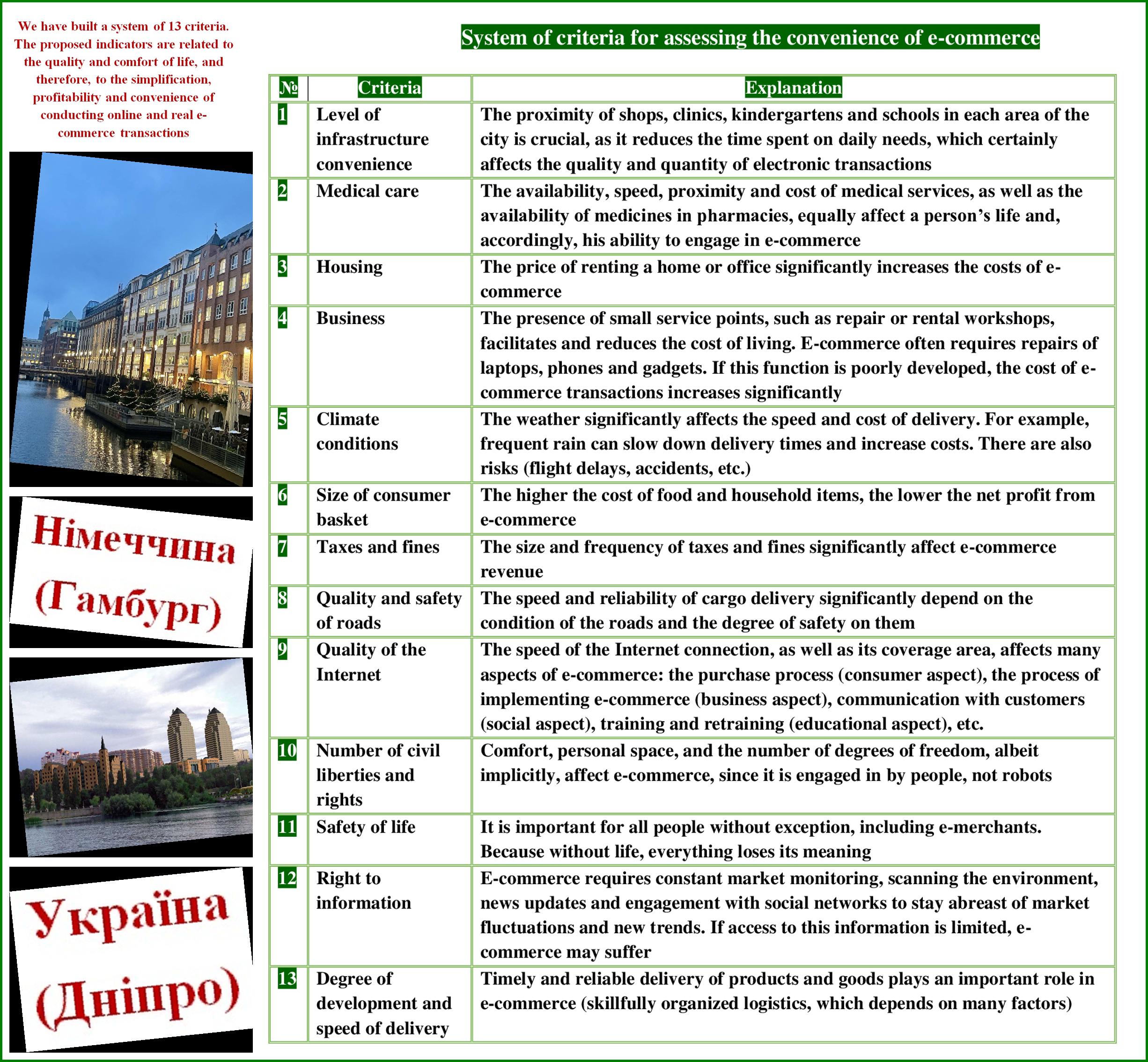
The subject of research is e-commerce and the conditions for its operation in different countries. One of the most problematic aspects is the lack of information about the attractiveness of countries in relation to this topic. To address this gap, the author’s own experience of conducting e-commerce in Germany and Ukraine was used, along with an analysis of the main factors influencing the state and development of e-commerce. The research methods used include: theoretical generalization and classification; comparative analysis; expert evaluations; formalization; and multi-criteria analysis. As a result, a system of 13 criteria was proposed to assess the convenience and profitability of conducting e-commerce: infrastructure convenience level, healthcare, availability of private housing and the possibility of purchasing it, small business development, climatic conditions, consumer basket size, tax and fine rates, road quality and safety, internet quality, degrees of freedom, life safety, right to information, and the level of development and speed of delivery. Based on this system and with the help of experts, a comparative analysis of e-commerce conditions and prospects in Germany and Ukraine was conducted. A methodology for assessing the attractiveness of e-commerce in Ukraine and Germany was developed. This methodology allows obtaining comparable values of indicators for any countries, which was not possible before but is desirable with the researchers’ practical experience, i. e., their long-term life and work in the countries being studied to ensure accurate results. Compared to other known systems for determining the attractiveness of countries, our methodology provides advantages such as: the availability of a specific mechanism for evaluating this indicator for e-commerce based on 13 criteria; the ability to involve different groups of experts to compare and adjust the results; and the construction of an integral criterion for the overall assessment of a country’s attractiveness. In practice, a methodology for calculating the degree of convenience and attractiveness of conducting e-commerce in different countries was proposed, and the results obtained were applied to the example of e-commerce in Ukraine and Germany.
References
- Hlushach, Yu. S. (2018). Ranking of Countries in the Global Economic World. Biznes-inform, 9, 13–19. Available at: https://cyberleninka.ru/article/n/reytinguvannya-krayin-u-globalnomu-ekonomichnomu-sviti/viewer
- Kyrychenko, K. I. (2017). International rankings and indexes in the system for evaluation of the level of social, economic and political transformations in Ukraine. Upravlinnia rozvytkom, 1-2, 18–25.
- HabroІ. (2024). International rankings and indices in forming the image of a state. Acta De Historia & Politica: Saeculum XXI, 8, 141–149. https://doi.org/10.26693/ahpsxxi2024.08.141
- Kytaichuk, T. (2023). Investment attractiveness: theoretical analysis and influential factors. Economy and Society, 54. https://doi.org/10.32782/2524-0072/2023-54-65
- Matyushenko, I., Hlibko, S., Khanova, O., Kudlai, Y. (2022). Investment climate of the EU countries and Ukraine in the context of realization of “green” economy. Economics of Development, 21 (4), 19–36. https://doi.org/10.57111/econ.21(4).2022.19-36
- Slavkova, A., Kolisnyk, D. (2023). Investment attractiveness of ukraine: realities in the context of war and prospects for post-war reconstruction. Economy and Society, 56. https://doi.org/10.32782/2524-0072/2023-56-138
- Iakushko, I. V. (2019). Rating approaches to estimating the investment attractiveness of the national economy. Naukovyi visnyk Uzhhorodskoho natsionalnoho universytetu. Seriia: Mizhnarodni ekonomichni vidnosyny ta svitove hospodarstvo, 23 (2), 152–159. Available at: http://www.visnyk-econom.uzhnu.uz.ua/archive/23_2_2019ua/31.pdf
- Shchytov, D., Mormul, M., Shchytov, O., Romanchuk, L., Chupilko, T. (2022). IT services outsourcing in Ukraine. Information Technology and Computer Engineering, 55 (3), 85–90. https://doi.org/10.31649/1999-9941-2022-55-3-85-90
- Chaliuk, Y. (2020). International assessment of the socio-economic situation of Ukraine. Herald UNU. International Economic Relations and World Economy, 31, 138–145. https://doi.org/10.32782/2413-9971/2020-31-21
- Zayats, O., Roshko, S., Ivashkovich, V. (2021). Image of Ukraine in the global economic space. Herald UNU. International Economic Relations and World Economy, 39. https://doi.org/10.32782/2413-9971/2021-39-11
- Kirilina, M. (2022). Indexes and ratings as a marketing tool for determining the competitiveness of the management system. Economy and Society, 40. https://doi.org/10.32782/2524-0072/2022-40-69
- Shchytov, D. M., Zhadko, K. S., Mormul, M. F. (2024). Status and trends of the development of electronic commerce potential by Ukrainian companies. Scientific innovations and advanced technologies, 8 (36), 1024–1036. https://doi.org/10.52058/2786-5274-2024-8(36)-1024-1036
- Romanchuk, L. A., Shchytov, D. M., Mormul, M. F. (2024). Reitynhova systema kryteriiv pryvablyvosti krain (na prykladi Nimechchyny ta Ukrainy): porivnialnyi analiz. Modern aspects of science, 43, 68–97. Available at: http://perspectives.pp.ua/public/site/mono/mono-43.pdf
- Vlasne zhytlo: bilshist ukraintsiv zhyvut na svoikh kvadratnykh metrakh (infohrafika) (2020). Available at: https://news.finance.ua/ru/news/-/480368/sobstvennoe-zhile-bolshinstvo-ukraintsev-zhivut-na-svoih-kvadratnyh-metrah-infografika
- Mуkhailenko, D. (2024). Current trends in the development of small business in Ukraine. Economy and Society, 60. https://doi.org/10.32782/2524-0072/2024-60-139
- Formy vedennia biznesu v Nimechchyni. Available at: https://europortal.biz.ua/evropa/nimechchyna/biznes/formy-oformlenyia-fyrm-u-hermanyy.html
- Ukraina ta Nimechchyna (2000). Kyiv: Derzhavnyi komitet statystyky Ukrainy; Federalne statystychne upravlinnia Nimechchyny, 40.
- Lipinskyi, V. M., Diachuk, V. A., Babichenko, V. M. (Eds.) (2003). Klimat Ukrainy. Kyiv: Vyd-vo Raievskoho, 343.
- Iaki tsiny v Nimechchyni? (2025). Migrant. Available at: https://migrant.biz.ua/nimechina/zhittya-de/tsiny-v-nimechyni.html
- Stepanova, T. (2024). Tsiny na produkty: skilky koshtuie skupytys do sviat v Ukraini, Polshchi ta Nimechchyni. RBK-Ukraina. Available at: https://www.rbc.ua/rus/news/tsini-produkti-skilki-koshtue-skupitis-svyat-1733235593.html
- Spozhyvchyi koshyk ukraintsia – 2024. Available at: https://www.buhoblik.org.ua/kadry-zarplata/vyplaty-kompensaczii-soczialnaya-zashhita/3363-spozhivchij-koshik.html
- Kurovtseva, N. (2024). Podatky v Nimechchyni. Monito. Available at: https://www.monito.com/uk/wiki/podatky-v-nimechchyni
- Aleksyk, A. (2024). Shtrafy za perevyshchennia shvydkosti v Nimechchyni: aktualna ta povna tablytsia shtrafiv na 2024 rik. Ukrainska hazeta. Available at: https://golooking.eu/korysno-znaty/shtrafi-za-perevishhennya-shvidkosti-v-nimechchini-povna-tabliczya-shtrafiv-na-2024-rik/
- Dlia vyzhyvannia u viini z RF Ukraina povynna znykhyty tsinnist liudskoho zhyttia, – Portnykov (2025). Available at: https://antikor.com.ua/articles/746958-dlja_vyhivanija_v_vojne_s_rf_ukraina_dolhna_snizitj_tsennostj_chelovecheskoj_hizni_-_portnikov
- Mormul, M., Shchytov, D., Shchytov, O., Rudianova, T. (2023). Aspects of multi-criterion selection of administrative decisions. SWorldJournal, 1 (19-01), 64–76. https://doi.org/10.30888/2663-5712.2023-19-01-018
- Azizova, M. (2024). Svitovyi reitynh shchastia 2024: khto ocholyv i na yakomu mistsi Ukraina. TSN. Available at: https://tsn.ua/svit/svitoviy-reyting-schastya-2024-hto-ocholiv-i-na-yakomu-misci-ukrayina-2539393.html
- E-commerce worldwide. Statista. Available at: https://www.statista.com/topics/871/online-shopping/ #topicOverview
Downloads
Published
How to Cite
Issue
Section
License
Copyright (c) 2025 Lyubov Romanchuk, Dmytro Shchytov, Mykola Mormul

This work is licensed under a Creative Commons Attribution 4.0 International License.
The consolidation and conditions for the transfer of copyright (identification of authorship) is carried out in the License Agreement. In particular, the authors reserve the right to the authorship of their manuscript and transfer the first publication of this work to the journal under the terms of the Creative Commons CC BY license. At the same time, they have the right to conclude on their own additional agreements concerning the non-exclusive distribution of the work in the form in which it was published by this journal, but provided that the link to the first publication of the article in this journal is preserved.





