Development of automated collection method of initial diagnostic information for the technical support service of organization network users
DOI:
https://doi.org/10.15587/2706-5448.2025.328856Keywords:
automation, support, networks, diagnostics, API, Celery, Zammad, FastAPI, incident managementAbstract
The object of the study is the process of collecting initial diagnostic information by the technical support service (Service Desk/Help Desk) in organizations where IT infrastructure is a key element of business processes.
One of the most problematic areas is the manual and inefficient collection of accurate diagnostic data from users who often lack sufficient technical knowledge. This leads to significant delays at the primary diagnostics stage, increases overall system downtime, and directly impacts employee productivity, especially when network infrastructure problems arise.
In the course of the study, an approach is proposed that involves optimizing and automating the collection of primary network diagnostic information directly from the user's side. This method includes automatically checking the physical connection, obtaining correct network settings (IP address, DNS, etc.), and verifying resource accessibility over the network.
The expected result is a significant increase in the speed and quality of the technical support service's work. This is due to the fact that the proposed automated method minimizes the need for lengthy user questioning and sequential manual checks of settings. It has a number of features, in particular, a focus on automating data collection specifically from the network infrastructure, which is the foundation for the vast majority of IT services.
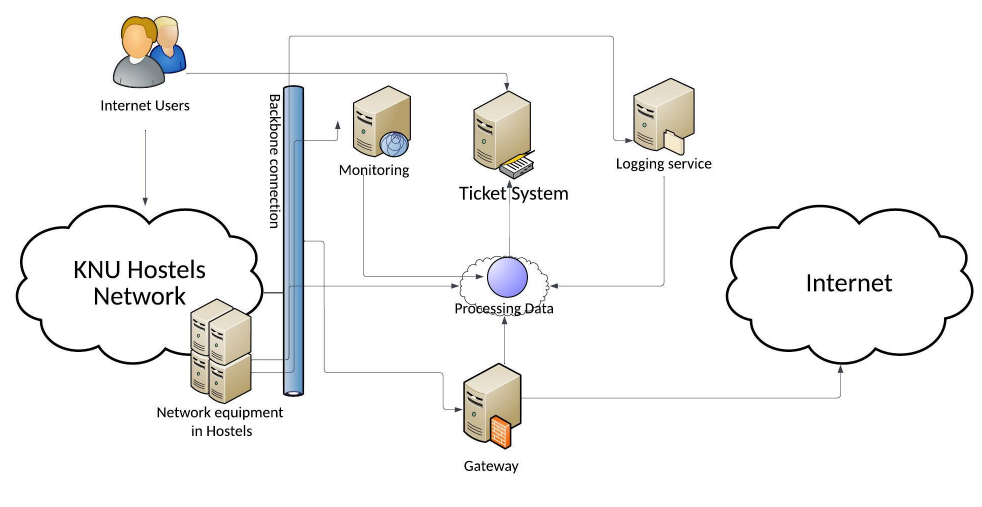
This approach allows to automate the collection of diagnostic data in an infrastructure built using equipment from different vendors and does not depend on the specific software implementation of network services, monitoring and logging services. Compared to similar known traditional methods, this approach provides such advantages as reduced downtime, a lower risk of significant financial losses for the company, and an increase in overall user satisfaction with the quality of IT services.
References
- Agyemang, D. Y., Fong, P. S. W., Kissi, E. (2019). The influence of organizational infrastructure on organizational effectiveness in the construction industry. CIB World Building Congress 2019.
- Abid, A., Khan, M. T., Iqbal, J. (2020). A review on fault detection and diagnosis techniques: basics and beyond. Artificial Intelligence Review, 54 (5), 3639–3664. https://doi.org/10.1007/s10462-020-09934-2
- The official introduction to the ITIL service lifecycle (2007). OGC-Office of Government Commerce. The Stationery Office, 238.
- Galup, S., Quan, J. J., Dattero, R., Conger, S. (2007). Information technology service management. Proceedings of the 2007 ACM SIGMIS CPR Conference on Computer Personnel Research: The Global Information Technology Workforce, 46–52. https://doi.org/10.1145/1235000.1235010
- Shen, N., Yu, B., Huang, M., Xu, H. (2021). Campus Network Architectures and Technologies. CRC Press. https://doi.org/10.1201/9781003143314
- He, Y., Wong, Y.-P., Liang, Q., Wu, T., Bao, J., Hashimoto, K.-Y. (2022). Double Busbar Structure for Transverse Energy Leakage and Resonance Suppression in Surface Acoustic Wave Resonators Using 42°YX-Lithium Tantalate Thin Plate. IEEE Transactions on Ultrasonics, Ferroelectrics, and Frequency Control, 69 (3), 1112–1119. https://doi.org/10.1109/tuffc.2022.3144188
- Peterson, L. L., Davie, B. S. (2007). Computer networks: A systems approach. Elsevier.
- IEEE 802.3-2022. IEEE Standard for Ethernet. IEEE Standards Association. Available at: https://standards.ieee.org/standard/802_3-2022.html
- Rigney, C., Willens, S., Rubens, A., Simpson, W. (2000). Remote Authentication Dial in User Service (RADIUS). RFC Editor. https://doi.org/10.17487/rfc2865
- Lubis, M., Cherthio Annisyah, R., Lyvia Winiyanti, L. (2020). ITSM Analysis using ITIL V3 in Service Operation in PT.Inovasi Tjaraka Buana. IOP Conference Series: Materials Science and Engineering, 847 (1), 012077. https://doi.org/10.1088/1757-899x/847/1/012077
- ISO/IEC 20000-1:2018 Information technology – Service management – Part 1: Service management system requirements (2018). International Organization for Standardization.
- Zammad System Documentation. Available at: https://docs.zammad.org
- Duman, İ., Eliiyi, U. (2021). Performance Metrics and Monitoring Tools for Sustainable Network Management. Bilişim Teknolojileri Dergisi, 14 (1), 37–51. https://doi.org/10.17671/gazibtd.780504
- Aglibar, K. D., Rodelas, N. (2022). Impact of critical and auto ticket: Analysis for management and workers productivity in using a ticketing system. arXiv. https://doi.org/10.48550/arXiv.2203.03709
- Postel, J. (1981). Internet Control Message Protocol. RFC Editor. https://doi.org/10.17487/rfc0792
- Turnbull, J. (2019). The art of monitoring. Available at: https://artofmonitoring.com
- Chakraborty, M., Kundan, A. P. (2021). Grafana. Monitoring Cloud-Native Applications: Lead agile operations confidently using open source software. Berkeley: Apress, 187–240. https://doi.org/10.1007/978-1-4842-6888-9_6
- Hoda, M. (2005). Cisco network security troubleshooting handbook. Cisco Press. Available at: https://www.ciscopress.com/store/cisco-network-security-troubleshooting-handbook-9781587054433
- Choi, B. (2024). Python Network Automation Labs: SSH in Action, paramiko and netmiko Labs. Introduction to Python Network Automation Volume II: Stepping up: Beyond the Essentials for Success. Berkeley: Apress, 121–227. https://doi.org/10.1007/979-8-8688-0391-8_3
- Lee, H. M., Lee, G. S., Kwon, G.-Y., Bang, S. S., Shin, Y.-J. (2021). Industrial Applications of Cable Diagnostics and Monitoring Cables via Time–Frequency Domain Reflectometry. IEEE Sensors Journal, 21 (2), 1082–1091. https://doi.org/10.1109/jsen.2020.2997696
- Ziade, T. (2017). Python microservices development: Build, test, deploy, and scale microservices in Python. Packt Publishing, 340.
- Tragura, S. J. C. (2022). Building Python microservices with FastAPI: Build secure, scalable, and structured Python microservices from design concepts to infrastructure. Packt Publishing, 420.
- Ponelat, J., Rosenstock, L. (2022). Designing APIs with Swagger and OpenAPI. Manning.
- Celery – Distributed Task Queue. Available at: https://docs.celeryq.dev/en/stable/
- Surwase, V. (2016). REST API modeling languages – A developer’s perspective. International Journal of Science Technology & Engineering, 2 (10), 634–637. Available at: https://www.ijste.org/articles/IJSTEV2I10199.pdf
- Postman documentation overview. Available at: https://learning.postman.com/docs/introduction/overview/
- Lubanovic, B. (2023). FastAPI: Modern Python web development. O’Reilly Media, Inc, 277
- Manases, L., Zinca, D. (2022). Automation of Network Traffic Monitoring using Docker images of Snort3, Grafana and a custom API. 2022 21st RoEduNet Conference: Networking in Education and Research (RoEduNet). Sovata: IEEE, 1–4. https://doi.org/10.1109/roedunet57163.2022.9921063
- Taiwo Joseph Akinbolaji, G., Nzeako, G., Akokodaripon, D., Aderoju, A. V. (2024). Proactive monitoring and security in cloud infrastructure: leveraging tools like Prometheus, Grafana, and HashiCorp Vault for Robust DevOps Practices. World Journal of Advanced Engineering Technology and Sciences, 13 (2), 74–89. https://doi.org/10.30574/wjaets.2024.13.2.0543
- Mohammed, A. R., Mohammed, S. A., Cote, D., Shirmohammadi, S. (2021). Machine Learning-Based Network Status Detection and Fault Localization. IEEE Transactions on Instrumentation and Measurement, 70, 1–10. https://doi.org/10.1109/tim.2021.3094223
Downloads
Published
How to Cite
Issue
Section
License
Copyright (c) 2025 Bohdan Hinko, Oleksandr Boretskyi, Vitalii Marianovskyi

This work is licensed under a Creative Commons Attribution 4.0 International License.
The consolidation and conditions for the transfer of copyright (identification of authorship) is carried out in the License Agreement. In particular, the authors reserve the right to the authorship of their manuscript and transfer the first publication of this work to the journal under the terms of the Creative Commons CC BY license. At the same time, they have the right to conclude on their own additional agreements concerning the non-exclusive distribution of the work in the form in which it was published by this journal, but provided that the link to the first publication of the article in this journal is preserved.