Intelligent energy consumption forecasting and microgrid state assessment using machine learning and fuzzy logic
DOI:
https://doi.org/10.15587/2706-5448.2025.329154Keywords:
time series, microgrids, load forecasting, state estimation, machine learning, BiLSTM, fuzzy logicAbstract
The object of research is the processes of generation, consumption and storage of electricity in microgrids with renewable energy sources. They are characterized by the certain parameters and together determine the state of the energy microgrid. The task of assessing the state of the microgrid, which is relevant for maintaining its stable operation, can be solved using machine learning methods.
Time series of data, which are created as a result of monitoring energy microgrids and contain indicators of their operation, were used as input dataset. Since microgrids operate in variable conditions, the ability of energy microgrids to meet the demand for electricity is characterized by uncertainty, and to assess the state of microgrids, there is a need for adaptive methods that can process inaccurate and incomplete data. Traditional methods of statistical analysis and deterministic algorithms do not provide sufficient accuracy in forecasting, which creates risks of incorrect management of energy resources. To solve this problem, this study uses a combination of machine learning and fuzzy logic, which allows not only to forecast the load, but also to adaptively assess the state of energy assets in real time.
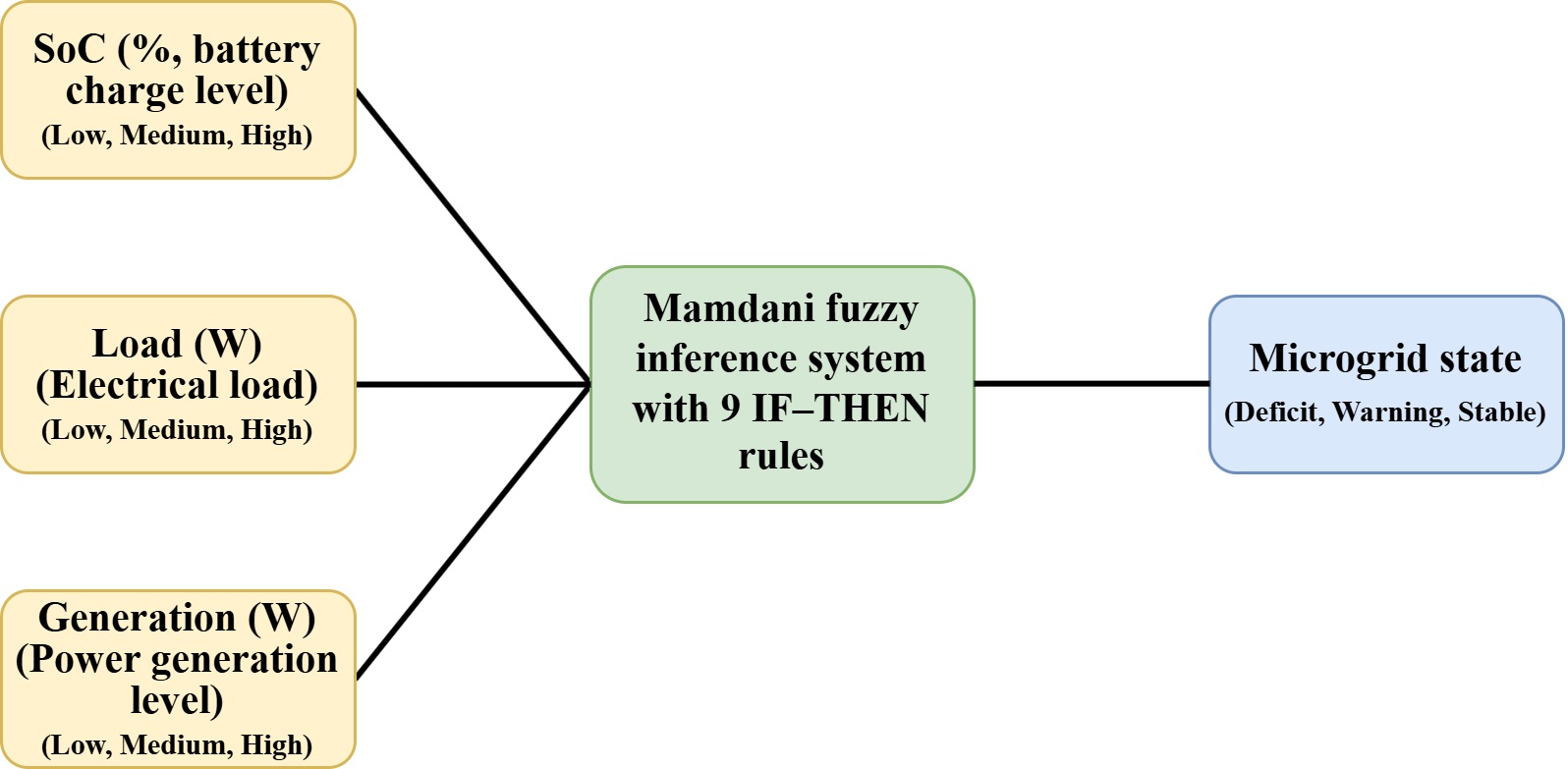
The essence of the obtained results is to create models for the information technology of assessing the state of microgrids, which integrates BiLSTM for forecasting electricity consumption and a fuzzy logic system for determining the state of the microgrid. The use of a neural network approach allows to take into account time dependencies in electricity consumption, while fuzzy logic classifies the state of the microgrid based on the battery charge level, current solar energy generation and forecasted load. The features of the obtained results are the integration of several approaches, which provides expansion of analytical capabilities and the formation of a comprehensive assessment of the energy balance in conditions of uncertainty and variability of input data.
The obtained results confirm the effectiveness of the proposed approach and its practical applicability in the tasks of monitoring and controlling microgrids. Experimental tests on real data showed that the BiLSTM model provides a mean absolute error (MAE) of load forecasting at the level of 18.15 W, a root-mean-square error (RMSE) of 20.74 W, and a mean absolute percentage error (MAPE) of 5.0%. The fuzzy logic-based assessment system classified the state of the microgrid with an accuracy of 93.2%, which indicates its ability to interpret situations with potential energy deficit. The developed models allow for timely detection of unstable operating modes, formation of solutions for load balancing, reduction of the load on batteries, and prevention of energy losses.
Supporting Agency
- The research was conducted at the expense of state budget research funding “Intelligent information technology for proactive management of energy infrastructure under conditions of risks and uncertainty”, state registration number 0123U101852, which is being carried out at Sumy State University.
References
- Adi, F. S., Lee, Y. J., Song, H. (2020). State Estimation for DC Microgrids using Modified Long Short-Term Memory Networks. Applied Sciences, 10 (9), 3028. https://doi.org/10.3390/app10093028
- Amirioun, M. H., Aminifar, F., Lesani, H., Shahidehpour, M. (2019). Metrics and quantitative framework for assessing microgrid resilience against windstorms. International Journal of Electrical Power & Energy Systems, 104, 716–723. https://doi.org/10.1016/j.ijepes.2018.07.025
- Arriaga, M., Canizares, C. A., Kazerani, M. (2016). Long-Term Renewable Energy Planning Model for Remote Communities. IEEE Transactions on Sustainable Energy, 7 (1), 221–231. https://doi.org/10.1109/tste.2015.2483489
- Chaudhary, G., Lamb, J. J., Burheim, O. S., Austbø, B. (2021). Review of Energy Storage and Energy Management System Control Strategies in Microgrids. Energies, 14 (16), 4929. https://doi.org/10.3390/en14164929
- Fesagandis, H. S., Jalali, M., Zare, K., Abapour, M., Karimipour, H. (2021). Resilient Scheduling of Networked Microgrids Against Real-Time Failures. IEEE Access, 9, 21443–21456. https://doi.org/10.1109/access.2021.3052653
- Han, D., Liu, P., Xie, K., Li, H., Xia, Q., Cheng, Q. et al. (2023). An attention-based LSTM model for long-term runoff forecasting and factor recognition. Environmental Research Letters, 18 (2), 024004. https://doi.org/10.1088/1748-9326/acaedd
- Hasan, S., Zeyad, M., Ahmed, S. M. M., Anubhove, Md. S. T. (2023). Optimization and planning of renewable energy sources based microgrid for a residential complex. Environmental Progress & Sustainable Energy, 42 (5). https://doi.org/10.1002/ep.14124
- Hemmati, M., Mohammadi-Ivatloo, B., Ghasemzadeh, S., Reihani, E. (2018). Risk-based optimal scheduling of reconfigurable smart renewable energy based microgrids. International Journal of Electrical Power & Energy Systems, 101, 415–428. https://doi.org/10.1016/j.ijepes.2018.04.005
- Khan, A. A., Kubra, K., Islam, Md. R., Rahman, Md. A., Hassan, M. (2024). Microgrid-based operational framework for grid resiliency enhancement: A case study at KUET campus in Bangladesh. Energy Reports, 11, 1752–1765. https://doi.org/10.1016/j.egyr.2024.01.032
- Kien, D. T., Huong, P. D., Minh, N. D. (2023). Application of Sarima Model in Load Forecasting in Hanoi City. International Journal of Energy Economics and Policy, 13 (3), 164–170. https://doi.org/10.32479/ijeep.14121
- Lee, J., Cho, Y. (2022). National-scale electricity peak load forecasting: Traditional, machine learning, or hybrid model? Energy, 239, 122366. https://doi.org/10.1016/j.energy.2021.122366
- Makkieh, A., Psaras, V., Pena-Alzola, R., Tzelepis, D., Emhemed, A. A. S., Burt, G. M. (2021). Fault Location in DC Microgrids Based on a Multiple Capacitive Earthing Scheme. IEEE Journal of Emerging and Selected Topics in Power Electronics, 9 (3), 2550–2559. https://doi.org/10.1109/jestpe.2020.2995946
- Mohammed, A., Kora, R. (2023). A comprehensive review on ensemble deep learning: Opportunities and challenges. Journal of King Saud University – Computer and Information Sciences, 35 (2), 757–774. https://doi.org/10.1016/j.jksuci.2023.01.014
- Olaru, L. M., Gellert, A., Fiore, U., Palmieri, F. (2022). Electricity production and consumption modeling through fuzzy logic. International Journal of Intelligent Systems, 37 (11), 8348–8364. https://doi.org/10.1002/int.22942
- Parfenenko, Y., Shendryk, V., Kholiavka, Y., Miroshnichenko, O. (2024). Electricity Forecasting Software for Microgrid Energy Management System. Available at: https://ceur-ws.org/Vol-3702/paper34.pdf
- Saeed, M. H., Fangzong, W., Kalwar, B. A., Iqbal, S. (2021). A Review on Microgrids’ Challenges & Perspectives. IEEE Access, 9, 166502–166517. https://doi.org/10.1109/access.2021.3135083
- Saoud, A., Recioui, A. (2023). Load Energy Forecasting based on a Hybrid PSO LSTM-AE Model. Algerian Journal of Environmental Science and Technology March Edition, 9 (1). Available at: https://www.researchgate.net/publication/351935234_Load_Energy_Forecasting_based_on_a_Hybrid_PSO_LSTM-AE_Model
- Yedidia W., D. (2016). Penentuan Alternatif Lokasi Tempat Pembuangan Akhir (TPA) Sampah Di Kabupaten Sidoarjo. Undergraduate thesis, Institut Teknologi Sepuluh Nopember. Available at: https://repository.its.ac.id/1448/
- Kumar, S. V., Vanajakshi, L. (2015). Short-term traffic flow prediction using seasonal ARIMA model with limited input data. European Transport Research Review, 7 (3). https://doi.org/10.1007/s12544-015-0170-8
Downloads
Published
How to Cite
Issue
Section
License
Copyright (c) 2025 Yevhen Kholyavka, Yuliia Parfenenko

This work is licensed under a Creative Commons Attribution 4.0 International License.
The consolidation and conditions for the transfer of copyright (identification of authorship) is carried out in the License Agreement. In particular, the authors reserve the right to the authorship of their manuscript and transfer the first publication of this work to the journal under the terms of the Creative Commons CC BY license. At the same time, they have the right to conclude on their own additional agreements concerning the non-exclusive distribution of the work in the form in which it was published by this journal, but provided that the link to the first publication of the article in this journal is preserved.