Бенчмаркінг трансформаторних архітектур для виявлення падінь: порівняльне дослідження
DOI:
https://doi.org/10.15587/2706-5448.2025.329398Ключові слова:
виявлення падіння на основі трансформатора, часовий згортковий трансформатор, об’єднання датчиків із даними барометра, розгортання країв для медичних AIАнотація
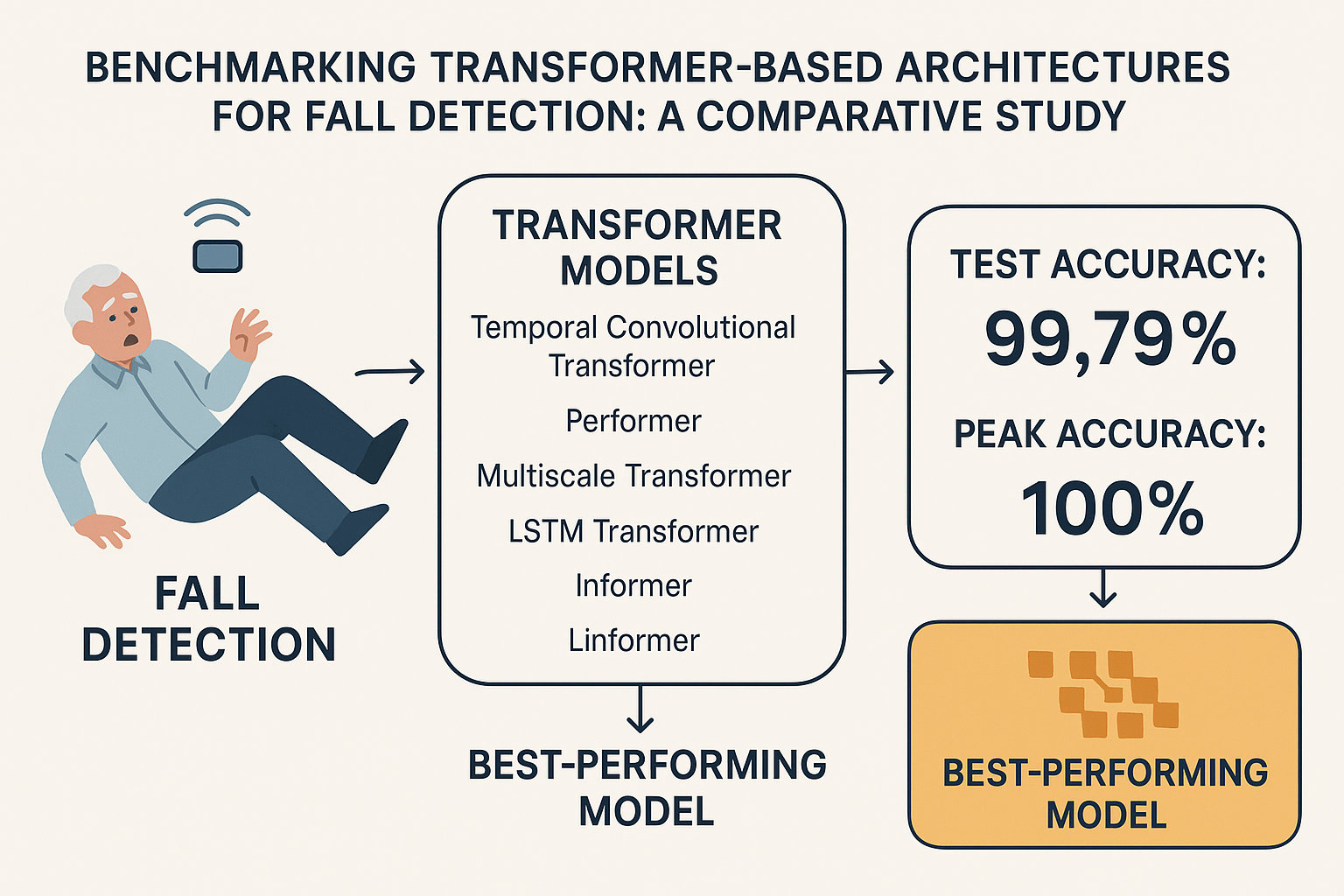
Об’єктом дослідження є трансформер-орієнтовані архітектури глибинного навчання, призначені для виявлення падінь на основі сенсорних даних. Одним із найбільш проблемних місць, виявлених під час аудиту традиційних рішень, виявилася надмірна обчислювальна складність стандартних трансформерів, що перешкоджає їх ефективному використанню на пристроях з обмеженими ресурсами й у режимі реального часу. В ході дослідження використовувалися Temporal Convolutional Transformer, Performer, Multiscale Transformer, LSTM Transformer, Informer, Linformer та класичний Transformer. Кожна з цих моделей передбачає застосування вдосконалених підходів до реалізації механізмів уваги та опрацювання коротко- й довготривалих залежностей у вхідних послідовностях. Temporal Convolutional Transformer досяг найкращих результатів, демонструючи тестову точність 99,79% та максимальну точність 100% при 50 епохах. Це пов’язано з тим, що запропонований підхід гармонійно поєднує згорткові операції із самоувагою, що істотно пришвидшує вилучення ключових ознак та дає змогу успішно фіксувати короткотермінові й довготривалі часові залежності. Зокрема, згортки допомагають ефективно відсіяти шум із сенсорних даних і зменшити обчислювальні витрати порівняно з класичними трансформерами. Завдяки цьому забезпечується можливість використання таких рішень у реальних «edge»‑сценаріях без втрати точності виявлення падінь. У порівнянні з традиційними підходами, запропоновані моделі дозволяють досягти вищої швидкодії й економії ресурсів, що є критичними факторами для впровадження системи виявлення падінь у реальному часі. Додатково було здійснено порівняння продуктивності згаданих моделей за різних режимів роботи, включно з тестами за умов низької пропускної здатності та обмеженої енергоефективності. Результати засвідчили, що оптимізовані архітектури трансформерів успішно розв’язують завдання виявлення падінь, залишаючись ефективними для портативних і вбудованих систем з обмеженою пам’яттю.
Посилання
- Gettel, C. J., Chen, K., Goldberg, E. M. (2021). Dementia Care, Fall Detection, and Ambient-Assisted Living Technologies Help Older Adults Age in Place: A Scoping Review. Journal of Applied Gerontology, 40 (12), 1893–1902. https://doi.org/10.1177/07334648211005868
- Global, regional, and national burden of diseases and injuries for adults 70 years and older: systematic analysis for the Global Burden of Disease 2019 Study (2022). BMJ, e068208. https://doi.org/10.1136/bmj-2021-068208
- Nguyen, H., Mai, T., Nguyen, M. (2024). A Holistic Approach to Elderly Safety: Sensor Fusion, Fall Detection, and Privacy-Preserving Techniques. Image and Video Technology. Singapore: Springer Nature Singapore, 380–393. https://doi.org/10.1007/978-981-97-0376-0_29
- Gutiérrez, J., Rodríguez, V., Martin, S. (2021). Comprehensive Review of Vision-Based Fall Detection Systems. Sensors, 21 (3), 947. https://doi.org/10.3390/s21030947
- Virginia Anikwe, C., Friday Nweke, H., Chukwu Ikegwu, A., Adolphus Egwuonwu, C., Uchenna Onu, F., Rita Alo, U., Wah Teh, Y. (2022). Mobile and wearable sensors for data-driven health monitoring system: State-of-the-art and future prospect. Expert Systems with Applications, 202, 117362. https://doi.org/10.1016/j.eswa.2022.117362
- Choi, H., Um, C. Y., Kang, K., Kim, H., Kim, T. (2021). Review of vision-based occupant information sensing systems for occupant-centric control. Building and Environment, 203, 108064. https://doi.org/10.1016/j.buildenv.2021.108064
- Gaya-Morey, F. X., Manresa-Yee, C., Buades-Rubio, J. M. (2024). Deep learning for computer vision based activity recognition and fall detection of the elderly: a systematic review. Applied Intelligence, 54 (19), 8982–9007. https://doi.org/10.1007/s10489-024-05645-1
- Ness, S., Eswarakrishnan, V., Sridharan, H., Shinde, V., Venkata Prasad Janapareddy, N., Dhanawat, V. (2025). Anomaly Detection in Network Traffic Using Advanced Machine Learning Techniques. IEEE Access, 13, 16133–16149. https://doi.org/10.1109/access.2025.3526988
- Al-Selwi, S. M., Hassan, M. F., Abdulkadir, S. J., Muneer, A. (2023). LSTM Inefficiency in Long-Term Dependencies Regression Problems. Journal of Advanced Research in Applied Sciences and Engineering Technology, 30 (3), 16–31. https://doi.org/10.37934/araset.30.3.1631
- Thundiyil, S., Shalamzari, S. S., Picone, J., McKenzie, S. (2023). Transformers for Modeling Long-Term Dependencies in Time Series Data: A Review. 2023 IEEE Signal Processing in Medicine and Biology Symposium (SPMB), 1–5. https://doi.org/10.1109/spmb59478.2023.10372632
- Huang, Y., Xu, J., Lai, J., Jiang, Z., Chen, T., Li, Z. et al. (2024). Advancing Transformer architecture in long-context large language models: A comprehensive survey. arXiv. https://doi.org/10.48550/arXiv.2311.12351
- Dhanawat, V., Shinde, V., Karande, V., Singhal, K. (2024). Enhancing Financial Risk Management with Federated AI. 2024 8th SLAAI International Conference on Artificial Intelligence (SLAAI-ICAI). Ratmalana 1–6. https://doi.org/10.1109/slaai-icai63667.2024.10844982
- Huang, L., Mao, F., Zhang, K., Li, Z. (2022). Spatial-Temporal Convolutional Transformer Network for Multivariate Time Series Forecasting. Sensors, 22 (3), 841. https://doi.org/10.3390/s22030841
- Grotowski, J. (2012). Performer. Logiche Della Performance. Accademia University Press, 127–132. https://doi.org/10.4000/books.aaccademia.311
- Kim, B., Mun, J., On, K.-W., Shin, M., Lee, J., Kim, E.-S. (2022). Mstr: Multi-scale transformer for end-to-end human-object interaction detection. Proceedings of the IEEE/CVF Conference on Computer Vision and Pattern Recognition, 19578–19587. https://doi.org/10.1109/cvpr52688.2022.01897
- Xu, M., Xiong, Y., Chen, H. et al. (2021). Long short-term transformer for online action detection. Advances in Neural Information Processing Systems, 34, 1086–1099.
- Zhou, H., Zhang, S., Peng, J., Zhang, S., Li, J., Xiong, H., Zhang, W. (2021). Informer: Beyond Efficient Transformer for Long Sequence Time-Series Forecasting. Proceedings of the AAAI Conference on Artificial Intelligence, 35 (12), 11106–11115. https://doi.org/10.1609/aaai.v35i12.17325
- Wang, S., Li, B. Z., Khabsa, M., Fang, H., Ma, H. (2020). Linformer: Self-Attention with Linear Complexity. arXiv. https://doi.org/10.48550/arXiv.2006.04768.
- Huang, X., Xue, Y., Ren, S., Wang, F. (2023). Sensor-Based Wearable Systems for Monitoring Human Motion and Posture: A Review. Sensors, 23 (22), 9047. https://doi.org/10.3390/s23229047
- Bourke, A. K., Lyons, G. M. (2008). A threshold-based fall-detection algorithm using a bi-axial gyroscope sensor. Medical Engineering & Physics, 30 (1), 84–90. https://doi.org/10.1016/j.medengphy.2006.12.001
- Minh Dang, L., Min, K., Wang, H., Jalil Piran, Md., Hee Lee, C., Moon, H. (2020). Sensor-based and vision-based human activity recognition: A comprehensive survey. Pattern Recognition, 108, 107561. https://doi.org/10.1016/j.patcog.2020.107561
- Kepski, M., Kwolek, B. (2014). Fall detection using ceiling-mounted 3d depth camera. 2014 International conference on computer vision theory and applications (VISAPP), 640–647. https://doi.org/10.5220/0004742406400647
- Lin, Z., Wang, Z., Dai, H., Xia, X. (2022). Efficient fall detection in four directions based on smart insoles and RDAE-LSTM model. Expert Systems with Applications, 205, 117661. https://doi.org/10.1016/j.eswa.2022.117661
- He, J., Zhang, Q., Wang, L., Pei, L. (2019). Weakly Supervised Human Activity Recognition From Wearable Sensors by Recurrent Attention Learning. IEEE Sensors Journal, 19 (6), 2287–2297. https://doi.org/10.1109/jsen.2018.2885796
- Kibet, D., So, M. S., Kang, H., Han, Y., Shin, J.-H. (2024). Sudden Fall Detection of Human Body Using Transformer Model. Sensors, 24 (24), 8051. https://doi.org/10.3390/s24248051
- Ursul, I. (2024). Elderly fall detection using unsupervised transformer model. Electronics and Information Technologies, 26. https://doi.org/10.30970/eli.26.7
- Haque, S. T., Debnath, M., Yasmin, A., Mahmud, T., Ngu, A. H. H. (2024). Experimental Study of Long Short-Term Memory and Transformer Models for Fall Detection on Smartwatches. Sensors, 24 (19), 6235. https://doi.org/10.3390/s24196235
- Haq, I. U., Lee, B. S., Rizzo, D. M. (2024). TransNAS-TSAD: harnessing transformers for multi-objective neural architecture search in time series anomaly detection. Neural Computing and Applications, 37 (4), 2455–2477. https://doi.org/10.1007/s00521-024-10759-1
- Ursul, I. (2024). Developing a High-Accuracy Fall Detection Device Using Raspberry Pi and Transformer Models. Ivanursul.com. Available at: https://ivanursul.com/developing-fall-detection-device-raspberry-pi
- Ursul, I. (2025). Sensor-Based Fall Detection Dataset with 8,953 Activities from 29 Subjects. Figshare. https://doi.org/10.6084/m9.figshare.28287482.v1
##submission.downloads##
Опубліковано
Як цитувати
Номер
Розділ
Ліцензія
Авторське право (c) 2025 Ivan Ursul

Ця робота ліцензується відповідно до Creative Commons Attribution 4.0 International License.
Закріплення та умови передачі авторських прав (ідентифікація авторства) здійснюється у Ліцензійному договорі. Зокрема, автори залишають за собою право на авторство свого рукопису та передають журналу право першої публікації цієї роботи на умовах ліцензії Creative Commons CC BY. При цьому вони мають право укладати самостійно додаткові угоди, що стосуються неексклюзивного поширення роботи у тому вигляді, в якому вона була опублікована цим журналом, але за умови збереження посилання на першу публікацію статті в цьому журналі.