Justification of the parameters of the active conical wood deformer
DOI:
https://doi.org/10.15587/2706-5448.2025.329722Keywords:
technology, biomass, wood, active deformer, anisotropic material, splitting, destruction forceAbstract
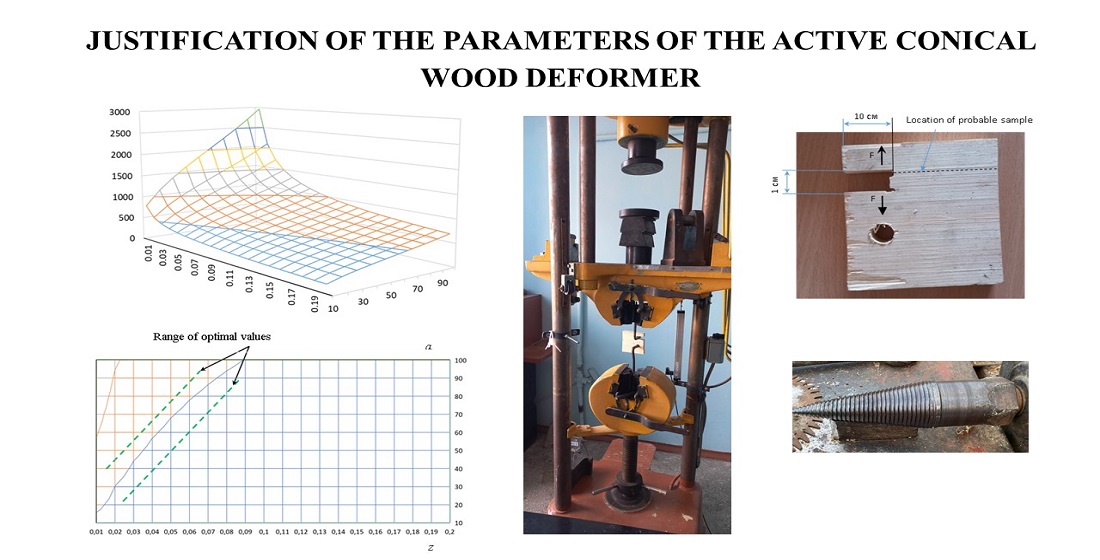
The object of research is the parameters of mechanisms for the destruction of anisotropic materials by a conical mechanical deformer. One of the known renewable energy sources is a material of plant origin (wood). Based on this, the search for optimal operating parameters and design features of working bodies for mechanized splitting of logs is relevant. Therefore, a new solution to the scientific problem is proposed, which consists in substantiating the main geometric parameters of an active conical deformer for splitting logs from wood at the lowest energy costs for its drive.
The analysis conducted during the study showed a general positive feature of the principle of operation, in which the penetration of an active deformer of a conical shape perpendicular to wood fibers facilitates the destruction of their ties and has a more promising and productive design. A mathematical model for determining the force required to destroy a log of wood has been developed. The specified dependence takes into account the elastic characteristics of the material, the forces that exist between the fibers of anisotropic substance, the friction forces between the deformer material and wood, and its geometric parameters. It was determined that the necessary value that characterizes the physical and mechanical properties of wood is the force required to destroy the bonds between the fibers (coefficient of longitudinal destruction). Therefore, the values of the coefficient of longitudinal destruction were experimentally obtained, which were for pine – 2533 ± 66 N/m, oak – 5583 ± 145 N/m and aspen – 5000 ± 279 N/m.
According to the research results, analytical recommendations for the geometric parameters of the active deformer were obtained. For pine material with a diameter of 0.15 m, the optimal cone length is in the range of 0.02–0.20 m at a cone angle of 20–90°. At the same time, the theoretical force for its destruction is 568–864 N. Similar results were also obtained for aspen and oak materials. This provides the opportunity to design the design of a conical wood deformer according to the specified ranges, which are optimal for each material or their groups.
References
- Gorbenko, O., Lyashenko, S., Kelemesh, A., Padaka, V., Kalinichenko, A. (2021). Waste Usage as Secondary Resources. Procedia Environmental Science, Engineering and Management, 8 (2), 417–429. Available at: https://www.scopus.com/inward/record.uri?eid=2-s2.0-85101384718&partnerID=40&md5=0f37db7a2ed0b54f62c2d50be70d056e
- Gorb, O., Rębilas, R., Aranchiy, V., Yasnolob, I., Boiko, S., Padalka, V. (2020). Strengthening Competitiveness of the National Economy by Inhancing Energy Efficiency and Diversifying Energy Supply Sources in Rural Areas. Journal of Environmental Management and Tourism, 11 (5), 1114–1123. https://doi.org/10.14505//jemt.v11.5(45).09
- Kulyk, M. I., Padalka, V. V.; Illiashenko, N. S. (Ed.) (2020). Rozvytok bioenerhetyky na osnovi roslynnoho enerhetychnoho resursu (na prykladi Poltavskoi oblasti). Upravlinnia stratehiiamy vyperedzhaiuchoho innovatsiinoho rozvytku. Sumy: Trytoriia, 109–118.
- Özden, S., Slater, D., Ennos, R. (2017). Fracture properties of green wood formed within the forks of hazel (Corylus avellana L.). Trees, 31 (3), 903–917. https://doi.org/10.1007/s00468-016-1516-0
- Özden, S., Ennos, A. R., Cattaneo, M. E. G. V. (2016). Transverse fracture properties of green wood and the anatomy of six temperate tree species. Forestry, 90 (1), 58–69. https://doi.org/10.1093/forestry/cpw023
- Gurney, C., Hunt, J. (1967). Quasi-static crack propagation. Proceedings of the Royal Society of London. Series A. Mathematical and Physical Sciences, 299 (1459), 508–524. https://doi.org/10.1098/rspa.1967.0152
- Ennos, A. R., van Casteren, A. (2009). Transverse stresses and modes of failure in tree branches and other beams. Proceedings of the Royal Society B: Biological Sciences, 277 (1685), 1253–1258. https://doi.org/10.1098/rspb.2009.2093
- Atkins, T. (2009). The Science and Engineering of Cutting: The Mechanics and Processes of Separating, Scratching and Puncturing Biomaterials, Metals and Non-Metals. Amsterdam: Elsevier, 432. https://doi.org/10.1016/c2009-0-17178-7
- Aicher, S., Reinhardt, H. W. (1993). Einfluß der Bauteilgröße in der linearen und nichtlinearen (Holz-)Bruchmechanik. Holz Als Roh- Und Werkstoff, 51 (3), 215–220. https://doi.org/10.1007/bf02628282
- Stanzl-Tschegg, S. E. (2006). Microstructure and fracture mechanical response of wood. International Journal of Fracture, 139 (3-4), 495–508. https://doi.org/10.1007/s10704-006-0052-0
- Tschegg, E. K., Humer, K., Weber, H. W. (1993). Fracture tests in Mode I on fibre-reinforced plastics. Journal of Materials Science, 28 (9), 2471–2480. https://doi.org/10.1007/bf01151682
- Shukla, S. R.; Mandal, A. K., Nicodemus, A. (Eds.) (2025). Wood Properties and Utilization. Textbook of Forest Science, 811–838. https://doi.org/10.1007/978-981-97-8289-5_37
- Pinto Moreira, A., da Silveira, E., Henrique de Almeida, D., Hendrigo de Almeida, T. et al. (2017). Toughness and Impact Strength in Dynamic Bending of Wood as a Function of the Modulus of Elasticity and the Strength in Compression to the Grain. International Journal of Materials Engineering, 7 (4), 61–67. https://doi.org/10.5923/j.ijme.20170704.01
- Stanzl-Tschegg, S. E., Tan, D.-M., Tschegg, E. (1995). New splitting method for wood fracture characterization. Wood Science and Technology, 29 (1), 31–50. https://doi.org/10.1007/bf00196930
- Kollmann, F. F. P. (1968). Mechanics and Rheology of Wood. Principles of Wood Science and Technology. Springer, Berlin, Heidelberg, 292–419. https://doi.org/10.1007/978-3-642-87928-9_7
- Padalka, V., Liashenko, S., Kalinichenko, A., Burlaka, O., Sakalo, V., Padalka, Y. (2021). Modeling of Resonance Phenomena in Self-Oscillating System of Agricultural Machines. 2021 IEEE International Conference on Modern Electrical and Energy Systems (MEES), 1–6. https://doi.org/10.1109/mees52427.2021.9598763
- Piatak, M. H., Padalka, V. V. (2024). Study of physical and mechanical properties of plant fruits on the example of walnut. Scientific Progress & Innovations, 27 (2), 148–153. https://doi.org/10.31210/spi2024.27.02.26
- Babytskyi, L. F., Padalka, V. V., Liashenko, S. V. (2011). The research of laboratore investigation of working torsionno – udarnyy rykhlitel pochvy. Visnyk Kharkivskoho natsionalnoho tekhnichnoho universytetu silskoho hospodarstva. Mekhanizatsiia silskohospodarskoho vyrobnytstva, 1 (7), 284–291. Available at: https://repo.btu.kharkov.ua//handle/123456789/55894
- Ennos, A. R., Oliveira, J. A. V. (2017). The Mechanics of Splitting Wood and the Design of Neolithic Woodworking Tools. EXARC Journal, 2017/4. Available at: https://exarc.net/ark:/88735/10312
- Mikhailova, T., Mustafina, S., Mikhailov, V. (2021). Automation of data processing of the results of the chemical experiment on modeling the production of synthetic rubber using Microsoft Excel. Journal of Physics: Conference Series, 2092 (1), 012003. https://doi.org/10.1088/1742-6596/2092/1/012003
Downloads
Published
How to Cite
Issue
Section
License
Copyright (c) 2025 Viacheslav Padalka, Oleksandr Gorbenko, Olena Ivankova, Volodymyr Dudnyk, Bohdan Horiunov

This work is licensed under a Creative Commons Attribution 4.0 International License.
The consolidation and conditions for the transfer of copyright (identification of authorship) is carried out in the License Agreement. In particular, the authors reserve the right to the authorship of their manuscript and transfer the first publication of this work to the journal under the terms of the Creative Commons CC BY license. At the same time, they have the right to conclude on their own additional agreements concerning the non-exclusive distribution of the work in the form in which it was published by this journal, but provided that the link to the first publication of the article in this journal is preserved.





