Інноваційні цикли як стратегічна методологічна об'єктивність нової технологічної парадигми соціально-економічного розвитку
DOI:
https://doi.org/10.15587/2706-5448.2025.331232Ключові слова:
інноваційні цикли, технологічна парадигма, промислова революція, стратегічне управління, соціально-економічна трансформаціяАнотація
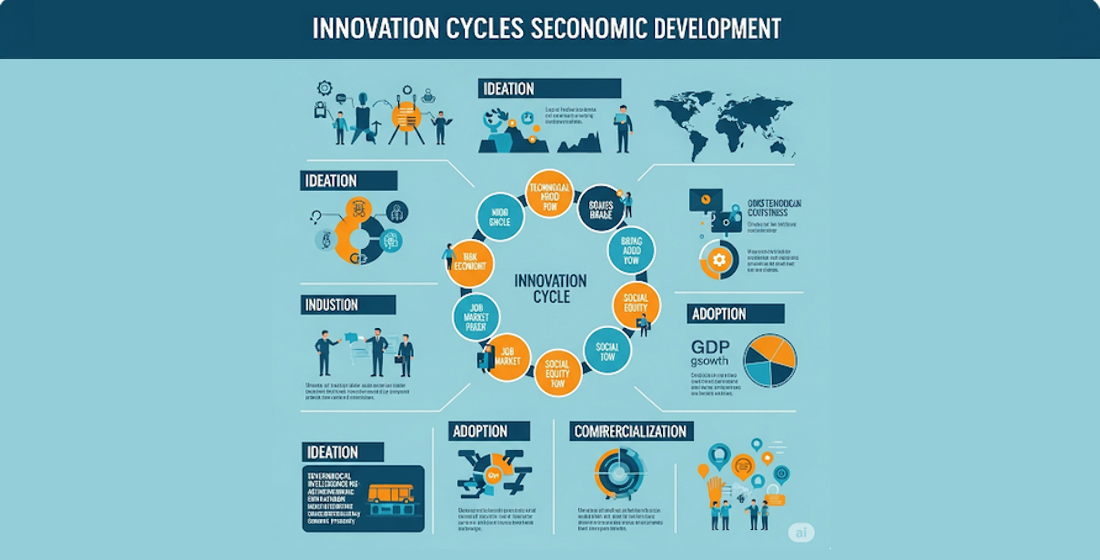
Об’єктом дослідження є процеси соціально-економічного розвитку в умовах технологічної трансформації з урахуванням інноваційних циклів. У роботі досліджується роль інноваційних циклів як стратегічної методологічної об'єктивності, що зумовлює динаміку соціально-економічного розвитку в умовах переходу до нової технологічної парадигми. Актуальність теми зумовлена глобальними викликами сучасності: цифровізацією, діджиталізацією економіки, розвитком штучного інтелекту, переходом до «зеленої» економіки та необхідністю формування адаптивних стратегій розвитку, здатних відповідати на темпи технологічних змін. Інноваційні цикли розглядаються як багатоетапний процес, що охоплює емерджентні ідеї, новітні технології, масове впровадження інновацій та їхній вплив на структуру виробництва, зайнятості й інституційних моделей.
На основі історико-теоретичного аналізу у роботі простежується еволюція промислових революцій – від Індустрії 1.0 до передбачуваної Індустрії 6.0. Зазначено, що кожна нова фаза промислового розвитку супроводжується формуванням нової технологічної парадигми, яка змінює принципи взаємодії між технологіями, капіталом, працею та знаннями. Індустрія 6.0, як передбачуваний наступний етап, пов’язується із симбіозом штучного та біологічного інтелекту, автономними економіками, децентралізованими структурами управління та ціннісно-орієнтованим інноваційним розвитком.
Обґрунтована необхідність осмислення інноваційних циклів не лише як емпіричного явища, а як методологічної основи стратегічного планування. У цьому контексті робота пропонує концептуальну модель, що передбачає інтеграцію циклічного аналізу в процеси державного регулювання, прогнозування та формування політик сталого зростання. Представлені висновки мають міждисциплінарне значення та можуть слугувати базою для подальших наукових розвідок у сферах економіки, соціології, публічного управління та технологічного розвитку.
Посилання
- Dmytrenko, H. V. (2009). Innovatsiinyi rozvytok suspilstva v konteksti tsyklichnoho rozvytku produktyvnykh syl. Politychnyi menedzhment, 2, 136–145. Available at: https://ipiend.gov.ua/wp-content/uploads/2018/07/dmytrenko_innovatsiinyi.pdf
- Petrenko, L. A. (2010). Life Cycles of Innovations. Ekonomika ta derzhava, 3, 94–96.
- Semenoh, O. M., Kravets, L. V., Stativka, V. I. (2022). Tekst u doslidnytskykh paradyhmakh: teoriia i praktyka. Sumy: SumDPU im. A. S. Makarenka, 248.
- Makarchuk, O. V. (2011). Refleksyvnyi potentsial osvitnoi paradyhmy. Visnyk NTUU “KPI”. Filosofiia. Psykholohiia. Pedahohika, 2, 77–80. Available at: https://ela.kpi.ua/bitstream/123456789/4393/1/15-filos-Makarchuk.pdf
- Kniazevych, A. O. (2010). Innovatsiinyi lah i yoho rol v innovatsiinomu protsesi. Aktualni problemy ekonomiky, 6, 26–30.
- Derevianko, Yu. M., Kontseva, D. S. (2010). Innovatsiini lahy v ekonomitsi. CORE. Available at: https://core.ac.uk/download/pdf/18593531.pdf
- Oriekhova, K. V., Ripka, L. M. (2010). Doslidzhennia klasyfikatsii innovatsii. Naukovi pratsi NAN Ukrainy, 3, 103–107.
- Iazliuk, B., Butonov, A., Kostetskyi, V. (2012). Theoretical basis of the essence of innovations and innovative activity. Visnyk TNTU, 6, 49–53. Available at: https://elartu.tntu.edu.ua/bitstream/123456789/2278/1/GEB_2012_v39_No6-B_Yazlyuk_A_Butonov_V_Kosteckij-Theoretical_basis_of_the_nature__52.pdf
- Prokhorova, V., Mushnykova, S., Kovalenko, D., Koleshchuk, O., Babichev, A. (2023). Convergence of educational technologies as an imperative for the development of innovation cooperation in the context of circular transformation. Eastern-European Journal of Enterprise Technologies, 4 (13 (124)), 26–35. https://doi.org/10.15587/1729-4061.2023.286183
- Prokhorova, V., Abernikhina, I., Mushnykova, S., Bozhanova, O., Toporkova, O. (2024). Risk management based on hedging tools in an export-oriented economy. Eastern-European Journal of Enterprise Technologies, 2 (13 (128)), 26–34. https://doi.org/10.15587/1729-4061.2024.299651
- Ralko, O. S. (2017). Waves of innovations: theoretical and practical aspects. Naukovyi visnyk Mizhnarodnoho humanitarnoho universytetu. Seriia: Ekonomika i menedzhment, 25 (1), 40–42.
- Dutta, S., Lanvin, B., Rivera León, L., Wunsch-Vincent, S. (Eds.) (2024). Global Innovation Index 2024: Unlocking the promise of social entrepreneurship. World Intellectual Property Organization, 326. https://doi.org/10.34667/tind.50062
- Derzhavna sluzhba statystyky Ukrainy. Available at: http://www.ukrstat.gov.ua
- Pro priorytetni napriamy innovatsiinoi diialnosti v Ukraini (2011). Zakon Ukrainy No. 3715-VI. 08.09.2011. Available at: https://zakon.rada.gov.ua/laws/show/3715-17#Text
- Stratehiia rozvytku sfery innovatsiinoi diialnosti na period do 2030 roku (2019). Rozporiadzhennia KMU No. 526-r. 10.06.2019. Available at: https://zakon.rada.gov.ua/laws/show/526-2019-%D1%80#n12
##submission.downloads##
Опубліковано
Як цитувати
Номер
Розділ
Ліцензія
Авторське право (c) 2025 Viktoriia Prokhorova, Svitlana Mushnykova, Iryna Abernikhina, Yaryna Yukhman, Olena Makovoz, Krystyna Slastianykova

Ця робота ліцензується відповідно до Creative Commons Attribution 4.0 International License.
Закріплення та умови передачі авторських прав (ідентифікація авторства) здійснюється у Ліцензійному договорі. Зокрема, автори залишають за собою право на авторство свого рукопису та передають журналу право першої публікації цієї роботи на умовах ліцензії Creative Commons CC BY. При цьому вони мають право укладати самостійно додаткові угоди, що стосуються неексклюзивного поширення роботи у тому вигляді, в якому вона була опублікована цим журналом, але за умови збереження посилання на першу публікацію статті в цьому журналі.