The impact of forest fires in the context of climate change: an interdisciplinary analysis
DOI:
https://doi.org/10.15587/2706-5448.2025.331295Keywords:
forest fires, ecosystem, climate change, modelling, management, anthropogenic factorsAbstract
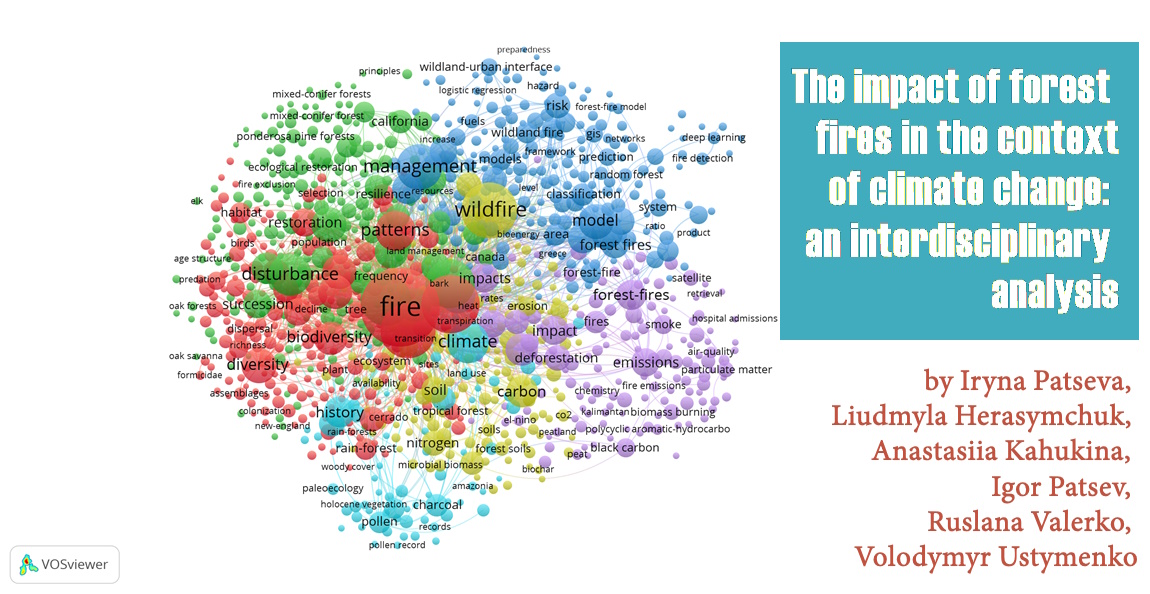
The object of the study is forest fires as a complex natural and social phenomenon that encompasses ecological, climatic, technological and management aspects of their occurrence, spread and consequences for ecosystems and society. Forest ecosystems are a complex natural system that plays a key role in economic activity, biodiversity conservation, climate regulation and the carbon cycle. One of the most problematic areas is the increasing frequency and scale of forest fires caused by both natural and anthropogenic factors, as well as the lack of an integrated approach to analyzing, forecasting and managing this phenomenon. The study used the method of an interdisciplinary literature review with a focus on key concepts: “forest fires”, “fire spread”, “anthropogenic impact”, “modelling”, “carbon cycle”, “environmental consequences”. The analysis of publications and clustering of topics in a term-oriented environment to identify structural links between scientific areas made it possible to obtain a qualitative typology of approaches to the study of forest fires, which includes: analysis of natural and social determinants, modelling of fire spread, assessment of environmental damage, impact on climate processes and development of prevention systems. This is due to the fact that the proposed approach covers a wide range of risk factors, allows for ecosystem specificity and emphasizes the need for interdisciplinary management. This makes it possible to develop effective strategies for climate change adaptation, increase ecosystem resilience and improve fire prevention systems. The proposed structure of the review provides a holistic view of the problem and identifies priorities for further research in the field of environmental safety and natural resource management.
Supporting Agency
- Funded by the State University Zhytomyr Polytechnic.
References
- Smith, J. E., Billmire, M., French, N. H. F., Domke, G. M. (2024). Application of the wildland fire emissions inventory system to estimate fire emissions on forest lands of the United States. Carbon Balance and Management, 19 (1). https://doi.org/10.1186/s13021-024-00274-0
- Peris-Llopis, M., Mola-Yudego, B., Berninger, F., Garcia-Gonzalo, J., González-Olabarria, J. R. (2024). Impact of species composition on fire-induced stand damage in Spanish forests. Scientific Reports, 14 (1). https://doi.org/10.1038/s41598-024-59210-4
- Peris-Llopis, M., Vastaranta, M., Saarinen, N., González-Olabarria, J. R., García-Gonzalo, J., Mola-Yudego, B. (2024). Post-fire vegetation dynamics and location as main drivers of fire recurrence in Mediterranean forests. Forest Ecology and Management, 568, 122126. https://doi.org/10.1016/j.foreco.2024.122126
- Roberts, L. J., Burnett, R., Fogg, A. (2021). Fire and Mechanical Forest Management Treatments Support Different Portions of the Bird Community in Fire-Suppressed Forests. Forests, 12 (2), 150. https://doi.org/10.3390/f12020150
- Tortorelli, C. M., Young, D. J. N., Reilly, M. J., Butz, R. J., Safford, H. D., Venuti, N. E. et al. (2024). Post-fire resurveys reveal predictability of long-term conifer recruitment in severely burned California dry forests. Forest Ecology and Management, 566, 122100. https://doi.org/10.1016/j.foreco.2024.122100
- Pati, P. K., Kaushik, P., Malasiya, D., Ray, T., Khan, M. L., Khare, P. K. (2024). Impacts of forest fire frequency on structure and composition of tropical moist deciduous forest communities of Bandhavgarh Tiger Reserve, Central India. Trees, Forests and People, 15, 100489. https://doi.org/10.1016/j.tfp.2023.100489
- Bargali, H., Pandey, A., Bhatt, D., Sundriyal, R. C. (2024). Loss of carbon stock in the forests of Uttarakhand due to unprecedented seasonal forest fires. Frontiers in Forests and Global Change, 7. https://doi.org/10.3389/ffgc.2024.1352265
- Mohd, A., Pritee, S., Mohanasundari, T. (2024). Analysing the escalation of forest fire in india: exploring causal factors and mitigation strategies. Journal of tropical forest science, 36 (2), 215–223. https://doi.org/10.26525/jtfs2024.36.2.215
- Pavel, M. A. A., Marques, M., Mukta, K. N. (2024). Impact of forest fires on portuguese forest ecosystem and its national emissions budget. Indonesian Journal of Forestry Research, 11 (1), 91–103. https://doi.org/10.59465/ijfr.2024.11.1.91-103
- Sati, V. P. (2024). Forest fires in the Indian Central Himalaya: major drivers, implications, and mitigation measures. Environmental Hazards, 23 (4), 390–404. https://doi.org/10.1080/17477891.2024.2304211
- Dhungana, B. P., Chhetri, V. T., Baniya, C. B., Sharma, S. P., Ghimire, P., Vista, S. P. (2024). Post-fire Effects on Soil Properties in High altitude Mixed-conifer Forest of Nepal. Trees, Forests and People, 17, 100633. https://doi.org/10.1016/j.tfp.2024.100633
- Noroozi, F., Ghanbarian, G., Safaeian, R., Pourghasemi, H. R. (2024). Forest fire mapping: a comparison between GIS-based random forest and Bayesian models. Natural Hazards, 120 (7), 6569–6592. https://doi.org/10.1007/s11069-024-06457-9
- Haydar, M., Hossain Rafi, A., Sadia, H., Tanvir Hossain, M. (2024). Data driven forest fire susceptibility mapping in Bangladesh. Ecological Indicators, 166, 112264. https://doi.org/10.1016/j.ecolind.2024.112264
- Asadollah, S. B. H. S., Sharafati, A., Motta, D. (2024). Satellite-based ensemble intelligent approach for predicting forest fire: a case of the Hyrcanian forest in Iran. Environmental Science and Pollution Research, 31 (15), 22830–22846. https://doi.org/10.1007/s11356-024-32615-4
- Chavardès, R. D., Daniels, L. D. (2016). Altered mixed-severity fire regime has homogenised montane forests of Jasper National Park. International Journal of Wildland Fire, 25 (4), 433. https://doi.org/10.1071/wf15048
- Zivanovic, S., Gocic, M., Lazic, I., Tosic, M., Tosic, I. (2024). Influence of thermal soil regimes on the forest fires frequencies. Thermal Science, 28 (2 Part C), 1917–1926. https://doi.org/10.2298/tsci230610277z
- Miezīte, O., Indriksons, A., Dreimanis, A., Freimane, L. (2013). The consequences of the forest fire in Sphagnosa forest site type ecosystem. Rural Development 2019, 2013. https://doi.org/10.15544/rd.2013.3.028
- Drobyshev, I., Niklasson, M., Ryzhkova, N., Götmark, F., Pinto, G., Lindbladh, M. (2021). Did forest fires maintain mixed oak forests in southern Scandinavia? A dendrochronological speculation. Forest Ecology and Management, 482, 118853. https://doi.org/10.1016/j.foreco.2020.118853
- Johnson, D. C., Shapcott, A. (2024). Koala forest habitat recovery varies with fire severity. Forest Ecology and Management, 556, 121704. https://doi.org/10.1016/j.foreco.2024.121704
- Araújo, F. D. C., Tng, D. Y. P., Apgaua, D. M. G., Coelho, P. A., Pereira, D. G. S., Santos, R. M. (2017). Post-fire plant regeneration across a closed forest-savanna vegetation transition. Forest Ecology and Management, 400, 77–84. https://doi.org/10.1016/j.foreco.2017.05.058
- Alpatova, O., Maksymenko, I., Patseva, I., Khomiak, I., Gandziura, V. (2022). Hydrochemical State of the Post-Military Operations Water Ecosystems of the Moschun, Kyiv Region. 16th International Conference Monitoring of Geological Processes and Ecological Condition of the Environment, 1–5. https://doi.org/10.3997/2214-4609.2022580145
- Melnyk-Shamrai, V., Shamrai, V., Patseva, I., Patsev, I. (2024). The influence of the accident at Chernobyl nuclear power plant on the condition of pine plantations of Ukrainian forests. IOP Conference Series: Earth and Environmental Science, 1415 (1), 012104. https://doi.org/10.1088/1755-1315/1415/1/012104
- Patseva, I. H., Nonik, L. Y., Gnatuk, B. Y., Patsev, I. S., Ustymenko, V. I. (2024). Increasing the level of ecologically oriented logistics system in the waste management for territorial communities. IOP Conference Series: Earth and Environmental Science, 1415 (1), 012131. https://doi.org/10.1088/1755-1315/1415/1/012131
- Patseva, I., Lukianova, V., Anpilova, Y., Mohelnytska, L., Gerasimchuk, O. (2024). The ecological assessment of small rivers in ukraine under conditions of intensive war impact. Romanian Journal of Geography, 68 (1), 127–134. https://doi.org/10.59277/rrg.2024.1.08
- Kotsiuba, I., Herasymchuk, O., Shamrai, V., Lukianova, V., Anpilova, Y., Rybak, O., Lefter, I. (2023). A Strategic Analysis of the Prerequisites for the Implementation of Waste Management at the Regional Level. Ecological Engineering & Environmental Technology, 24 (1), 55–66. https://doi.org/10.12912/27197050/154918
- Whitman, E., Barber, Q. E., Jain, P., Parks, S. A., Guindon, L., Thompson, D. K., Parisien, M. (2024). A modest increase in fire weather overcomes resistance to fire spread in recently burned boreal forests. Global Change Biology, 30 (6). https://doi.org/10.1111/gcb.17363
- White, A. M., Manley, P. N., Tarbill, G. L., Richardson, T. W., Russell, R. E., Safford, H. D., Dobrowski, S. Z. (2015). Avian community responses to post‐fire forest structure: implications for fire management in mixed conifer forests. Animal Conservation, 19 (3), 256–264. https://doi.org/10.1111/acv.12237
- Hu, H., Deng, X., Zhang, G., Feng, L., Long, J., Li, Z. et al. (2024). Fire behavior simulation of Xintian forest fire in 2022 using WRF-fire model. Frontiers in Forests and Global Change, 7. https://doi.org/10.3389/ffgc.2024.1336716
- Fangrong, Z., Yuning, G., Guochao, Q., Yi, M., Guofang, W. (2024). Multi-factor coupled forest fire model based on cellular automata. Journal of Safety Science and Resilience, 5 (4), 413–421. https://doi.org/10.1016/j.jnlssr.2024.06.002
- Cao, Y., Zhou, X., Yu, Y., Rao, S., Wu, Y., Li, C., Zhu, Z. (2024). Forest Fire Prediction Based on Time Series Networks and Remote Sensing Images. Forests, 15 (7), 1221. https://doi.org/10.3390/f15071221
- Whittier, T. R., Gray, A. N. (2016). Tree mortality based fire severity classification for forest inventories: A Pacific Northwest national forests example. Forest Ecology and Management, 359, 199–209. https://doi.org/10.1016/j.foreco.2015.10.015
- Li, S., Han, J., Chen, F., Min, R., Yi, S., Yang, Z. (2024). Fire-Net: Rapid Recognition of Forest Fires in UAV Remote Sensing Imagery Using Embedded Devices. Remote Sensing, 16 (15), 2846. https://doi.org/10.3390/rs16152846
- Puttapirat, P., Woradit, K., Hesse, H., Bhatia, D. (2024). FireFly Project: UAV Development for Distributed Sensing of Forest Fires. 2024 International Conference on Unmanned Aircraft Systems (ICUAS), 594–601. https://doi.org/10.1109/icuas60882.2024.10556892
- Ibraheem, M. K. I., Mohamed, M. B., Fakhfakh, A. (2024). Forest Defender Fusion System for Early Detection of Forest Fires. Computers, 13 (2), 36. https://doi.org/10.3390/computers13020036
- Hartung, M., Carreño-Rocabado, G., Peña-Claros, M., van der Sande, M. T. (2021). Tropical Dry Forest Resilience to Fire Depends on Fire Frequency and Climate. Frontiers in Forests and Global Change, 4. https://doi.org/10.3389/ffgc.2021.755104
- Patseva, I., Kahukina, A., Lunova, O. (2023). Climate change trends in the Zhytomyr region. Ecological Sciences, 6 (51), 156–159. https://doi.org/10.32846/2306-9716/2023.eco.6-51.25
- Markina, L., Todchuk, D. (2024). Assessment of the efficiency of modern technologies for reducing greenhouse gas emissions in industrial enterprises of Ukraine. Technology Audit and Production Reserves, 6 (3 (80)), 25–30. https://doi.org/10.15587/2706-5448.2024.319856
- Kahukina, A., Patseva, I. (2025). Assessment and forecast of atmospheric pollutant dynamics in the urban ecosystem of Zhytomyr. Technology Audit and Production Reserves, 2 (3 (82)), 36–42. https://doi.org/10.15587/2706-5448.2025.326893
- Park, J., Moon, M., Green, T., Kang, M., Cho, S., Lim, J., Kim, S.-J. (2024). Impact of tree species composition on fire resistance in temperate forest stands. Forest Ecology and Management, 572, 122279. https://doi.org/10.1016/j.foreco.2024.122279
- Shinneman, D. J., Palik, B. J., Cornett, M. W. (2012). Can landscape-level ecological restoration influence fire risk? A spatially-explicit assessment of a northern temperate-southern boreal forest landscape. Forest Ecology and Management, 274, 126–135. https://doi.org/10.1016/j.foreco.2012.02.030
- Bargali, H., Pandey, A., Bhatt, D., Sundriyal, R. C., Uniyal, V. P. (2024). Forest fire management, funding dynamics, and research in the burning frontier: A comprehensive review. Trees, Forests and People, 16, 100526. https://doi.org/10.1016/j.tfp.2024.100526
Downloads
Published
How to Cite
Issue
Section
License
Copyright (c) 2025 Iryna Patseva, Liudmyla Herasymchuk, Anastasiia Kahukina, Igor Patsev, Ruslana Valerko, Volodymyr Ustymenko

This work is licensed under a Creative Commons Attribution 4.0 International License.
The consolidation and conditions for the transfer of copyright (identification of authorship) is carried out in the License Agreement. In particular, the authors reserve the right to the authorship of their manuscript and transfer the first publication of this work to the journal under the terms of the Creative Commons CC BY license. At the same time, they have the right to conclude on their own additional agreements concerning the non-exclusive distribution of the work in the form in which it was published by this journal, but provided that the link to the first publication of the article in this journal is preserved.





