Express method for determining power of equivalent dose in radiation-contaminated territories of radioactive tailings storage facilities
DOI:
https://doi.org/10.15587/2706-5448.2025.331755Keywords:
mathematical model, equivalent dose rate, tailings storage facility, radiation-hazardous facility, γ-radiationAbstract
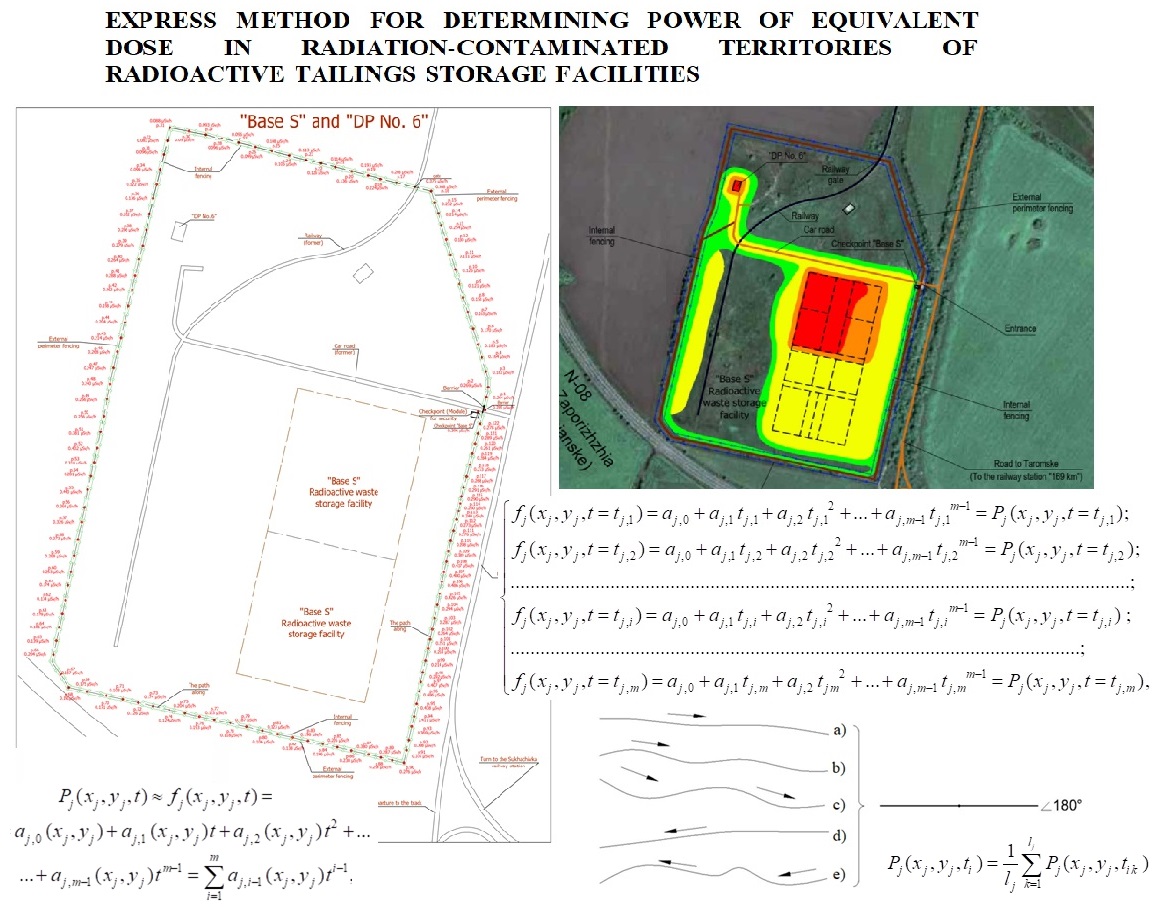
Operation of radiation-hazardous facilities, such as tailings facilities of the former uranium production of the Prydniprovsky Chemical Plant (PСP, Ukraine), with buildings, structures, observation points, communications, technological equipment, etc. located on their territory, is impossible without a system of physical protection and radiation monitoring. Operation of such facilities in peacetime allows for fairly rapid data collection in the operating mode at the radiation-hazardous facility itself using the method of walking gamma imaging on the perimeter of the tailings storage facility. In conditions of martial law and under certain restrictive circumstances, it is not possible to go directly to the industrial site and conduct full-scale measurements. For this, express methods of mathematical forecasting can be used. Based on the conducted research, the dynamics of observations is calculated, and the predictive model allows determining the regulated radiation parameters (RRP), one of which is the equivalent dose rate, without using radiation control devices with specialists who will conduct measurements.
For ten years, the actual values of radiation doses to personnel at the tailings storage facilities of the former uranium production of the PCP were determined. The article presents the developed universal mathematical model for determining the equivalent dose rate of gamma radiation for personnel conducting one-time measurements at a radiation-hazardous facility. The developed mathematical model for measuring the equivalent dose rate values is used for 2D modeling in places where dusty particles with radionuclides settled from the leeward side in the summer in places where the tailings mirror surface decreases. This makes it possible to predict the further radiation situation that will occur in the coming years and improve the system for calculating the total effective dose to a person.
Supporting Agency
- This article is a logical continuation of the scientific developments of the Department of Labor Protection, Civil and Technogenic Safety of the Ukrainian State University of Science and Technology of the National Research Institute “Prydniprovska State Academy of Civil Engineering and Architecture”. Current scientific and research work is carried out according to the departmental theme “Labor Protection, Industrial, Civil and Environmental Safety in Various Spheres of Human Life” No. State Registration 0124U001896 (in the period 2024–2026). This issue is of great importance for both the Dnipropetrovsk region and the state of Ukraine. Forecasting of possible scenarios that may occur at industrial sites or at individual tailings facilities is carried out using mathematical models and calculations, one of which is presented in this study. The proposed mathematical model provides an opportunity to conduct an express assessment of radiation contamination in wartime conditions.
References
- 1990 Recommendations of the International Commission on Radiological Protection (1991). ICRP Publication 60. Ann. ICRP 21 (1-3).
- The 2007 Recommendations of the International Commission on Radiological Protection (2007). ICRP Publication 103.
- Nuclear Decay Data for Dosimetric Calculations (2008). ICRP Publication 107. Ann. ICRP, 38 (3).
- Adult Reference Computational Phantoms (2009). ICRP Publication 110. Ann. ICRP, 39 (2).
- Ghazal, A. A., Alakash, R., Aljumaili, Z., El-Sayed, A., Abdel-Rahman, H. (2023). Enhancing Gamma-Neutron Shielding Effectiveness of Polyvinylidene Fluoride for Potent Applications in Nuclear Industries: A Study on the Impact of Tungsten Carbide, Trioxide, and Disulfide Using EpiXS, Phy-X/PSD, and MCNP5 Code. Journal of Radiation Protection and Research, 48 (4), 184–196. https://doi.org/10.14407/jrpr.2023.00213
- Lee, C. (2024). A Review of Organ Dose Calculation Methods and Tools for Patients Undergoing Diagnostic Nuclear Medicine Procedures. Journal of Radiation Protection and Research, 49 (1), 1–18. https://doi.org/10.14407/jrpr.2023.00087
- Lee, Y., Choi, J. W., Braunstein, L., Lee, C., Yeom, Y. S. (2024). Investigation on Individual Variation of Organ Doses for Photon External Exposures: A Monte Carlo Simulation Study. Journal of Radiation Protection and Research, 49 (1), 50–64. https://doi.org/10.14407/jrpr.2023.00661
- Poorbaygi, H., Salimi, S. M., Torkzadeh, F., Hamidi, S., Sheibani, S. (2023). Determination of Exposure during Handling of 125I Seed Using Thermoluminescent Dosimeter and Monte Carlo Method Based on Computational Phantom. Journal of Radiation Protection and Research, 48 (4), 197–203. https://doi.org/10.14407/jrpr.2023.00255
- Nizam, Q. M. R., Ahmed, A., Ahmed, I. (2023). Monte Carlo Calculation for Production Cross-Sections of Projectile’s Isotopes from Therapeutic Carbon and Helium Ion Beams in Different Materials. Journal of Radiation Protection and Research, 48 (4), 204–212. https://doi.org/10.14407/jrpr.2023.00262
- Paquet, F., Etherington, G., Bailey, M. R., Leggett, R. W., Lipsztein, J., Bolch, W. et al. (2015). ICRP Publication 130: Occupational Intakes of Radionuclides: Part 1. Annals of the ICRP, 44 (2), 5–188. https://doi.org/10.1177/0146645315577539
- Paquet, F., Bailey, M. R., Leggett, R. W., Lipsztein, J., Fell, T. P., Smith, T. et al. (2016). ICRP Publication 134: Occupational Intakes of Radionuclides: Part 2. Annals of the ICRP, 45 (3-4), 7–349. https://doi.org/10.1177/0146645316670045
- Paquet, F., Bailey, M. R., Leggett, R. W., Lipsztein, J., Marsh, J., Fell, T. P. et al. (2017). ICRP Publication 137: Occupational Intakes of Radionuclides: Part 3. Annals of the ICRP, 46 (3-4), 1–486. https://doi.org/10.1177/0146645317734963
- Paquet, F., Leggett, R. W., Blanchardon, E., Bailey, M. R., Gregoratto, D., Smith, T. et al. (2022). ICRP Publication 151: Occupational Intakes of Radionuclides: Part 5. Annals of the ICRP, 51 (1-2), 11–415. https://doi.org/10.1177/01466453211028755
- Deiaki pytannia identyfikatsii obiektiv pidvyshchenoi nebezpeky (2022). Postanova KMU No. 1030. 13.09.2022. Available at: https://www.kmu.gov.ua/npas/deiaki-pytannia-identyfikatsii-obiektiv-1030
- Osnovni sanitarni pravyla zabezpechennia radiatsiinoi bezpeky Ukrainy (2005). Nakaz Ministerstva okhorony zdorovia Ukrainy No. 54. 02.02.2005. Available at: https://zakon.rada.gov.ua/laws/show/z0552-05#Text
- Pro zatverdzhennia norm radiatsiinoi bezpeky Ukrainy (NRBU-97) (1997). Nakaz Ministerstva okhorony zdorovia Ukrainy No. 206. 14.07.1997. Available at: https://zakon.rada.gov.ua/rada/show/v0208282-97#Text
- Deiaki pytannia obiektiv krytychnoi infrastruktury (2024). Postanova KMU No. 1109. 09.10.2020. Available at: https://zakon.rada.gov.ua/laws/show/1109-2020-%D0%BF#Text
- Osnovni vymohy do budivel i sporud. Hihiiena, zdorovia ta zakhyst dovkillia (DBN V.1.2-8:2021) (2022). Nakaz Minrehion Ukrainy No. 366. 30.12.2021. Available at: https://online.budstandart.com/ua/catalog/doc-page.html?id_doc=98032
- Bolch, W. E., Jokisch, D., Zankl, M., Eckerman, K. F., Fell, T., Manger, R. et al. (2016). ICRP Publication 133: The ICRP computational framework for internal dose assessment for reference adults: specific absorbed fractions. Annals of the ICRP, 45 (2), 5–73. https://doi.org/10.1177/0146645316661077
- Kim, C. H., Yeom, Y. S., Petoussi-Henss, N., Zankl, M., Bolch, W. E., Lee, C. et al. (2020). ICRP Publication 145: Adult Mesh-Type Reference Computational Phantoms. Annals of the ICRP, 49 (3), 13–201. https://doi.org/10.1177/0146645319893605
- Rashid, H., Mohd Siam, F., Maan, N., W. Abd Rahman, W. N., Nasir, M. H. (2022). Mathematical Models of the Generation of Radiation-induced DNA Double-strand Breaks and Misrepair Cells by Direct and Indirect Action. Malaysian Journal of Fundamental and Applied Sciences, 18 (4), 402–412. https://doi.org/10.11113/mjfas.v18n4.2406
- Hanfland, R., Pattantyús-Ábrahám, M., Richter, C., Brunner, D., Voigt, C. (2022). The Lagrangian Atmospheric Radionuclide Transport Model (ARTM) – development, description and sensitivity analysis. Air Quality, Atmosphere & Health, 17 (6), 1235–1252. https://doi.org/10.1007/s11869-022-01188-x
- Lee, U., Lee, C., Kim, M., Kim, H. R. (2019). Analysis of the influence of nuclear facilities on environmental radiation by monitoring the highest nuclear power plant density region. Nuclear Engineering and Technology, 51 (6), 1626–1632. https://doi.org/10.1016/j.net.2019.04.007
- Bonin, A., Zammataro, M., Larmier, C. (2022). Modelling of radioactive dust for dose calculations with stochastic geometries. EPJ Nuclear Sciences & Technologies, 8, 6. https://doi.org/10.1051/epjn/2022001
- Larmier, C., Zoia, A., Malvagi, F., Dumonteil, E., Mazzolo, A. (2017). Monte Carlo particle transport in random media: The effects of mixing statistics. Journal of Quantitative Spectroscopy and Radiative Transfer, 196, 270–286. https://doi.org/10.1016/j.jqsrt.2017.04.006
- Brun, E., Damian, F., Diop, C. M., Dumonteil, E., Hugot, F. X., Jouanne, C. et al. (2014). TRIPOLI-4®, CEA, EDF and AREVA Reference Monte Carlo Code. SNA + MC 2013 – Joint International Conference on Supercomputing in Nuclear Applications + Monte Carlo, 82, 151–160. https://doi.org/10.1051/snamc/201406023
- Pylypenko, O. V., Kaplia, O. I., Bielikov, A. S. (2010). Analiz stanu radiatsiinoho zabrudnennia khvostoskhovyshch rezhymnoi terytorii kolyshnoho uranovoho vyrobnytstva VO PKhZ. Visnyk PDABA, 8, 36–41.
- Korotaiev, V., Bielikov, A., Pylypenko, O., Podkopaiev, S., Tkachuk, O., Shalomov, V. (2024). Theoretical and practical substantiation for prediction of equivalent dose rate of gamma radiation at the Sukhachivske tailings storage facility I section. Technology Audit and Production Reserves, 6 (2 (80)), 16–27. https://doi.org/10.15587/2706-5448.2024.319636
- Pylypenko, O. V. (2024). Dynamika vyznachennia faktychnykh ta prohnozovanykh znachen potuzhnosti ekvivalentnoi dozy na khvostoskhovyshchi “Sukhachivske” II sektsiia. International Science Group, 115–125. Available at: https://isg-konf.com/innovative-scientific-research-theory-methodology-practice/
- Pylypenko, O. V., Sankov, P. M., Dziuban, O. V., Papirnyk, R. B., Tkach, N. O. (2022). Osoblyvosti orhanizatsii radiatsiinoho kontroliu na obiektakh yaderno-palyvnoho kompleksu Ukrainy. Scientific Collection “InterConf”, 124, 196–206. Available at: https://archive.interconf.center/index.php/conference-proceeding/article/view/1316
- Pylypenko, O. V., Bielikov, A. S., Rahimov, S. Yu., Andrieieva, A. V., Sankov, P. M. (2023). Monitorynh terytorii promyslovykh maidanchykiv radiatsiino-nebezpechnykh obiektiv za dopomohoiu malykh dystantsiino kerovanykh nazemnykh aparativ. Problems of the development of science and the view of society. Hrats, 411–421. Available at: https://isg-konf.com/wp-content/uploads/2023/03/PROBLEMS-OF-THE-DEVELOPMENT-OF-SCIENCE-AND-THE-VIEW-OF-SOCIETY.pdf
- Pylypenko, O. V., Rudenko, V. P., Palamarchuk, V. M. (2025). Zastosuvannia metodu dystantsiinoi ziomky dlia pobudovy 2D kart radiatsiinoho zabrudnennia. Problemy harantuvannia bezpeky liudyny v umovakh suchasnykh vyklykiv. Lutsk: Viddil imidzhu ta promotsii LNTU, 25–27.
Downloads
Published
How to Cite
Issue
Section
License
Copyright (c) 2025 Oleksandr Pylypenko, Anatoly Zelensky, Kateryna Rybalka, Viktor Kolokhov, Pavlo Nazha

This work is licensed under a Creative Commons Attribution 4.0 International License.
The consolidation and conditions for the transfer of copyright (identification of authorship) is carried out in the License Agreement. In particular, the authors reserve the right to the authorship of their manuscript and transfer the first publication of this work to the journal under the terms of the Creative Commons CC BY license. At the same time, they have the right to conclude on their own additional agreements concerning the non-exclusive distribution of the work in the form in which it was published by this journal, but provided that the link to the first publication of the article in this journal is preserved.





