Improvement of prediction of oil displacement efficiency during waterflooding due to detailing of lithological distribution
DOI:
https://doi.org/10.15587/2706-5448.2025.331872Keywords:
oil displacement efficiency, waterflooding, Buckley-Leverett method, lithological distribution, relative permeabilitiesAbstract
The object of research is the process of oil displacement during waterflooding. The research aims to develop and substantiate a methodology that improves the reliability of predicting oil displacement efficiency during waterflooding. For this purpose, the classical Buckley-Leverett method and the State Standard of Ukraine method for calculating the oil displacement efficiency during waterflooding were extended by integrating lithological data, which allows considering the influence of geological characteristics on the process of oil displacement by water.
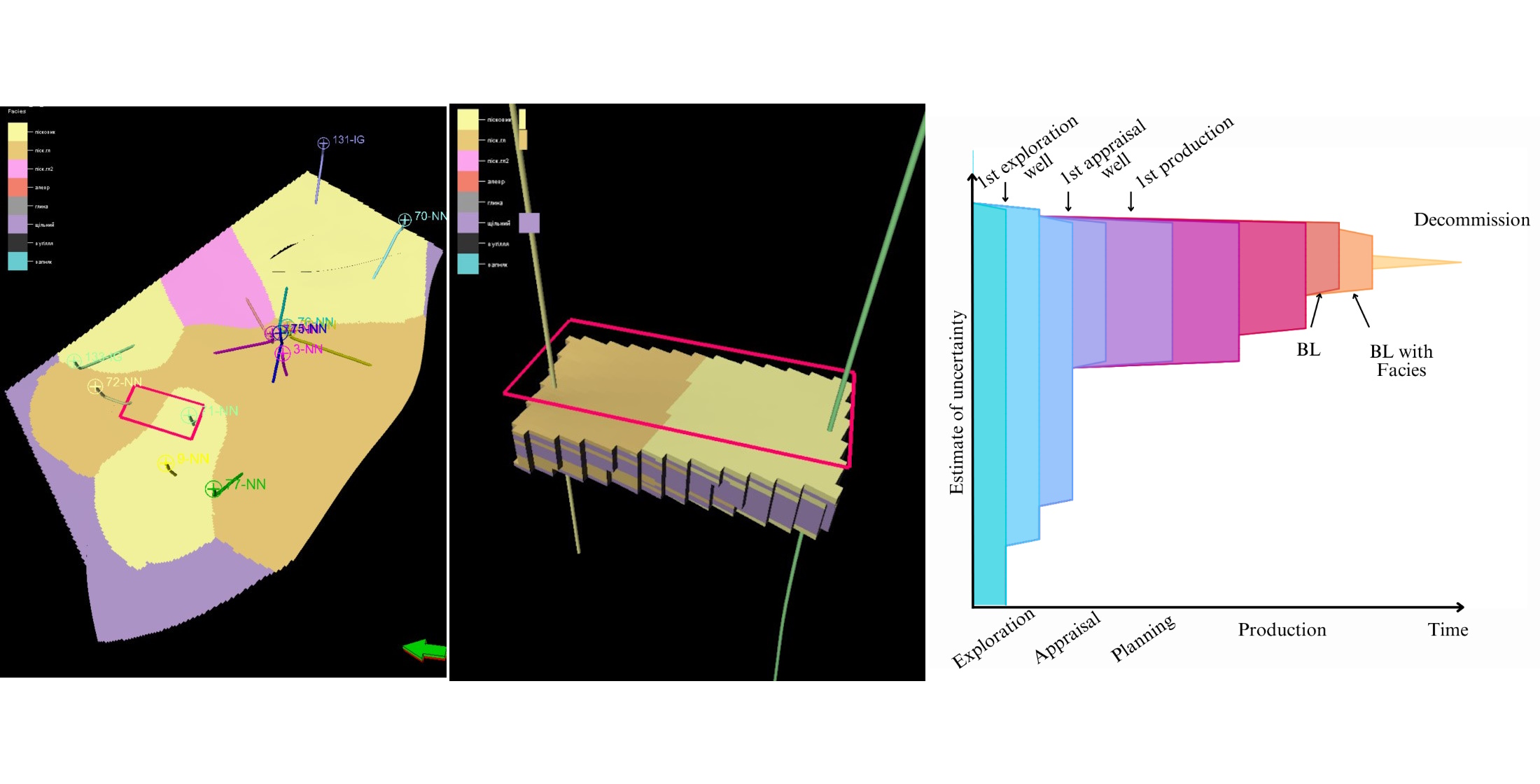
The developed methodology for improving the reliability of oil displacement efficiency prediction encompasses the identification of lithofacies and the determination of core and fluid sample properties. Subsequently, the representative elementary volume (REV) is ascertained for each facies. Based on this, the irreducible water saturation and irreducible oil saturation are calculated. Relative permeability curves are then constructed for each facies. The Buckley-Leverett equation is applied, and fractional flow curves are generated. The data is integrated into a three-dimensional reservoir model, with facies volumes determined using the kriging method. Finally, the averaged oil displacement efficiency is calculated.
A comparative analysis of the reliability of methods, with and without lithological subdivision, was conducted by constructing an experimental histogram and a normal distribution plot, considering or disregarding lithological distribution, respectively. For the comparative analysis, this research generates one hundred reservoir realizations, both with and without lithological subdivision, using the Sequential Indicator Simulation tool.
It was established that the use of lithological data in the calculations of the Buckley-Leverett method, with consideration of the lithological factor, allows a reduction in the scatter of predicted values by 11% in comparison with a similar method without consideration of the lithological factor.
The originality of the research lies in integrating lithological distribution into the Buckley-Leverett method and the State Standard of Ukraine method of calculating the oil displacement efficiency during waterflooding, which significantly improves the predictive results. The proposed approach allows considering the lithological factor at the level of analytical formulas when calculating the two methods.
References
- HSTU 41-00032626-00-022-2000. Vyznachennia koefitsiientiv vyluchennia nafty dlia heoloho-ekonomichnoi otsinky resursiv i zapasiv prohnoznykh i vyiavlenykh pokladiv. Ministerstvo ekolohii ta pryrodnykh resursiv Ukrainy (2000). Derzhavnyi standart Ukrainy.
- Ahmed, T. (2019). Reservoir engineering handbook. Gulf professional publishing. https://doi.org/10.1016/c2016-0-04718-6
- Buckley, S. E., Leverett, M. C. (1942). Mechanism of Fluid Displacement in Sands. Transactions of the AIME, 146 (1), 107–116. https://doi.org/10.2118/942107-g
- Dake, L. P. (2001). Fundamentals of Reservoir Engineering. Elsevier.
- Ertekin, T., Abou-Kassem, J. H., King, G. R. (2001). Basic Applied Reservoir Simulation. SPE Textbook Series. https://doi.org/10.2118/9781555630898
- Thomas, S., Farouq Ali, S. M. (1999). Improved Oil Recovery by Chemical and Gas Processes. Journal of Canadian Petroleum Technology, 38 (3).
- Alikhani, P., Guadagnini, A., Inzoli, F. (2019). Feedback Between Gravity and Viscous Forces in Two-phase Buckley-Leverett Flow in Randomly Heterogeneous Permeability Fields. Petroleum Geostatistics 2019, 1–5. https://doi.org/10.3997/2214-4609.201902185
- Cui, G., Liu, M., Dai, W., Gan, Y. (2018). Pore-scale modelling of gravity-driven drainage in disordered porous media. arXiv preprint. arXiv:1810.11989. https://doi.org/10.48550/arXiv.1810.11989
- Lai, J., Wang, G., Cai, C., Fan, Z., Wang, S., Chen, J., Luo, G. (2017). Diagenesis and reservoir quality in tight gas sandstones: The fourth member of the Upper Triassic Xujiahe Formation, Central Sichuan Basin, Southwest China. Geological Journal, 53 (2), 629–646. https://doi.org/10.1002/gj.2917
- Liu, Z., Wu, S., Li, J., Xu, Z., Tian, M., Zhang, T., An, Y. (2021). Impact of petrographic characteristics on reservoir quality of tight sandstone reservoirs in coal‐bearing strata: A case study in Lower Permian Shihezi Formation in northern Ordos Basin, China. Geological Journal, 56 (6), 3097–3117. https://doi.org/10.1002/gj.4091
- Ali, S., Li, H., Ali, A., Hassan, J. I. (2024). Lithological Discrimination of Khyber Range Using Remote Sensing and Machine Learning Algorithms. Applied Sciences, 14 (12), 5064. https://doi.org/10.3390/app14125064
- Guo, A., Li, F. (2024). Carbonate reservoir waterflood development: Mechanism analysis, process optimization, and typical case studies. Advances in Resources Research, 4 (3), 338–361. https://doi.org/10.50908/arr.4.3_338
- Blunt, M. J. (2017). Multiphase flow in permeable media: A pore-scale perspective. Cambridge university press. https://doi.org/10.1017/9781316145098
- Welge, H. J. (1952). A Simplified Method for Computing Oil Recovery by Gas or Water Drive. Journal of Petroleum Technology, 4 (4), 91–98. https://doi.org/10.2118/124-g
- Kurovets, I., Hrytsyk, I., Prykhodko, O., Chepusenko, P., Kucher, Z., Mykhalchuk, S. et al. (2021). Petrophysical models of deposits of the Menilite suite of the Oligocene flysh of the Carpathians and the Precarpathian deep. Geology and Geochemistry of Combustible Minerals, 3-4 (185-186), 33–43. https://doi.org/10.15407/ggcm2021.03-04.033
- Havryshkiv, H., Radkovets, N. (2020). Paleocene deposits of the Ukrainian Carpathians: geological and petrographic characteristics, reservoir properties. Baltica, 33 (2), 109–127. https://doi.org/10.5200/baltica.2020.2.1
- Vyzhva, S., Onyshchuk, V., Onyshchuk, I., Reva, M., Shabatura, O. (2021). Petrophysical properties of the Lower Permian limestones of the Glinsko-Solokhivsky gas-and oil-bearing region of the Dnieper-Donets depression. 15th International Conference Monitoring of Geological Processes and Ecological Condition of the Environment. European Association of Geoscientists & Engineers, 1–5. https://doi.org/10.3997/2214-4609.20215k2066
- Ftemov, Y. M., Fedoriv, V. V., Maniuk, V. M. (2021). Petrophysical models for estimating filtration-capacity parameters of complex reservoir rocks at Kachalivske oil and gas condensate field. Geoinformatics. European Association of Geoscientists & Engineers, 1–6. https://doi.org/10.3997/2214-4609.20215521017
- Martus, O., Agarkov, V. (2022). Development of improved method for evaluation of reservoir properties of formation. Technology Audit and Production Reserves, 5 (1 (67)), 33–37. https://doi.org/10.15587/2706-5448.2022.266572
- Martus, O., Cvetkovic, B. (2023). Development of oil extraction screening methodology taking into account innovative methods using the example of the Ukrainian field. Technology Audit and Production Reserves, 6 (1 (74)), 47–53. https://doi.org/10.15587/2706-5448.2023.294081
- Martus, O., Cvetkovic, B. (2024). Increasing the accuracy of oil recovery factor predictions by integrating lithology data. Technology Audit and Production Reserves, 3 (1 (77)), 47–52. https://doi.org/10.15587/2706-5448.2024.307628
Downloads
Published
How to Cite
Issue
Section
License
Copyright (c) 2025 Olena Martus, Branimir Cvetkovic, Olena Mykhailovska, Andrii Yaholnyk, Anna Liashenko

This work is licensed under a Creative Commons Attribution 4.0 International License.
The consolidation and conditions for the transfer of copyright (identification of authorship) is carried out in the License Agreement. In particular, the authors reserve the right to the authorship of their manuscript and transfer the first publication of this work to the journal under the terms of the Creative Commons CC BY license. At the same time, they have the right to conclude on their own additional agreements concerning the non-exclusive distribution of the work in the form in which it was published by this journal, but provided that the link to the first publication of the article in this journal is preserved.





