Influence of the properties of secondary α-titanium casts, obtained by chamberless electroslag casting, for processing by turning
DOI:
https://doi.org/10.15587/2706-5448.2025.331902Keywords:
ingot, machinability, α-titanium, roughness, strength, macrostructure, microstructure, turning, wear resistance, hardnessAbstract
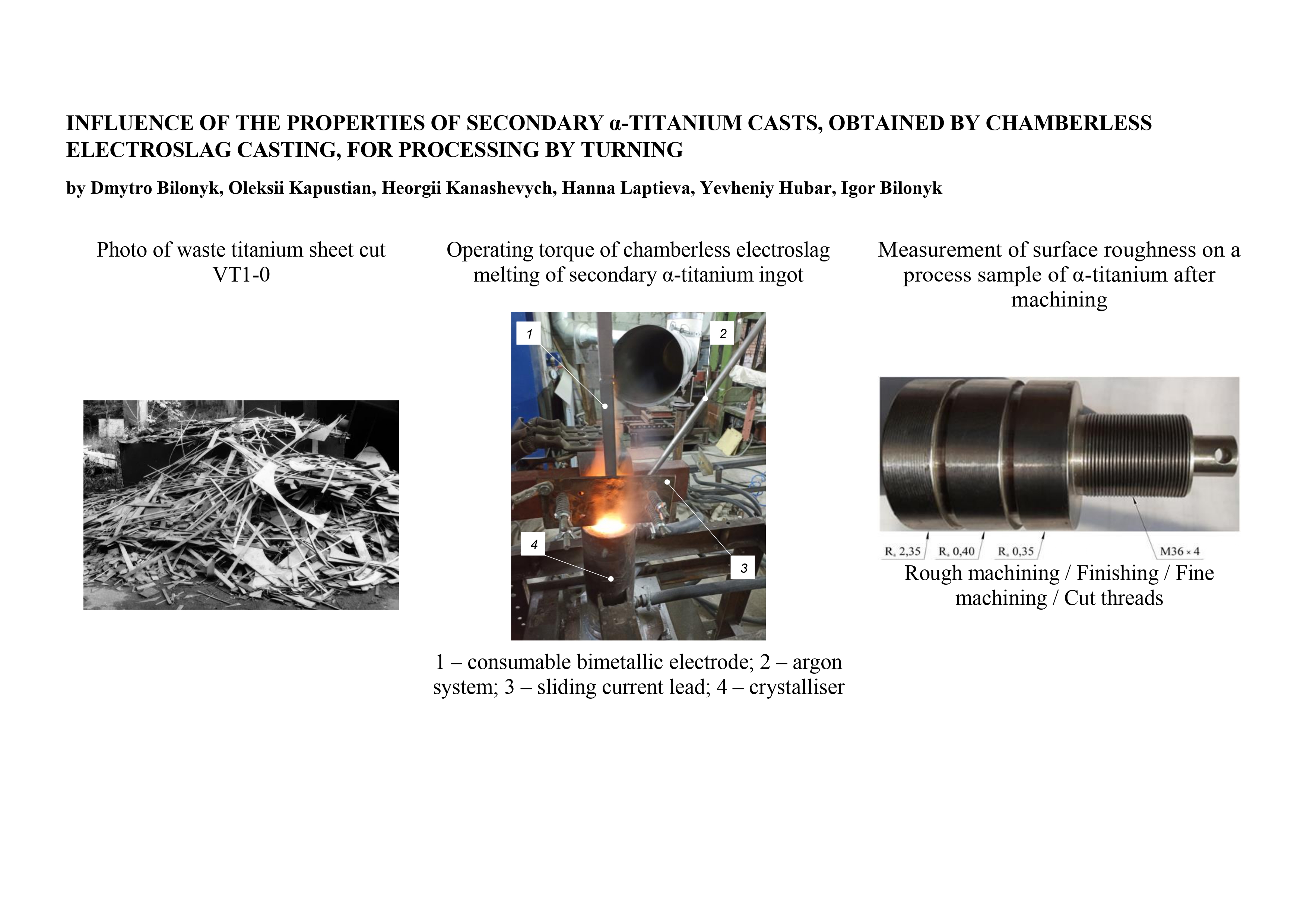
The object of the study is the machinability by turning of secondary α-titanium casts produced via chamberless electroslag remelting (CESR) (hereinafter referred to as secondary α-titanium), using non-consumable electrodes fabricated from 100% VT1-0 titanium scrap. One of the most challenging issues is the difficulty of machining both primary and secondary titanium. Specifically, this includes chip adhesion to the cutting tool due to the high plasticity of titanium alloys and increased contact surface temperatures, which lead to oxidation.
The study employed modern metallographic methods to examine the macrostructure, chemical composition, and mechanical properties of α-titanium; experimental methods were used to determine optimal turning conditions; and the machinability coefficient was determined using graphical interpolation. Tool wear resistance was evaluated by comparative methods.
Optimal machining parameters were established for the removal of the alpha-case layer and achieving a surface roughness of classes 5–8: cutting speed V = 25–30 mm/min; feed rate S = 0.5–0.9 mm/rev; cutting depth T = 1.0–1.2 mm. The selected turning regimes enable the production of complex threaded profiles in accordance with ISO 724:1993 requirements. The study demonstrated that turning secondary α-titanium casts does not require additional technological measures or high-wear-resistant specialized tools. The machinability coefficient was determined to be 0.47–0.48. The improved machinability of the secondary α-titanium casts is attributed to the high quality of the metal, ensured by droplet-based metal transfer and consistent crystallization in a water-cooled copper mold, resulting in higher density and structural homogeneity. The application of chamberless electroslag casting technology enhanced the quality of α-titanium and expanded the potential for its use in the manufacturing of parts for mechanical engineering, chemical, and aerospace industries.
Producing secondary α-titanium using titanium scrap through this technology allows a reduction in production cost by approximately 25–30%.
References
- Sheiko, I. V., Shapovalov, V. A., Konstantinov, V. S. (2007). Alternative technologies of remelting of industrial wastes of titanium and alloys thereof. Sovremennaia elektrometallurgiia, 3 (88), 44–53. Available at: http://dspace.nbuv.gov.ua/handle/123456789/95819
- Kolobov, G. A., Vodennikov, S. A., Pecheritca, K. A., Lichkonenko, N. V., Bubinetc, A. V. (2017). Technologies of utilization of circulating castings wastes are in productions of titanic shaped casting and bars. Metallurgiia, 2 (38), 46–60. Available at: https://dspace.znu.edu.ua/jspui/handle/12345/466
- Tebaldo, V., Gautier di Confiengo, G., Duraccio, D., Faga, M. G. (2023). Sustainable Recovery of Titanium Alloy: From Waste to Feedstock for Additive Manufacturing. Sustainability, 16 (1), 330. https://doi.org/10.3390/su16010330
- Burnashev, V. R., Nykytenko, Yu. O., Barabash, V. V., Shapovalov, V. O. (2021). Remelting wastes of titanium and titanium alloys under the conditions of plasma-arc melting. Suchasna Elektrometallurgiya, 4, 32–37. https://doi.org/10.37434/sem2021.04.05
- Mazur, M. P., Vnukov, Yu. M., Hrabchenko, A. I., Dobroskok, V. L., Zaloha, V. O., Novosolov, Yu. K., Yakubov, F. Ya. (2020). Osnovy teorii rizannia materialiv. Lviv: Novyi Svit – 2000, 471.
- Kiianovskyi, M. V., Tsyvinda, N. I., Pikilniak, A. V., Zuiev, I. O. (2024). Zalezhnosti protsesu rizannia vazhkoobrobliuvanykh materialiv detalei hirnycho-metalurhiinoho kompleksu yak vypadkovi funktsii. Rozvytok promyslovosti ta suspilstva. Kryvyi Rih, 169. Available at: http://ds.knu.edu.ua/jspui/handle/123456789/7090
- Che-Haron, C. H. (2001). Tool life and surface integrity in turning titanium alloy. Journal of Materials Processing Technology, 118 (1-3), 231–237. https://doi.org/10.1016/s0924-0136(01)00926-8
- Niknam, S. A., Khettabi, R., Songmene, V. (2014). Machinability and Machining of Titanium Alloys: A Review. Machining of Titanium Alloys, 1–30. https://doi.org/10.1007/978-3-662-43902-9_1
- Bilanenko, V. H. (2019). Physical and technological features of titanium alloy machining. ΛΌГOΣ. The art of scientific mind, 2, 90–93.
- Seredenko, B. M., Zabolotnii, O. A., Orobchenko, A. P. (2016). Determination of cutting temperature while milling titanium alloy by face mills. Journal of Mechanical Engineering the National Technical University of Ukraine “Kyiv Polytechnic Institute”, 3 (78), 71–75. https://doi.org/10.20535/2305-9001.2016.78.84954
- Mazur, M. P., Vnukov, Yu. M., Hrabchenko, A. I., Dobroskok, V. L., Zaloha, V. O., Novosolov, Yu. K., Yakubov, F. Ya. (2021). Osnovy teorii rizannia materialiv. Vydannia 2-e pereroblene i dopovnene. Lviv: Novyi Svit – 2000, 428.
- Bulyha, Yu. V., Veselovska, N. R., Miskov, V. P. (2019). Teoriia rizannia. Rozrakhunok rezhymiv rizannia. Vinnytsia: VNTU, 67.
- Palyvoda, Yu. Ye., Diachun, A. Ye., Leshchuk, R. Ya. (2019). Instrumentalni materialy, rezhymy rizannia, tekhnichne normuvannia mekhanichnoi obrobky. Ternopil: Ternopilskyi natsionalnyi tekhnichnyi universytet imeni Ivana Puliuia, 240.
- Bilonik, D. I., Ovchynnykov, О. V., Bilonik, I. M., Kapustian, O. Ye., Shumikin, S. A., Raspornia, D. V., Savonov, Yu. M. (2022). Electroslag melting in an open mould of ingots from sheet scrap wastes of titanium VT1-0. Suchasna Elektrometallurgiya, 1, 34–39. https://doi.org/10.37434/sem2022.01.04
- Mishchenko, A. V. (2019). Status and trends of development of the production of cold-rolled tubes from titanium alloys. Metall i lite Ukrainy, 3-4, 58–68. Available at: http://nbuv.gov.ua/UJRN/MLU_2019_3-4_10
- Koike, M., Jacobson, D., S. Chan, K., Okabe, T. (2009). Grindability of alpha-case formed on cast titanium. Dental Materials Journal, 28 (5), 587–594. https://doi.org/10.4012/dmj.28.587
- Mishchenko, V. G., Menyaylo, A. I. (2015). Control of carburization and decarburization processes of alloy steels at thermo-chemical and thermal treatment. Metallurgical and Mining Industry, 11, 244–249.
- Netrebko, V. V., Volchok, I. P., Popov, S. M., Akimov, I. V. (2022). Specific Features of the Fracture of High-Chromium Cast Irons Under Abrasive Wear. Materials Science, 57 (4), 439–445. https://doi.org/10.1007/s11003-022-00563-4
Downloads
Published
How to Cite
Issue
Section
License
Copyright (c) 2025 Dmytro Bilonyk, Oleksii Kapustian, Heorgii Kanashevych, Hanna Laptieva, Yevheniy Hubar, Igor Bilonyk

This work is licensed under a Creative Commons Attribution 4.0 International License.
The consolidation and conditions for the transfer of copyright (identification of authorship) is carried out in the License Agreement. In particular, the authors reserve the right to the authorship of their manuscript and transfer the first publication of this work to the journal under the terms of the Creative Commons CC BY license. At the same time, they have the right to conclude on their own additional agreements concerning the non-exclusive distribution of the work in the form in which it was published by this journal, but provided that the link to the first publication of the article in this journal is preserved.





