Development of a method for using color in machine-readable optical codes to increase the information capacity
DOI:
https://doi.org/10.15587/2706-5448.2025.332931Keywords:
optical identification, machine-readable code, QR code, image processing, color spaceAbstract
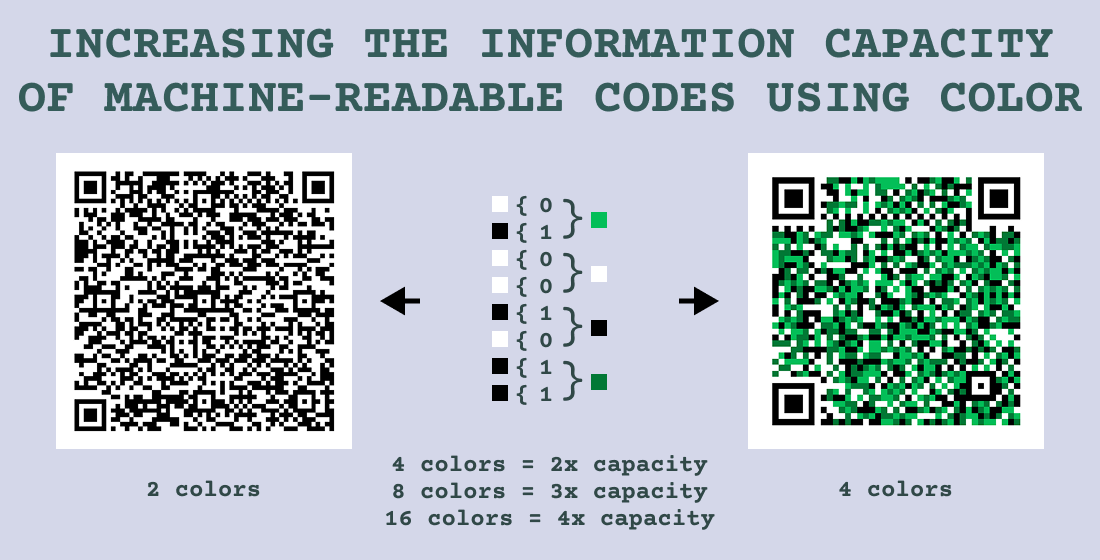
The possibility of increasing the capacity of QR codes by using color modules without adding new metadata is studied. A method for automatically determining the number of colors and their palette using image processing is proposed, which ensures compatibility with classical QR codes. A system is proposed that allows creating a QR code that uses 4, 8 or 16 colors in addition to the standard black and white version.
The main problem is the optimal use of the available color space to minimize errors when reading an informative image with an optical camera, compensate for the effects of uneven lighting and poor image quality, and ensure backward compatibility with the black and white version.
In the course of analyzing the use of different color spaces, the most promising perceptually uniform OKLCH space was determined. Algorithms for image preprocessing for correct decoding of information and an algorithm for encoding and decoding information using color have been developed.
The results obtained are explained by the distribution of the color gamut after the test reading of informative images, the number of errors and successful readings. Using the OKLCH color space, it was possible to read 60% of 16-color test images, while in HSL it was not possible to read any image due to color overlap. However, both spaces have a fairly high rate of successful reads in 4 and 8 color codes.
The use of color will allow the introduction of new standards for high-capacity color machine-readable codes without requiring changes to existing ones for additional metadata, while maintaining full backward compatibility and reliability of black and white codes. Increased information capacity in some cases allows to eliminate the need to be connected to the Internet, reduce the size of the code, and make it more visually appealing by using colors.
References
- GS1 Barcodes. Bar Code Graphics, Inc. Available at: https://www.gs1standards.info/gs1-barcodes/
- 2D Barcode: Types, Use Cases, and Benefits (2023). Bitly. Available at: https://bitly.com/blog/2d-barcode/
- Ricson, E. (2025). 61+ QR Code Statistics & Trends 2025 Full Report. QR TIGER PTE. LTD. Available at: https://www.qrcode-tiger.com/qr-code-statistics-2022-q1
- What is a QR Code? QR Code. Available at: https://www.qrcode.com/en/about/
- ISO/IEC 18004:2015: Information technology – Automatic identification and data capture techniques – QR Code bar code symbology specification (2015). International Organization for Standardization. Geneva. Available at: https://raw.githubusercontent.com/yansikeim/QR-Code/master/ISO%20IEC%2018004%202015%20Standard.pdf
- David, C. (2024). QR Codes – what's the real risk? NCSC. Available at: https://www.ncsc.gov.uk/blog-post/qr-codes-whats-real-risk
- Grillo, A., Lentini, A., Querini, M., Italiano, G. F. (2010). High Capacity Colored Two Dimensional codes. Proceedings of the International Multiconference on Computer Science and Information Technology. Wisla, 709–716. https://doi.org/10.1109/imcsit.2010.5679869
- Taveerad, N., Vongpradhip, S. (2015). Development of Color QR Code for Increasing Capacity. 2015 11th International Conference on Signal-Image Technology & Internet-Based Systems (SITIS). Bangkok, 645–648. https://doi.org/10.1109/sitis.2015.42
- You, F., Zhang, Q., Welt, B. (2019). Research on color matching model for color QR code. Journal of Applied Packaging Research, 11 (3), 57–68. Available at: https://repository.rit.edu/japr/vol11/iss3/5
- Galiyawala, H. J., Pandya, K. H. (2014). To increase data capacity of QR code using multiplexing with color coding: An example of embedding speech signal in QR code. 2014 Annual IEEE India Conference (INDICON). Pune, 1–6. https://doi.org/10.1109/indicon.2014.7030441
- Understanding gamma correction. Cambridge in Colour. Available at: https://www.cambridgeincolour.com/tutorials/gamma-correction.htm
- Vidra, V., Pešička, O. (2023). LCH vs OKLCH: what is the difference? Atmos. Available at: https://atmos.style/blog/lch-vs-oklch
- OKLCH Color Picker & Converter. OKLCH. Available at: https://oklch.com/#0.6,0.1032,210,100
- ZXing-Dart. GitHub, Inc. Available at: https://github.com/shirne/zxing-dart
- Fechan, A., Khoverko, Y., Daliavskyi, V., Dyhdalovych, T. (2024). Contactless dual-function sensors based on Si-cholesteric liquid crystal systems for optical identification. Journal of Materials Science: Materials in Electronics, 35 (18). https://doi.org/10.1007/s10854-024-13005-5
Downloads
Published
How to Cite
Issue
Section
License
Copyright (c) 2025 Oleksandr Kozyra, Andrii Fechan, Vladyslav Daliavskyi

This work is licensed under a Creative Commons Attribution 4.0 International License.
The consolidation and conditions for the transfer of copyright (identification of authorship) is carried out in the License Agreement. In particular, the authors reserve the right to the authorship of their manuscript and transfer the first publication of this work to the journal under the terms of the Creative Commons CC BY license. At the same time, they have the right to conclude on their own additional agreements concerning the non-exclusive distribution of the work in the form in which it was published by this journal, but provided that the link to the first publication of the article in this journal is preserved.