Виявлення факторів впливу гідророзриву на скін-ефект у привибійній зоні пласта
DOI:
https://doi.org/10.15587/2706-5448.2025.333613Ключові слова:
привибійна зона, проникність пласта, кольматація, скін, дебіт газу, інтенсифікація, гідравлічний розрив пластаАнотація
Об’єктом дослідження є кольматація привибійної зони продуктивного пласта, яка призводить до формування позитивного скін-фактора та зниження продуктивності свердловин. Предметом дослідження є вплив гідравлічного розриву пласта на колекторські властивості привибійної зони, а також оцінка ефективності застосування сучасних методів моделювання для прогнозування продуктивності свердловин і оптимізації технологічних параметрів операцій з інтенсифікації видобутку.
В дослідженні вирішувалася проблема зниження продуктивності газових свердловин через погіршення фільтраційно-ємнісних властивостей привибійної зони пласта, що зумовлене кольматацією, накопиченням рідин, ретроградною конденсацією та іншими фізико-хімічними процесами, які ускладнюють рух флюїдів до вибою свердловини. Робота спрямована на пошук ефективного способу інтенсифікації для збільшення дебіту свердловини та зменшення скін-фактору, а також на уточнення методів прогнозування дебіту з урахуванням колекторських властивостей пласта.
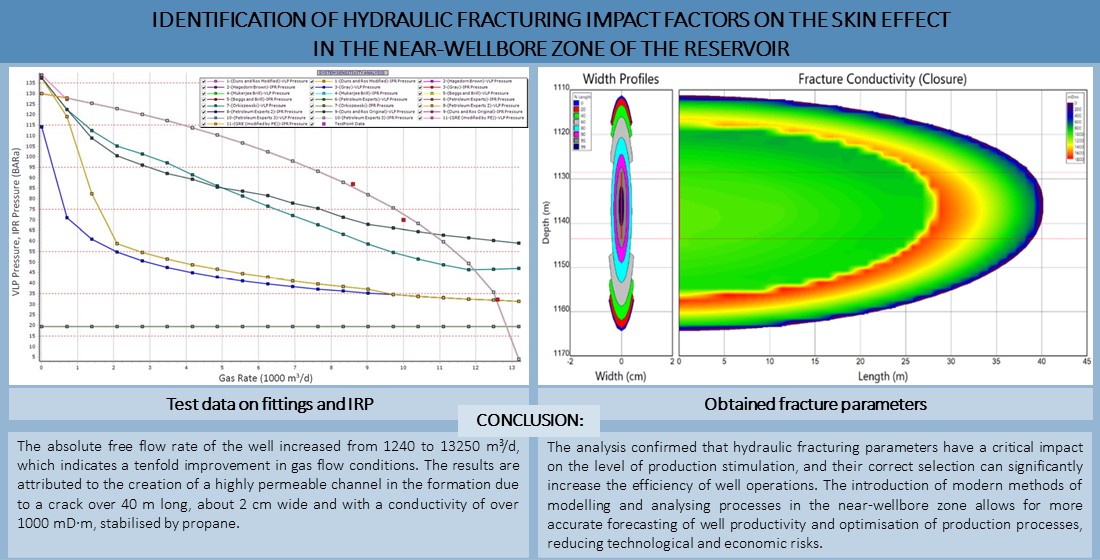
У ході виявлення закономірностей проведено нагнітальний тест та регресивний аналіз, моделювання продуктивності з використанням програмного забезпечення, а також виконано гідравлічний розрив пласта (ГРП) на свердловині Х1. Після ГРП було зафіксовано істотне зростання абсолютного вільного дебіту – з 1,24 тис. м³/добу до 13,25 тис. м³/добу. Проведене чисельне моделювання до та після ГРП дозволило оптимізувати інженерні рішення, знизити невизначеність при плануванні робіт і досягти високої точності прогнозу дебіту. У ході виявлення закономірностей було визначено залежності між геометрією тріщини, скін-фактором і дебітом, що дозволило кількісно оцінити ефективність впливу ГРП. Розроблено практично орієнтований підхід до реалізації моделювання роботи свердловин.
Отримані результати можуть бути ефективно використані при проєктуванні та моделюванні гідравлічного розриву пласта на практиці за умов кольматації привибійної зони пласта, наявності позитивного скін-фактора, низької проникності пласта. Це своєю чергою дозволить суттєво збільшити дебіти свердловин та ефективність експлуатації родовищ зі складними фільтраційними умовами.
Посилання
- Iwaszczuk, N., Zapukhliak, I., Iwaszczuk, A., Dzoba, O., Romashko, O. (2022). Underground Gas Storage Facilities in Ukraine: Current State and Future Prospects. Energies, 15 (18), 6604. https://doi.org/10.3390/en15186604
- Stefurak, R. I., Yaremiychuk, R. S. (2023). Some aspects of integration of modern technologies for drilling deep oil and gas wells (review article). Mineral Resources of Ukraine, 3, 30–38. https://doi.org/10.31996/mru.2023.3.30-38
- Yan, X., You, L., Kang, Y., Deng, S., Xu, C. (2022). Formation Damage Induced by Oil-Based Drilling Fluid in a Longmaxi Shale Gas Reservoir: A Comprehensive View of the Drilling, Stimulation, and Production Processes. Energy & Fuels, 37 (2), 945–954. https://doi.org/10.1021/acs.energyfuels.2c03100
- Karpenko, O., Sobol, V., Myrontsov, M., Karpenko, I. (2021). Detection of intervals / layers in sections of the wells with anomalous areas of drilling mud filtrate contamination according to the well logging (with negative test results of horizons). E3S Web of Conferences, 280, 09007. https://doi.org/10.1051/e3sconf/202128009007
- Akhundova, N. R., Rzazade, S. A., Aliyeva, O., Bahshaliyeva, S. O. (2023). Compression of liquids from the operating wells to the surface applying the sequential approximation. Nafta-Gaz, 79 (3), 184–189. https://doi.org/10.18668/ng.2023.03.04
- Adebiyi, F. M. (2020). Paraffin wax precipitation/deposition and mitigating measures in oil and gas industry: a review. Petroleum Science and Technology, 38 (21), 962–971. https://doi.org/10.1080/10916466.2020.1804400
- Kuper, I. M., Doroshenko, V. M., Myhailiuk, V. D. (2021). To the issues of retrograde condensate extraction. Prospecting and Development of Oil and Gas Fields, 21 (2 (79)), 16–23. https://doi.org/10.31471/1993-9973-2021-2(79)-16-23
- Shajari, M., Rashidi, F. (2021). Evaluation of thermodynamics effect on mineral scale formation in water injection wells supported by laboratory experiments. AUT Journal of Mechanical Engineering, 5 (3), 439–450. https://doi.org/10.22060/ajme.2021.18473.5900
- Sanei, M., Duran, O., Devloo, P. R. B., Santos, E. S. R. (2022). Evaluation of the impact of strain-dependent permeability on reservoir productivity using iterative coupled reservoir geomechanical modeling. Geomechanics and Geophysics for Geo-Energy and Geo-Resources, 8. https://doi.org/10.1007/s40948-022-00344-y
- Chang, W. J., Al-Obaidi, S. H., Patkin, A. A. (2021). Assessment of the condition of the near-wellbore zone of repaired wells by the skin factor. International Research Journal of Modernization in Engineering, Technology and Science, 3 (4), 1371–1377. https://doi.org/10.31219/osf.io/7sjtb
- Zezekalo, I. H., Ivanytska, I. O., Aheicheva, O. O. (2020). Formation damage wells productivity recovery in the process of their drilling and operation by acid treatments method. Bulletin of the National Technical University “KhPI”. Series: Innovation researches in students’ scientific work, 6, 90–94.
- Chen, B., Barboza, B. R., Sun, Y., Bai, J., Thomas, H. R., Dutko, M. et al. (2021). A Review of Hydraulic Fracturing Simulation. Archives of Computational Methods in Engineering, 29 (4), 1–58. https://doi.org/10.1007/s11831-021-09653
- Alhaj, H. K., Shutah, A., Bahri, M., Muhammad, M. (2024). Estimating the productivity index for some libyan wells using prosper and kappa saphir softwear. Sebha University Conference Proceedings, 3 (2), 1–6.
- McClure, M. (2024). Technology Focus: Hydraulic Fracturing Modeling. Journal of Petroleum Technology, 76 (11), 95–96. https://doi.org/10.2118/1124-0095-jpt
- Vogelij, N. A. M. (2022). Integrated Hydraulic Fracturing and Well-Test Data Analytics using R. SPE International Hydraulic Fracturing Technology Conference & Exhibition. Muscat. https://doi.org/10.2118/205260-ms
##submission.downloads##
Опубліковано
Як цитувати
Номер
Розділ
Ліцензія
Авторське право (c) 2025 Ivan Kuper, Bohdan Mykhailyshyn, Iryna Lartseva

Ця робота ліцензується відповідно до Creative Commons Attribution 4.0 International License.
Закріплення та умови передачі авторських прав (ідентифікація авторства) здійснюється у Ліцензійному договорі. Зокрема, автори залишають за собою право на авторство свого рукопису та передають журналу право першої публікації цієї роботи на умовах ліцензії Creative Commons CC BY. При цьому вони мають право укладати самостійно додаткові угоди, що стосуються неексклюзивного поширення роботи у тому вигляді, в якому вона була опублікована цим журналом, але за умови збереження посилання на першу публікацію статті в цьому журналі.