Enhancing housing and communal services delivery in Ukraine: an integrated framework for risk, stakeholder, and project prioritization
DOI:
https://doi.org/10.15587/2706-5448.2025.334092Keywords:
housing, infrastructure, risk, stakeholder, prioritization, Ukraine, budget, integration, digital, performanceAbstract
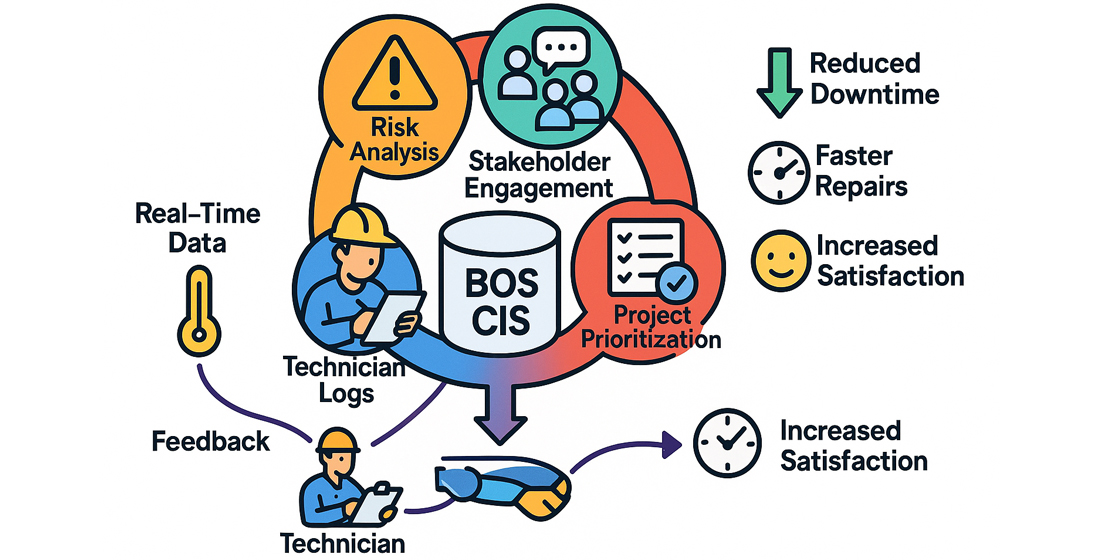
Object of research – an integrated framework combining risk analysis, stakeholder engagement, and dynamic project prioritization within the BOS CIS ERP-BPMS platform at Mastergaz, a major HCS provider in Kyiv (Ukraine) serving over 750,000 subscribers. Problem, which is solved – housing and communal service providers in Ukraine face critical challenges from Soviet-era aging infrastructure, severely constrained budgets, and fragmented management, resulting in frequent service disruptions and low customer satisfaction rates. Methods used – a convergent mixed-methods single case study design combining quantitative operational data from BOS CIS platform with qualitative insights from surveys of 220 respondents and 10 semi-structured management interviews; multi-criteria decision analysis (MCDA) with knapsack-style budget allocation algorithm; statistical validation through paired t-tests and repeated-measures ANOVA. Main results – over a six-month pilot period, the integrated approach achieved 23% reduction in critical infrastructure downtime, 44.4% improvement in mean repair times, 42.9% faster response times, 12% increase in customer satisfaction, and 8% decrease in monthly heating expenses, all within existing budget constraints. Scope of practical use of results – the framework provides a replicable model for HCS providers in Ukraine and similar post-Soviet contexts, offering transparent, data-driven decision-making for optimizing limited resource allocation and enhancing community trust. Integrating real-time risk management, systematic stakeholder collaboration through monthly forums, and adaptive multi-criteria prioritization within a unified digital platform significantly enhances HCS delivery efficiency and strategic decision-making even under severe budgetary constraints.
References
- Rane, S. B., Potdar, P. R., Rane, S. (2019). Development of Project Risk Management framework based on Industry 4.0 technologies. Benchmarking: An International Journal, 28 (5), 1451–1481. https://doi.org/10.1108/bij-03-2019-0123
- Cuppen, E., Bosch-Rekveldt, M. G. C., Pikaar, E., Mehos, D. C. (2016). Stakeholder engagement in large-scale energy infrastructure projects: Revealing perspectives using Q methodology. International Journal of Project Management, 34 (7), 1347–1359. https://doi.org/10.1016/j.ijproman.2016.01.003
- Damages to Ukraine’s infrastructure due to the war have risen to $170 billion – KSE Institute estimate as of November 2024 (2025). Kyiv School of Economics. Available at: https://kse.ua/about-the-school/news/damages-to-ukraine-s-infrastructure-due-to-the-war-have-risen-to-170-billion-kse-institute-estimate-as-of-november-2024/
- Ukraine: Fourth Rapid Damage and Needs Assessment (RDNA4) (2025). Government of Ukraine, World Bank Group, European Commission, & United Nations. Available at: https://www.undp.org/sites/g/files/zskgke326/files/2025-02/ukraine_fourth_rapid_damage_and_needs_assessment_rdna4_february_2022_december_2024.pdf
- Wojewnik-Filipkowska, A., Dziadkiewicz, A., Dryl, W., Dryl, T., Bęben, R. (2019). Obstacles and challenges in applying stakeholder analysis to infrastructure projects. Journal of Property Investment & Finance, 39 (3), 199–222. https://doi.org/10.1108/jpif-03-2019-0037
- Chernenko, Y., Danchenko, O., Melenchuk, V. (2022). Conceptual model of risk management in development projects of providers of housing and utility services. Management of Development of Complex Systems, 51, 41–48. https://doi.org/10.32347/2412-9933.2022.51.41-48
- Fatima, A., Mubin, S., Masood, R. (2024). Risk-based integrated performance assessment framework for public-private partnership infrastructure projects. Organization, Technology and Management in Construction: An International Journal, 16 (1), 251–274. https://doi.org/10.2478/otmcj-2024-0018
- Usenko, J., Savytskyi, O., Mikhnych, V. (2025). Status of municipal heat supply in Ukraine: Challenges and solutions from the bottom up (Version 1.1). Green Deal Ukraina & Helmholtz-Zentrum Berlin für Materialien und Energie. Available at: https://greendealukraina.org/assets/images/reports/status-of-municipal-heat-supply.pdf
- Xia, N., Zou, P. X. W., Griffin, M. A., Wang, X., Zhong, R. (2018). Towards integrating construction risk management and stakeholder management: A systematic literature review and future research agendas. International Journal of Project Management, 36 (5), 701–715. https://doi.org/10.1016/j.ijproman.2018.03.006
- Willumsen, P. L., Oehmen, J., Selim, H. M. R. (2024). Project risk management in practice: the actuality of project risk management in organizations. International Journal of Managing Projects in Business, 17 (4/5), 593–617. https://doi.org/10.1108/ijmpb-09-2023-0214
- Ali, F., Haapasalo, H. (2023). Development levels of stakeholder relationships in collaborative projects: challenges and preconditions. International Journal of Managing Projects in Business, 16 (8), 58–76. https://doi.org/10.1108/ijmpb-03-2022-0066
- Chernenko, Y., Teslenko, P. (2024). Integration of stakeholder management and risk management methods in projects of housing and communal services providers. Technology Audit and Production Reserves, 2 (4 (76)), 6–10. https://doi.org/10.15587/2706-5448.2024.301995
- Dandage, R., Mantha, S. S., Rane, S. B. (2018). Ranking the risk categories in international projects using the TOPSIS method. International Journal of Managing Projects in Business, 11 (2), 317–331. https://doi.org/10.1108/ijmpb-06-2017-0070
- Hansen, S., Too, E., Le, T. (2019). Criteria to consider in selecting and prioritizing infrastructure projects. MATEC Web of Conferences, 270, 06004. https://doi.org/10.1051/matecconf/201927006004
- Bošnjak, A., Jajac, N. (2023). Determining Priorities in Infrastructure Management Using Multicriteria Decision Analysis. Sustainability, 15 (20), 14953. https://doi.org/10.3390/su152014953
- Beutler, P., Larsen, T. A., Maurer, M., Staufer, P., Lienert, J. (2024). A participatory multi-criteria decision analysis framework reveals transition potential towards non-grid wastewater management. Journal of Environmental Management, 367, 121962. https://doi.org/10.1016/j.jenvman.2024.121962
- Manzolli, J. A., Yu, J., Miranda-Moreno, L. (2025). Synthetic multi-criteria decision analysis (S-MCDA): A new framework for participatory transportation planning. Transportation Research Interdisciplinary Perspectives, 31, 101463. https://doi.org/10.1016/j.trip.2025.101463
- de Souza, F. H., Gavião, L. O., Sant’Anna, A. P., Lima, G. B. A. (2021). Prioritizing risks with composition of probabilistic preferences and weighting of FMEA criteria for fast decision-making in complex scenarios. International Journal of Managing Projects in Business, 15 (4), 572–594. https://doi.org/10.1108/ijmpb-01-2021-0007
- Qazi, A., Shamayleh, A., El-Sayegh, S., Formaneck, S. (2021). Prioritizing risks in sustainable construction projects using a risk matrix-based Monte Carlo Simulation approach. Sustainable Cities and Society, 65, 102576. https://doi.org/10.1016/j.scs.2020.102576
- Eichhorn, B., Tukel, O. (2018). Business user impact on information system projects. International Journal of Managing Projects in Business, 11 (2), 289–316. https://doi.org/10.1108/ijmpb-02-2017-0016
- Kuura, A., Lundin, R. A. (2018). Process perspectives on entrepreneurship and projects. International Journal of Managing Projects in Business, 12 (1), 25–47. https://doi.org/10.1108/ijmpb-12-2017-0165
- Szelągowski, M., Berniak-Woźny, J., Lupeikiene, A., Senkus, P. (2023). Paving the way for tomorrow: the evolution of erp and bpms systems. Scientific Papers of Silesian University of Technology. Organization and Management Series, 2023 (185), 481–510. https://doi.org/10.29119/1641-3466.2023.185.27
- Chernenko, Y., Bedrii, D., Haidaienko, O., Meliksetov, O. (2025). Mitigating operational risks in critical infrastructure through integrated ERP-BPMS: a multi-case study. Technology Audit and Production Reserves, 3 (4 (83)), 53–63. https://doi.org/10.15587/2706-5448.2025.330660
- ISO 31000:2018 Risk management – Guidelines (2018). International Organization for Standardization. Available at: https://www.iso.org/standard/65694.html
- Widianti, T., Firdaus, H., Rakhmawati, T. (2024). Mapping the landscape: a bibliometric analysis of ISO 31000. International Journal of Quality & Reliability Management, 41 (7), 1783–1810. https://doi.org/10.1108/ijqrm-09-2023-0287
- Freeman, R. E. (1984). Strategic management: A stakeholder approach. Pitman.
- An introductory guide to multi-criteria decision analysis (MCDA) (2024). Government Analysis Function. Available at: https://analysisfunction.civilservice.gov.uk/policy-store/an-introductory-guide-to-mcda/
- Marinoni, O., Higgins, A., Hajkowicz, S.; Ehrgott, M., Naujoks, B., Stewart, T. J., Wallenius, J. (Eds.) (2009). A Multi Criteria Knapsack Solution to Optimise Natural Resource Management Project Selection. Multiple Criteria Decision Making for Sustainable Energy and Transportation Systems. Berlin, Heidelberg: Springer 47–55. https://doi.org/10.1007/978-3-642-04045-0_5
- Pollack, J., Helm, J., Adler, D. (2018). What is the Iron Triangle, and how has it changed? International Journal of Managing Projects in Business, 11 (2), 527–547. https://doi.org/10.1108/ijmpb-09-2017-0107
Downloads
Published
How to Cite
Issue
Section
License
Copyright (c) 2025 Yuri Chernenko, Inga Semko, Valentyna Kharuta, Olena Lobach

This work is licensed under a Creative Commons Attribution 4.0 International License.
The consolidation and conditions for the transfer of copyright (identification of authorship) is carried out in the License Agreement. In particular, the authors reserve the right to the authorship of their manuscript and transfer the first publication of this work to the journal under the terms of the Creative Commons CC BY license. At the same time, they have the right to conclude on their own additional agreements concerning the non-exclusive distribution of the work in the form in which it was published by this journal, but provided that the link to the first publication of the article in this journal is preserved.





