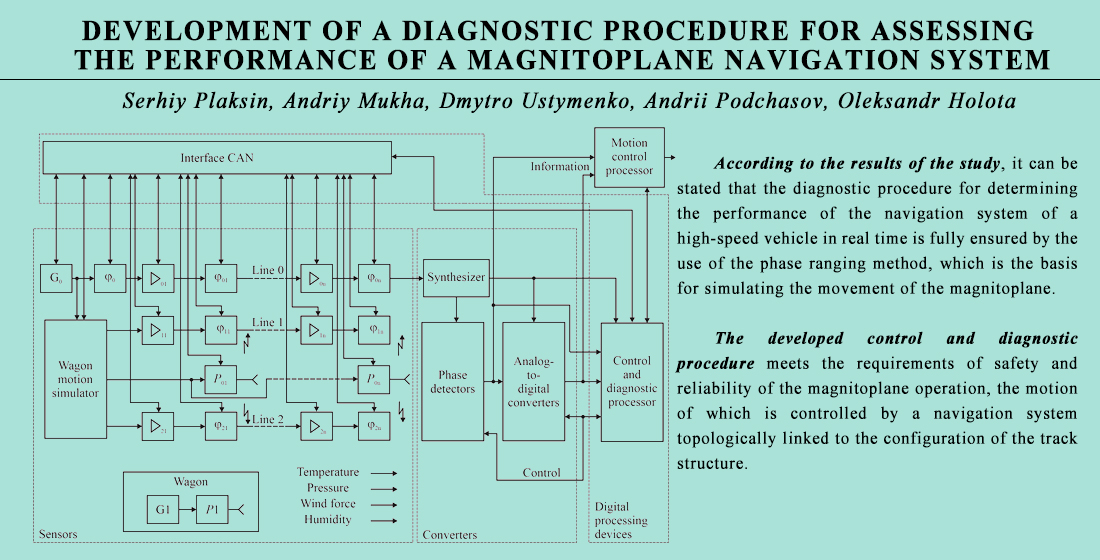
Development of a diagnostic procedure for assessing the performance of a magnitoplane navigation system
DOI:
https://doi.org/10.15587/2706-5448.2025.334444Keywords:
magnetic levitation transport, phase ranging, navigation, diagnostics, generator, synchronization, signalAbstract
The object of research is the process of ensuring the reliability of high-speed magnetic levitation.
Navigation tasks of high-speed ground transport require high accuracy and reliability along with high speed of obtaining data on the location of the magnetic levitation. The problem to be solved is to ensure the integrity of the magnetic levitation navigation system by means of essential integration into its structure of the diagnostic subsystem, the basis of which is the phase ranging method.
It has been established that the diagnostic procedure for determining the operability of the navigation system of a high-speed vehicle in real time is fully ensured by the use of the phase ranging method. A method of continuous precision positioning of a high-speed magnetic levitation vehicle based on the phase ranging method for an arbitrary configuration in three-dimensional space of a fixed track structure, as well as a method of ensuring the integrity of the navigation system of a maglev train, has been substantiated. A new approach to solving the location problem is proposed, which allows using the train communication channel with the traffic control center as a distributed location sensor as an integral element of the radio wave information and control system.
The structure of the information packet cycle is proposed. The volume of the information flow and the degree of redundancy introduced into the information flow to ensure the required reliability of information transmission are determined.
The developed diagnostic procedure meets the requirements for the safety and reliability of operation of high-speed ground transport based on magnetic levitation technology, the movement of which is controlled using a navigation system topologically connected with the configuration of the track structure.
References
- Hasegawa, D., Nicholson, G. L., Roberts, C., Schmid, F. (2016). Standardised approach to energy consumption calculations for high‐speed rail. IET Electrical Systems in Transportation, 6 (3), 179–189. https://doi.org/10.1049/iet-est.2015.0002
- Pierrejean, L., Rametti, S., Hodder, A., Paolone, M. (2025). A Review of Modeling, Design, and Performance Assessment of Linear Electromagnetic Motors for High-Speed Transportation Systems. IEEE Transactions on Transportation Electrification, 11 (1), 2146–2159. https://doi.org/10.1109/tte.2024.3416870
- Noland, J. K. (2021). Prospects and Challenges of the Hyperloop Transportation System: A Systematic Technology Review. IEEE Access, 9, 28439–28458. https://doi.org/10.1109/access.2021.3057788
- Sinha, P. (1984). Design of a magnetically levitated vehicle. IEEE Transactions on Magnetics, 20 (5), 1672–1674. https://doi.org/10.1109/tmag.1984.1063552
- Fujiwara, S. (1988). Characteristics of EDS magnetic levitation with ground coils for levitation arranged on the side wall. Electrical Engineering in Japan, 108 (3), 101–110. https://doi.org/10.1002/eej.4391080312
- Long, Z., Wang, Z., Zhai, M., Li, X. (2024). High-Speed Maglev Train’s Levitation and Guidance Control. Advances in High-speed Rail Technology. Singapore: Springer Nature. https://doi.org/10.1007/978-981-97-2309-6
- Gao, Z., Cecati, C., Ding, S. X. (2015). A Survey of Fault Diagnosis and Fault-Tolerant Techniques – Part I: Fault Diagnosis With Model-Based and Signal-Based Approaches. IEEE Transactions on Industrial Electronics, 62 (6), 3757–3767. https://doi.org/10.1109/tie.2015.2417501
- Gao, Z., Cecati, C., Ding, S. (2015). A Survey of Fault Diagnosis and Fault-Tolerant Techniques Part II: Fault Diagnosis with Knowledge-Based and Hybrid/Active Approaches. IEEE Transactions on Industrial Electronics, 62 (6), 3768–3774. https://doi.org/10.1109/tie.2015.2419013
- Beard, R. V. (1971). Failure accommodation in linear systems through self-reorganization. Report No. MVT-71-1. Cambridge: Massachusetts Institute of Technology.
- Dzenzerskii, V. A., Plaksin, S. V., Sokolovskii, I. I. (2002). Radiovolnovye metody kontrolia i upravleniia dvizheniem magnitolevitiruiushchikh transportnykh sredstv. Radioelektronika, informatyka, upravlinnia, 1 (7), 108–114.
- Dzenzerskii, V. A., Omelianenko, V. I., Vasilev, S. V., Matin, V. I., Sergeev, S. A. (2001). Vysokoskorostnoi magnitnyi transport s elektrodinamicheskoi levitatciei. Kyiv: Naukova dumka, 480.
- Heinrich, K., Kretzschmar, R. (1989). Transrapid MagLev system. Darmstadt: Hestra-Verlag.
- Dzenzerskiy, V. A., Plaksin, S. V., Pogorelaya, L. M., Toldaev, V. G., Shkil, Yu. V. (2014). Sistemy upravleniya i energoobespecheniya magnitolevitiruyushchego transporta. Kyiv: Naukova dumka, 276.
- Soloviov, V. S., Tkachuk, O. O., Topchii, V. M., Yaitskyi, V. M., Sahaidak, H. I., Mozghovyi, V. V. (2004). Derzhavnyi pervynnyi etalon odynyts chasu i chastoty: rezultaty doslidzhen ta osnovni problemy. Metrolohiia ta vymiriuvalna tekhnika. Kharkiv, 219–221.
- Mukha, A. M., Plaksin, S. V., Pohorila, L. M., Ustymenko, D. V., Shkil, Y. V. (2022). Combined System of Synchronized Simultaneous Control of Magnetic Plane Movement and Suspension. Science and Transport Progress, 1 (97), 23–31. https://doi.org/10.15802/stp2022/265332
- Dzenzerskiy, V. O., Gnilenko, A. B., Plaksin, S. V., Pogorelaya, L. M., Shkil, Y. V. (2018). Perspective transport-power system based on the integration of maglev-technology and distributed photo-electric station. Science and Transport Progress, 1 (73), 77–86. https://doi.org/10.15802/stp2018/123116
- Plaksin, S., Mukha, A., Ustymenko, D., Doskoch, V., Sandul, T., Kulikov, S. (2025). Justification of the application of a distributed network of photoelectric converters to power a linear motor of magnetolevitation transport. System technologies, 6 (155), 10–19. https://doi.org/10.34185/1562-9945-6-155-2024-02
Downloads
Published
How to Cite
Issue
Section
License
Copyright (c) 2025 Serhiy Plaksin, Andriy Mukha, Dmytro Ustymenko, Andrii Podchasov, Oleksandr Holota

This work is licensed under a Creative Commons Attribution 4.0 International License.
The consolidation and conditions for the transfer of copyright (identification of authorship) is carried out in the License Agreement. In particular, the authors reserve the right to the authorship of their manuscript and transfer the first publication of this work to the journal under the terms of the Creative Commons CC BY license. At the same time, they have the right to conclude on their own additional agreements concerning the non-exclusive distribution of the work in the form in which it was published by this journal, but provided that the link to the first publication of the article in this journal is preserved.